Category Archives: Abbie’s column

Abbie’s newspaper columns

The Avocado Thief

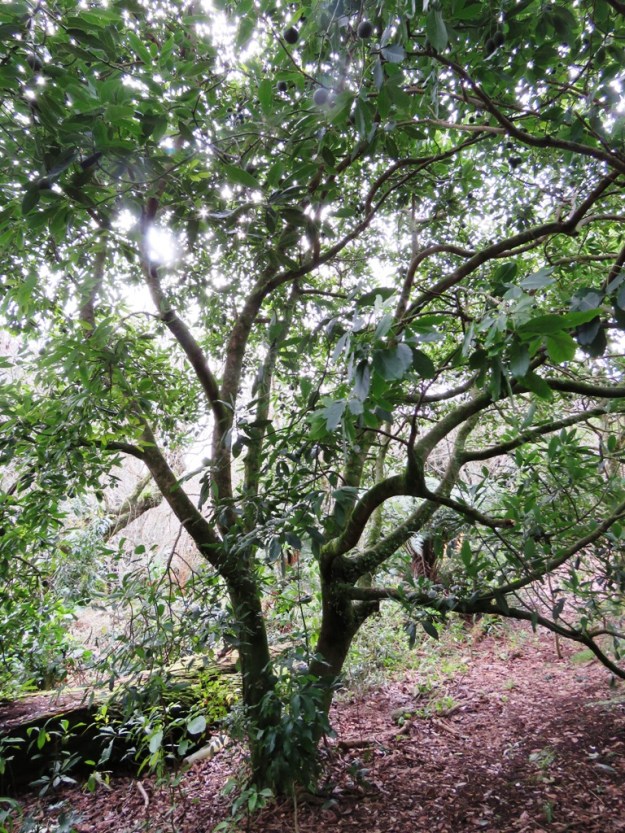
Avocado tree

Avocado tree

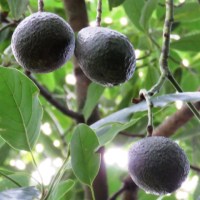
023 - CopyBehold an avocado tree. A tree, I admit, that demonstrates a case of allowing a twin trunk to develop though I am told that is permitted with avocados. It is a tree which has had the best ever crop of Hass avocados this year. It has truly been a mast year. We are a bit marginal when it comes to avocados and they tend to crop biennially. There is no crop next year so we are making hay (or guacamole, to be precise) while the winter sun shines.
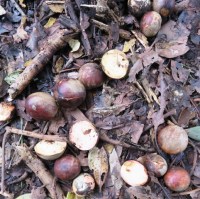
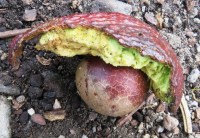
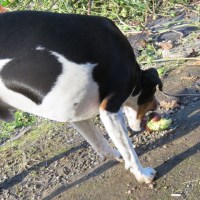
 

Exhibit A

Exhibit A

Exhibit A is the pile of avocado pits around the place. These tell us that we are not alone in harvesting the crop. In fact given the predations of waxeyes, starlings, blackbirds, rats and possums, it is a miracle that we still collect fruit by the bucket load. Possums are a major pest in this country and Mark and the dogs do a round each evening checking for them. Mark conducts an autopsy on the stomach contents of each possum he shoots – mostly to check who is eating the buds of the magnolia trees at this time of the year – and noted last week that one appeared to be full of guacamole.

Exhibit B

Exhibit B

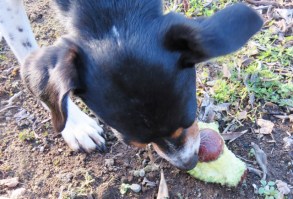
But exhibit B fingered another avocado thief. None of the aforementioned raiders stashes partially eaten fruit all round the place. We had noticed that new dog Dudley was looking particularly glossy and plump. The natural avocado oils are clearly kind to his fur. Mark has taken to doing a circuit twice a day to pick up whole fruit that has fallen in an attempt to beat Dudley to the draw but any time the dog disappears from view, it is a fair bet that he can be found near the avocado tree.

005 - Copy009 - Copy


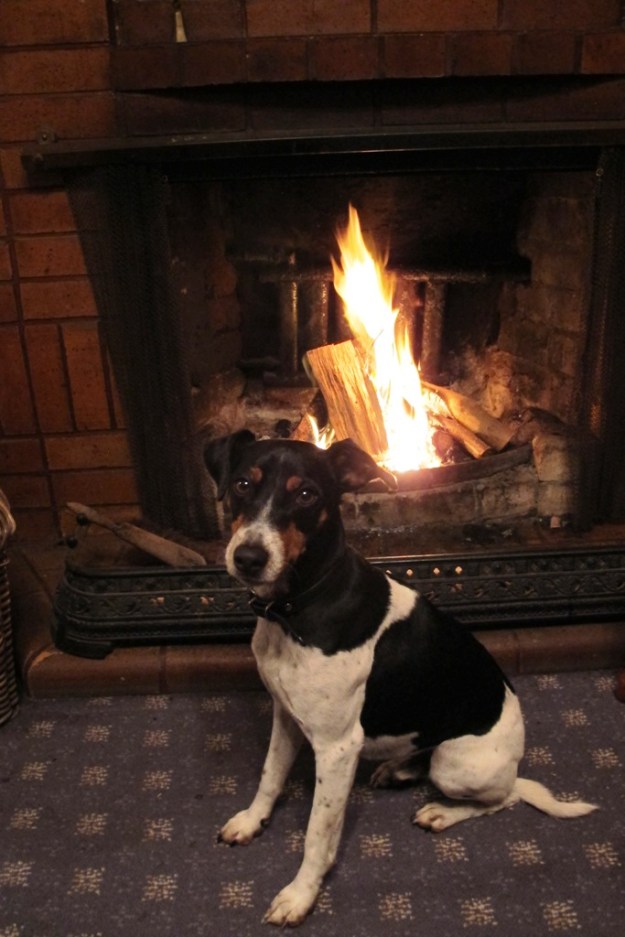
Dudley is a four year old fox terrier, surrendered by his previous owner to the SPCA for re-homing. He came to us in January – clearly a well-loved townie dog used to being fed tidbits any time his previous owner was eating, allowed on any furniture and accustomed to sleeping in his owner’s bed. He was a little timid at the space here and confused by the changes in rules. But now he has taken on the role of estate dog as though he were to the manner born. He is a whizz on rats, a keen possum dog, happy to assist with moving the four beefies that comprise Mark’s little cattle herd, patrols the boundary to ensure that Sam the neighbour’s dog does not make incursions and  he is more than happy to deal to the perceived surplus of avocados.


To the manner born

To the manner born

Not quite lawn-free but leaning more to meadows

019 (3) - Copy
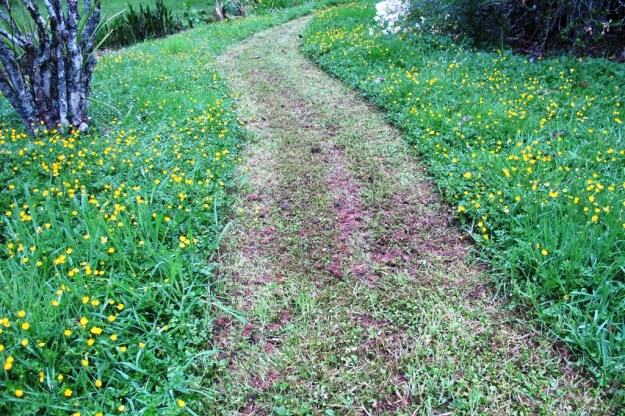
One of the advantages of having our garden closed to the public for a year or two, or maybe more, is the freedom to experiment. And experimenting we are with lawns – or mown green areas may be a more accurate description. We stopped mowing half our park at the end of last winter, choosing instead to keep to a mown track meandering through, so it is possible to walk without getting wet feet.

We have been talking about lawns and grass for years here. Lawns are arguably the most environmentally unfriendly gardening practice of all. Yet there is considerable value placed on the perfect lawn and some people take great pride in achieving this. Perfection is measured against the bowling green which has no connection whatever to the home garden, let alone to nature.

I have never forgotten taking Mark along when I was doing an interview for a commissioned garden story. The owners were very proud of their lush, green sward and claimed that garden visitors often said they wanted to take their shoes off and walk barefoot or roll on it. I saw Mark throw me a telling glance and later he expostulated: “You want to let your bare skin touch that?’ For we both knew that sort of lawn perfection is only achievable by regular spraying with a fair range of chemicals, as well as fertiliser application and the usual frequent mowing, scarifying and over sowing that is required to keep it in such an artificial state.

The perfect lawn is a triumph of man or woman over nature, a dominance achieved at considerable cost to the environment and no small financial cost. There are all sorts of concerns around the western world about run-off from domestic lawns and frankly, when your lawn clippings are too toxic to put into the compost without risking your tomatoes and other crops for the next six months, there is a problem. Some folk will even kill off the worms with a residual spray in the quest for lawn perfection.

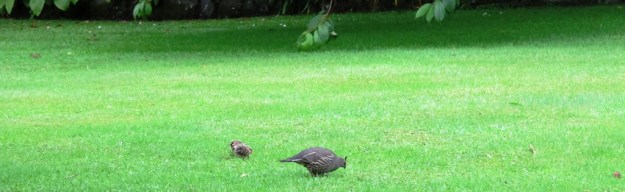
Mama Quail and two little feathered bumble bees of babies feeding on the lawn

Mama Quail and two little feathered bumble bees of babies feeding on the lawn

Mark is keen to have grass expanses with at least one flowering a year to feed the bees and other insect life. An added bonus has been unexpected. We made a decision a few years ago not to replace our cat, even though I adore fluffy felines. As a result, the Californian quail population has been steadily increasing and these lovely birds are a delight, foraging across the house lawns for seed. We might feel differently about a flowering lawn if we had small people in our lives running around bare footed, but in their absence, there is no need to worry about the bees.

We use a mulcher mower so the clippings are returned to the grass and this has eliminated any need to feed the lawn. Come early November, we let the grass grow long before cutting because then the dreaded Onehunga weed gets stretched and cut off before it can set its prickles. We do a certain amount of hand weeding to keep the flat weeds and undesirable grasses at bay in the house lawns. Beyond that, as long as it is fine or small leaved and cuts neatly, it is allowed to stay. Our lawns are more mixed colony environments than controlled grass species. We still mow regularly, but we are stretching out the intervals between mowing because we have become very aware of how dependent we now are on the motorised gardening aids and just how much fuel we have to buy to keep the mower, strimmer, chain saw and leaf blower running.

One of the delightful gardening books on my shelf is early Alan Titchmarsh, the Yorkshire gardener who is now a star TV presenter in the UK. Back in 1984, he wrote about The Lawn:
“Avant-gardeners do not have lawns; they have grass….The ‘bowling green’ lawn is a feature that belongs in front of council houses where it is surrounded by borders of lobelia, alyssum, French marigolds and salvias with standard fuchsias used as ‘dot plants’.

The avant-gardener’s grass is intermingled with daisies, plantains, buttercups… and plenty of moss (usually at least of 50% of the total coverage). This is a state of affairs to be encouraged. The grass is mown (avoiding a striped effect at all costs)…” (Avant-Gardening, a guide to one-upmanshop in the garden).

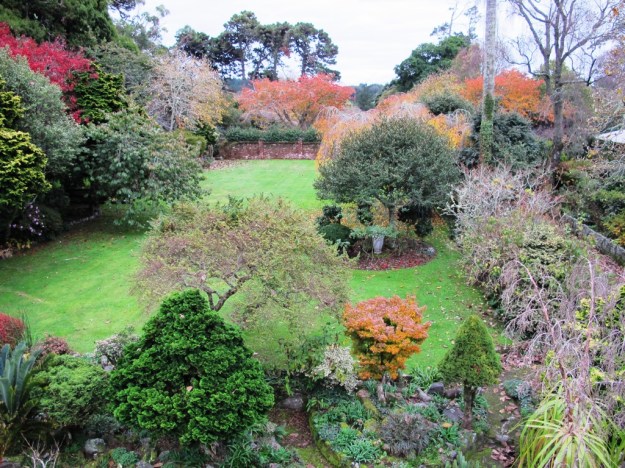
We have extensive areas of grass but have already decided that the front lawn should remain mown lawn rather than mixed meadow

We have extensive areas of grass but have already decided that the front lawn should remain mown lawn rather than mixed meadow

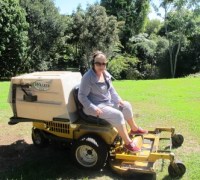
I admit we own the Rolls Royce of lawnmowers. It cost more than our car to buy

I admit we own the Rolls Royce of lawnmowers. It cost more than our car to buy

It does not appear that we have moved a long way since 1984 avant-garde thinking. If you are wondering what half our park looks like after six months without cutting the grass, I can report that the buttercup and self heal are thriving. To a critical eye it probably looks better in the shady areas than in the full sun but the mown strip is indeed like a path through a meadow and that is the effect we now want. We have worked out that we want the lawns immediately around the house more tightly maintained but, even in a large garden, we can achieve that without chemical intervention and top-up feeding. We see that as far more sustainable and environmentally friendly than the suburban value of an immaculate lawn.

First published in the June issue of the New Zealand Gardener and repinted here with their permission.

Gone in a morning – the loss of the Waitara riverbank pohutukawa

Gone. The view from the lookout on Manukorihi Hill.

Gone. The view from the lookout on Manukorihi Hill.

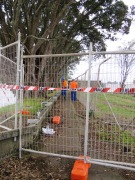
Regular readers will know of our battle to save the pohutukawa trees that line our local river. We lost. Today the chainsaws moved in. In a couple of short hours, trees that were over sixty years old were felled to the ground.
001047068043
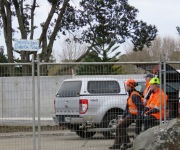
Clearly there was some concern about the possibility of protests. Ironically the body that was hellbent on felling these trees is also the body charged with protecting the environment – that is what we call a Tui billboard moment in New Zealand vernacular. In a case of overkill, Taranaki Regional Council marshalled their staff to patrol the entrances to the area. Why, there was even a boat patrolling the river access. They would have been very cold out there on the river for a few hours. Truly, it is mid-winter here and most of us feel a little too old to scale large trees in order to protect them, so the fear of the operation being disrupted by protest was unfounded.

But oh, how sad to see the needless desecration of handsome, well established trees. Despite their public relations spin, the Taranaki Regional Council didn’t consult widely. They preferred to talk to people who said what they wanted to hear. As the protesting voices grew, rather than taking another look at the plans and seeing whether saving the trees could be accommodated, they set about discrediting, denying and deriding the opposing voices.
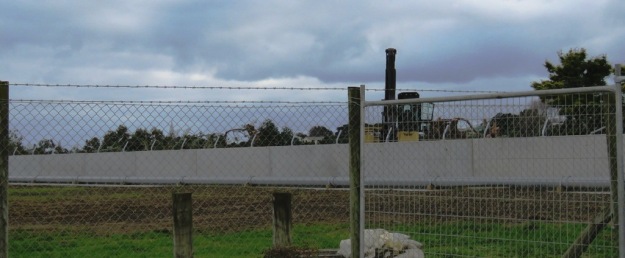
053How anybody in their right mind could think that the hostile expanse of concrete flood wall, topped with barbed wire (it is doing double duty as a security wall for the meat packing works behind) was an appropriate form of town flood protection in this day and age is beyond comprehension. It looks like a prison wall. This is the face of Waitara in 2015. We regard it as simply shameful action by Taranaki Regional Council.
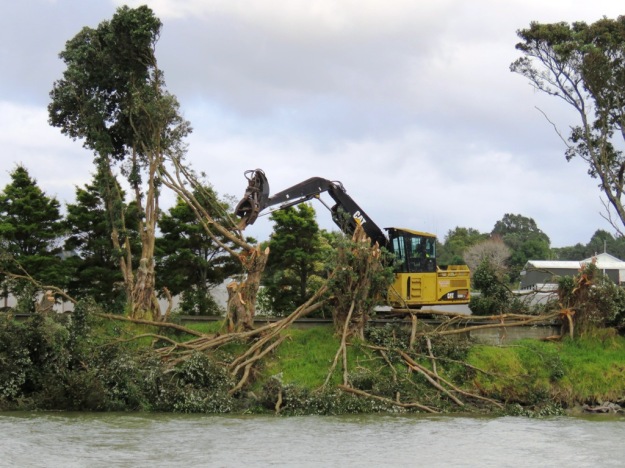
042While the chainsaws worked at one end of the row, the digger driver proved that you don’t need chainsaws at the other end – the might of the machine means you can break apart the trees. There was no sign that the men on the site felt any sorrow at the unceremonious felling.
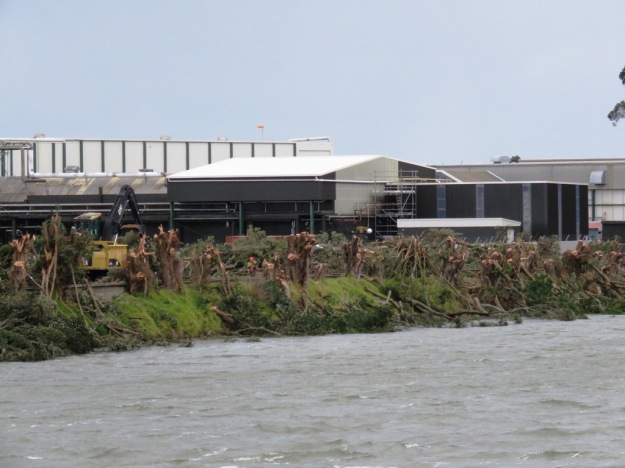
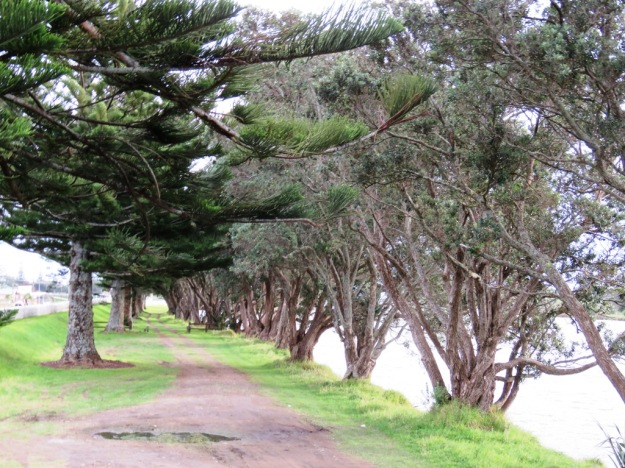
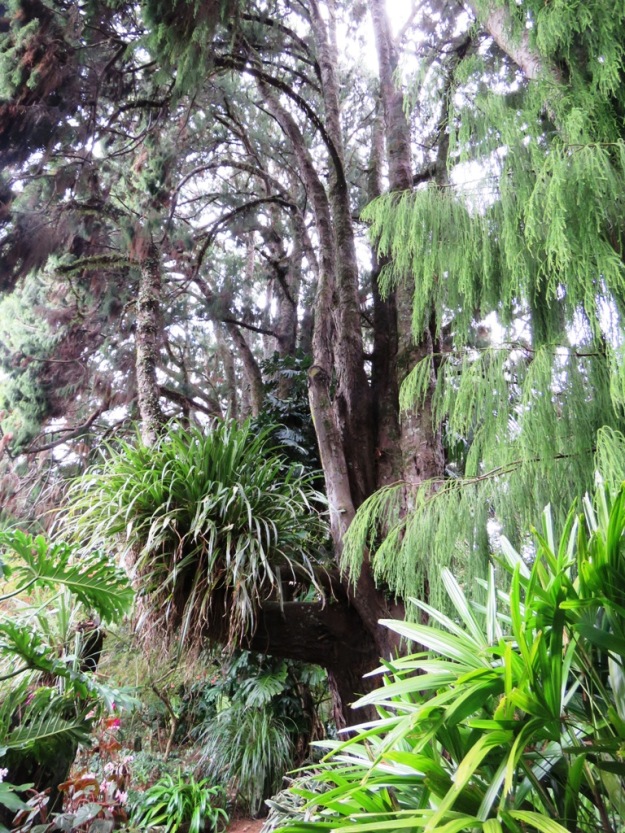
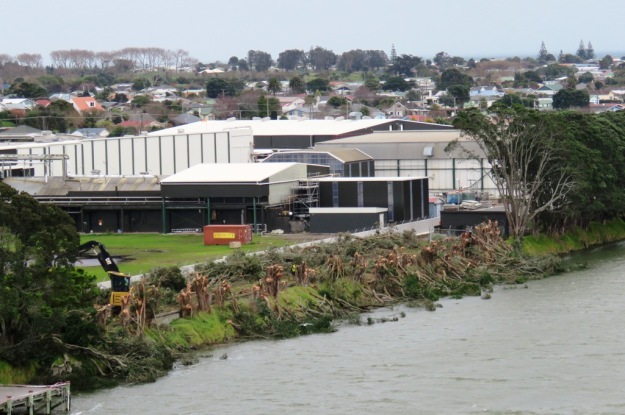
Once were trees. The new view from our town bridge

Once were trees. The new view from our town bridge

With ever increasing population in urban areas, we had thought that the role of protecting mature and handsome trees fell increasingly upon our local bodies, particularly in public spaces. These trees had the potential to live for many hundreds of years without causing any harm or inconvenience to residents while enhancing the centre of Waitara. No more.

Will this pretty scene downstream be allowed to remain?

Will this pretty scene downstream be allowed to remain?

Earlier plans were to fell ALL the riverbank trees. There is fear that this might yet happen. I found this pretty scene just down the river a little further. I wonder if it, too, will suffer the same treatment in the next year or two because the engineer who designed the flood protection doesn’t think there is any place for trees on river banks.

There is no place like home

There is no place like home

Fortunately, I do not live in the town itself so I could come home to our own place with its many, very large trees to soothe my heavy heart. These at least are beyond the reach of the chainsaw-happy regional council.

Lavender and cricket

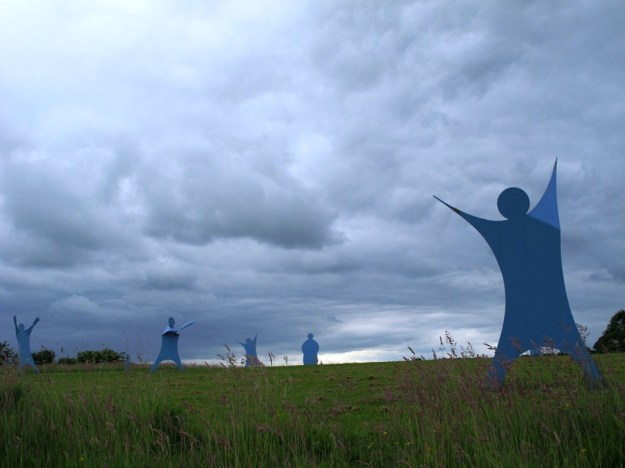
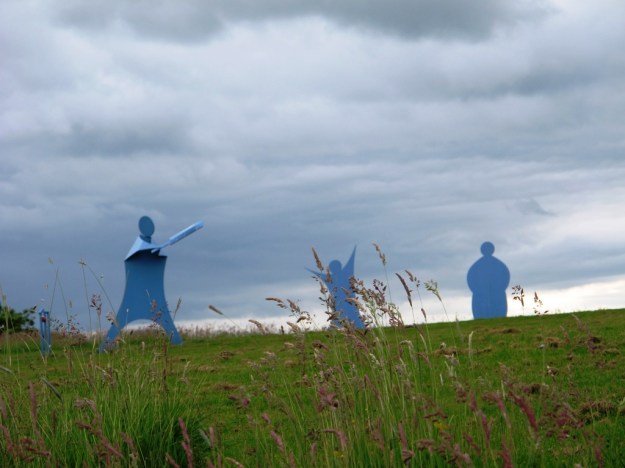
368369Maybe it was our national cricket team playing in Yorkshire that brought this scene back to mind. I photographed it at Yorkshire Lavender near Terrington, about this time last year. I was greatly charmed at the time. It was set on top of a small hill with a big sky and big vistas. I admit I like cricket – well, I like it when our team is winning and they did win the test match a few weeks ago – but it was the large scale whimsy that I appreciated with this scene.
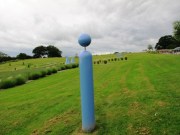
364365366

This particular installation was a memorial but on theme

This particular installation was a memorial but on theme

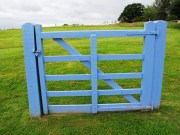
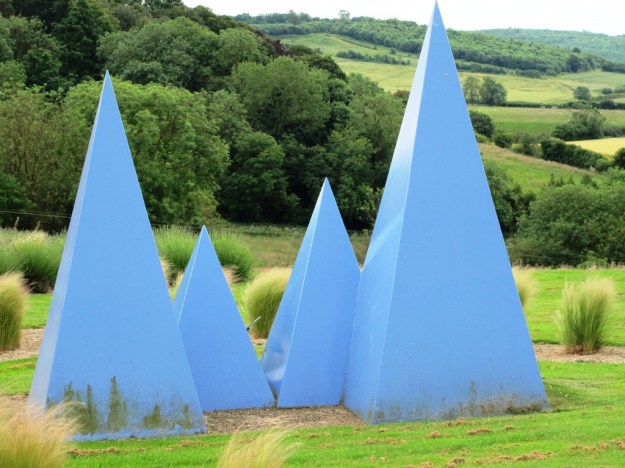
In terms of garden decoration, I wished they had stopped the pastel blue with the cricket team. There was rather a lot of it repeated throughout other areas – out of the “but wait there is more” school of garden features. The use of bridges that are entirely unnecessary and gates with no purpose are by no means limited to this garden, but they were certainly here in force, suggesting that the owners saw the repetition of blue features as a unifying device through the garden. To my eyes, this sort of device ends up dominating, bordering on clutter, when there was quite sufficient charm to carry the scene without their addition.
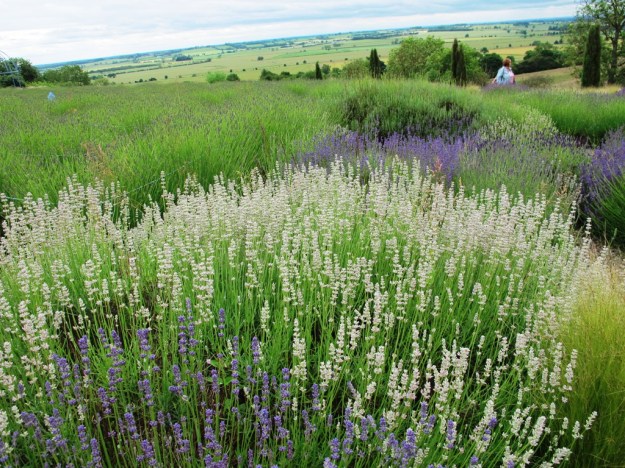
360I like lavender. I really enjoy the open fields of lavender which are so evocative of a different climate. It is not a plant for our fertile conditions with high humidity and high rainfall all year round. I have just one plant left and it lurches on from year to year, clutching at the remnants of its life. I liked the way Yorkshire Lavender didn’t just keep to lavender but were extending into the New Perennial style as well with their mixed plantings and the mandatory grasses.
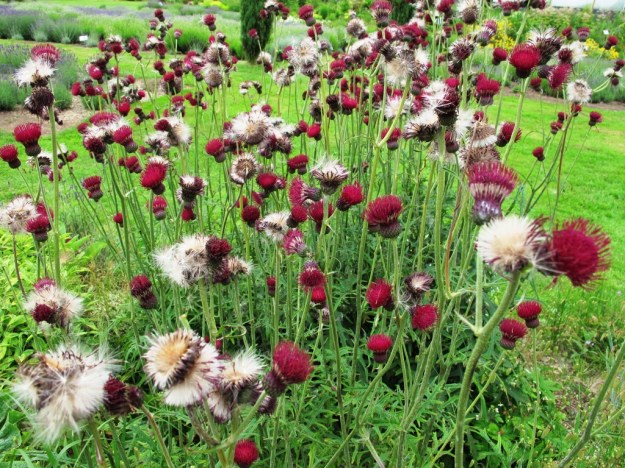
 Cirsium rivulare 'Atropurpureum' or plume thistle, I think.

Cirsium rivulare ‘Atropurpureum’ or plume thistle, I think.

I am quite grateful that the lavender fragrance is no longer associated solely with genteel old ladies, lace edged hankies and net curtains. Shall we just leave 4711 cologne with that demographic? We also enjoy the added experience of good tearooms in gardens in the UK. This country lacks sufficient population to make these economically viable in most cases but the tearooms at Yorkshire Lavender were both charming and … very lavender. The shortbread, I recall, was particularly tasty and on trend with the aromatic theme.
345

When near enough is not far enough

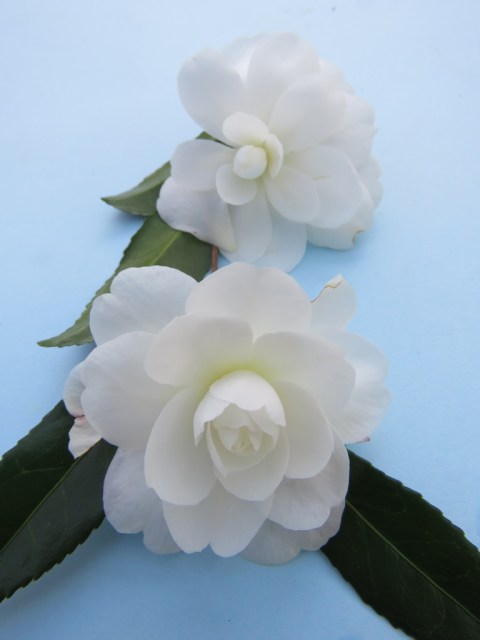
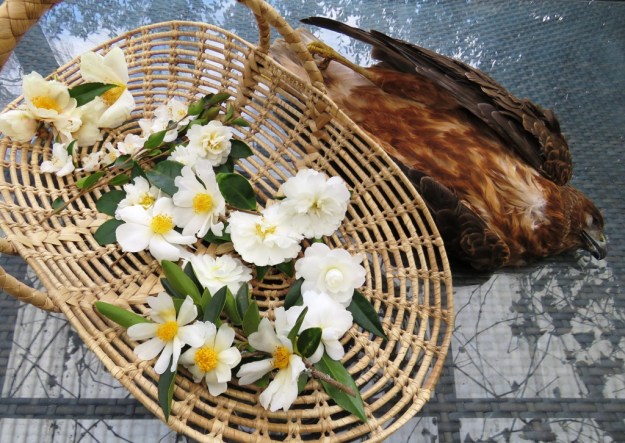
012It being autumn, ‘tis the season of sasanqua camellias here. Ever since camellia petal blight arrived to wreak havoc on the later flowering japonicas, we have been a great deal more appreciative of the sasanquas. What they lack in flower form, they make up in performance.

Gay Border on the left, Navajo to the  right

Gay Border on the left, Navajo to the right

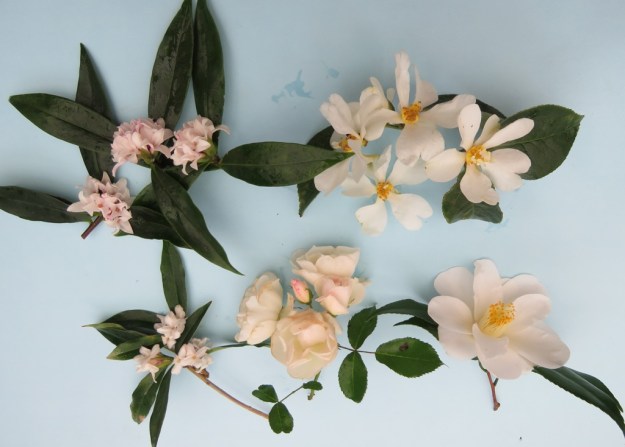
On a grey and somewhat bleak day, I thought to entertain myself with photographing the flowers but became sidetracked onto comparisons. When we had our nursery in full production, Mark would regularly make calls as to which cultivars we would propagate and sell. Would it be Navajo or Gay Border? We chose Navajo. It is not just the flowers that are the deciding factor. The habit of growth, foliage, size, performance and ease of propagation and production were also considered although the decisions were often a little ad hoc. When it came to Sparkling Burgundy and Elfin Rose, we chose the latter because its foliage looked better.


Sparkling  Burgundy left, Elfin Rose right

Sparkling Burgundy left, Elfin Rose right

We felt that it is not helpful to a customer to look at a range of plants with very subtle differences. “The man on the galloping horse” test, Mark calls it – the differences should be obvious, not just subtle variations. As far as we were concerned, we were professionals and customers had a right to expect us to do some filtering in selections and to pick good performers.

When it comes to naming his own cultivars from his breeding programme, Mark is hugely more rigorous and restrained. A new release has to be significantly different, distinctive or a major improvement. He has only named four of his own deciduous magnolias so far and that is out of many, many hundreds – maybe into the thousands – of seedlings he has raised. This restraint is somewhat unusual in the world of plant breeding.

Honey Tulip top left with other named cultivars. Might we have seen this as a breakthrough in flower form?

Honey Tulip top left with other named cultivars. Might we have seen this as a breakthrough in flower form?

When we released Magnolia Honey Tulip, we received an email from an overseas self-appointed expert acknowledging that Mark was extremely – excessively, some may say – restrained about the new selections that he named and released but he should not have released a yellow magnolia. The world has enough yellow magnolias already, he loftily told us. Right-o then. We knew what he meant – there are many yellow magnolias named which all look very similar, but apparently it had not occurred to him that Mark, with his self-imposed restraint, may actually have managed to breed one that was a breakthrough and very different. We did not reply.

Anybody can raise seedlings of Black Tulip but are they then all worth naming? We think not.

Anybody can raise seedlings of Black Tulip but are they then all worth naming? We think not.

A plant breeder, by our definition, does more than just raise open pollinated seed. Not so the gentleman who visited us (again from overseas). He loved Mark’s Magnolia Black Tulip which sets seed. So he raised a whole batch of seed and spawned a whole lot of similar looking flowers which he then named and insisted on showing Mark all the photographs. None looked to be distinctive, a breakthrough or an improvement. They were just subtly different, as seedlings usually are. That sort of willy-nilly approach is not helpful to the plant and gardening world but we see it often.

That is why we have never coveted a National Collection – of anything really. The UK is very big on national collections. The parent website states:

“Plant Heritage’s (NCCPG’s) mission is to conserve, grow, propagate, document and make available the amazing resource of cultivated plants that exists in the UK….

Our main conservation vehicle is the Plant Heritage National Plant Collection® scheme where individuals or organisations undertake to document, develop and preserve a comprehensive collection of one group of plants in trust for the future.”

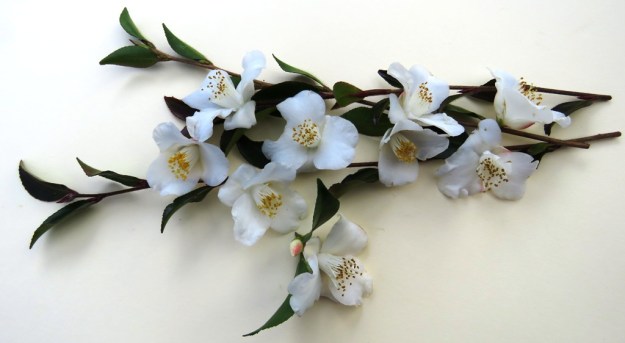
Camellia brevistyla left, microphylla right. They look mighty similar to us.

Camellia brevistyla left, microphylla right. They look mighty similar to us.

It is one thing to collect species – that is important for biodiversity and many are endangered in the wild. Mind you, we remain unconvinced that Camellias brevistyla and microphylla are actually different species. It looks more like seedling variation to us.

"For I have seen the national rhubarb collection"

“For I have seen the national rhubarb collection”

Also the compilation and maintenance of a wide genetic pool is important when it comes to crops like fruit and veg. “For I have seen the National Rhubarb Collection”, I tweeted when we visited Wisley. It seemed such a random and esoteric plant to collect, which is not meant in any way to deride its worth. And it was certainly a beautifully maintained collection.

But a National Collection that takes in many named hybrids? We have seen too many inferior and indistinct hybrids named to ever want to start a collection of any plant genus. We would rather have plants that are selected on individual merit in our garden.

Plant collecting is like stamp collecting, Mark explained. The search for a particular named cultivar may be challenging, rewarded by the thrill of acquisition. Whether the plant was actually worth acquiring – whether it warranted naming in the first place – becomes irrelevant.

Postscript: we don’t like to dwell too much on the travesty of our Cordyline Red Fountain and the ring-in Cordyline Burgundy though this was not, we think, motivated by misplaced breeder pride but by much baser motives indeed.