Category Archives: Abbie’s column

Abbie’s newspaper columns

The November Garden – rose time

November is peak rose season for us

This is the first spring in twenty seven years that our garden has not been open to the public. It has been something of a revelation. We have so many friends and colleagues who open their private gardens for at least some of the year that it had become normal – an integral part of our lives and how we gardened. We wanted a break but the main driver for the decision to close has been the high impact of the petrochemical industry. From being a sleepy little rural enclave, in a few short years Tikorangi has become Petrochemical Central and this has sent scarily large amounts of heavy and often hazardous transport past our gate. It is not a good fit with an open garden. We take the long view here. Our garden is built around trees originally planted by Mark’s great grandfather from 1870 onwards. The house gardens have been intensively worked since they were first put in by Mark’s parents in 1950. It seems likely that the garden will still be here when the gas has been pumped out from the ground below us and the petrochemical companies have moved on from fossil fuels – to renewables, we hope. In the interim, I don my iPod because I would rather listen to music in the garden than heavy industry. Now we garden for our own pleasure and without having to titivate to open garden standards – or garden grooming we call it.

Cymbeline, on of the David Austen roses

Cymbeline, on of the David Austen roses

November is peak rose season for us. I have a love-hate affair with roses. I am forever debating with myself whether the beauty of the blooms outweighs the foliage and form which are often disappointing – even more so as the poor defoliated things battle through summer and autumn. But is a large, comprehensive garden ever complete without roses? The problem is that we don’t spray our roses. Ever. I never spray anything and Mark point blank refuses to do roses. If they don’t perform without spraying, rip them out and replace them is his view. We do a bit of that and we are trialling some almost thornless pillar roses for a new pergola we have planned.

Mme Plantier, I understand

Mme Plantier, I understand

Mme Plantier, I understand [/caption]Personally, I am not a fan of hybrid teas. They don’t even rank amongst desirable cut flowers for me. I much prefer the informal floribunda types. We have a wonderful white shrub rose which was finally identified for us as Mme Plantier. It keeps excellent foliage without intervention, flowers in abundance and is sweetly scented. But it is only once-flowering and so many gardeners now refuse to grow any rose that doesn’t repeat-flower through the season. We don’t expect other shrubs to flower continually but poor roses are now judged by a different standard. Is six weeks not enough?

Rose Flower Carpet Appleblossom

Rose Flower Carpet Appleblossom

While the Rose Flower Carpet series never attract descriptors such as delicious or exquisite, as high health backbone plants, we have yet to find anything to rival them. Year in and year out, they flourish despite our high humidity and high summer rainfall.  The somewhat vibrant pink form that was the first to be released and the white have particularly long flowering seasons. In fact the white is rarely without blooms. The bright pink looks great when surrounded by large amounts of background green. It took me a few attempts to find the right locations. I prefer the paler apple blossom pink but it doesn’t repeat as well and blooms can ball in heavy rain. While we don’t spray, I am old fashioned and prune by the manual, even though there is research which says that a pass over with hedge clippers is just as effective. We keep roses in open, sunny positions with good air movement. As a point of principle, we do not routinely add fertilisers to our ornamental gardens but we mulch often with homemade compost. That is their feed. If any roses can’t perform well enough with the same regime of care that the rest of the garden gets, then I am afraid they are not for us. But those that do well here are a November delight.

First published in the November issue of NZ Gardener and reprinted here with their permission. 
Don Quixote Gardens

 Te Popo is a cool climate, woodland garden on a large scale inland from Stratford with a romantic feel that I love.


Te Popo is a cool climate, woodland garden on a large scale inland from Stratford with a romantic feel that I love.

Only old friends know that the man to whom I am still married was once a rock and pop drummer. A teaching colleague of mine roped him into playing in the orchestra for two musicals. While Joseph will be forever referred to in this house as he of the “bloody technicoloured nightmare”, the magic of “Man of La Mancha” did not pall over time and has entered our personal lexicon. I have to explain this because it is the irrepressible optimism and personal vision, drive and conviction that we see in what we now refer to as Don Quixote gardens.

This is a syndrome I know well because I am married to one such gardener so I recognise it in others. Don Quixote gardens are grand visions but personal visions of an individual. Let us rule out immediately those gardens – and I have seen a few – where the owners have set out to create what they think will be an impressive garden in order to impress other people. That is status symbol gardening.

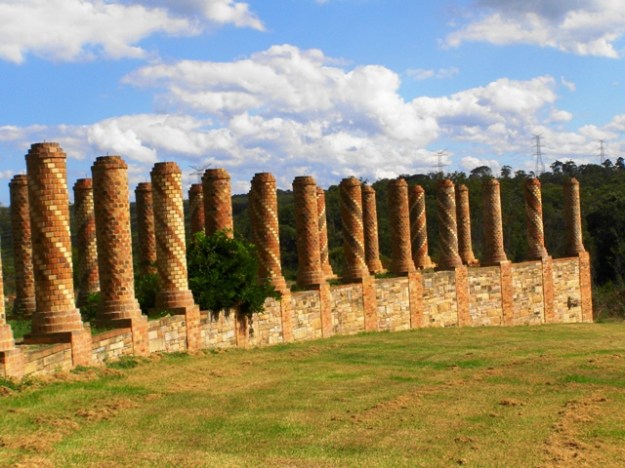
These are only half the columns at Paradise. The other half of the crescent is already wreathed in plants as a completed section of colonnade.

These are only half the columns at Paradise. The other half of the crescent is already wreathed in plants as a completed section of colonnade.

Don Quixote gardens are personal creations but on a bigger scale than most people contemplate, usually against the odds and without the corresponding budget that allows a small army of trained but subservient gardeners to follow in one’s wake. There is bravery, passion and a steadfast determination common to these garden creators. And a compulsive passion for both plants and landscape. Generally, Don Quixote gardeners would like it if you liked their garden, but they are not going to feel a failure if you don’t because they haven’t made it to impress you.

Let me give you a few examples. If you have ever been to ‘Paradise’, the extraordinary creation of Bob Cherry (assisted by Mrs Derelie Cherry) in New South Wales, you will know what I am talking about. It is an enormous garden, with some simply astounding brickwork and structure combined with a remarkable plant collection. Bob Cherry will be known to many New Zealanders as the originator of the Paradise sasanqua camellia range, but his plant knowledge and interest go well beyond this. As the saying goes, he has probably forgotten more about plants than others have ever known.

I think it unlikely that ‘Paradise’ will ever be finished. And I do not think that matters.

Paloma is unique amongst New Zealand gardens in design, plant content and genuine creativity, aided the boundless energy of its owners

Paloma is unique amongst New Zealand gardens in design, plant content and genuine creativity, aided the boundless energy of its owners

Closer to home, it is far too many years since we last visited Trelinnoe, the garden built by John and Fiona Wills near Napier but I think that probably fits the Don Quixote genre. Paloma, the extraordinary garden of Clive and Nicki Higgie near Wanganui is another. One of my favourite Taranaki gardens is the woodland garden of Te Popo – the work of Lorri and Bruce Ellis. It is big. It is soft-edged rather than tightly manicured but maintained to a very high standard without a big budget and primarily as a result the owners’ personal passion for the place and Lorri’s willingness to spend every day in the garden.

These are not places where the owner says airily: “We don’t want to be slaves to the garden. It only takes us about two hours a week to maintain.” Don Quixote gardens are created by people who would rather be in their garden than anywhere else.

Wildside in North Devon was different to any garden that we have seen and we were quite simply entranced

Wildside in North Devon was different to any garden that we have seen and we were quite simply entranced

I have mentioned before the inspiration we gained from visiting Wildside in North Devon but I have yet to write about it in detail. Sometimes it takes time to mentally process an experience. This was another such garden, and the garden owner, Keith Wiley is a splendid latter day Don Quixote. He took an almost flat cropping field and created a landscape. The scale of the earthworks involved in sculpting the land is difficult to comprehend but he created a rise and fall of more than twelve metres before he even started planting. It is a work in progress by a man who is not only possessed of huge energy and vision, but also a pre-eminent plantsman. I did laugh when he told us his artist wife had drawn a line of demarcation beyond which she would not garden. Any additional area beyond that line, he is to manage on his own. He will, I am sure.

Truth be told, these are not Don Quixote gardens, so much as Don Quixote gardeners, characterised by heroic visions backed by hard graft and above average knowledge – well above in some cases. These are people who will never say “my garden is full” or “my garden is finished” for, should that stage be reached, one might as well be dead. These Don Quixote gardens are about as far as one get from an urban courtyard, a contemporary designer look or a suburban back yard. They are not for the faint hearted or the uncommitted gardener.

First published in the Waikato Times and reprinted here with their permission.
A Place to Sit and Contemplate

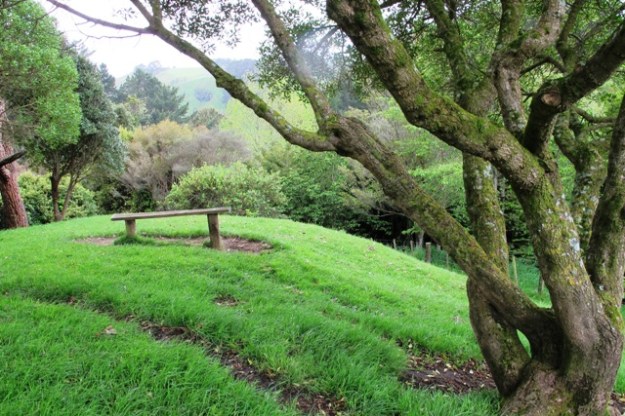
???????????????????????????????1. Sometimes it is the setting, not the seating which is the important feature. A simple bench is all that is needed to draw attention to the beautiful long vista, inviting you to take the time to sit and look. You need tanalised timber of course and farm posts are the most practical option. Make the bench long enough to hold two people and their coffee mugs without having to be too close, but not so long that it sags if somebody sits in the middle. This lovely scene is at Puketarata Garden near Hawera.
???????????????????????????????2. How could I not include this example from Wairere Garden in Gordonton? Obviously there are a few practical issues when it comes to sitting on this hand crafted bench which looks as if it has been made from old fence battens. With that length it would only be suitable for a single person or two young lovers. I really liked the sense of enclosure with it being placed inside a curved hedge and the contrast between the lichen-encrusted, rough simplicity and the clipped formality behind.
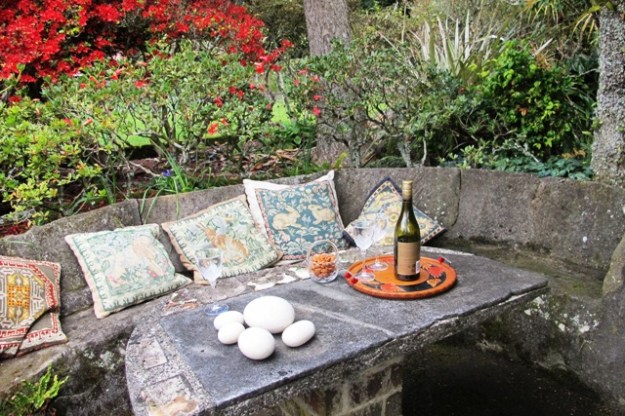
???????????????????????????????3. This is one of our own favoured seating areas, especially in summer when there is dappled light through the trees above. It is comfortable enough even without the tapestry cushions made by my late mother. The curved bench seat is stone, the table concrete on a brick plinth. I am guessing it was Mark’s mother who inset the vintage tiles around the edge of the table to add detail although few remain now. It does not always come equipped with the bottle of wine.
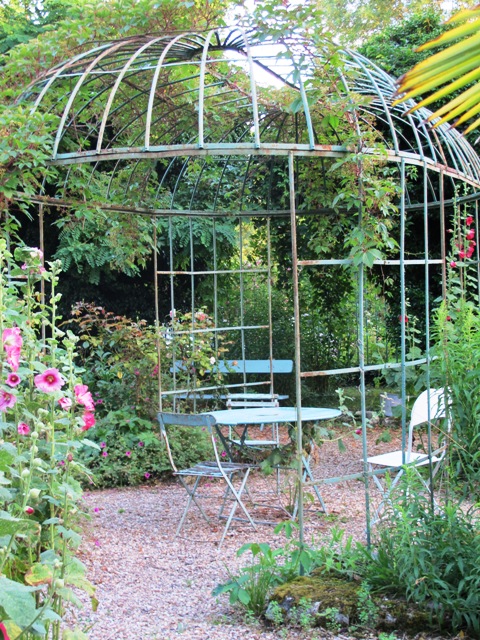
???????????????????????????????4. From home to away – the garden out the back of Restaurant Baudy in Giverny (where Monet himself used to dine with friends and you can repeat the experience to this day) applied casual French deshabille style to the outdoors. You would not want to be of large stature and trust to this outdoor setting, but the hollyhocks and gently rusting iron are the epitome of what is sometimes styled shabby chic in modern parlance.
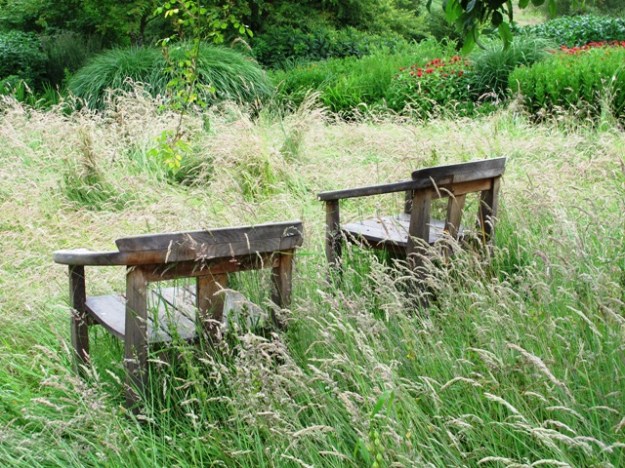
???????????????????????????????5. Let’s be honest, you would not be wanting to sit on these chairs when the grass is wet, but then if it has been raining, outdoor seating will be wet too. The absence of worn track marks to the chairs suggested that they were not in great use when we visited this garden near Stratford on Avon. But that long grass, meadow look is very charming. And at least if the seats are sited in the long grass, the legs will not be making holes in the lawn and you don’t have to move the furniture to mow.
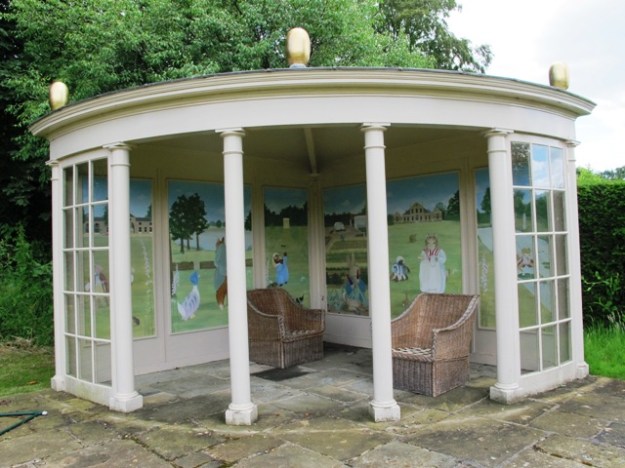
???????????????????????????????6. This is in a private Yorkshire garden and is, believe it or not, the children’s pavilion though I doubt that the comfortable cane chairs are there for the children to sit upon – far more likely for adults. Traditional cane needs to be under cover. It is only the all weather modern synthetics that can be left out in all weathers but modern or old, I have yet to meet outdoor seating that is more comfortable than cane. Personally I covet a little semi-enclosed pavilion like this one – with or without the Beatrix Potter wall paintings. In a climate which is never quite as warm as I would like, this type of outdoor room seems eminently practical.

First published in the Waikato Times and reprinted here with their permission.
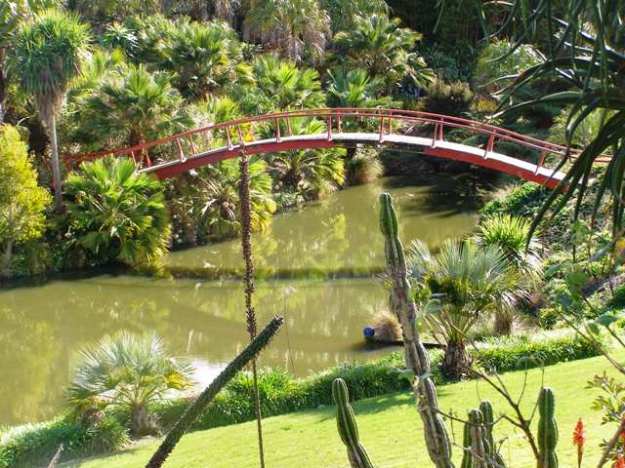
Romantic Gardens (part 2) – the grand, historic and famous

???????????????????????????????My first encounter with a garden strongly promoted for its romanticism was in northern Italy – Villa San Remigio. If you have ever been to the Italian lakes district, you will nod in agreement when I say that the whole place seems impossibly romantic. Stresa, Mennagio, Bellagio (the Lake Como one, not the Las Vegas one) – in the right circumstances these are places of charm bordering on enchantment.

Villa San Remigio had a wildly romantic back story – the love affair between a Neapolitan poet and musician and an Irish artist. If my memory serves me right, there was some sadness, earlyish deaths and childlessness. It had the mandatory handsome villa and a particularly lovely old church along with beautiful views across Lake Maggiore. But were the gardens romantic? It was all gentle decay when we were there, especially of the old concrete (and there was a lot of old concrete in larger than lifesize shrine-like constructions and terraces) and whoever managed the place was hoping to get grants for a major restoration. It may have been done by now but competition for restoration money is stiff in a country with such a long history and so many things in need of major investment.

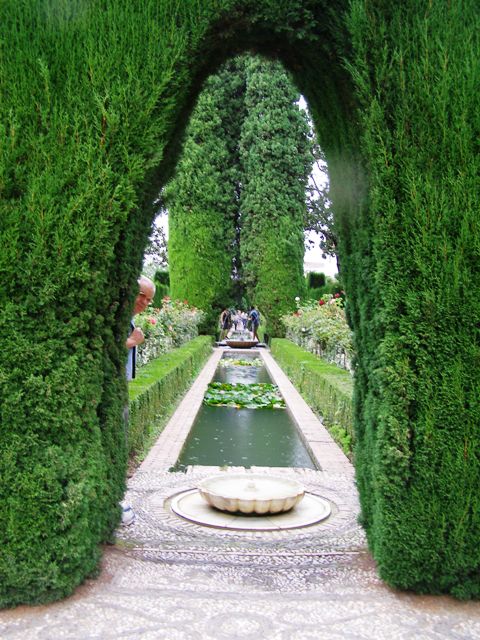
The gardens at the Alhambra are re-creations. Note the gentlemen on the left, politely trying not to intrude on my photo.

The gardens at the Alhambra are re-creations. Note the gentlemen on the left, politely trying not to intrude on my photo.

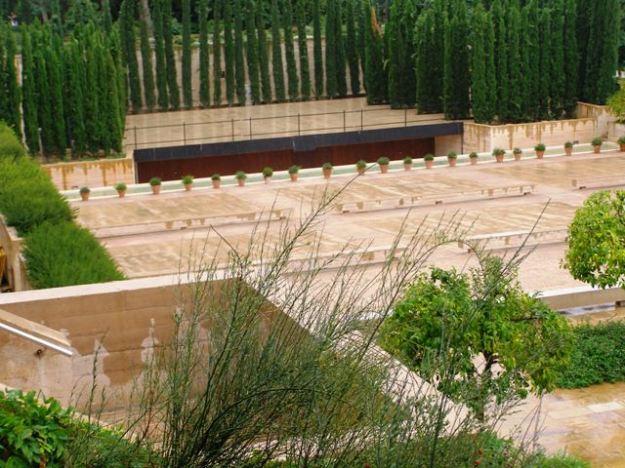
I searched on line and found an article in the UK Telegraph, listing their pick of the ten most romantic gardens. Villa San Remigio wasn’t on it, but the Alhambra in Grenada, Spain and Monet’s water lily garden in France were and I have been to both of those. The Alhambra is an amazing place but the gardens are a modern re-creation. It is the whole package there that makes the romance – the history, the beautiful palaces which are on quite an intimate scale, the light, the view across to the Albaicin (or medina)…. The garden enhances but does not generate the romance. The most recent. modernistic gardens at the Alhambra were anything but romantic.

There is nothing romantic at all about the latest, hard-edged modern garden addition at the Alhambra.

There is nothing romantic at all about the latest, hard-edged modern garden addition at the Alhambra.

Monet immortalised his garden in so many paintings which imbues the place with added mystique. An analysis of the garden itself rather belies that. However the water lily garden is loosely maintained and in a naturalistic style which contrasts with his more rigid stripes in the upper garden.

Monet’s waterlily garden is charming enough, as long as you don’t mind sharing it with many strangers.

Monet’s waterlily garden is charming enough, as long as you don’t mind sharing it with many strangers.

What these gardens have in common is a rich history, age and gentle decay, some solid architecture of note and romantic back stories. The gardens do not necessarily stand on their own merits. And let’s face it, in this country we lack most of the above although some of us can manage some gentle decay. But age is measured here in decades, not centuries.

These gardens – and most of the ones on the Telegraph list – are all well out of private ownership now but the love of romantic gardening dates back to the original visions of private owners, albeit generally ones with considerable personal wealth to achieve their dreams. These days the romance is a product of sophisticated marketing. I am yet to be convinced that an institution or business ownership model is capable of generating a romantic garden.

But private individuals can and do. I would disagree with the Telegraph’s list but that is because I am interested in the modern return to romantic gardening – what is being done here and now, not what was done last century or the centuries before.

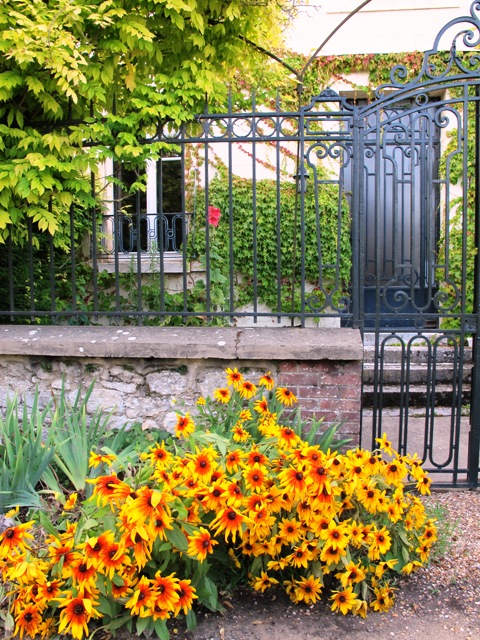
The soft-edged naturalism, helped by French village style, showed romantic gardening at a very domestic level.

The soft-edged naturalism, helped by French village style, showed romantic gardening at a very domestic level.

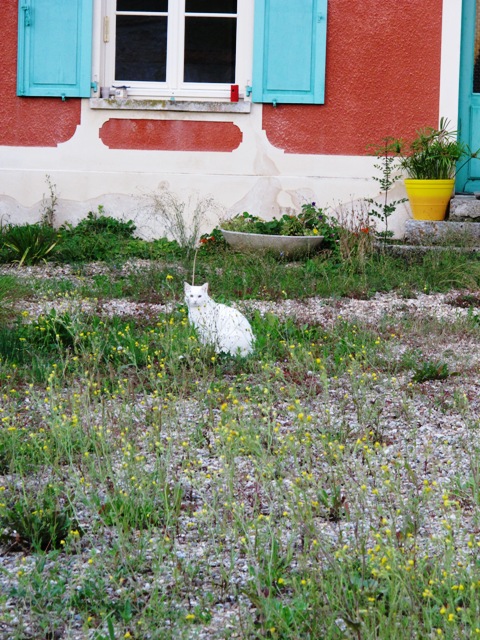
We spent a couple of nights in the village of Giverny where Monet’s garden is located. I am quite willing to admit that our delight in the charm of the village may have been influenced by the departure of the daytime crowds, the soft evening light and the consumption of the fermented fruit of the French vine, but we found ourselves more engaged with the village scenes than we were with the star attraction. This was romanticism on a very personal, domestic level. The soft-edged naturalism, often with charming detail, has nothing to do with great wealth, grand vision and power. It is equally within the reach of the individual.

In the village of Giverny, even le chat français and le yellow plastic pot had a certain romantic charm in the evening light.

In the village of Giverny, even le chat français and le yellow plastic pot had a certain romantic charm in the evening light.

The Romantic Garden Part 1

First published in the Waikato Times and reprinted here with their permission.
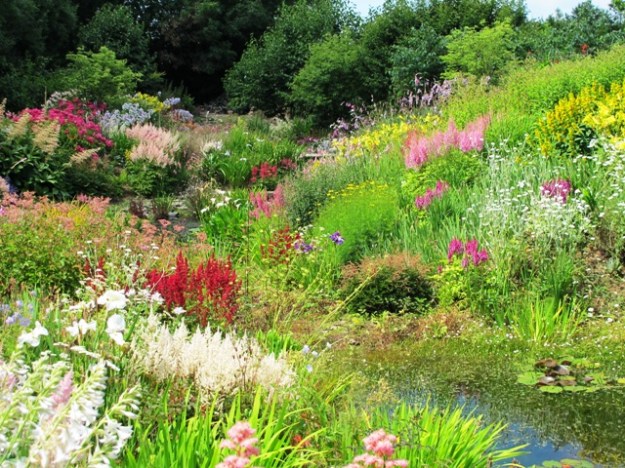
The Giverny Experience – Monet’s Garden

The iconic bridge at Giverny is recognisable from many Monet paintings.

The iconic bridge at Giverny is recognisable from many Monet paintings.

In the world of gardening pilgrimages, Monet’s garden at Giverny rules supreme. His water lily paintings, the evocative scenes of irises, beds of summer flowers in the French countryside – could there be anything more romantic? Many were inspired, we know, from his personal garden. Surely in visiting, we will be able to absorb some of this magic? Maybe.

To get maximum enjoyment from the experience, it helps to be A Believer. But be humble. You will be but one believer amongst the half million who visit over the seven months of the year that the garden is open. That is over 2300 a day.

A rare sight - the garden not full of people

A rare sight – the garden not full of people

As we lined up for opening with our tickets pre-purchased on line, a phalanx of 95 Swiss bore down upon us in the tiny lane. We resolutely held our pole position and were directed left upon entry whereas they were headed right. This sent them to the water lily garden and us to the house gardens where we had the unusual experience of having the place entirely to ourselves for a few precious minutes. I even managed some photos without people in them but this state of affairs was not to last and soon equal numbers were pouring in from the top entrance too.

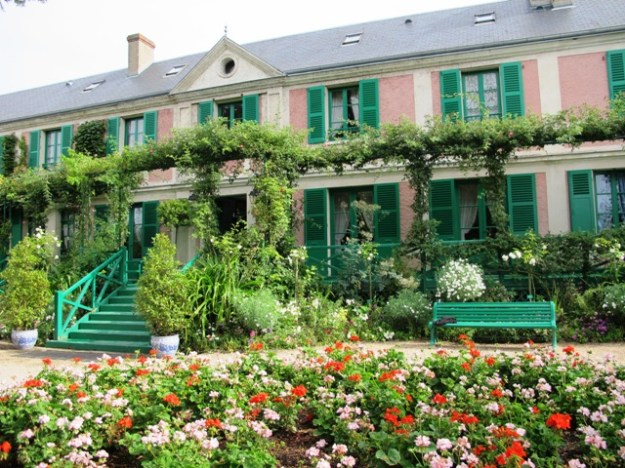
Entry to the garden includes entry to Monet’s house which is presented as it was in his day

Entry to the garden includes entry to Monet’s house which is presented as it was in his day

We had worked out that it may be wise to traverse the house interior early and so proved to be the case. Goodness knows how that poor house stands up to the beat-beat-beat of a million feet but it is an interesting place in terms of its interior decor and the art. The yellow dining room was pretty astonishing.

There is a very good collection of Japanese prints which were a source of inspiration to Monet, though the print count was exceeded by the number of Japanese visitors on the day we were there. Some fine examples of Impressionist art are on display but don’t expect originals. This is a re-creation of Monet’s house as it was in his day and so too are the paintings reproductions, albeit some good ones.

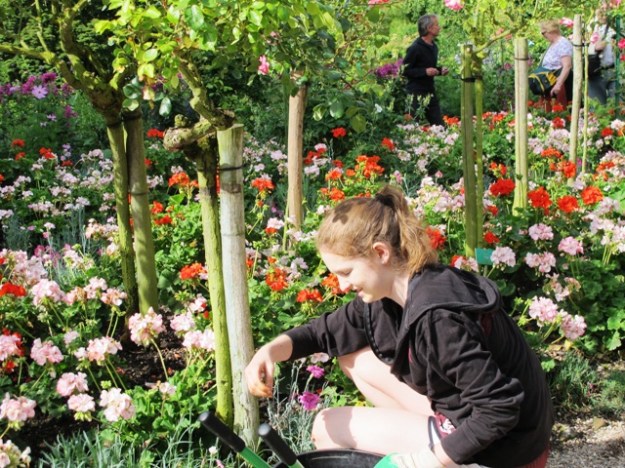
Almost Madonna-like in the garden, one of a small tribe of young women grooming the pelargoniums petal by petal

Almost Madonna-like in the garden, one of a small tribe of young women grooming the pelargoniums petal by petal

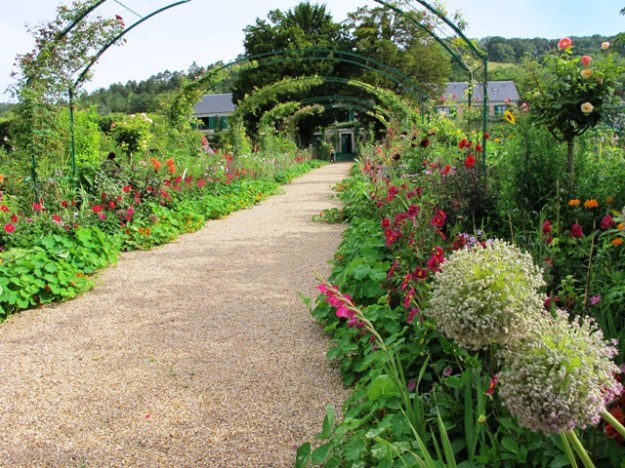
The garden? I probably have to whisper this, but if you are a keen and knowledgeable gardener, you may find it a little underwhelming. Monet is said to have taken inspiration for many of his paintings from the garden and to have played with colour to make it zing. Private gardens are private visions. Once they pass into public ownership, that dissipates over time and it has had 88 years to do so. In midsummer, there is a heavy emphasis on annuals and some “interesting” plant choices. We rather doubted that Monet would ever have gone for enormous, overblown modern dahlia hybrids. The flower gardens were reminiscent of English cottage garden style but with strong colours. And immaculately maintained. Hordes of gardeners were picking over the pelargonium florets to remove individual spoiled petals.

The water lily gardens were somewhat wilder and charming for that. There are two Monet bridges there but smaller in scale than they appear in his paintings. The mistake is to expect the gardens to reproduce the paintings in real life. They were an inspiration for an Impressionist artist, never a detailed representation of what he saw before him.

About the coaches... just a few and yes, some of these are parked two deep

About the coaches… just a few and yes, some of these are parked two deep

It is the whole Giverny package that makes it a special experience. If you simply arrive on a coach tour, shuffle around the garden, then the house followed by the gift shop before boarding your coach for the next attraction, you may secretly wonder what the fuss is all about. It is different if you make the time to stay.

We spent two nights in Giverny, staying in a rustic mill house B&B. This gave us time to walk the streets, to bike the countryside and to soak up the romance which still lies below the tourist machine. The first night we dined at the historic Restaurant Baudy which is reputedly largely unchanged from the days when Monet and his friends used to patronise it. The garden out the back was dishevelled and had no plant interest but was utterly romantic in the way we associate with the French.

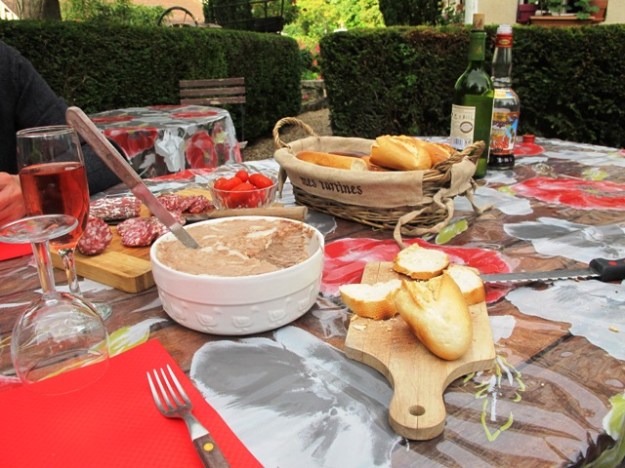
On the second day we pedalled the 5km to nearby Vernon, along a flat cycle way. “Bonjour,” all the oncoming cyclists and pedestrians called and we replied in kind. We found that it is possible to buy a perfectly acceptable bottle of plonk at the supermarket for €2.50. That evening we had the table d’hote offered at our B&B – freshly cooked local fare eaten al fresco where we talked broken French and some English with our hosts and their friend.

There is still huge charm to be found in Giverny but Monet’s garden, despite all the history and the hype, is only one part of that.

The table d’hote dinner at our bed and breakfast was home-cooked rustic fare and particularly delicious

The table d’hote dinner at our bed and breakfast was home-cooked rustic fare and particularly delicious

Monet’s Garden is open daily from 9.30am to 6.00pm from April 1 to November 1. Further details on all matters related to visiting the garden, transport, accommodation, the village and surrounding areas can be found on http://giverny.org/ Tickets to Monet’s garden cost €10.20 and can be purchased on line through this site.

Giverny is reached easily from either Paris or Rouen. The train journey from Gare St Lazare in Paris to the nearest station at Vernon takes 50 minutes and costs €14.30 each way.

We stayed in an impossibly romantic converted mill house, Moulin des Chennevieres in the village of Giverny paying €90 per night double for bed and breakfast.


First published in the Sunday Star Times.