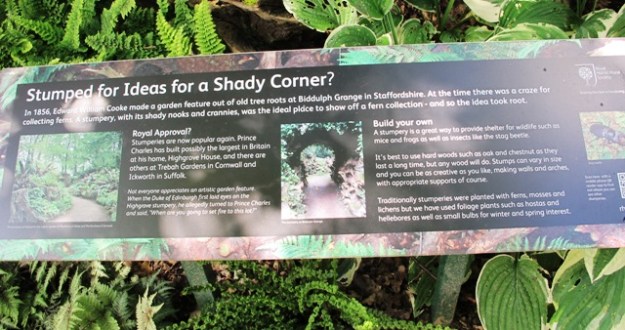
“Not everyone appreciates an artistic garden feature. When the Duke of Edinburgh first laid eyes on the Highgrove stumpery, he allegedly turned to Prince Charles and said, ‘When are you going to set fire to this lot?’”
Spotted on an information board at Wisley Gardens, England (2014).
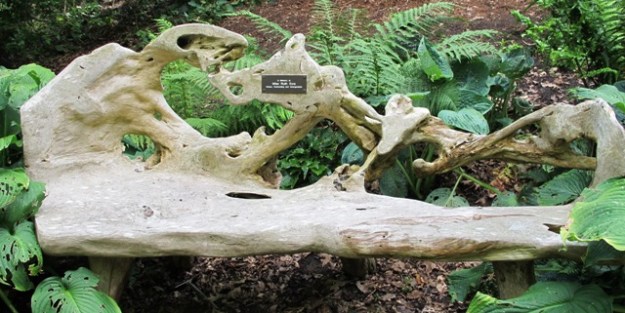
Not our seat as you can probably tell from the dedication plaque to Miss Ruth Ezra who was, apparently, ‘Unique, Outstanding and Unforgettable’, but a fine example of a bench seat constructed from a weathered tree trunk.
The origins apparently date back to 1856 when the owner of Biddulph Grange in Britain created the first recorded instance of a deliberate construction using old tree roots and stumps in order to display a fine collection of ferns, but I suspect that incidental stumperies must have occurred throughout garden history. Mark pointed out to me that our rimu avenue gardens are in fact a stumpery, though the creation of a garden beneath those trees only dates back to the 1950s.
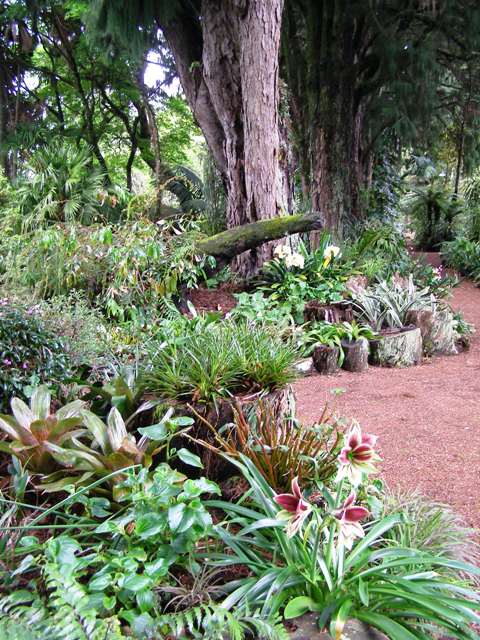
The addition of wood in this garden is for both decorative purposes but also to enable the soil levels to be built up so that plants will thrive despite competition from tree roots
Our newest stumperies in the garden here are a pragmatic solution but one with which we are happy to work. When large trees fall – and this happens from time to time here – the initial mess can be daunting. But once the superficial clean-up has been done, it is always amazing how little long term damage huge trees actually cause when they fall – as long as they miss buildings and do not bring other trees down with them.
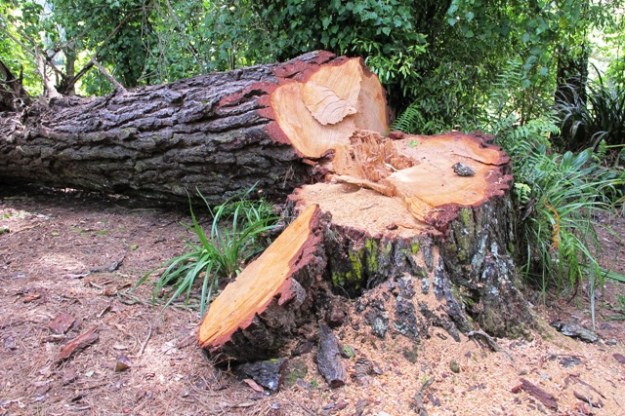
A recently fallen pine tree needed some chainsaw work to tidy up the remains but the trunk will be left to lie where it is and we will garden around it

This is fallen poplar and it has only taken a few short years for Nature to move back in and colonise what remains. Poplar is a soft wood that will break down quickly.
Who needs a trendy little insect hotel when you have a natural environment which is the equivalent of an insect estate? These fallen logs quickly become entire ecosystems in the space of a few short seasons. The rawness soon blurs and the first colonising mosses and ferns take hold. It is all part of the cycle of nature and fits with our philosophy of trying to garden with nature, rather than in competition. Mind you, the initial clean-up is what makes the difference. We remove or mulch the smaller side branches, anything broken and much of the foliage. We clear paths and basically leave just the main trunk to gently decay.
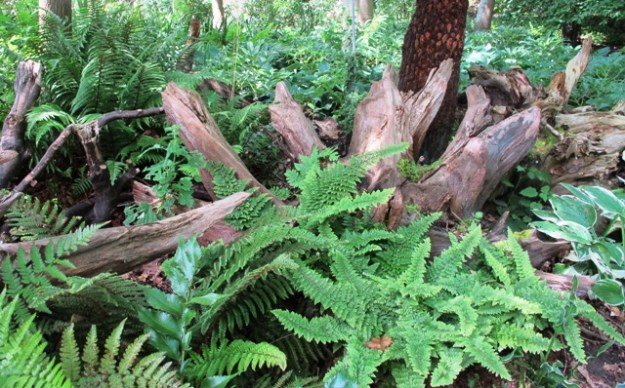
The stumpery style can be adapted to narrow house borders on the shaded side and will give a low maintenance option
Just don’t ever think that sawn timber boards are going to give you the right effect. Worse is the very idea of tanalised or treated timber. The whole concept of a stumpery is creating a healthy ecosystem based on gentle decay and natural change while creating pockets to display plants. There is nothing gentle or healthy or natural about tanalised timber. It has its place and purpose, but a stumpery is not one.
First published in the Waikato Times and reprinted here with their permission.


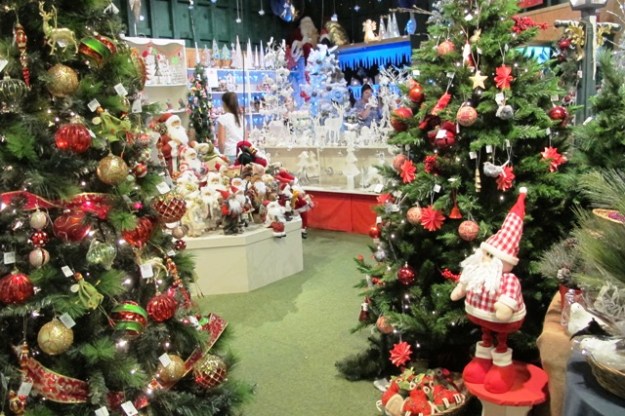 1) I have not made a great study of artificial Christmas trees but from what I can see, there is a vast range and both quality and price are equally variable. They are not as easy to customise as a living tree (or a dying tree, to be precise, if you have one without roots). There is a certain danger of ending up with one that looks similar to a shopping centre tree, especially if you opt for decorations that are restrained and unified as is favoured by many designers. For many, much of the charm of the traditional tree lies in the mishmash of family decorations passed down the decades.
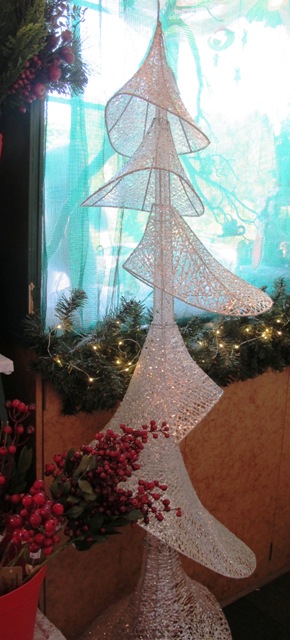
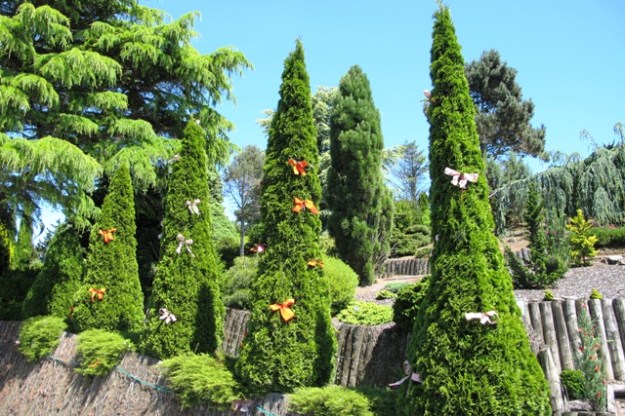
 3) If you have a suitable tree outdoors, decorating it with expendable decorations can be a festive greeting to be shared with passers-by. These are thujas. Norfolk Island pines look magnificent with a star on the top if you can work out how to reach their elevated heights. I have seen it done, though I am not sure how one would manage without a cherry picker or a tree-climbing monkey in the family. But folk are sufficiently enterprising to festoon their houses in Christmas lights (and pay the power bill) so no doubt there are some quite capable of decorating trees outside.
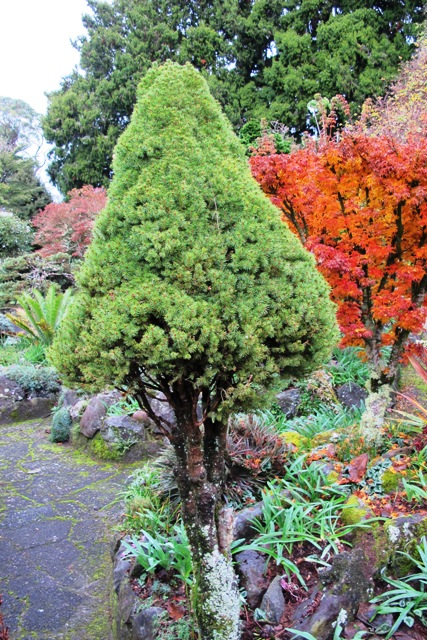 4) Our cute little Picea albertiana conica died. I have wondered about shaking all the dead foliage out of it and recycling it for the next few years as a skeleton Christmas tree. It is the perfect size and shape and could be stored in a shed. However, I recall one year using a large yet shapely dead branch which I spray-painted white. The children were young at the time but they were distinctly underwhelmed by their mother’s creativity and just wanted a proper Christmas tree such as other families had.
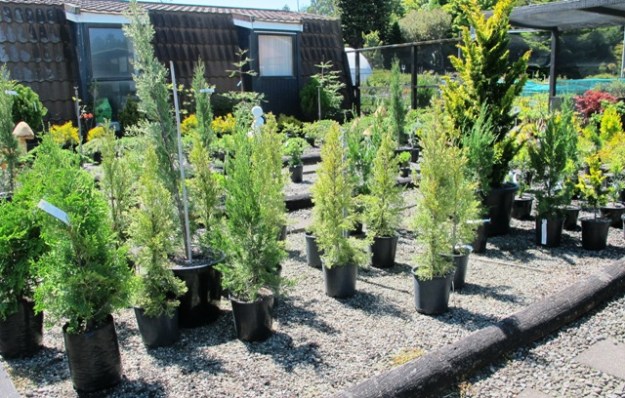 5) If you want a living tree, you need to set your sights small and choose a dwarf if you are intending to keep it alive for several years. Conifers have relatively large root systems and will not thrive on benign neglect when kept in a pot long term. However the very small growing varieties can be kept for many years with just the usual care that container plants require. They get more characterful with age, though not necessarily a whole lot larger.
 6) At the risk of repeating myself from previous years, I offer up our two variations. Both use a handy, permanent, metal frame I was given.
 This is what our corner of Otaraoa and Tikorangi Roads used to look like in the mid 1990s. The havoc on the left hand side is the result of major work Mark carried out to reduce flooding through our park and to return some of the stream to its original bed. His tidy grandfather had straightened up the stream to run along the boundary back around the early 1900s.
 A year or two later and our children are getting off the school bus on what was a quiet country road. Note the trees on the right hand side.
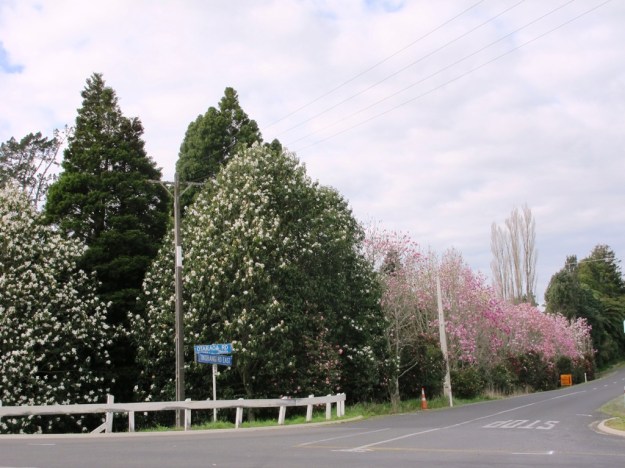 This is what our side of the road looks like now. The trees have grown up and many people tell us how much they enjoy the flowering.
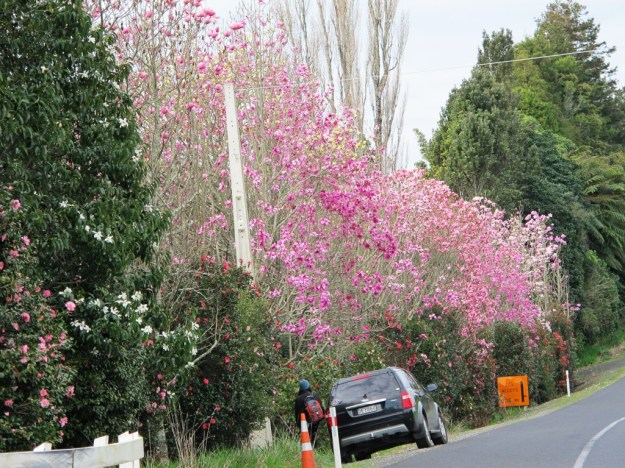 But we now have the petrochemical industry all round us and down this formerly quiet little country lane is the huge Mangahewa C site with its eight gas wells, single men’s camp and much additional activity. The road has been strengthened and widened for their heavy transport, all done in such a way as it is now impossible to walk along the verge. It is sometimes referred to as “loss of rural amenity”. Children can no longer walk safely to and from school bus stops, cycling is not safe, forget horse riding. It is pretty difficult to find a safe position to stand clear when the heavy transport thunders by. Meantime, across the intersection, the other side of Tikorangi Road – largely unused by the petrochemical industry – has remained unchanged over the past 20 years. It is a stark contrast.
 And on the right hand side of the road where there used to be trees, there is now a green wasteland dominated by the designated high tension power lines that Todd Energy, a petrochemical company, deemed necessary for their operations. Sadly, petrochemical development is now given precedence over rural amenity, local residents or the preservation of the environment. This is our world of 2014. During the day we listen to the heavy transport. At night, our formerly pitch black sky is often lit by gas flares in one or more quadrants. On an otherwise quiet Sunday morning today, I could hear the distant noise from Mangahewa E site. Every night we go to sleep to a low drone from one of the plants and we are not even sure which one it is any longer because there are four possible sources for the noise. But under the Resource Management Act, we are told by our councils that “effects are less than minor” and we are not, therefore, an affected party.