Category Archives: Abbie’s column

Abbie’s newspaper columns

The vexing issue of underplanting

A row of alternating annuals makes a statement, though it may not be the statement the gardener is aiming for

I had a day out and about looking at gardens recently and I was struck by the nature of under planting, though this preoccupation may have had more to do with my thoughts at the time. What I noticed about the under planting was how badly it was done in a couple of gardens. Bear with me, dear readers. You are going to have to imagine it because I know the garden owners so I was not going to whip out m’camera and take photos of the worst examples to embarrass them in the newspaper and on line.

Words like mishmash and hodgepodge came to mind as I looked at the bottom layer of plants in otherwise perfectly competent gardens. In other words, they had good upper layers of larger plants but when it came to the bottom layer of ground covers and under plantings, the selection criterion seemed solely that the plant should not reach more than 30cm in height. And there was one of this, one of that and one of the other, bunged in higgledy piggledy in most spaces.

Even worse, and I had to visit my local garden centre to set up a photo to demonstrate, is the horror of alternating annuals in a row along the edge. These certainly make a statement in the garden, though it may not be the statement that the gardener thinks when he or she plants them. I saw something similar (maybe with pansies and alyssum?) looking incongruous in a garden with otherwise high quality woody trees and shrubs and there were not any resident children to justify such a lapse in taste.

Nor am I a fan of edging plants, or indeed anything planted in rows other than proper hedges or vegetables, but that is a matter of style and personal taste. Fringes of mondo grass, liriope or anything else leave me cold but edging rows of matched annuals make me raise my eyebrows. Not even moderately tasteful white petunias cut the mustard when planted as an edging.

The contemporary look is to plant in blocks. The landscaper look is to plant in sharply defined geometric blocks each comprised of only one evergreen plant. Clivias are good, renga renga lilies are a bit untidy. Hellebores are probably acceptable, as is liriope or trachelospermum. Natives like prostrate muehlenbeckia are better.

Bergenia ciliata and Siberian irises – this gardener’s version of block planting

The middle ground is to gently block-plant but in more interesting combinations and in less rigidly defined grids. I am far more comfortable with that approach and it makes gardening interesting to play with different combinations. It also has advantages in making maintenance easier to group plants which require more frequent care – such as dead heading, staking, dividing, or grooming. Rectifying mistakes or bad decisions including eliminating invasive thugs is more localised if you are planting in blocks. I tend to blur the edges of my block plantings so that the overall look is softer and less delineated because that suits our style of gardening better. There is no doubt that if the upper layers of the garden are varied and mixed, some sort of unity in the bottom layer creates a more harmonious picture. I would argue that the flip side of the coin is also true: if your upper layers are rigidly conformist and consist of restrained plantings of only one or two different plants, ringing the changes with more complex and varied under plantings will make it a great deal more interesting.

Acceptable clivias

If you don’t want to go the block planting route, the old fashioned cottage garden genre may be an alternative. Essentially this is a jostle of perennials, annuals and bulbs in combination with small shrubs, often roses, where self seeding is encouraged. If you want a more modern look, you colour tone it rather than the traditional riot of random colour that nature achieves. If you like a tidy garden which is weed free, it is not an easy style to manage well. More often it is best viewed in passing, rather than looking at the detail.

Then, of course, you could ask yourself whether under planting is even necessary in some areas. The requirement that all garden beds and borders be layered with nary a glimpse of garden soil is relatively recent. In times past, it was fine to plant shrubs and trees without any bottom layer at all. It was called a shrubbery. Just don’t plant the shrubs too close together or you end up with a hedge. Each shrub needs to stand in its own space. As nature abhors a vacuum, mulch all the bare earth with something anonymous or you will grow a carpet of weeds. It is certainly easier to maintain than more complex plantings. It will probably look more attractive than the hodge podge assemblage of random plants I saw. It should look classier than the row of alternating annuals. Maybe it is time to start a movement called The Shrubbery Revival. Neo-shrubberies, maybe?

First published in the Waikato Times and reprinted here with their permission.
Modernist gardening, modern gardens and contemporary design


I felt as if I was looking at a parallel universe as I browsed “Contemporary Gardens of New Zealand”.

In fact, I think that the book is incorrectly named. It might be more accurately titled: “The Modernist Revival in New Zealand Garden Design”. The dominant impression is that the contemporary garden in this country is hard-edged design stripped of colour and plantsmanship. Who needs more than griselinia, nikau palms, corokia, strelitizia (the bird of paradise plant), xeronema (Poor Knights lily) and trachelospermum (star jasmine)? Yes, I know that is over simplifying, but most of the gardens included in the book use a very limited range of plants.

Modernist gardening has its roots in 1930s garden design. In fact, if you look back at some of those early examples, they would still look cutting-edge today. But it is only one style and the mistake is to think that modernism as a movement is synonymous with modern and therefore contemporary.

I would argue that modern gardening in this country goes well beyond the modernist revival style. How can anyone write about modern gardening without discussing the huge resurgence in interest in the edible garden? There is a distinct trend returning to utilitarianism usually seen in times of war and food shortage, where the growing of plants for ornamental purposes was seen as frivolous and every plant should be edible. These edible gardens, even when dressed up as potagers, don’t look contemporary and don’t photograph as well, but they are a definite modern trend.

Similarly, we are witnessing a movement against the chemical intervention of the last few decades. Call it organics, call it ecology, or naturalistic gardening, even sustainability – all reflect a rejection of the gardening values of the previous generation and a concern for harmony in nature. The modernistic gardens in the aforementioned book all play lip service to the idea of a “strong sense of place”, being “deeply respectful of the unique location”, the context – to the extent that I somewhat uncharitably started to think of all the Miss Universe contestants who give 60 second speeches about wanting world peace and homes for fluffy kitties. I would argue that at least some of those gardens demonstrated man’s imposition of rigid symmetry and entirely unnatural monocultures which is in fact the opposite of a harmony with place.

Most people actually like flowers

Most people actually like flowers

What is difficult to believe is that a garden genre which strips colour, seasonality and flowers from the garden is ever going to be more than a passing trend which appeals to a minority, most of whom are not gardeners themselves. There is next to no pink in this book on contemporary gardens, nothing voluptuous or even pretty. At its best, it is all terribly sculptural. If the owners want to have flowers indoors, most of them will be buying them from the flower shop. In my experience, most people like flowers and colour in their garden. And while seasonal change is messy, it is also what gladdens the heart for many.

The Foreman Garden in Lepperton

The Foreman Garden in Lepperton

I visited two local gardens last week which I would describe as modern or contemporary examples. Both are the creations of younger woman who are very keen gardeners and both are beautifully maintained and represent a great deal of time, thought and skill. The first was an example of green and brown austerity with a very limited range of plants, which has its origins in the modernist style though I found the use of curves to be more sympathetic to the surrounding countryside than hard edged symmetry. The total package of “the look” was what mattered and it was clearly designed to be as static as is possible when working with living plants. It was well executed and I can enjoy looking at such a garden, even if it is not to my personal taste.

La Rosaleda - photo credit Jane Dove Juneau

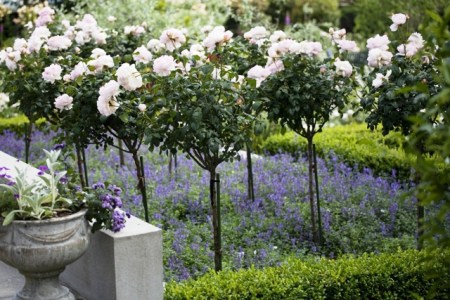
La Rosaleda – photo credit Jane Dove Juneau

The second garden was equally beautifully executed but could not be more different. It was an over the top riot of flowers, particularly roses, where the owner wields total control over the colour scheme and every plant combination represents thought. But pastel. Indubitably pastelle, with the most refined colour transitions throughout the garden. That love affair with the romance of pastel colour and the rejection of primary hues harks back to the Edwardian rejection of the garish Victorian gardens. It is incredibly pretty, feminine and romantic and in its most recent incarnation, is just as contemporary as the modernist garden design.

Landscapers are a breed apart from gardeners. That is not a value judgement. They are just on a different path, as indeed are plantspeople who have no interest in design but find the botanical detail of different plants fascinating. Both landscapers and plantspeople have their own unique language which sets them apart, accords them a higher plane is some eyes. In the middle are the gardeners who try to bring together both the design and the plants.

That said, there was one garden in the book that rendered me awestruck. It was the work of Queenstown landscape architect, Paddy Baxter and the location was in a remote area on the flanks of the Remarkables. It was not pretty, it was not conventional. It used pretty much all local native plants and it was the most exquisite example of anchoring a residence into its environment by sensitive landscaping. That was a very fine example of one type of contemporary garden.

First published in the Waikato Times and reprinted here with their permission.

But where are the hollyhocks?

Bragging rights on the home grown pineapple

Bragging rights on the home grown pineapple

“But where are the hollyhocks? I can’t find any hollyhocks,” the garden visitor said last weekend. I can honestly say that that is a first here. Nobody has ever commented on the absence of hollyhocks before. But it is true. We have none. I haven’t tried growing hollyhocks since the children were young and school gardens were still a part of the gardening calendar. The problem with hollyhocks is that they are very prone to rust in our climate which spoils the look.

There are, of course, many other plants we don’t grow. I can’t think that we have any petunias and gerberas are notable for their absence. Sweet peas we lack. Ditto tuberous begonias and we are distinctly light on fuchsias. Some plants we do not grow because we don’t like them, others because they don’t like us. Some are not worth the effort and presumably at least some are because we have never even thought of growing them.

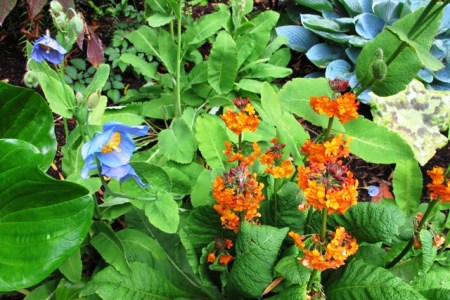
The cold border in the park with meconopsis and Inshriach primulas

The cold border in the park with meconopsis and Inshriach primulas

The challenge for many a keen gardener is to grow plants which are either very difficult or are well out of their natural zone. We certainly identify with this group. It is enormously satisfying to grow something which is not known in your local area. To this end, we are always trying to stretch the climatic boundaries and we do have options in a big garden. Mark put his cold border onto a south facing slope where temperatures are noticeably cooler and he has managed to get some of the plants which want a colder winter settled in. The blue poppies (meconopsis) from the Himalayas, less common but colourful Inshriach primulas from Scotland, the Chatham Island forget-me-nots and the deep coloured burgundy hellebores are all much happier in cooler conditions.

On the ridge above, the Marlborough rock daisy (Pachystegia insignis) and trickier forms of astelias perch in exposed conditions  compensating for our high humidity and mild temperatures. A different north facing slope gives us hotter conditions for the aloes and yucca plants that will rot out elsewhere.

Some highly desirable plants defeat us entirely. We’d certainly grow herbaceous paeonies if we could but they want low humidity, hot, dry summers and dry, cold winters to do well. There is no way we can simulate those conditions. Having had a Dunedin childhood, I loved the Bleeding Heart plant (now named Lamprocapnos spectabilis but formerly and widely known as Dicentra spectabilis). I bought several over a few years to try in different parts of the garden but they never returned for a second season. There was a little lesson there for me – just because garden centres sell a lovely looking plant in full flower does not mean that it is suitable for the local area. Oftimes they are shipped in from places where they do grow well. That is a lesson many others have learned, I am sure.

Where we draw the line is when it comes to having to spray in order to grow plants out of their normal climatic zone. We are not prepared to festoon sensitive plants in frost cloth either but that is because we can’t be bothered and we don’t want that ghostly presence of draped shapes in the garden. Chemical intervention is a step too far altogether.

I have never gotten over my shock when a very experienced gardener told me she kept her alpines alive in our conditions by drenching them in fungicide once a week. I can no longer look at her alpine area as an example of good gardening. Fungicides are not that good for the environment and in my opinion, good practice dictates they should only be used when absolutely necessary and not as a routine application. So no hollyhocks here – we are not going to spray to keep them healthy and we don’t want diseased plants sitting around festering.

If you are not a gardener who relishes the challenge of pushing climatic boundaries, then keeping to plants which are happy in your conditions is going to make life a whole lot easier. This does tend to mean you can’t have a sub tropical garden in Hamilton because winters get cold and frosty. Second daughter attended Waikato University a decade ago and she commented on the gardens she walked past which had clearly been “landscaped” in summer on a tropical theme. Come winter, the plants were blackened, looking very sad and often dead. If you are a novice gardener, take up walking. You can see much more on foot than you will ever see from a car window and noting what is growing well and is being repeated in gardens around your area is a good guide. It may also be an indication of what plants are available for sale.

For those of us who like a challenge, there is nothing quite like the bragging rights that come with… a pineapple! Yes, this was grown and harvested from our very own pineapple patch set against a warm brick wall. Not as sweet as a Dole one but not exactly a run of the mill crop for our area.

First published in the Waikato Times and reprinted here with their permission.
The generosity of some gardeners and the vandalism by non gardeners

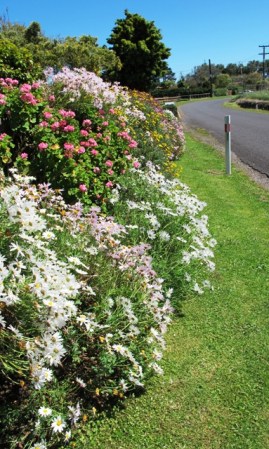
I smile each time I pass a property down our road. The frontage is a froth of flowers for much of the year. There is nothing choice. Most of them are common enough daisy bushes and pelargoniums which balloon out onto the road verge. It is just a delightful picture for the passing motorist – it being in a position where there is no foot traffic. What makes it a little bit special, to my mind, is that the sole reason for this planting is to bring pleasure to passersby. From my vantage point on the road verge, it looks as if the property owner would not really see this particular planting from their house windows or indeed from inside their garden. That shows a generous gardening spirit, in my opinion.
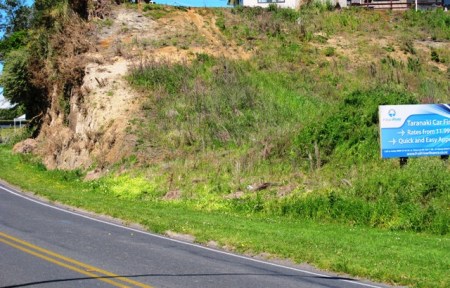
The contrast to the bleak hillside on the edge of my local town could not be more extreme. Until about two years ago, this hillside was fully planted in mixed trees and shrubs, many of which were flowering varieties. I am guessing the property was sold and that it was the previous owners who had planted it up two decades ago. We always enjoyed the roadside view, particularly because at the bottom, it had a well established specimen of our Magnolia Vulcan which the owners must have planted in a prominent position not long after we released it on the market. Being in town, the air temperature tends to be a degree or two warmer so this Vulcan would come into bloom every spring just ahead of the time it opens in our own garden. It was such a feature and was on the way to becoming a mature specimen.

Cleared entirely and left to weeds and erosion

Cleared entirely and left to weeds and erosion

The hillside is too steep to garden intensively or indeed to mow or graze, and it lacks sufficient space to be terraced so there is very little that can be done with it beyond establishing permanent plantings. It took a lot of plants to cover the area but over twenty years, they had grown to give an attractive cover which had knitted together in a patchwork of colour, foliage and flowers. It would have stopped most of the weed growth below, prevented the risk of slipping in rain and given an attractive drive in to reach the house at the top. It would also have required very little maintenance yet it brought a great deal of pleasure to passersby who stood to benefit the most. The house, perched on the top, looked over the plantings.

It must be two years ago now that I drove past as the hillside was being stripped. By stripped, I mean every tree and shrub was removed, even the Magnolia Vulcan at the base of the hill. My heart sank but I thought they must have plans to develop the property differently. Not so. After two years, all that remains are weeds, rank grass growth and clay. But wait – a billboard has appeared, advertising loans at 11.9% to people who cannot afford them to buy new cars. It’s a destructive travesty.

My guess is that new owners moved in and found the shrubs at the top of the slope were starting to block their soaring views across the town and maybe distant views of the river and sea. You have to understand that these are soaring views of a former freezing works town which is not noted for the beauty of its architecture. Rather than seeking advice as to how to frame views, to establish view shafts and to thin or selectively remove problem plants near the top of the slope, they went in and cleared the lot from top to bottom. Believe me, the house will have unimpeded views (and wind) at the top and the owners may never realise how much pleasure people used to receive because of the generous gardening spirit of the previous owners.

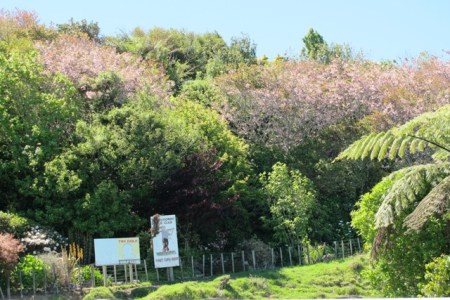
Fortunately, this planting facing State Highway 3 still grows and blooms

Fortunately, this planting facing State Highway 3 still grows and blooms

Fortunately a similar planting alongside the state highway survives. A different owner with another difficult slope of some area, she planted it around the same time. Many rhododendrons, camellias and flowering cherries grace this hillside along with a large specimen of Magnolia grandiflora at the base of the slope. Very little of it will be visible from the house and again it is relatively steep. It too has billboards but in this case they are faded old ones promoting the activity of golf, rather than the town’s newest finance company. Every day thousands of motorists pass the boundary and for three months in spring, many of them will notice seasonal blooms and maybe it will bring a smile to their day.

To me, that sets a standard for generous gardening, way beyond the sharing of cuttings and divisions. With no expectation of admiration or appreciation, these good folk create beautiful plantings in areas where they can see little from their own homes or outdoor living spaces. They are there to be enjoyed by passing strangers.

The late spring bulbs


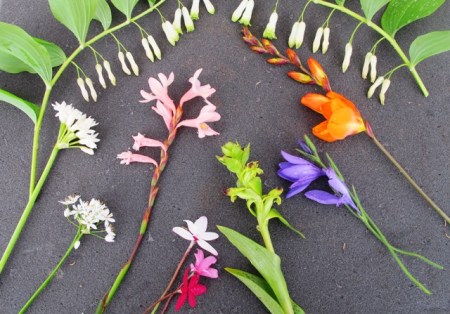
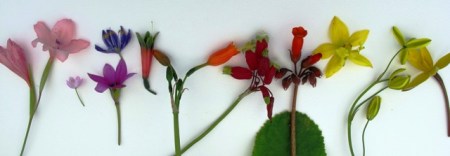
Left to right: Gladious carneus, a dainty allium, Romulea rosea, camassia, Phaedranassa cinerea, Stenomesson miniatum, Gesneria cardinalis, calanthe orchid, Albuca candadensis and spiloxene.

When spring bulbs are mentioned, most people think of daffodils, bluebells and tulips. But when they have been and gone and all that is left is the scruffy foliage, there are the late spring bulbs coming into flower. Most of these are less well known and certainly less celebrated in literature and art. For all that, they are often more interesting, maybe because they are unexpected.

We love bulbs here and with bulbs I include corms, rhizomes and tubers. More than any other type of plant, they seem to mark the passage of the seasons and to create the smaller, detailed pictures that add layers of interest to the garden. Maybe because the perennials and annuals are coming into their own at this time, the late spring bulbs are often ignored and therefore harder to source.

I headed out to the garden to see what was coming into flower. Discounting the earlier bulbs which are still flowering but well past their peak (veltheimias, the late lachenalias, Hippeastrum aulicum and the like), I found about 20 different types of bulbs coming into their own and that is by no means complete. There is little which is duller than endless lists and plant descriptions so I lined a number up for photographs.


Clockwise from top – Soloman Seal (Polygonatum multiflorum), tritonia, babiana, Satyrium odorum (orchid), rhodohypoxis, Watsonia brevifolia, tulbaghias – probably comminsii and possibly simmleri

I featured the rhodohypoxis in Plant Collector a fortnight ago. These are relatively common and form attractive carpets in pinks, whites and carmine red with their mass of star flowers. There is nothing rare or exclusive about Soloman Seal (Polygonatum multiflorum) either. It was common in the gardens of grandparents and is perhaps undergoing a surge of discovery amongst newer generations of gardeners. It is particularly handy for semi shade positions and, after battling a near impenetrable mass of entangled rhizomes, I decided it may well have some merit as a natural stabiliser for an eroding bank. I will report back in three years about the success or otherwise of this venture but as it will grow pretty much on top of the ground and grip hard, I am optimistic. As a bonus, the foliage turns golden in autumn – an unexpected source of autumn colour for us.

Hippeastrum papilio

Hippeastrum papilio

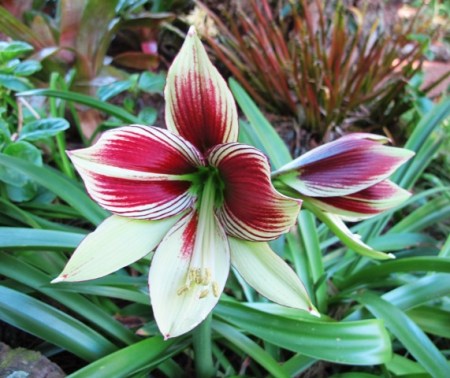
For sheer exotica, it is hard to beat Hippeastrum papilio which is just opening. Papilio means butterfly though I think it is more orchid-like really. This is a spectacular bulb from Brazil which is offered for sale from time to time. It is more expensive than rare. We had to try a couple of different places in the garden before we found a spot where it was happy but we now have it thriving in open woodland conditions.

Scadoxus puniceus

Scadoxus puniceus

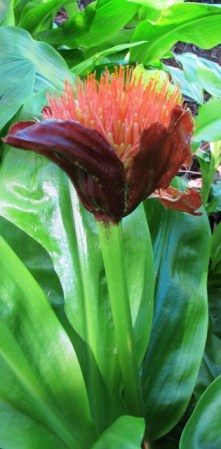
While on the big bulbs, Scadoxus puniceusis one of our showiest but I won’t dwell too long on it because it is rather too frost tender for inland areas and rare in this country. Its cousin, Scadoxus katherinae, is a better bet for frosty areas because it is dormant in winter and doesn’t start moving until spring, flowering in summer. Similarly, our love affair with the arisaema family (sometimes called snake’s head lilies though they aren’t lilies) is of limited value because our showiest ones are Mark’s hybrids which we have never sold so they can’t be seen anywhere but in our garden. Given time, we may put them on the market but that is a way off. Most of the arisaema family hide their flowers below the foliage but Mark has managed to breed with varieties to bring out the desirable trait of holding their flowers above the leaves, making them much showier as well as being easy garden plants. You may, however, find Arisaema speciosum which is easy to grow and Arisaema ringens is relatively common. If you have a bank that you look up to, the flowers are little more obvious without having to part the leaves to see them. We describe A. speciosum as the closest thing to a cobra you would want in the garden.

If you are getting frustrated trying to find more unusual plants, there are good reasons why. Many if not most of the specialist nurseries throughout the country have closed down over the last decade as have most mail order nurseries. Treasure the ones that are left because there are few new plant businesses opening. However, bulbs are perhaps a little easier than trees and shrubs and I occasionally look at the bulbs section of Trade Me and see some interesting and less common material offered for sale there. Beyond that, you may have to start haunting your local horticultural society or keen gardening groups where there are likely to be one or two people who know their bulbs from their onions.

First published in the Waikato Times and reprinted here with their permission.