Category Archives: Abbie’s column

Abbie’s newspaper columns

Meet the maddenii rhododendrons

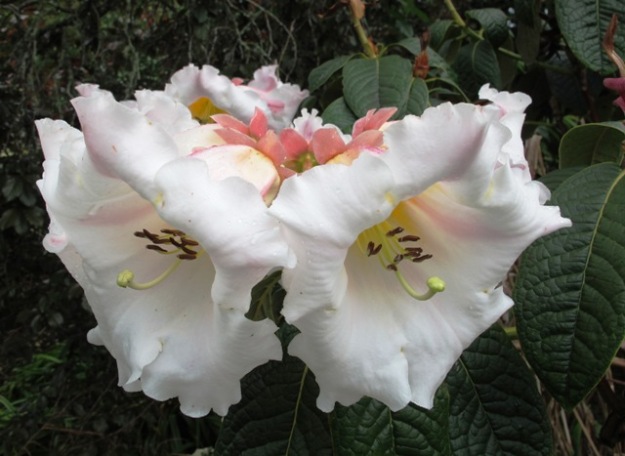
The Rolls Royce of rhododendrons - sino nuttallii

The Rolls Royce of rhododendrons – sino nuttallii

Allow me to introduce you to maddenii rhododendrons. We are pretty keen on them here, although you may not share our enthusiasm if you think all rhododendrons should have the tight ball truss of blooms which is usually regarded as typical of the family. Maddenias don’t hold their flowers in that style.

But the family does include the spectacular nuttalliis with their huge trumpets. I rate these as the most stunning rhododendrons of all with their flowers which look as if they have been cast out of wax and their wonderful, big leaves which are heavily veined – described as bullate foliage. There is nothing quite like them but they are not generally available on the market. They don’t produce much cutting material and they are not easy to propagate but many will set seed so, if you are really keen, you could try raising seed. Some of the hybrids can be found from time to time – Mi Amor and Floral Sun in particular.

There are two huge pluses for the maddeniis. Most are scented, some strongly so. R. polyandrum can waft out for a metre or two which is an indication of a strong scent. Many will pass the 30cm sniff test which is good. And if you are willing to risk the pollen on the nose, most have a sweet scent when you bury your face in the flower.

The second big bonus is that the maddeniis show much better resistance to thrips than most other rhododendrons. Thrips are nasty sucking insects that hide away beneath the leaves, sucking out the chlorophyll. This turns the leaves silver and once that has happened, they can never be turned green again though the new season’s growth will be green, at least until the thrips get hold. Over time, serious infestations can weaken a plant past the point of return. Very cold winters will kill the bugs off, but we don’t get cold enough here so there is not a whole lot one can do beyond spraying with insecticide or neem oil, or trying a cloth collar soaked in systemic insecticide wrapped around the main trunk. Or you can choose varieties which are more resistant.
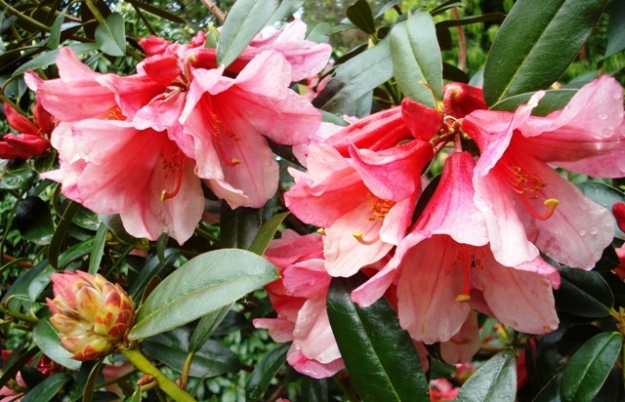
Bernice, as red as the maddeniis get

Bernice, as red as the maddeniis get

There is a preponderance of whites and pastels in the maddeniis and where there are coloured ones, they lean to the subtler, softer shades. In other words, there are no pure reds, purples, blues or oranges. We don’t mind because we can get the stronger colours in azaleas and other types of rhododendrons. Some of the hybrids flower so heavily that it can be like viewing a wall of bloom with barely any foliage visible at all.
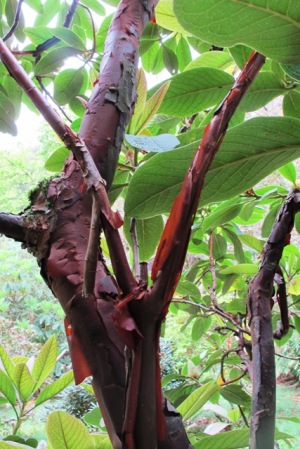
Wonderful peeling bark and bullate foliage

Wonderful peeling bark and bullate foliage

I should perhaps mention also that most of Maddenia types don’t make tidy compact little buns of bushes either. They are inclined to be more open in their growth – though by no means are all of them giants. Some can only be described as leggy, but all is forgiven when they flower. Besides, another attractive feature of these rhododendrons is the lovely peeling cinnamon bark many have. If they were bushy, dense plants, you would never see it.

Google tells me that this group were first introduced to the West in 1849 by famous plant collector Joseph Hooker – he who also visited New Zealand. For reasons which are not entirely clear, he named them after Lieutenant Colonel E Madden of the Bengal Civil Service. How random is that? Given that these rhododendrons are found in northern India, Burma, southern China and the milder areas of Tibet, maybe Lt.-Col. Madden was particularly helpful to Hooker’s expeditions.

Internationally the maddeniis are rated as subtropical and somewhat tender so they are the envy of gardeners from cold climates. Our climate in New Zealand is so temperate that you are able to grow most of the maddeniis in all but the coldest, inland conditions. They form the backbone of the rhododendron collection in our garden and, being later flowering than many others, are coming into bloom right now.

There is no simple way to determine which rhododendrons fall into the maddenii group. That is what books and Google are for. But ones you may find, or know of, include Fragrantissima, Elsie Frye, Princess Alice, Bernice, Moon Orchid, the aforementioned Mi Amor and the plant confusingly known simply as Rhododendron maddenii.

The problem is sourcing these rhododendrons. In fact the problem is sourcing any interesting rhododendrons at all in these days when specialist nurseries have fallen like flies. The best option for Waikato readers may be Rhodohill or Tikitere Nurseries in Rotorua. Failing that, try Trade Me where there is a South Island grower, RhodoDirect, producing and selling by mail order. I have seen them listing the lovely Floral Sun and there are other maddeniis in their range.
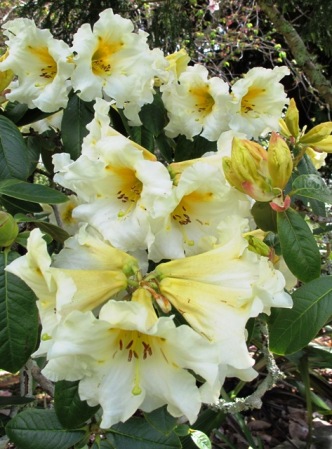
Our very own Floral Sun

Our very own Floral Sun

First published in the Waikato Times and reprinted here with their permission.
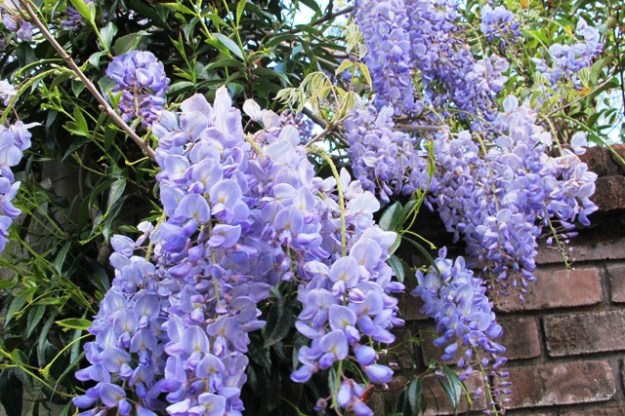
For the love of wisteria

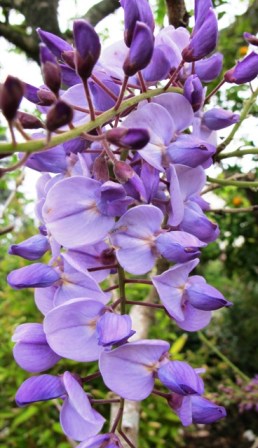
Blue Sapphire - a classic blue sinenis wisteria

Blue Sapphire – a classic blue sinenis wisteria

I am feeling the love for wisterias. This love does not last 52 weeks of the year, but when they are in flower, you would have to be lacking in all romance not to admire them. This week it is Blue Sapphire that is looking its very best. White Silk and Amethyst are just opening, to be followed by Snow Showers and Pink Ice. Even the very names are romantic and evocative.

If you have your wisteria beautifully trained and tied in across your verandah (best with an equally romantic looking old villa or cottage) where its long racemes of fragrant flowers festoon down, so much the better. All you need is the rocking chair with calico cushions to complete the picture. I don’t go there, because I know that in the 49 weeks of the year when it is not flowering, that plant is going to take on triffid-like characteristics and try to split the spouting and drive a wedge between the roof and the ceiling. The oh-so-lovely blue wisteria on the side of our house was eradicated years ago. I was too much of a novice to understand why Mark’s father took it out when it looked so beautiful in flower, but now I understand just how quickly a wayward tendril can leap into a gap in the roof tiles, thicken, harden and bingo, you have a broken tile before you’ve even noticed it got away on you.

One growing season is all it takes. Believe me. I have had the lovely Snow Showers split the plastic spouting immediately outside my office window and I prune thoroughly every year. By autumn, one stem had driven such a wedge between the spouting and the building that something had to give.

Snow Showers - a floribunda selection on our bridge

Snow Showers – a floribunda selection on our bridge

Growing wisteria takes a bit of work. You need to prune them and to train them and picking a suitable location is important. Currently we grow a couple over a wooden bridge (and they have made an attempt to split the bridge timbers), three up strings on a brick wall where they can do no harm beyond leaping into nearby trees if not supervised closely and the aforementioned one up a wooden wall out my office window. I have two waiting to be planted out and they will be going on freestanding metal frames which will support a canopy over time. A bit of forethought can save a lot of trouble later. Wisterias are not something you can plant and leave. I was once told that the largest plant in the world is a wisteria which has layered and leapt its way along 5km somewhere in China. I have no idea if it deserves the title of the largest plant, but I have little doubt that such a one exists.

There are two main groups of wisterias, the Chinese ones (“sinensis” which just means from China) and the Japanese ones (floribunda). The Chinese ones usually have finer leaves and they flower on bare wood before the spring foliage appears. As a relatively random piece of information, the Chinese ones twine anti clockwise whereas the Japanese ones twine clockwise.

Wisteria White Silk

Wisteria White Silk

The floribunda wisterias flower as the new foliage appears but to compensate, they tend to have much longer racemes of flowers. Some can be 50cm or more and, as the plant gains maturity, the flowers just get better. White Silk (or Shiro Kapitan) is an exception with its short, fat racemes but it makes up in flower size and heavy fragrance what it lacks in festooning capacity. There are also North American species and I have yet to discover whether they twine clockwise or anti clockwise. The ones most commonly available on the market here originate from China and Japan. The flowers resemble pea and bean flowers and indeed wisterias are members of the legume family.

The trunks of these vines are borer fodder supreme. If you look at an old wisteria, you are almost certain to find extensive borer damage. They battle on remarkably well for quite a long time, but left untreated, sooner or later sections will die and snap out. It pays not to put all your trust in one central leader or even a central plait of three leaders. Sooner or later, the borer are likely to take them out so you want to be training the occasional replacement through as well.

Whenever you spot a borer hole or borer sawdust, treat it. Either cut it out or pump the hole full of insecticide (fly spray seems to work) or light oil such as a cooking oil. I favour CRC because the spray cans come with those handy little tubes for poking down the hole.

If you are willing to put the work into managing your wisteria, they will reward you in a most gratifying manner.

Wisteria Amethyst

Wisteria Amethyst

Help! My wisteria won’t flower.
1) Check for borer infestation and make sure the plant is still alive.
2) The sparrows may have disbudded it. Sometimes they develop a taste for the buds but you should see freshly damaged debris lying below.
3) The plant has been pruned incorrectly in winter. If you cut it back to a stump every year, you are cutting off all the flowering spurs. Sort out the main stems and then prune back all the side canes to three or four buds out from the main framework. That is where the flowers develop from.
4) You have bought a seedling instead of a named variety. Replace it.
5) You have a grafted plant and the root stock has taken over. We much prefer cutting grown wisteria so this problem does not arise. If you can identify what is root stock, remove it to allow the grafted variety to grow without competition. These days, most plants are cutting grown.

First published in the Waikato Times and reprinted here with their permission.

The high cost of “regional gardens”

The Taranaki Regional Council’s summary of their annual report arrived as an inclusion in our free community newspaper. “Duty of Leadership”, it heads itself with a wonderful air of importance. The section that interested us was the one on the regional gardens which had around $2,100,000 spent on them in the last financial year.

Just to clarify, the regional gardens do not include the likes of Pukekura Park and King Edward Park which remain with District Councils. The regional gardens are a different kettle of fish entirely to the highly valued urban spaces that city parks and gardens provide. They are comprised of Tupare and Hollards (both former private gardens of a similar size and age to our own garden) and Pukeiti (formerly a private trust garden).

When Regional Council took over these gardens, in their wisdom they decided to give free entry. Except nothing is free. It just means the entry charges have been replaced by ratepayer funding despite the fact that many of the bona fide garden visitors are tourists. So ratepayers are paying for the free entry of people from beyond the region.

The same report this week claims close to 20,000 visitors to Pukeiti last year. We wonder how entries are counted for all the gardens, given that people just walk in. Without electronic counters, there is no way of knowing how many people actually visit and I can’t say I have noticed electronic counters on Tupare’s entrances. As far as we know, Council are claiming combined visitor numbers in the vicinity of 50,000 people. That sounds great – until you divide the $2mill and find it is costing ratepayers around $40 per head for every person that sets foot in those gardens.

We question how many of those 50,000 claimed attendances are actually to see the gardens. A fair proportion are there simply because the gardens are being used as a ratepayer subsidised venue. People who go to Farmers Markets, Fun Runs (there’s an oxymoron for you), an Antiques Fair and weddings are NOT garden visitors. The gardens are merely an incidental backdrop.

Our educated guess is that the number of bona fide garden visitors who go specifically to look at lovely gardens would be less than half that figure. There just aren’t that many garden visitors around. So even if they attract 25 000 genuine garden visitors, that ratepayer subsidy leaps to $80 for every man, woman and child who sets foot in the gate.

The decision to waive all entry fees and place the full costs of these gardens on the ratepayer is one which immediately put Regional Council in direct competition with the private sector. I am still stunned at the naivety of one councillor who said to me recently, “Have you had no positive spin-off?” Well no, because Council set the value of a garden visit at a big fat zero. We see garden tours come in to the province whose itineraries include all or most of the free Council gardens and one or two small town gardens. The much vaunted cruise ship last summer is only one case in point. Of course tour participants pay an all-inclusive price so any extra profit from concentrating on the free gardens goes straight into the pockets of the tour operators.

I quote an email received by friends with a large private garden: “We plan to bring a group down to New Plymouth for 4days early Nov.& have had your gardens recommended to visit. Even though we have brought other groups to New Plymouth we have not come out to Oakura. We are looking at coming to your place either the 5th or 6th Nov. depending on the weather. Are your gardens open all year?, & is it a free council one?

In fact Council have made it much harder for the private gardens which suddenly look very expensive at a $10 per adult gate charge. But to say so publicly (as I am here), is to open oneself to accusations of self interest and sour grapes. Of course we are more interested in our own garden. What couldn’t we do with half a million dollars of public money a year? In fact the annual garden festival (the Powerco Taranaki Garden Spectacular) is the event that makes opening a private garden viable here, not the provision of very expensive regional gardens with free entry.

The Taranaki Regional Gardens have a whiff of empire building about them. Add in the rugby stadium in New Plymouth, as the Taranaki Regional Council has, and the empire expands. Bring on local body reform.

Today’s column is but the latest in a series over recent years. Earlier columns on this topic include:
1) Taranaki Regional Gardens Part 1 – first published late 2004
2) Taranaki Regional Gardens Part 2 – first published, apparently January 2005. A satirical take on the situation.
3) And Taranaki Regional Gardens Part 3 – which tells about the treatment of an unsolicited submission. When in doubt, levy accusations of self interest. This may explain why we no longer bother trying to follow the “official” channels (read: hoops to jump through) set up by Council.
4) A tale of Pukeiti Rhododendron Trust and ratepayer funding Published March 2010.
5) A letter from a ratepayer My satirical letter to the chair of the Taranaki Regional Council from July, 2010. (He never replied, of course.)

The potential folly of the phalanx planting

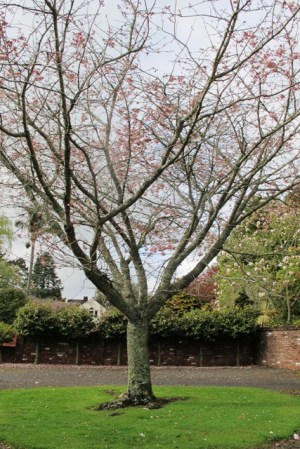
The seductively quick result of grid planting

The seductively quick result of grid planting

As I drive into town, I pass a grid planting of trees in a garden. I understand these formal grid plantings are called a phalanx these days, which is probably an indication of their growing popularity in modern design. A chic interpretation of the commercial plantation, perhaps?

If you have a big garden with a large flat area, there is a seductive appeal to grid planting the same tree. It has an immediate impact and as such is a weapon in the landscaper’s armoury. A 4 x 4 grid is a small one, but it is still 16 matched trees all flowering at the same time (assuming you have chosen a flowering one). A 6 x 5 grid is 30 trees which is potentially impressive. It is using soft landscaping (plants) to achieve the impression of hard landscape structure. It should look like a deliberate statement of style.

That is about all I can think of in favour of the phalanx.

If you are going to try one, get out the tape measure. Don’t even think of doing the spacings by eye. You need accurate measurements all the way so the trunks line up. You also need closely matched trees. One or two with poor root systems may struggle for years and spoil the uniformity. While minor variations in height will even out over a year or two, variations in shape or vigour may never do so.

I don’t like them because I think it is a very short term trick for effect and if you are going to go to the trouble of planting trees, I think they should include good quality specimens planted in situations where they have at least some chance of reaching maturity. I see too little consideration going into the selection of the cultivar. If you are going to plant somewhere up to 36 or even more identical trees, it matters a great deal which one you choose. Alas, the selection is more likely to be governed by price and availability than anything else. Too often these grids are done in short term cheapies.

Next there is the problem of working with living plants and not all may oblige equally. If one or two trees die in the phalanx, it destroys the uniformity on which the formality depends. The same is true of formal avenues, of course and it is one of my enduring memories of an otherwise splendid Italian villa garden – random and obvious gaps in a line of mature lindens.

Pearly Shadows - but allow 15m spacings long term

Pearly Shadows – but allow 15m spacings long term

Spacing is an issue. I looked at our Prunus Pearly Shadows which would make a handsome phalanx specimen with its upright Y-shaped growth. A phalanx relies on each tree standing in its own space. As soon as they mesh together, you have something more akin to a forest. While not a particularly large tree, the extent of the canopy on a free standing, mature Pearly Shadows is in fact 15 metres. I paced it out. Yet planting out at final spacings would simply look mingy and dwarfed in the early years. Sure you can plant closer and plan to go through in due course removing every second tree to give the remaining ones a chance but that is not without risk and considerable expense. You would have to fell very carefully so the falling branches and trunks do not cause damage. If you don’t take out the stump, roots and all, you run the real risk of opening up the remaining trees to armillaria – honey fungus, which will take hold in the rotting stump and move on to healthy neighbouring root systems, usually killing the host.

Then there is the problem of maintaining the grass below. If you like the formality of the phalanx, then odds on you won’t want rank, long grass beneath. But mowing around all the trunks is fiddly and you certainly couldn’t manage the formal striped effect. Using a weed eater is risky in the wrong hands because of the likelihood of damaging the bark on the trunk and maybe ringbarking the tree. Spraying will leave ugly, rank brown grass.

When I thought about phalanxes, I came to the conclusion that they are a lot harder to do well than initially appears to be the case and are decidedly impractical in the mid to long term. If you go for a more random planting, it won’t spoil the effect if some specimens fail to thrive. In the short term, you could achieve a copse, in the long term a woodland. You could manage some level of uniformity by keeping to one plant genus – say, all maples or all magnolias, without keeping to the same plant variety. But then I would say that. I am happy to sacrifice the instant appeal of a formal planting in order to achieve a higher level of plant interest. I would much prefer to look at a collection of different maples, rather than serried rows of the same one.

Each to their own, but I would only plant a phalanx if I was tarting up a property to sell.

The humble origins of the ornamental phalanx may lie in commercial plantations

First published in the Waikato Times and reprinted here with their permission.
Of slugs and snails but no puppy dogs’ tails

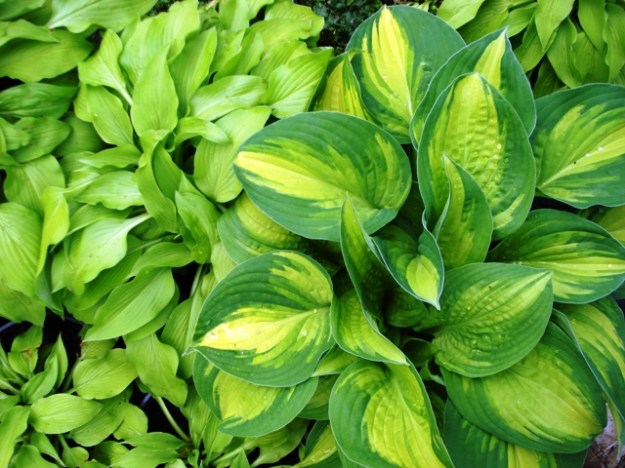
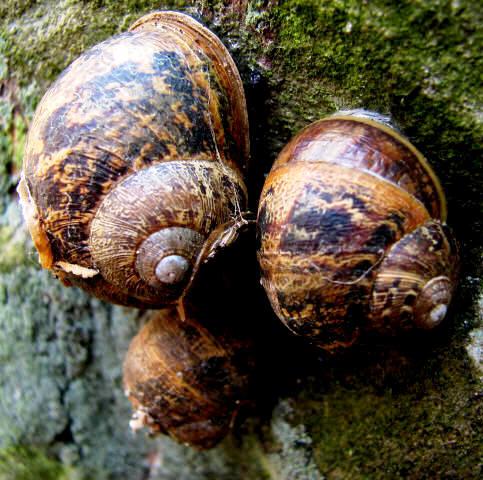
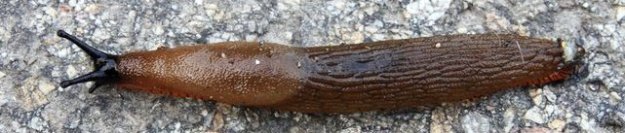
The hostas are all romping into growth. There is nothing quite like this for focussing the mind on slugs and snails.

We don’t have a big slug and snail problem here and we rarely resort to using bait. We can only conclude that we must have a struck a reasonable balance with the main natural predators – birds. We have a rich birdlife in our garden and think that eating slugs and snails which have been poisoned is not a good call for our feathered friends.

Where we see the slimy critters making inroads to something precious, we resort to discreet little bait stations – a bottle cap with two or three pellets beneath a paua shell. The roof keeps the bait dry so it lasts a lot longer. A small packet of bait lasts us for ages.

Mark has been railing for years against gardeners who broadcast slug bait as thickly as fertiliser. Baits have an attractant so you don’t need to layer them on so densely that you trip up passing targets. One bait placed at the base of a lettuce seedling is all that is required to kill the marauders.

The bait trap

The bait trap

If, like us, you are reluctant to reach for the poisons as a routine solution, there are alternatives. The night time prowl with the torch can be effective though it may take a few forays to get the timing right. The snails don’t usually come out until a good hour or more after dark. The richest hunting nights are when there has been rain after a dry period. I squash all but the giant tiger slugs underfoot, which is a quick end for them. Others of more delicate dispositions drop them into a bucket of salted water where I imagine they die a slow and lingering death. Sentimentalists and, presumably, Buddhists release them in farther reaches or drop them over the fence to the neighbours so they live on causing damage. I am afraid that I think the only good garden slug or snail is a dead one (our native powelliphanta excluded).

As much of our problem slimy population was imported, it has always seemed a great pity to me that the early settlers who were so determined to bring food crops and plants to remind them of home, did not while away the hours of the long sea voyage ensuring that this vegetative material was free of the pests. It seems a missed opportunity and would have saved a lot of bother later. While we have a remarkable number of native slugs and snails, most of these feed on decaying material whereas the imported ones generally feed on fresh, green growth and do the damage.

I have not tried the beer can approach (I just don’t want cans of flat beer lying around my garden) but, as with the hollowed out orange half, these traps require you to do a morning round to dispose of any lurkers. There is nothing in the beer and the orange to kill them.

It is a myth that slimy critters will not crawl over rough and gritty surfaces. Insect expert Ruud Kleinpaste once showed a photo of a snail crawling over the sharp end of a razor blade. But they will take the line of least resistance so surrounding vulnerable plants in a thick enough ring of something less appealing can deflect them in another direction. However, you need a small mound rather than just a scattering of crushed egg shells, sawdust, rimu needles, sand, gravel or similar and you need it round each plant individually. It can certainly help with new plantings. Copper rings are reputed to work but it seems an awful lot of effort to go to, fashioning a copper bangle for each plant.

One eco friendly solution I have tried with success is generous amounts of cheap baker’s bran. Apparently slugs and snails find it irresistible. I don’t think the bran actually kills them, unless they gorge so much that it swells up inside and dehydrates them. I think it more likely they eat too much and then lie around in a comatose state making easy pickings for the early bird in the morn. All I can say is that it did work when I tried it on a patch of hostas that was getting slaughtered.

I have not tried the temptation approach suggested by BBC Gardeners’ World presenter, Monty Don. According to him, there is nothing slugs and snails like more than comfrey so he lays fresh comfrey leaves beside vulnerable plants. What he didn’t say is that you would have to replace the comfrey leaves every two days and you would need to follow up in the evening and deal to the revellers. I don’t think there is anything in the comfrey that kills them. It is merely an attractant (like the beer). I thought it seemed to be a case for not planting comfrey near vulnerable plants to reduce temptation.

In the end, we will never win the war on slugs and snails. It can only be managed and if you can get your garden to a balanced state of co-existence, you can target your efforts to areas of particular damage. If you are the type who carpets an area in slug bait (which then breaks down with moisture), just remember you are in fact carpeting your garden with a poison. It is better to try other ways of management if you can and save the slug bait as a last resort.

First published in the Waikato Times and reprinted here with their permission.