Category Archives: Abbie’s column

Abbie’s newspaper columns

The Bad Tempered Gardener from the Welsh borderlands

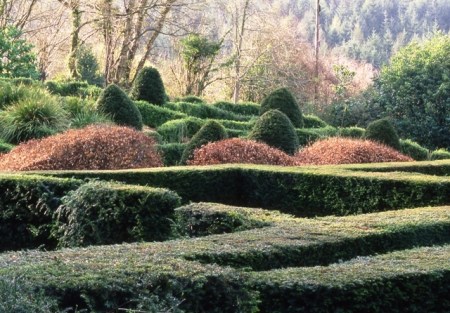
Veddw, the garden of Anne Wareham and Charles Hawes (photo copyright Charles Hawes)

Veddw, the garden of Anne Wareham and Charles Hawes (photo copyright Charles Hawes)

Anne Wareham (photo credit Charles Hawes)

Anne Wareham (photo credit Charles Hawes)

Anne Wareham had my attention from the first page of her book, bravely titled “The Bad Tempered Gardener”. Her second sentence opens:

I have to make my way in a world which is totally alien to me. A world where people are inevitably passionate, always ‘green’ and always terribly concerned about the little furry things….

She continues:

I began to get tired of hearing every garden described as ‘lovely’. I visited many of them and often found them to be banal and uninspired. I began to wish for writers who would tell the truth about the gardens and gardening and found only ‘garden stories’ and discussions of gardening techniques…. The problem is the fond idea that gardening is inevitably nice but dull…. ”

What is interesting about Anne Wareham’s work is that this is contemporary thinking about gardening from a hands-on perspective. I have also been reading Vita Sackville West’s collated newspaper columns from the early 1950s. She is renowned for creating the garden at Sissinghurst. There has been a proud tradition of garden writing by gardeners – Russell Page, Beth Chatto, Penelope Hobhouse and other great names, particularly in the world of English gardening. Not to put too fine a point on it, they are all either elderly or dead. Where is the current thinking?

Garden writing at this time seems to fall into three categories. There are academic treatises out of institutions where gardening has been hijacked by higher status landscape design. Then there are all the novice wannabe books which are of no interest at all to the serious gardener. All that breathless naivety and ingenuous enthusiasm wears very thin if you are not in the target demographic. The rest tends to be either prosaic description or praise in purple prose. There is no attempt at critique and very little in the way of ideas.

Apparently it is the same in the UK though I did think that the writer of the BBC Gardening Blog was guilty of gross hyperbole when he or she babbled of this book that: “Everyone, but everyone has been talking about possibly the most controversial book ever written about gardening.” It is not that radical and actually slots quite nicely into the tradition of garden writing. It is thought provoking and a breath of fresh air.

That said, it is not highly polished and the forty five chapters stand independently, almost as if they are a collation of pieces published previously, though there is no reference to this being the case. So there is not a cohesive argument but more a case of recurring themes. What I can tell about this book is that there is a great deal of thinking time that has gone into formulating the ideas and opinions. The author has two acres of intensive garden which she started from scratch and two acres of woodland which she maintains with her husband. Much of gardening is repetitive and takes little concentration so there is a lot of solitary thinking time. It takes one to know one. It is how I operate so I recognise it in someone else. And I have never before read a book where I have so often felt as if I was in conversation with the author. I kept wanting to say: “Exactly. I wrote about this very thing here.” Whether it is water maintenance, show gardens, rose gardens, scented plants, the impact of devaluing the garden visit experience by bringing it under the amateur and charitable banner, the hyperbole of garden descriptions – this is all familiar territory.
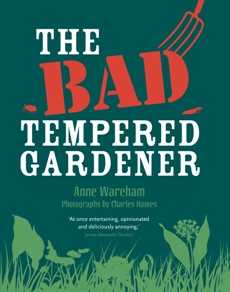
The Bad Tempered Gardener by Anne Wareham

The Bad Tempered Gardener by Anne Wareham

Thought provoking chapters are interspersed with short pieces on plants. These have little relevance in New Zealand. Erigeron is that highly invasive daisy that is actually on the banned list here. Tulip mania has never struck this country in the European manner (to buy fresh bulbs every season seems profligate). Alchemilla mollis is not the easy, frothy plant here that it is in the UK. These are just little interludes, breathing spaces, between the more opinionated pieces. Of interest are the chapters on the creation of her own garden, Veddw, on the Welsh border and the principles which drove her in design and plant selection. We are not in agreement on plants, but that is fine. To disagree with a well thought out and strongly held position challenges one’s own thinking.

Best guess is that the author has cultivated a certain prickly persona. I doubt very much that she is inherently any more bad tempered than the rest of us. The title of her book is probably as much a nod to the late Christoper Lloyd (he of Great Dixter fame) with his book titled “The Well-Tempered Garden” and maybe to Germaine Greer. Readers here may not be aware of the latter’s enthusiasm for gardening. She wrote a newspaper column under the pseudonym of Rose Blight and a collation of these were released in book form under the title of “The Revolting Gardener”.
Indeed, I am wondering about extending the theme with my own book – “The Opinionated Gardener”. Don’t hold your breath, however. I am unlikely to find a publisher any time soon.

I sourced my copy through Amazon though Touchwood Books or good bookshops will be able to order it in. As far as I know it is not on the shelves in this country.

The Bad Tempered Gardener by Anne Wareham. Photographs by Charles Hawes. (Frances Lincoln Ltd; ISBN: 978 0 7112 3150 4).

The reflecting pool at Veddw (instructions are in the book). Photo credit: copyright Charles Hawes

The reflecting pool at Veddw (instructions are in the book). Photo credit: copyright Charles Hawes

First published in the Waikato Times and reproduced here with their permission.

A blue as blue verbascum. Apparently.

Oh wow. That is a true blue verbascum. (Photo: Thompson and Morgan)

Oh wow. That is a true blue verbascum. (Photo: Thompson and Morgan)

It is rare for us to get excited about plants we see overseas which are not available here. In fact, between us we can only recall three. There were the double hellebores in the mid nineties which Mark saw when he was taken to meet the English breeder. Similar ones are now readily available here but they represented a major breakthrough at the time in the heady world of hellebores.

Then there was the red Edgeworthia papyrifera we saw in northern Italy. We have the yellow form in this country (often called the yellow daphne though it is a different genus) but as far as we know, the red form has still not been imported.

Now there is the blue verbascum which was featured at Chelsea Flower Show last week. Not that we were there. I merely found the write-up on line and saw it – a knock-out blue verbascum. Well, verbascums plural, on the Hilliers’ Nursery stand.

Not all verbascums are equal. The family is large and some can be a bit weedy, let alone insignificant and untidy. Some can be downright difficult. We have never succeeded growing the popular English hybrid ‘Helen Johnson’, with its dusky, apricot pink colouring. We were disappointed to lose a big white flowered verbascum we bought from Peter Cave before he closed down his Cambridge nursery. It had large, felted grey leaves and would have been a lovely addition to our garden. (Has anybody got seed of it? Do tell.)

Take one good, large flowered verbascum (this one is V. creticum though Blue Lagoon is a different species))...

Take one good, large flowered verbascum (this one is V. creticum though Blue Lagoon is a different species))…

In fact our dedication to the family has much to do with the splendid Verbascum creticum. It hails from the areas of Crete and Malta and is biennial in our conditions. This means it germinates and forms a rosette of leaves in its first year and flowers, seeds and usually dies in its second year. We leave one or two strong plants in situ to go to seed and just weed out the surplus seedlings or those growing where we don’t want them. It is wonderfully easy care and in springtime we get handsome flowering spires up to a metre high which then open large, clear yellow individual blooms all the way down the stem. In the rockery, it gives us vertical accents (like exclamation marks) and the flowering lasts for many weeks.

What wouldn’t we give for blue vertical accents? Not just any old blue or lilac purple tones pretending to be blue. No, this new Verbascum Blue Lagoon is described as being the pure electric blue seen in meconopsis (Himalayan poppies). It is a rare and distinctive shade and meconopsis are notoriously difficult to keep going in our climate. In the photos, one could be forgiven for thinking one is looking at delphiniums – another plant that is not so easy to keep going without constant care and intervention.

We, of course, are visualising Blue Lagoon as a pure blue equivalent of our tried and true yellow Verbascum creticum. If it is that good, it should be a sensational addition to a garden. And the initial information says it is perennial (though possibly a shortlived perennial), not just biennial.

... but in the pure biue of the meconopsis....

… but in the pure biue of the meconopsis….

But don’t hold your breath. It won’t be here yet and it is a moot point as to whether it ever will be. We have one of the tightest border controls in the world – and rightly so. I do not dispute for one moment that we need to be very careful to mimimise the risks of introducing some of the dreadful pests and diseases which afflict other parts of the world. It is just that some of the policy got lost in translation by the bureaucratic administration process. In this day and age, you would never be able to import kiwifruit (actinidia) and it would cost a swag of money and take a long time to get approval for an apple tree if we had none here. In fact, for a country which has built its agricultural and horticultural industries on imported species, nothing new of note has come across our borders for over a decade. You can only bring in plants if the species is known to be here already. I don’t know whether the species that has thrown up the blue verbascum (from Armenia and Turkey, originally) is on the magic list. It may take a very determined individual to import it.

Nor is it as simple as importing the seed. This blue colour came as a one-off result and the plants for sale have been built up by tissue culture from that one blue seedling. Let them go to seed and they will probably revert to the common colours with only occasional exceptions. You need to raise a lot of seed to find the occasional blue ones and it will take years of selection and subsequent generations to stabilise the blue colouring – if it is possible at all. However, the original work has been done by a well established British seed company, Thompson and Morgan, so odds on they are working to stabilise the colour in a seed strain.

In the meantime, we just cast covetous eyes at the photographs.

First published in the Waikato Times and reproduced here with their permission.

Reviewing our mixed borders

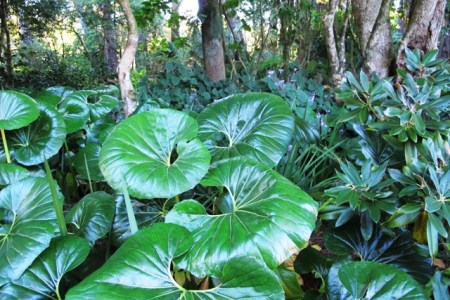
The Ligularia reniformis were gratifyingly responsive to being dug and divided

The Ligularia reniformis were gratifyingly responsive to being dug and divided

Because I garden extensively, I have a lot of thinking time. Not for me the IPod and little headphones to fill the solitary quietness. I prefer to hear the birds and be aware of all my surroundings while I talk to myself and ponder.

My thinking this week has been coloured by a book I am reading. You will have to wait a little longer for the full discourse on “The Bad Tempered Gardener” by Anne Wareham. I am still digesting the contents but it has certainly focussed my attention on some of my least favourite areas of our garden. I had figured that in one area, the fact that I didn’t enjoy gardening it at all was an indication that all was not well there.

What got me thinking was the oft repeated message in the book that it was better to keep to a more limited plant selection and to shun the bits and bobs effect of one of this and one of that. This particular viewpoint is so much at odds with a great deal that I have written that it has taken some reconciling. I have often bemoaned the boring and limited planting schemes of so many New Zealand gardens and the simple fact is that neither Mark nor I have any interest at all in visiting a garden with a totally restrained use of a very limited number of different plants. Similarly, I have been critical of the ever diminishing range of plants on offer to the home gardener as nurseries continue to refine their production. To us, a garden that is all form and no plant interest is boring. To the author of this book, a garden that is all plant interest and no form is just as bad.

As always, the answer lies somewhere in the middle. And that was what led me to A Revelation. The messy borders and beds I dislike maintaining and sometimes find myself walking past with eyes averted, are frankly messy beds with too many bits and bobs at ground level. The underplanting, in other words. Too often there has been a gap so I have tucked something in to fill the space – and ain’t that the way many of us garden? And all these areas are mixed borders.

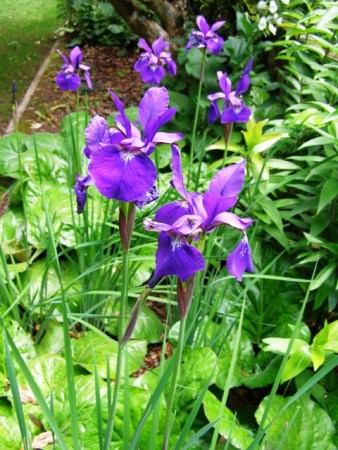
The combination of Siberian iris and Bergenia ciliata works very well

The combination of Siberian iris and Bergenia ciliata works very well

Mixed borders are by far the most common method of gardening – planting woody shrubs, maybe trees, and underplanting with herbaceous material and bulbs. I am not a huge fan of this style of gardening, though we have plenty of examples here. They are probably the least successful areas of our garden. But the remedy, I think, lies in revamping that bottom layer of mostly herbaceous material and getting more unity and harmony in managing the combinations.

Not carpet bedding. It is only a short step up the social scale from bedding plants on roundabouts to carpet bedding nepeta (catmint) beneath your roses, or swathes of uninterrupted mondo grass around your topiaried bay trees. It is just as utility and unimaginative, merely in better taste than marigolds.

That is where my thinking, coming from the other end of the spectrum to the author, met up with hers. The magic is in the plant combinations. If you are going to narrow your plant selection, it matters a great deal more which ones you choose and how you put them together.

I am revisiting my intense dislike of mass plantings. I realise now that my out of hand dismissal had much to do with all those Bright Young Landscapers who dominated the garden scene in this country in the decade through to the global financial downturn. Often with big budgets and other people’s gardens, they rejected plantsmanship in favour of form. Lacking any technical knowledge of plants themselves, or indeed any interest in plants beyond their role as soft furnishings, they claimed superior status as they used some of the dullest plants on earth to create gardens which ideally looked the same for twelve months of the year.

The hallmark of good gardens, in my opinion, is the ability to combine both form and detail, which involves thoughtful and original plant combinations. They don’t all have to be wildly unusual plants. One of my successful recent efforts was a cold corner where I used Bergenia ciliata (that is the one with big hairy leaves and pink and white flowers in spring) with deep blue siberian irises. It is unusually restrained for me, but the combination of the narrow upright leaves of the iris and the large but low foliage of the bergenia looks good even without flowers. I hasten to add, I only have about six square metres of this planting. Had I done the entire length of the border the same, it would have been over forty square metres and that I would have found extremely dull.

The same principle of contrast applies to an area where I dug and divided Ligularia reniformis (that is the enormously popular tractor seat ligularia). It was so grateful it romped away and stands large, lush and over a metre tall. With a backdrop of a common plectranthus which has pretty lilac flowers at this time and interplanted with the narrow, upright neomarica, it is simple but pleasing to the eye.

Now my mind is focussed on the messy borders that don’t work. I am pretty sure that if I refine the bottom layer of plantings, that will set off the upper layers. I can’t wait to start.

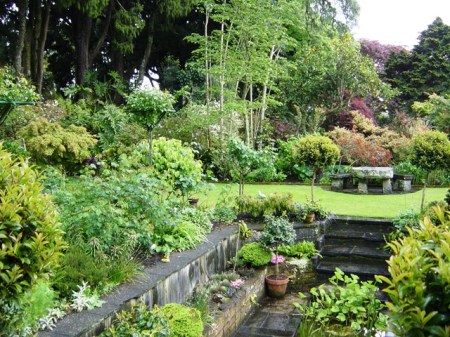
First up for a revamp

First up for a revamp

First published in the Waikato Times and reprinted here with their permission.

Differing shades of organic gardening (akin to the sliding scale of vegetarianism)

Anything but organic.....

Anything but organic…..

I see Prince Charles feels vindicated about organic gardening, pointing out that when he first started talking about it, he was the subject of much derision. There is no doubt that the prince is a very keen gardener and he has been a flag bearer for organic techniques in the ornamental garden as well as the kitchen garden. I just recall some discussion about him advocating talking to one’s plants which still seems perilously close to being flaky in my books.

But Prince Charles is absolutely right about home organics. In fact the chemical approach to weed and pest control is comparatively recent, dating back to about the 1950s, as is the routine use of manufactured fertiliser. It was the result of war technology. We’ve been getting steadily better but the intervening decades were not gardening’s finest hours and some pretty dodgy practices and attitudes linger on.

We never describe ourselves as organic gardeners because we are not. We do, however, follow many organic gardening practices because they make good sense in terms of gardening in harmony with nature and enhancing the environment. This is not true of all gardening, much of which has to do with imposing human will upon nature.

As a result of this, we spend a fair amount of time on a quest for reliable information. There is an awful lot of puffery around organics, from flaky thinking to fervent faith, but that does not mean the underpinning principles are wrong. It just means it is a little harder to decode some of it. We’ve still come up short on good information regarding nutritional density, but given time, I am sure we can find that out.

In the meantime, it may help readers to think of organic gardening running a similar line to vegetarian diets – there are a whole lot of points on the continuum where you can find your niche. Starting from one extreme, you have the old fashioned eater whose dinner plate is 50% meat (usually red), 35% spuds and the remainder in consolation green veg. This gardener sees nothing wrong with pouring on insecticides, fungicides and herbicides, along with chemical fertilisers. We won’t dwell too long on this 1960s model.

The realisation of heavy carbon footprints and lack of flavour in food which saw a return to seasonal eating, and then to eating locally produced foods may be analogous to the home gardeners who suddenly decide they must have raised vegetable beds on the quest for self sufficiency. It matters not that they are filling the beds with compost mix sourced from the garden centre, trucked considerable distance and packed in heavy plastic bags. Nor does it matter that any resulting produce will be extremely expensive. They have made a start and they claim it is organic because they are not using sprays. At this point, organics has more to do with what is being left out rather than a change to the way we garden and it tends to be the domain of the enthusiast who is not always particularly well informed or indeed experienced.

Move along to the partial vegetarian movement (which seems sometimes to extend to the genre of foraging and wild foods). We belong around here – two or three meals a week which are vegetarian and always seasonal using our own produce. Gardening organically at this point has much to do with sustainable practice wedded to pragmatism. We factor in issues such as plant and seed selection, plant heath, soil health, maintaining ecosystems, composting, mulching, and lawn management to avoid needing to spray or feed. But we want to be able to get crops of tomatoes through and we are yet to be convinced you can do that organically in our climate. We make relatively well informed choices in food and gardening.

Genuine vegetarians usually underpin their diet choice with philosophical beliefs. Many will eat dairy products and eggs, some even fish. But others will shun any dead animal products including cheeses made with animal rennet, even leather shoes. Being a certified organic gardener tends to come parallel at about this point. It is much more rigorous and prescriptive while offering the security of rules to follow.

At the far end of the spectrum are the vegans, probably matched in gardening by those who operate closed horticultural systems (with no external inputs) and biodynamics. While there is a tendency to accord these extremes the mantle of purity, the higher moral ground, in practice they are usually more faith based than science based. Neither a vegan diet nor a closed growing system is complete in the long term without supplements.

So organics is not a hard and fast set of rules, unless you are after accreditation. What is really interesting to us about Prince Charles is that he is serious about having a beautiful, traditional garden, all the while applying organic principles at every level, not just to his cauliflowers. It is looking increasingly like common sense these days. We just wish we could afford the prince’s eighteen garden staff to help us towards greater purity in gardening practice.

First published in the Waikato Times and reprinted here with their permission.

Passing the sniff measurement test – fragrance in the garden

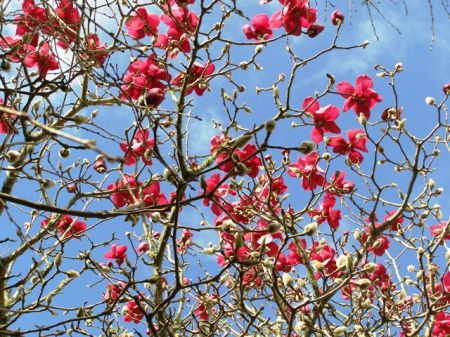
Magnolia Vulcan - spectacular and magnificent in flower but too far up to ever smell

Magnolia Vulcan – spectacular and magnificent in flower but too far up to ever smell

When I entered my teens, my mother gave me a book on charm. I can only recall two pieces of advice from it, though I read it time and again. One was to err on the side of restraint – that one white accessory with a little black dress may be stunning but three or four are bitsy (think Audrey Hepburn-esque style). The second was not to apply perfume before 10am. Until mid morning, the subtle scent from one’s morning bath should carry one through and to add perfume on top is heavy handed and inappropriate. Understatement was an integral part of charm in the sixties.

It was the perfume rule that had me thinking (though the merit of subtlety in accessorizing is a handy rule of thumb and not just for clothing). In years of plant retailing, I met a scary number of people – always women – who would only buy a plant if it was fragrant.

As a defining attribute, I think fragrance is over-rated and doesn’t stand up to logical scrutiny. It is different in cut flowers. The wafting fragrance from a vase of flowers indoors is a delight but even then you need quite a large amount of very fragrant flowers to scent an entire room.

Seriously, apply the sniff test in the garden if you are obsessed with growing scented plants. There are not that many plants that will pass the metre sniff test – that is, able to perfume the air a metre beyond the plant and that usually requires a warm, calm day. Some daphnes will do it, as will the rare Michelia alba and proper orange blossom.

Luculia Fragrant Pearl - passing the 50cm sniff test

Luculia Fragrant Pearl – passing the 50cm sniff test

Come in a little closer and there are a range of plants which will tease you with a hint of fragrance as you pass by – philadelphus or mock orange blossom, luculia, auratum lilies, the stronger scented jonquils. But if you stop and immerse your olfactory organ (that is your nose) in the reproductive organs of the plant (that is the flower), there is a very strong perfume.

Therein lies the problem. Generally you have to stop and sniff a flower to get a true sense of its scent, or, in many cases, any scent at all. And nobody goes around their garden sniffing each and every flower every time. So the presence of perfume is often irrelevant in practice.
Some flowers are so subtly scented that you need the right conditions to get any fragrance at all. Scented camellias are of this ilk, but the public romanticism is such that merely advertising this attribute will help sales. I know.

Then there are plants where scent is related to time of day. How many people have bought the common port wine magnolia (Michelia figo) because of the promise of heady scent, only to be disappointed? The flowers are small and insignificant, the scent comes in late afternoon to night so you won’t get a whiff of anything at other times, and then the actual aroma is closer to the old Juicy Fruit chewing gum than anything else.

The bottom line is that plants have not evolved with scent to please humans. So there is no guarantee that the biggest, showiest and brightest blooms will also have the best fragrance. More often, the scent is there to attract pollinators so it is frequently linked to rather small, insignificant blooms which might otherwise pass unnoticed. There are a whole lot of scented rhododendrons and, almost without exception, they are white or pastel coloured. Bright flowers don’t need scent to attract their pollinator when they do it by colour. Night scented plants are generally pollinated by night flying insects so they don’t need to be fragrant during the day and they don’t need size and colour.

Floral scent is delightful and much appreciated. No synthetic scent can match the best natural fragrances. But those natural scents are by their very essence ephemeral. To extend their life, you have to capture the scent in oils, perfumes, pot pourri and the like. To make it mandatory that a plant be scented before you will buy it, is to elevate one characteristic beyond its merit. I regard scent as a bonus but first and foremost, a flowering plant must be interesting, attractive and appropriate to the position.

And when the next person asks me whether such and such a magnolia is scented, I may weep. We grow many magnolias here and revere them above other flowering trees. Many of ours are large now, and I can safely state that I have never stood beneath a large magnolia in flower and been amazed at the heady fragrance. Stick your nose in the flower and some are pleasantly scented, but that is pretty hard to do when the flower is five metres up the tree. Who cares when the floral display so astounding? Must the lily be gilded further with compulsory scent?