Category Archives: Abbie’s column

Abbie’s newspaper columns

Being thankful for gardening in a benign climate

We tend to take it for granted that our gardens are green and lush all year round

We tend to take it for granted that our gardens are green and lush all year round

As the days get shorter and the nights get colder, it is easy to lose sight of quite how benign our climate really is. There is a tendency to take our bright, clear light for granted and the fact that we can sit outside for morning coffee all year round on sunny days comes as a surprise to those from harsher climates. Of course it means we have to keep mowing the lawns, though the interval between cuts will stretch.

True, down the southern half of the South Island, it is cold enough to stop growth (and therefore stop mowing lawns in winter) but at least they keep the bright light which is a hallmark of both this country and Australia. I recall visiting London one December. Quite aside from the fact that darkness fell soon after 3.00pm, when the sun did struggle above the horizon, it was a poor watery thing. On that visit, we headed out to Leeds Castle which has a notable garden designed by famous English gardener, Russell Page. It had been put to bed for winter. Literally. There was only the formal structure to see. Beds were smothered in straw to protect the plants below. Some plants were wrapped up in their own padded sleeping bags – layers of straw, sacking and insulating material and that was just for echiums which are clearly prized a great deal more there than here. It is altogether a different way of gardening.

Autumn cheer in the earliest azalea flowers

Autumn cheer in the earliest azalea flowers

Here we may moan about miserable winter days, whinge about winter wind and stress over storms (enough alliteration!), but the bottom line is that we are green and verdant with flowers all year round. For most of us, temperatures are high enough to be out in the garden in fine weather, even in June and July. Autumn is recommended as the very best planting time for trees and shrubs because it gives plants a chance to settle in over winter and start getting their roots out before the spring flush. Similarly, many perennials can be dug and divided throughout winter. In cold climates, this is a spring and summer activity only because the plants can rot out when dormant in their cold conditions. The timing of pruning is a great deal more critical in colder climates. This applies to deciduous plants like roses, hydrangeas, wisterias, as well as evergreens such as hedges. Pruning can force plants into growth and, when carried out too early, the tender new growth gets burned off by frost and cold.

In cold climates where you only get to view your garden through the window in winter, design, shape and form become all because that is all you see. Most cold climate gardens have a large quantity of deciduous plants, punctuated by a few hardy evergreens such as buxus, conifers, or laurels. Even if the design is good and strong, it can be a bit bleak.

But unless you live in a really cold winter location by our standards (National Park, Ohakune or the like), it is reasonable to expect to look around your garden and see flowers and fresh foliage for twelve months of the year. Sure you may get frosts. Anywhere more than five kilometres from the coast can expect frosts, even in Northland. But we can still grow winter flowering plants.

The gordonias are opening. This is an unidentified Vietnamese species

The gordonias are opening. This is an unidentified Vietnamese species

The sasanqua camellias are opening now and will take us into winter when the early flowering japonicas open. Early season evergreen azaleas are flowering. I see flowers on the gordonias. These look like big, white camellias on steroids but they are only very distant relatives. The first of the luculias is in flower and we always have sub tropical vireya rhododendrons blooming, no matter what the season. These last two plant types are more problematic if you have hard frosts, but in favoured positions or closer to the coast, they are a delight. In the depths of winter, the Magnolia campbellii, michelias and rhododendrons will be opening. None of these flowering trees and shrubs are particularly viable in cold climates. Even the utility camellia can be hard to grow in colder parts of Britain.

There are plenty of autumn bulbs still in flower. Hot on their heels are the winter bulbs, already rocketing through the ground and some showing the first flowers. The earliest narcissi are opening. Most of the dwarf and miniature types flower much earlier than the classic daffodils. In so doing, we find they are less susceptible to narcissi fly which lays its eggs in the crowns of bulbs later in the springtime. Narcissus bulbocodium citrinus “Pandora”, the pale lemon hooped petticoat type, has its first flowers out. The peak display of our dwarf collection is in the depths of winter. The earliest of the lachenalias will be opening soon. The first to flower here is the easy to grow red L. bulbifera which has naturalised happily around tree trunks.

In some places, our common NZ pongas are so highly prized, they are lifted from the garden and moved under cover for winter. True. I have seen it done in the north of Italy. It really does seem churlish to complain about colder seasons here.

First published in the Waikato Times and reprinted here with their permission.
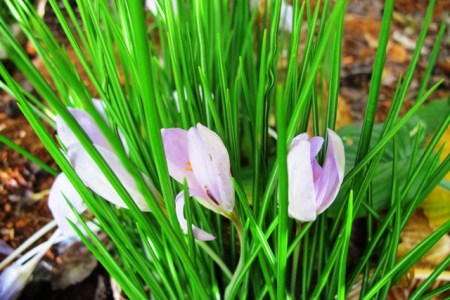
Of naked ladies, autumn crocus and so-called autumn crocus.

Just for the record, and in light of finding myself in print with some incorrect information which I didn’t actually write, I offer the following clarification.

The true autumn crocus is indeed a crocus

The true autumn crocus is indeed a crocus

The true autumn flowering crocus is in fact a crocus. There are many different species in the genus of crocus, some flowering in spring and some in autumn. Generally, crocus flower around the same time their foliage appears. We don’t have a species name on this pretty autumn crocus in our garden. Trace the botany of crocus back and they are part of the subfamily of Crocoideae, the family of Iridaceae and the order of Asparagales.

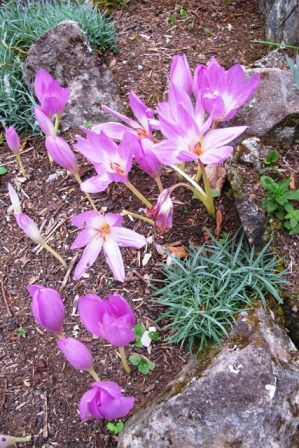
Colchicum autumnale

Colchicum autumnale

Colchicum autumnale flower about the same time for us, but the flowers appear a long time before the foliage so they are sometimes called naked ladies. Equally, they are sometimes referred to as autumn crocus but they are not. Again it is a big genus with many different species but they come from the family of Colchicaceae and the order of Liliales.

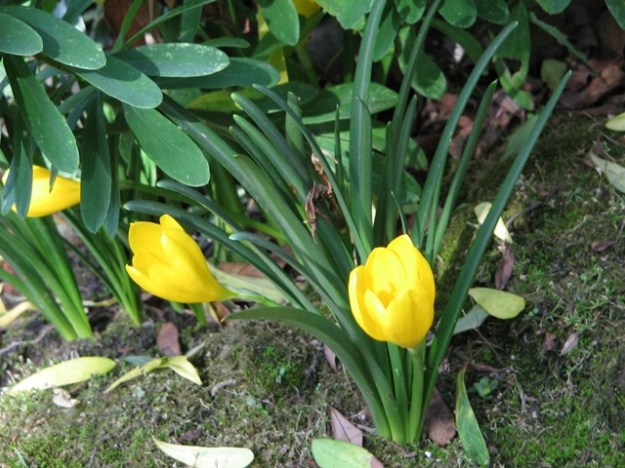
Sternbergia are not autumn crocus either (Photo credit: Meneerke bloem)

Sternbergia are not autumn crocus either (Photo credit: Meneerke bloem)

Sternbergia are sometimes referred to as autumn crocus but they are no more autumn crocus than colchicums. In fact they are more closely related to narcissi than crocus (a fact I discovered from the Pacific Bulb Society) and they are closely related to amaryllis. However, they flower with their foliage and their blooms, generally yellow, resemble a crocus in form. We have sternbergia in the garden here but they don’t flower overly well for us, possibly because they are essentially a Mediterranean plant which likes a hot, dry summer.

Amaryllis belladonna - the other naked ladies and closely related to sternbergia

Amaryllis belladonna – the other naked ladies and closely related to sternbergia

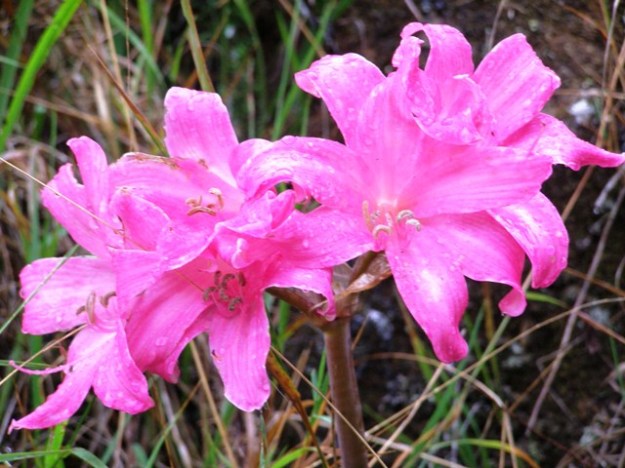
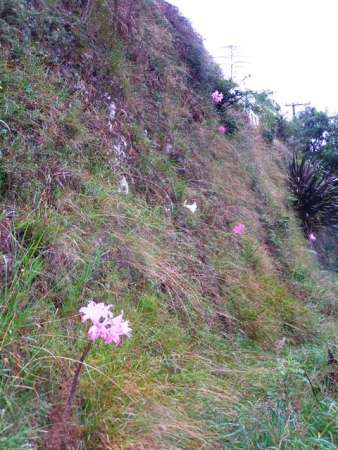
Also widely referred to as naked ladies are Amaryllis belladonna or the belladonna lilies that are mostly seen as roadside plants here. The genus is amaryllis, the species is belladonna (and there is only one other species in that genus) but the sub family (Amaryllidoideae) and then family (Amaryllidaceae) are the same as sternbergia. Trace them back another step on the Linnaeus chart and you find they are from the order of Asparagales which is where they meet the family tree of crocus – quite a long way back, botanically.

The bottom line is that the true autumn crocus is indeed a crocus, though it may be one of many different species.

Amaryllis belladonna (or naked ladies) are usually seen as a roadside flower

Amaryllis belladonna (or naked ladies) are usually seen as a roadside flower

Garden assessment and the NZGT

Mark, nose pressed to the window (or door, in this case). On the outside looking in.

Mark, nose pressed to the window (or door, in this case). On the outside looking in.

Hamilton is playing host to some good gardeners this weekend. It is the New Zealand Gardens Trust (NZGT) having its annual conference in the city. This is the parent organisation of many, but not all, open gardens in this country. We are not attending. We were enthusiastic founder members. Indeed, we even contributed $2000 to get the thing up and running. There is nothing like resigning on principle and being totally ignored to remind one not to get ideas above one’s station.

The purpose of the trust is to vet gardens, rank them and give garden visitors an accurate idea of what to expect. Along the way, it aims to provide a pleasant membership club of collegial conviviality for the garden openers and this is really the only aspect we miss.

There aren’t many circumstances where garden assessment is required. There is the occasional local competition which invariably gives lie to the idea that gardening is a non competitive activity – for some at least. There are plenty of people who would like to claim the biggest pumpkin, tallest sunflower, prettiest road frontage, or the best vegetable or flower garden. Winning can be wonderfully affirming.

Some of the garden festivals around the country insist on vetting gardens before accepting them. In this case, assessment is only setting the base line for inclusion. It can be alarmingly controversial but anybody with experience knows just how necessary the process is. Too many gardeners wear rose tinted glasses where their own patch of dirt is concerned.

Show gardens such as seen at the Ellerslie Flower Show are judged and there are some excellent international precedents for how these are assessed, emanating particularly from Britain’s Royal Horticultural Society. Interestingly, the RHS is taking a close look at its assessment processes right now.

And there is our national scheme for ranking gardens, administered by the aforementioned NZGT. Of course you can still open your garden independently, as we do these days, but from the point of view of the garden visitor, some credible outside endorsement and ranking can be helpful. Originally, this open garden scheme had three categories with the top tier being grandly named: Gardens of National Significance. We were really honoured to be named one of only six private gardens to carry this elevated status in the first year. That meant something. These days, with a huge number of gardens in the top categories, it doesn’t seem anywhere near as prestigious. Do we really have over sixty two top tier gardens, of national significance and a few even described with great puffery as being of INTERnational significance, in this country?

Equally, it seems really odd that the next tier of gardens down numbers a mere thirty six. One might expect a pyramid shape – fewer top gardens and a whole lot more in the next layer who would like to move up. Either the organisation is singularly bad at retaining membership below the top tiers, or it gives out its rankings way too cheaply.

The problem, I would suggest, is likely to stem from too heavy a dependence on a points based system. By that, I mean allocating so many points for the state of your lawns, your paved surfaces, how neatly your hedges are clipped, how you support and tie up plants, plant combinations, plant health and so on. It matters not a whit if you are scoring out of 10, 100 or 300.

In practice, slavish adherence to a points based system can mean a damned ordinary or downright awful garden lacking in any charm or originality can get through as long as it scores highly in sufficient categories. The sum of the parts is sometimes greater than the whole. We saw it happen a few years ago when someone with a good level of knowledge trotted around a number of local gardens, clipboard and marking schedule in hand. “When I got to the end,” he told us, “and added up the points, I was astonished at who came out with the highest score.” As indeed we were, too.

A marking schedule is just one tool, not an end in itself. Neither is it a shield to hide behind, to justify decisions. It needs to be used in conjunction with clear definitions, agreed frameworks, some bigger picture thinking about downstream outcomes, maybe a mediated process and preferably in the hands of a convenor. Done well, assessment can even be an empowering experience for the candidate.

I have no idea whether NZGT is now employing a wider range of strategies in assessment. They certainly didn’t in the past. From my current position out in the cold with my nose pressed up against the window pane, the current outcomes are not suggesting that there has been significant change.

Notwithstanding those reservations, one hopes that the keen and dedicated gardeners visiting Hamilton this weekend will encounter fine weather, wine and gardens to be enjoyed in convivial company.

Before becoming a garden writer, Abbie Jury spent 18 years working in education, across all sectors before specialising in adult learning. She was appointed to an advisory committee to the Minister of Education, to a standing committee of NZQA and was awarded a Commonwealth Relations Trust bursary to study alternative forms of assessment of adults in the UK.

First published in the Waikato Times and reprinted here with their permission.
Three years ago, I published the reasons for our resignation from the New Zealand Gardens Trust. Despite being widely read then and in the intervening years, those comments appear to have fallen into an abyss.

Eight years ago, I wrote in strong support of the NZGT. That does seem rather a long time ago now.

Raised beds and to dig or not to dig, that is the question.

Raised beds have their place, but not necessarily every place (Photo Joe Mabel, Wikimedia Commons)

Raised beds have their place, but not necessarily every place (Photo Joe Mabel, Wikimedia Commons)

Maybe the gardening world divides into diggers and non diggers. The non diggers favour raised vegetable beds and no dig gardening methods. We old diggers, on the other hand, are closer to our peasant ancestry.

Digging is not an activity to be feared. The physical effort is terribly good for you and it is only hard the first time. The more you work the soil, the easier it becomes. One of our vegetable gardens has been tilled for anything up to ten decades in some places and it is like working in potting mix. While Mark prefers to dig with a shovel, I swear by a good, sharp spade. People often neglect sharpening their spade but it makes a huge difference if you keep a good cutting edge on it.

Being of the digging persuasion, we have never felt the need for raised beds. If you put some effort into turning over the soil of your raised bed, it will fly in every direction, spoiling your surrounding paths. Lesson number one, should you decide you want them, is to keep the soil level lower than the surrounds and leave room to build up further as you add compost, green crops and all the additions which keep it fertile and friable over time.

Raised vegetable gardens have their uses in certain situations. Obviously they are of inestimable value for disabled gardeners or those who cannot bend comfortably. They can be useful where you are trying to garden in an area choked with old tree roots or with really bad drainage. They are, my daughter tells me, particularly useful in Canberra where a combination of clay, a new puppy and a heavy population of ground birds named choughs (pronounced chuffs) condemn any vegetables at ground level. But in the main, if you have halfway decent soil, I think it is actually easier to follow the traditional way and garden at ground level. The current vegetable garden craze has seen a building boom for raised beds and too little questioning of the rationale.

For starters, there are issues related to the construction of raised beds. Brick or concrete block is permanent and relatively expensive – devilishly difficult if you change your mind about your garden layout further down the track. Hardwood railway sleepers are expensive and heavy to handle. Most people end up with pine. Herein lies a major problem. If you use untreated pine in a high rainfall climate, it is going to start breaking down within a couple of years. Don’t forget it is permanently wet on the inside of the bed. So what about tanalised pine?

“No,” said my scientist daughter in Canberra. I trust her judgement in these matters and she did spend one summer as a chemistry student looking at sap staining on tanalised timber. She comments that the information on the internet is not particularly up to date, and in the absence of scientific evidence proving safety, she certainly would not want to be growing anything edible near tanalised timber. She points out that the preservative was, and may still be, a mixture of arsenic and chrome and plants are very good at absorbing and holding heavy metals. She wouldn’t risk it. She is constructing her raised beds out of untreated pallet timber which will break down in due course but is at least free, recycled and will last longer in her dry climate than here. She has also coated it with linseed oil.

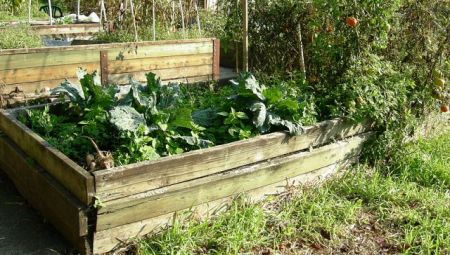
The conventional approach to vegetable gardens, though one hopes the timber sides are not tanalised

The conventional approach to vegetable gardens, though one hopes the timber sides are not tanalised

Once you have built your raised bed, you have the problem of filling it. Too often, I have seen people on TV wheeling in large, heavy grade plastic bags, each containing 40 litres of soil mix bought from the garden centre. I can’t think of much that is less environmentally friendly. If you are not going to go down the expensive, convenience route, you are going to have to find or create your own soil. It takes a much greater volume than you would ever dream of to fill a raised bed. Then you have to shovel or lift the soil in. Don’t underestimate the size of the task.

At this point, some advocate going the no dig route. I know the theory, but being diggers, we have never done it. It consists of layering a mixture of compostable materials and leaving the worms to do the task of breaking it down. So you layer green material (but avoid weeds, seeding plants and anything diseased such as mildewed tomatoes) alternately with dry matter (fine twigs, newspaper, even old woollen carpet, straw and the likes). Essentially you are building a cold compost heap. It takes time for it all to break down and form a tilth and longer term, it matters a great deal what your proportion of green matter to dried matter is. Kay Baxter of Koanga Institute has written about this and why she chose to abandon the no dig approach after many years to return to old fashioned double digging.

If you want to hasten your no-dig garden, you end up adding large quantities of compost and humus and this is where my vegetable growing husband draws the line. We make large quantities of hot compost here and as far as he is concerned, that compost is destined to be spread annually to a depth of no more than 5cm across as much garden as possible – thereby feeding and conditioning the soil while acting as mulch. There is no way he will allow a single garden bed, whether raised or not, to absorb more than its allotted share just to avoid having to dig the soil.

Raised beds and no dig gardening require higher inputs for the same, or often less output. We are waiting for practitioners with several decades of experience to convince us that these gardening techniques are an improvement, rather than recent converts.

First published in the Waikato Times and reprinted here with their permission.
Tarting up the veggie patch

Setting the standard, really. The ultimate potager in the parterres of Villandry (Wiki Commons photo)

Setting the standard, really. The ultimate potager in the parterres of Villandry (Wiki Commons photo)

The arrival of a book on ornamental edible gardening set us thinking and talking about tarting up the veggie patch (in the vernacular), or the role of the potager (for those who aspire to a touch more class).

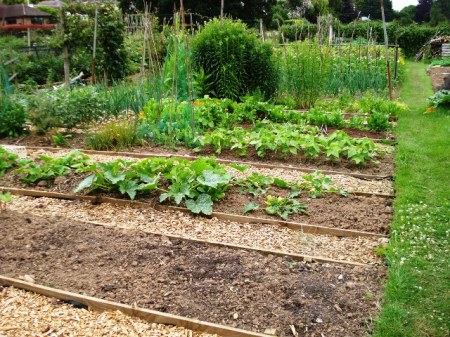
Keen vegetable gardeners may throw their hands up in horror. For some, there is beauty in a well presented vegetable garden with good straight rows, obedient plants in healthy condition and a succession of crops. There are sound reasons for planting vegetables in rows, including ongoing maintenance with a push hoe which is not only effective for weed control but also keeps the surface well tilled. I doubt that any other method of vegetable gardening can rival the traditional techniques for productivity. It takes ongoing work to keep it all in tiptop condition but that is to be expected. Why, some veggie gardeners may wonder, would you want to turn it into an even higher maintenance, yet lower productivity style of gardening by imposing ornamental values on what is essentially an unpretentious, utilitarian activity?

The ornamental edible garden, or potager, is almost de rigeuer today. Here is the marriage of food production with traditional garden design and practice, right? Well, yes and no. If you look at the history, it is another gardening style that has its origins with the rich and powerful of Europe, now democratised. Another example of prole drift, one could say a little unkindly. The stylised and designated herb garden, often laid out on formal principles dates back to times when herbs were more about medicine than cooking. As such, the range of plants grown was considerably more extensive and these gardens belonged in monasteries or designated apothecary gardens attached to institutions.

A word about parterres and potagers. The parterre is a highly stylised form of gardening, laid out on lines of rigid symmetry, much favoured in the sixteenth and seventeenth centuries. One of the grandest was created at Versailles for Louis XIV. The famous parterres of Villandry, also in France, are modern, dating back to the early 1900s. I liken the parterre to tapestry gardening. It is about building pleasing designs with plant blocks, originally planned for viewing by the lord from upper story windows. It doesn’t have a whole lot to do with the harvest, even when vegetables are included.

Potager is another French word, now widely applied to ornamental edible gardens. It is on a more domestic scale but its origins were also socially elevated. The peasants of yore would not have been growing in such a managed and decorative manner and the middle classes had yet to appear. So it was the upper echelons of society who could afford to indulge in creating formal gardens to grow edible crops in an ornamental style.

Rosemary Verey popularised the potager on a domestic scale (Photo:  Brian Robert Marshall)

Rosemary Verey popularised the potager on a domestic scale (Photo: Brian Robert Marshall)

The late English gardener, Rosemary Verey, is credited with popularising the potager in the last twenty years and in her hands it became a marriage of formal garden design, herbaceous traditions and food production. However, she seemed to refer to it, in the main, as simply a vegetable garden. The English show mastery of understatement. There is a pleasing symmetry in a well cared for ornamental edible garden and the formality means such gardens photograph well. It is a particularly feminine style.

It is just not a style to which we aspire personally. It is not quite one thing or the other. The principal criterion for plant inclusion is that it be edible or possibly medicinal, not that one will actually harvest it. Frankly, how many bay leaves will you ever use? One bay tree has its place, a row of topiary laurus nobilis is technically fitting the edible criterion but is primarily ornamental. And if one is going to grow ornamentals, I’d rather have topiary michelias, camellias or something more interesting than boring bay trees.

If you are gardening for looks, then the whole block of highly decorative red cabbages is going to mature at the same time so, unless you are into pickled cabbage big time, most will end up on the compost heap. Besides, you spoil the effect if you harvest one at a time, as required.

And then there are those tidy buxus hedges defining garden beds. Leaving aside the ravages of buxus blight and the fact that these tidy hedges harbour snails, buxus has an invasive root system. It sucks the goodness out of the soil and as the roots reach further afield, it becomes problematic to get crops of lush, healthy vegetables in the middle.

Often lavender is used as an edging plant but any of those big, floppy types of edgers are a problem if you have narrow paths (brick is the favoured option) and a high rainfall climate. I prefer to pop out to the garden to pick a lemon or a lettuce without getting wet lower legs.

More meadow garden than potager here

More meadow garden than potager here

We are pragmatic here. We would rather have good crops of vegetables, easily planted, tended and able to be harvested as required, with more permanent plantings of ornamentals elsewhere. That said, our vegetable gardens are by no means limited to vegetables. By this time in late summer, they are more akin to meadow gardens. Mark is fond of growing annuals for butterfly food but zinnias, marigolds and the like do not sit comfortably in our more restrained ornamental gardens so they get bedded in and allowed to seed amongst the vegetables. For us, the meadow has more romance than the potager. Besides, in this day and age when two raised beds out of tantalised timber and a citrus tree in a pot are claimed to be a potager, we would rather tread a different path.

First published in the Waikato Times and reprinted here with their permission.