Category Archives: Abbie’s column

Abbie’s newspaper columns

Please, value trees

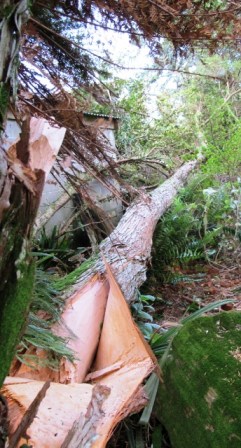
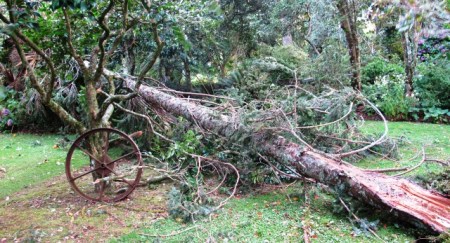
A totara, torn apart by strong winds

A totara, torn apart by strong winds

A fierce storm delivered us a sharp reminder last week. Avoid forked trunks in trees. Half a totara split out entirely. It had stood and grown for fifty years. Alas, early in life, the trunk had divided into two leaders and that meant a major structural weakness. The wind tunnel created as a result saw a triple trunked Picea omorika drop one of its leaders. It too was over fifty years old. Early intervention on both trees would have saved us a great deal of work and ensured that what remained was in better shape.

In years of retailing plants, I saw countless people debating over the selection of trees and seeking advice as to whether one tidy little specimen was going to be better than another equally tidy specimen of the same variety. It was very hard to sell a plant with what we call a hockey stick bend at the base. Sometimes this can occur with budded or grafted plants. I rarely bothered trying to explain that a hockey stick on a tree where the trunk is 2.5cm through will not be an issue at all when the trunk is 25cm in diameter. It may be true but it sounded too much like hard sell. The same goes for minor kinks in trunks on juvenile plants. They don’t look the best for the first year but it is not a long term problem. However, forked trunks are a different matter.
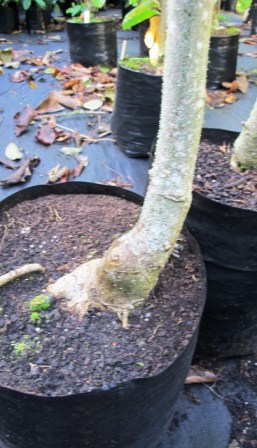
The dreaded hockey stick shaping

The dreaded hockey stick shaping

We are too cavalier in our attitude to trees in this country. Notwithstanding the customer angst about small imperfections, most people spend a great deal more time choosing the right carpet or curtains for their house than in deciding an appropriate variety of tree. Yet those furnishings will long have deteriorated to shabbiness and need replacing before a beautiful tree reaches maturity. You can’t magic up maturity in trees but they are frequently treated as disposable commodities. A combination of ridiculously cheap prices and extraordinarily rapid growth rates in this country has devalued them in the eyes of many.

That said, by no means are all trees equal. City council regulations which set a height above which resource consent is required before trees can be touched have an inbuilt contradiction. Such a rule catches all – trees worth protecting and valuing, trees simply planted in the wrong places and cheap nurse trees of neither long term value nor aesthetic merit.

There is no substitute for a little knowledge. Making an unwise choice may only cost a few dollars at the time of purchase but if it is a rapid growing, brittle variety or one that is shortlived in our conditions, you can pay dearly when it outgrows its allotted space or, in the case of filler trees, outlives its use. Not everybody has a handy person on site with chainsaw, trailer and mulcher and it is very expensive if you have to pay somebody to come in and do it for you.
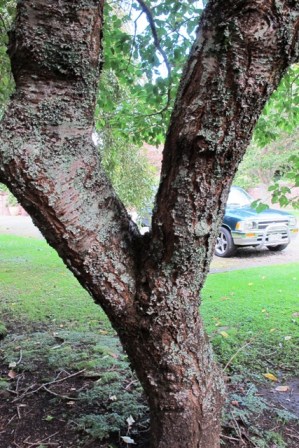
The forked trunk - an inherent structural weakness

The forked trunk - an inherent structural weakness

Similarly, planting trees and leaving them to their own devices can cause major issues further down the track. For the want of a five minute job keeping our Picea omorika and totara to single leaders some fifty years ago, we have faced a cleanup taking at least two days. Some trees naturally multi trunk like an overgrown shrub but most are better kept to a single leader. The sooner you carry out the shaping on such trees, the easier it is. At the really early stage, you can do it with secateurs. Select out the better or best looking leader and either remove competing growths entirely or shorten them to reduce competition for dominance. The longer you leave the situation, the more major the progression of tools becomes – to loppers, a pruning saw and then a chainsaw. Never having mastered the chainsaw, I am a strong advocate for a good quality pruning saw.

While some respond to these issues by deciding that trees are altogether too much of a potential problem and nothing will be allowed to grow beyond two metres in their garden, thank you very much, I would urge you to look beyond these gardening Philistines. I do not think any garden or landscape is complete without trees. It is just a matter of choosing the right ones appropriate to the situation and looking after them while they get established. Spend at least as much time on finding out about suitable selections as you would to choosing something major for your house. I try not to bag garden centre staff, but you might be placing altogether too much trust in many if you think they can give you expert advice on trees as well as on carrot seed. Either find someone who is genuinely knowledgeable or look to books. Some of the very best gardening books I know are about trees and one of the strongest and most knowledgable international horticulture societies is devoted to trees – the IDS or International Dendrology Society. The information is there to find.

Few of us will leave any legacy of note when we shuffle off the mortal coils. But good long term trees planted in the right situation and cared for during the early years of establishment are a fine legacy, to my mind.
Felling of the Picea omorika by strong wind

Felling of the Picea omorika by strong wind

Recommended books on trees include:
New Zealand’s Native Trees by John Dawson and Rob Lucas (Craig Potton Publishing)
New Trees. Recent Introductions to Cultivation by John Grimshaw, Ross Bayton and Hazel Wilks (Kew)
Trees and their Bark by John and Bunny Mortimer (Taitua Books)
Trees and Shrubs for Flowers/ Fragrance/ Foliage. 3 volumes all by Glyn Church (Batemans)

First published in the Waikato Times and reprinted here with their permission.

Lower maintenance gardening

The raised beds are going - to be replaced by wider steps

The raised beds are going - to be replaced by wider steps

I have been forced to look at practical lower maintenance gardening this week. Most of the time, we are practitioners of relatively high maintenance gardening on a large scale. I think it was the late Christopher Lloyd (he of Great Dixter fame) who made a comment that the more experienced one is, the more one realises that a high maintenance garden is a great more interesting. But there are times when a low maintenance one is required, particularly with rental properties.

For our sins, we are landlords. Just the one rental house and it is one we used to live in ourselves. There was a certain irony when we bought the property many years ago. We were doing a little land amalgamation at the time and Mark had exchanged quite a few plants with a previous owner for some work with his handy little bob-cat. When we came to buy the property, the valuation mentioned the high quality plantings. We certainly paid dearly to get our own plants back.

While living in the house, we duly extended the gardens and plantings to the point where they were reasonably expansive. When it came to letting the house, we realised the scope of the lawns and gardens were beyond what most tenants would manage, so part of the successive tenancy agreements has been that we will mow the lawns and loosely maintain the gardens as required.

Mowing tenants’ lawns is not a bad thing. We mow pretty much every Friday and it gets you onto the property on a regular basis so you can keep a discreet eye on things. It operates as an early warning system, so to speak.

But gardens are another thing. Few tenants garden. A few scratch around from time to time, but none we have met take as good care as we did. It is a fact of life. In this hiatus between tenants, we are doing a major clean out and simplification in the garden. Once it has been reduced to bare bones, the onus will be on the incoming tenants to maintain the gardens at that standard. There will be nothing too demanding.

Simplification has been ongoing but reached its zenith this time. The only garden borders left are the two defined by concrete paths alongside the house. A previous property owner had put in a number of raised garden beds. The last two are going now. Out with garden beds. They just look messy if not maintained.

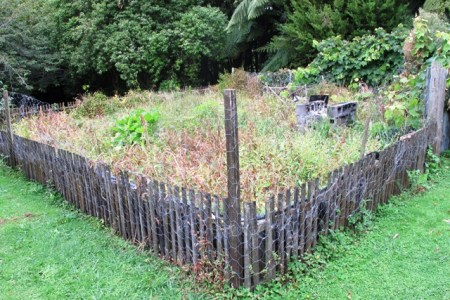
The designated vegetable garden needs clearing but is being retained

The designated vegetable garden needs clearing but is being retained

The designated and fenced vegetable garden is staying. In this day and age, it is probably an asset and it has good soil, is an appropriate size and is sheltered but in full sun. It will be ready for a tenant to plant. We just need to clear it first. Similarly, the citrus trees can stay. They are fine with total neglect.

The extensive perimeter plantings have matured to shrubbery and they are staying. If you want low maintenance, long term plantings, go for shrubberies. Over time, shrubs and small trees will gently mesh and knit together to provide a green and flowery undulating wall of foliage. Being relatively dense, few weeds grow beneath. The herbaceous plantings we had there have long gone but that is fine. All we have to do from time to time in the shrubberies is to go through with a pruning saw and trim anything that is getting too large. In return, the mixed plantings of camellias, rhododendrons, magnolias, maples, self sown pongas, feijoas and the rest provide a soft and pleasing backdrop to the property. They stop it from being too austere and bare.

Any plants that require regular attention have gone. The last of the roses are on the burning heap. The espaliered camellias have gone. The devastatingly rampant wisteria has gone. It put up a brave fight but truly, wisterias are unsuitable plants to leave in a situation where they are not actively managed. This beautiful Blue Sapphire had put out its runners a good 20 metres away.

I have replanted the remaining, tiny house borders. I couldn’t stop myself especially as I found spring bulbs. But I have gone for simple mass plantings. A shaded, dry border which is a pathetic 20cm wide (honestly, who would make a permanent border 20cm wide?) is now mass planted with green mondo grass and bedding begonias. Utility and easy to maintain by non gardeners. The one hot, dry border retained its existing vireya rhododendrons which have survived total neglect and fifteen years of tenants, underplanted en masse with a compact yellow sedum. That is it for herbaceous material. As the one who does the knapsack spraying, Mark approved the mondo grass and sedums as being largely resistant to glyphosate so he could spray amongst them if necessary.

When you are preparing a property for sale, it is often about good looks in the short term – as we have all learned from those property makeover programmes on TV. When you are preparing a rental, it is about easy care, easy living in the long term. It can be done.

The shrubbery is the lowest maintenance form of gardening I know

The shrubbery is the lowest maintenance form of gardening I know

First published in the Waikato Times and reprinted here with their permission.
"It is natural and plant-based so it must be safer and healthier, mustn't it?"

The call went out to UK gardeners for yew clippings. Yew snowman from Helmingham Hall

The call went out to UK gardeners for yew clippings. Yew snowman from Helmingham Hall

I keep waging war on what I see as very sloppy thinking and pseudo science. The sort of thinking that says natural = good, chemical = bad, synthetic = even worse, modern medicine = corrupt multi national pharmaceutical hijack, herbalism and natural medicines = healthy alternatives. Often there’s a sort of Luddite sentimentality, a belief that the wise women and healers of long ago knew better.

Ahem. Life expectancy was much shorter, by decades in fact. And for every natural plant-based cure that worked, there were probably many more that didn’t. Poisonings went unrecorded, as did misidentification of plants. Medical misadventure was not exactly a matter of record.

The binomial plant naming system devised by Linnaeus in the mid 1700s has stood the test of time, though it is now under siege from the dumb-it-down brigade of Make Gardening Easy persuasion. Linnaeus’s plant classification system was incredibly important when it came to medicine. Until that time, there was no standard identification, naming and recording system for plants. Doctors and healers were often at the mercy of those who went out collecting the wild plants, many of whom would have had little idea of what they were harvesting. The same plant could be given many different names and vice versa – the same name could be applied to many different plants. It still happens.

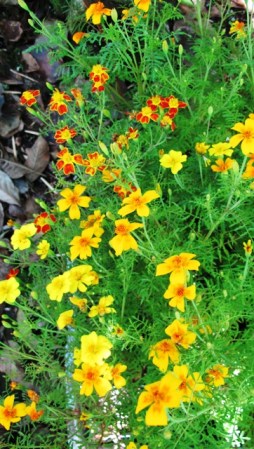
Marigolds. But which one?

Marigolds. But which one?

Take marigolds. Yes do take them. They are not my favourite plant at all. But how many readers understand the difference between calendulas and tagetes? They are entirely different plant families and we commonly refer to both as marigolds. Both are used quite extensively for their natural compounds but they are not interchangeable. If anybody is going to treat me either internally or externally with marigold extracts, I would like to think they know the difference between, for example, Calendula officinalis and Tagetes minuta, let along the various other plants entirely which are often referred to as marsh marigolds, corn marigolds or marigolds of various other persuasions. I prefer my medicine a little more exact and for that, I thank Linnaeus.

A large proportion of modern pharmaceuticals continue to be derived from plants. Aspirin originated from willow. Much work has been done on the cancer fighting properties of yew. Valerian has long been recognised for its special properties – but false valerian is a different plant family altogether.

The yew is an interesting case study for those who think synthetic copies are all bad. In the early days of cancer research into the curative properties of taxus, British gardeners were encouraged to gather all their trimmings when they clipped their yew hedges and topiary and to deliver them to collection points. If you had sufficient volume of high quality trimmings, you could even get paid for it. They responded with enthusiasm but it took an awful lot of yew trimmings to yield a very small amount of the relevant compounds used in chemotherapy. Even more problematic was the one which derived from the bark of the Pacific yew (Taxus brevifolia). You cannot continually harvest tree bark in large quantities. Clearly it would never be viable unless the researchers were able to reproduce the compounds efficiently in a laboratory. It is called synthetic organic chemistry because it is about reproducing a natural compound by synthesis. I know a small amount about this on account of having a daughter study it to a very advanced level (by which I mean post doctoral fellowship, working as part of a team isolating the active ingredients from a Thai plant with huge potential). It is not all bad. In some cases it may save the natural environment, not having to harvest huge volumes of natural products. It can even out seasonal and geographic variations in the strength of active compounds in plants. It can certainly deal to the problems of misidentification.

Most of our poisons are also plant-based. Many people know about laburnum seeds. Fewer realise the toxicity of daphne seeds. Cyanide has its origin as a plant product. So indeed does strychnine. Euphorbias exude a sticky sap which is renowned as a skin irritant. Rhus trees are problematic – so much so that after one bad encounter with some sawdust while chainsawing a fallen branch, Mark refuses to approach our rhus tree without donning protective gear similar to a beekeeper. Derris dust is seen as natural and organic – and it is because it comes from roots of certain plants but that doesn’t make it safe. Rotenone (which is sold as Derris dust) is linked to Parkinson’s Disease and is very toxic indeed.

It is a dangerous natural world out there. It’s a miracle we gardeners survive really. Which is why I am deeply suspicious of ill-informed enthusiasts rushing out to promote the use of plant remedies on the grounds that they are natural and therefore safer. A little bit of knowledge is a dangerous thing. Until herbalists and natural healers are as strong on botany and chemistry as they are on traditional “wisdom”, I will err on the side of caution.

First published in the Waikato Times and reproduced here with their permission.
Learning about lobelia

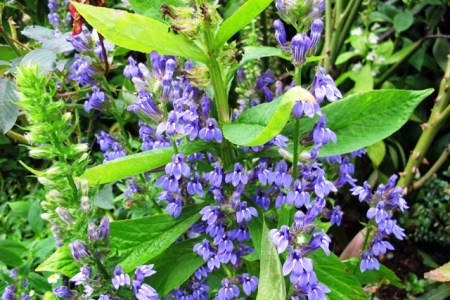
A perennial lobelia from North America - but which one?

A perennial lobelia from North America - but which one?

Lobelias, I thought. I will do lobelias this week. Now you may quite possibly have led a full and happy life without putting any thought to lobelias. My interest had been desultory at best, but as soon as I started to delve a little, I uncovered a whole lot more.

Lobelias go well beyond that little, mounding blue annual that is a summer stalwart. Yes it comes in white and purple as well but it is usually blue. That handy little plant is Lobelia erinus, hailing from southern Africa. If you garden with bedding plants, you start afresh each year with organised plantings. Or if you are more cottage garden oriented, you just let one plant go to seed and it will naturalise and reappear around the place the following spring in an obliging but gentle sort of way. It is just a handy filler – nothing too exciting about that.

It was quite exciting, in a botanical sort of way, when we were given Lobelia gibberoa. This one hailed from mountain gorilla territory in central and eastern Africa. Indeed, if you get your eye in for footage of those gorillas in the mist, you may see them browsing amongst things that look a little like palm trees or even our tree ferns. Lobelia like we had never seen it before. It rockets upwards at about two metres a year, forming rosettes of big tropical leaves on top. Apparently it stops when it gets to about 5 metres high. Ours rocketed up but we rather lost interest when we realised it was not going to impress us with a magnificent display of bright blue flowers on its huge flower spike. The flowers were negligible and inconspicuous but the plant was a magnet for white fly and red spider so we didn’t worry when it succumbed to a cold, wet winter.

Sometimes you will see Lobelia aberdarica offered for sale. It is another lobelia mega herb, a little more cold hardy, though from a similar geographical area and it too has huge leaves growing in rosettes. However, it clumps closer to the ground rather than on top of its trunk though it seems to share the same huge flower spike with underwhelming flowers.

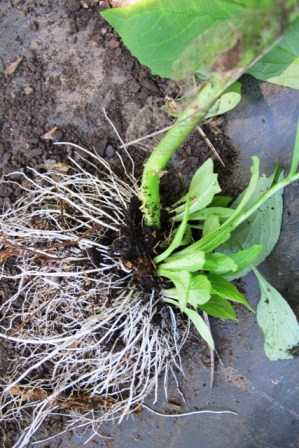
The North American perennial lobelias are very easy to lift and divide

The North American perennial lobelias are very easy to lift and divide

No, it was the unequalled display of the perennial, clumping lobelias from North America which made me sit up and take notice. We have had these for years here. They form neat little rosettes at ground level and put up metre high flower spikes which, in the past, have all then proceeded to fall over. I think what made the difference this season is that I had divided most of the plants, splitting up the crowns and spreading them around. And in these rejuvenated beds and borders, there were sufficient other plants to hold the flower spikes up. In this process, I had still managed to keep the colours separate. We have pale blue and mid blue, rich purple, cerise pink, white and even red. This year we had lots of blues and they have been a real feature.

As summer perennials, these are excellent garden plants for sun to semi shade. They’re easy. If you have a pure red one, it is likely that it will prefer damper conditions, even water’s edge. It is a different species, though still from USA.

I thought I would try and decode the species. Ha! There are somewhere up to 400 different ones. It is a huge family and many of what we have appear to be hybrids between different species. So we won’t confuse matters.

What became really interesting was the long history of lobelias in traditional herbal medicine. We come to this topic from a botanical angle which makes it really scary (identification is often wrong). But those American lobelias promise a cure for pretty much everything, though they can also be highly toxic. Lobelia inflata, also known as Indian tobacco, does not carry the alternative common name of puke weed or the equally charming vomitwort for nothing. But from snake bites to pleurisy to bronchial difficulties, it can be just the ticket. Best guess is that it is what Billy Connelly was given in the shaman’s tent on a recent Route 66 TV programme.

Be careful, should you happen to be suffering from syphilis, that it is Lobelia siphilitica that you harvest for a natural cure. I didn’t delve far into the history of syphilis in the indigenous American people around 400 years ago, but it is believed that this disease was introduced to Europe by sailors with Christopher Columbus.

The problem is that siphilitica and inflata are different species but look very similar and I have no idea whether our plants here are one, the other or a hybrid of the two. Nor am I confident that any research has been done to ascertain whether they are interchangeable in herbal medicine.

For sheer optimism, I loved the website dispensing advice on using lobelia as a herbal treatment. “Always consult your Health Professional to advise you on dosages and any possible medical interactions” it said. Yeah right. I am sure I am surrounded by health professionals who are far better than I am on botany, understand chemistry and have a deep knowledge of traditional medicines. I will just keep using these charming perennials as garden plants.

First published in the Waikato Times and reproduced here with their permission.
Gardening with grasses

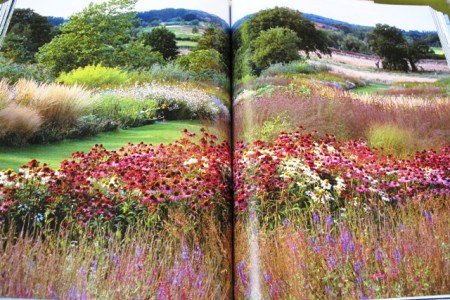
We were entranced by the Piet Oudolf borders at Wisley

We were entranced by the Piet Oudolf borders at Wisley

Years ago I was editing garden descriptions and amongst the plethora of developing gardens or tranquil havens filled with birdsong, I came across one which claimed to have “a fascinating collection of grasses.” Fascinating seemed to be overstating the case. I think I toned down the adjective. It has taken a long time to win us over to the merits of grasses here, even though we have some lovely native varieties in New Zealand.

Big grasses need big space

Big grasses need big space

I have never actually seen grasses used in a breathtakingly beautiful way in gardens in this country though I have seen some handsome amenity planting combinations. The problem lies, I think, in how we use them. For starters we tend to limit ourselves to varieties which are knee high or lower. Even worse is the habit of forcing innocent grasses into an edging role where they are destined forever to be like an untidy fringe. And yes, mondo grass (both black and green), liriope, Carex Frosted Curls and blue fescue – I’m looking at you here. Grasses by their very form are designed to grow in the round, not to be forced into a narrow row as an edger. Nor indeed do I understand the obsession with uniform edging plants on all garden beds and borders in this country but that is another matter.

It wasn’t until we went to look at summer gardens in the UK that we were won over by grasses. We had heard slightly disparaging comments about the Piet Oudolf twin borders at Wisley (the RHS flaghip gardens) – a chevron design in grasses, I think somebody told us sniffily. It wasn’t that at all. Twin parallel borders were united by rivers of colour and texture flowing from one to the other with grasses featuring along with other plantings. Not knee high grasses, these were at least waist high and integrated with other carefully chosen perennials. It was an inspirational planting.

On the same trip, I saw the most exquisite grass I have ever seen at Beth Chatto’s garden. I don’t even know if Stipa barbata is in this country but it was light, ethereal and remarkably beautiful. Since then, we’ve seen grasses featured frequently in British TV garden programmes. One of the reasons we subscribe to Sky is to get gardening shows on the Living Channel.

Early view of the Wisley Oudolf borders before the glasshouse was built (from Penelope Hobhouse's book "In Search of Paradise" - magic

Early view of the Wisley Oudolf borders before the glasshouse was built (from Penelope Hobhouse's book "In Search of Paradise" - magic

The common threads to making these plantings work are:
1) Inspired combinations. Grasses are not planted with other grasses. They are integrated into mixed plantings which are carefully managed to look naturalistic in style. Grasses don’t generally suit formal plantings.
2) Forget grasses which are ankle high to knee high. Statement clumps are at least waist high and often considerably taller. This of course means they need quite a bit of space.
3) Big grasses plus big plantings result in a big effect. It rarely scales down effectively. Therein lies the problem – not that many of us have the space to garden on this sort of scale. Those of us who do have space (and it needs to be sunny, well drained space), have usually cluttered it up with mixed plantings including trees and shrubs. These exciting perennial plantings using grasses are usually only perennials, not mixed borders. The aforementioned Oudolf borders at Wisley are around 150 metres long by 11 metres wide – each. While that is on a grand and public scale, you really can’t expect to replicate it in miniature in a border which is only a metre wide and three metres long.
4) Many of these successful plantings have their origins in a garden interpretation of American prairies. It is a managed but not manicured style of gardening. It is some distance away from the classic herbaceous border and it is a long way away from the formal garden rooms genre we have adopted so enthusiastically in this country. It does not combine well with clipped hedges.

Set the grasses free. That is not original. I read it somewhere and it was a NZ writer though I can’t recall who. Stop trying to straitjacket them into contrived and managed combinations. If you have your grasses in a situation where they require grooming and regular combing, it is likely that you are straitjacketing them.

We were told that the Oudolf borders we so admired at Wisley required only a third of the labour input that the classic herbaceous borders needed. Partly that is because they don’t need staking or deadheading. They are cut down in late January (for us that translates to the end of July or late winter). I imagine by that stage they are quite scruffy so it is not a style that will appeal to tidy gardeners. But despite that scruffy stage, these prairie styled plantings contribute a great deal to the ecology of an area, feeding birds and wildlife. It is different to wildflower meadows in that it is managed plantings in varied combinations, often within a somewhat formal layout and with tight weed management. It is not random or self sown. This is not a style we seem to have picked up on this country. We are still mulling around as to whether we have the right position to try.

First published in the Waikato Times and reproduced here with their permission.