Category Archives: Abbie’s column

Abbie’s newspaper columns

Lunar planting – your very own personal organiser

Mark has had A Revelation. If he turns around three times in an anticlockwise direction in front a pot of fresh sown seed, the seed germinates and grows more rapidly. He is fairly sure this has something to do with channelling cosmic energy and just to prove it, he is going to sow two pots at the same time but hide one around the corner so it can’t see his actions. He is confident that the seed that has received the special attention will grow better and this experiment will give conclusive scientific proof.

Silly? Of course.

We have been looking at planting by the moon, in an attempt to see if there is any independent evidence to back up the claims. We are seeing lunar gardening being featured ever more widely in this country, almost to the point of becoming mainstream. Is there any scientific foundation to it? Not that we could find. Well, there is the work by Nicholas Kollerstrom but there is a bit of a credibility gap with him – he being best known as a leading Holocaust denier. Beyond that, it is all affirmation, testimonial and anecdote.

We could comprehend the theory that the times when the moon’s gravitational pull is at its strongest are the best times for plant growth. I don’t say we believed, but we could understand it. What we failed entirely to get a grip on was why this meant you could ONLY plant at this time for best results. Some seeds can take a long time to germinate. If you planted them two weeks early (when the gravitational pull is weaker), what is to stop them just sitting there waiting until the time is right? Why are they allegedly so disadvantaged when compared to seed planted 14 days later at the right phase of the moon? Logically, should not the gravitational pull be a deadline, not a tight time frame? We also failed to get to grips with the differentiation between the positive forces of a waxing moon and the negative forces of a waning moon when the gravitational pull is roughly equal at various stages.

There is a fair amount of wiggle room. There does not seem a definitive source of guidance so beyond the principles of gravitational pull and the lunar influence on tides, most other interpretations appear to be flexible. Some claim that you should only water on a waxing moon, others that if you mow your lawns or clip your hedges in the last quarter, you will slow regrowth. This might be termed residual effect? It appears that timing is everything and we can indelibly affect the long term behaviour and subsequent performance of plants based simply on the exact timing of planting, pruning and other gardening activities.

It didn’t get any better when we delved further. Fertile and barren days are apparently linked to the zodiacal belt. You know, the signs of the zodiac. That is astrology and you have to be of a certain ilk to take astrology seriously in your daily life.

We came to the conclusion you have to be a believer. Planting by the moon in modern times has more to do with pagan moon worship than scientific fact. And it arouses great passion and devotion amongst followers, a sense of belonging and a belief that all will go well – as long as you follow the rules.

Ancient practice alone is not validation. We are so selective in our use of history. Fortunately we no longer think that sacrificing the odd virgin or two will bring better harvests. In the days before calendars and clocks, it is likely that the ancients did indeed use the moon’s phases to determine planting times, along with other factors like day length, temperature change and seasonal rainfall. Productivity and harvests have long been wrapped up with religion and both the moon and the sun were objects of veneration. How curious that moon worship has persisted in this form and remains a major source of spiritual inspiration.

And yet, just as the outcome of biodynamic practices can be sound organic land management no matter how flaky some of the underpinning rules appear to be, so too can planting by the moon have beneficial outcomes. As far as we can see, it is the perfect tool for people who need deadlines to get themselves organised and motivated. “You must plant this carrot seed within the next three days or you will have to wait another month by which time it will be too late.” You obediently follow instructions. Whereas the non believer procrastinates and delays, thinking there is still plenty of time, so often doesn’t get around to planting the seed at all. Lunar planting is your own personal organiser but, as far as we can see, it does not actually have anything to do with the moon’s gravitational pull.

Organics, biodynamics, permaculture, planting by the moon – these are all ways of encouraging sound gardening practices which enhance the environment rather than harming it. I just wish some of the proponents and their devoted followers didn’t feel the need to use pseudo science to try and justify what are sometimes faith-based gardening systems.

First published in the Waikato Times and reprinted here with their permission.

Photos for this article here have been sourced from Wiki Commons. Photo credit for lunar eclipse time lapse: A. Skorochod.

From big picture gardening to small picture detail

Ours is not a rockery for growing alpines

Ours is not a rockery for growing alpines

My mission to weed our stream and ponds, about which I wrote last week, has been subsumed. That is to say it has largely been taken over by the menfolk in my life and turned into something much larger but I am not complaining. I was trying to clear the water weed. They are now building an additional weir, flushing the stream and hiring a sludge pump to clear the ponds. I know my limits. I have moved up from the park and into the rockery.

Moving from the open areas to the intimacy of the rockery is going from one extreme to another. The former is big picture gardening and much concerned with giving large trees space to grow and anchoring the whole picture well into the surrounding environs. This used to be called borrowed views and vistas before those terms became so pretentious they fell into naffdom. The rockery is all about little pictures, highly detailed gardening. I wouldn’t be without either, but I really enjoy the attention the rockery requires.

Traditionally, rockeries were about creating an environment that resembled scree slopes of mountains in order to grow alpines. We cannot grow alpines. We’ve tried but it doesn’t work. Our high humidity, high rainfall and mild year-round temperatures conspire against alpines. For us the rockery has become the place to keep track of treasures and to confine dangerous but attractive bulbs. Most gardeners know how easy it is to lose bulbs in garden borders. Some get swamped out by neighbouring plants, some are so anonymous when dormant that they get pulled out with other plants, some just seem to go, we know not where. If they have their own pocket in the rockery, it is possible to label their location and restrict competition.

Rockery conditions are surprisingly harsh. All that stone and other hard material heats up in summer so the soil dries out quickly. The gentle, steady rain we had last week didn’t penetrate very far. This means you have to be pretty selective about small shrubs, perennials and other plants but the bulbs don’t usually mind. In the wild, most are used to marginal conditions.

Too much of a good thing - Cyclamen hederafolium with black mondo grass

Too much of a good thing - Cyclamen hederafolium with black mondo grass

Two summers ago, I took the rockery apart pocket by pocket. At the time, I estimated there were about 500 separate compartments and it took me a full month’s work. At least I got to know it and all its inhabitants. This time I am only concentrating on the messy bits and the areas where plants responded a little too enthusiastically to the earlier renovation. The combination of black mondo grass and pink Cyclamen hederafolium is very pretty, especially as snowdrops come through the marbled foliage of the cyclamen in the depths of winter. But you can have too much of a good thing and all three inhabitants were trying to outcompete each other. I am thinning them drastically.

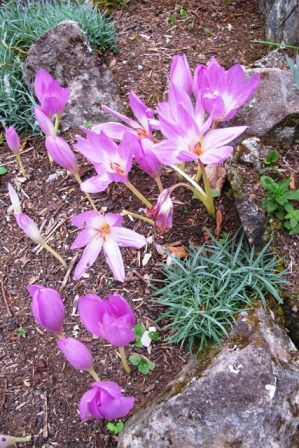
To garden in this style, you have to be willing to tolerate the messy season bulbs have, when their foliage is looking past its best. Most bulbs use the time after flowering to build strength below ground so they can flower again next year. When they have done that, their foliage dies down naturally. With some, this is a quick turnaround. Others, like nerines and colchicums, take many months. We just try and ensure that other areas of the rockery have more attractive displays to distract the viewer and leave the plants to their natural cycle.

I used to think that every pocket of the rockery should have something of interest in it all the time. This is actually a lot harder than it sounds because you then need to use a succession of maybe four different plants which can co-exist quite happily – and each compartment should have different combinations. In other words, for me this would be getting on for 500 miniature gardens. Rockeries are no place for mass planting. I flagged that idea – too hard and not necessary. Some compartments will have periods of the year when they appear empty and that is fine as long as there are no weeds. There is no place for any weeds at all in this intensive style of gardening.

Ours is an aged example – sixty years to be precise. We have some fine, gnarly, old, characterful dwarf conifers to give year round structure along with some smaller growing cycads (though somebody forgot to tell the handsome Cycas revoluta to stop growing). We have a few easy care, small perennials to soften the edges. A compact little blue campanula is one of the best of these along with a well behaved little scutellaria. We like the tall punctuation marks of some plants drifted through the rockery. The upright orange-toned orchid, Satyrium coriifolium, is the choicest one. The large flowered yellow Verbascum creticum seeds down gently to give the statement in late spring and the amaranthus (Love Lies Bleeding), similarly self seeded, is growing before our very eyes to fill the vertical accent role in autumn. These plants just provide a framework for the real stars – a succession of any and all interesting bulbs we can grow.

It means there is always something of interest to look at. I enjoy that sort of detailed gardening.


First published in the Waikato Times and reproduced here with their permission.
The battle with the water weeds

We have dropped the water level for me to hand scoop the stream

We have dropped the water level for me to hand scoop the stream

I have been getting really down and dirty this week, hand pulling the weed from our main stream. As this involves wading in mud up to my knees, I emerge looking decidedly worse for the wear and no, you are not going to see a photo of me in this state.

Our main issues are with dreaded oxygen weed, Cape Pond weed and blanket weed. If we didn’t stay on top of them, the entire water surface would disappear below vegetation, which rather defeats the purpose of having a stream in the garden. I asked Mark if he thought our problems were related to farm run-off and excessive nitrogen but he is of the opinion that it has more to do with slow water flow rates, though he felt the build up of mud and silt in our streambed would be extremely fertile. When we get sudden bright green algal bloom, it is an indication of nitrogen being applied on farms upstream.

The worst offenders: Cape pond weed and oxygen weed

The worst offenders: Cape pond weed and oxygen weed

There is something very appealing about a natural stream but they are not without their problems. Offhand, I thought of three gardening colleagues with natural streams. One has problems with flooding in torrential rain. The water cannot get away fast enough so it builds up on his property. One has no problem at all with flooding because their stream is in a deep ravine, maybe 20 metres below the level of their land, but this means it isn’t really a significant garden feature. The third has a picturesque mountain brook to die for, bar two factors. Their land has sufficient natural fall to clear flood waters quickly but the bubbling brook can turn into a torrent that scours everything alongside. This means that they can’t have streamside plantings of any quality. They tried two or three times before giving up, having seen the plants ripped out and carried away. Their second issue is that the water is of high purity so a number of neighbours have water rights granted. Each neighbour has installed their own alkathene pipe at the top of our friends’ garden where the stream enters, running the pipes along the streambed until they exit at their adjoining properties down the bottom. There must be at least five alkathene pipes, both black and garish white, visible in that stream. It is not a good look.

So be careful what you wish for. None of these people, however, have to do what we do and clear the waterway of vegetation every year or two. We eliminated problems with flooding and scouring but our water flow is not sufficient to stop the growth of water weed. Our wonderfully natural looking stream is actually the result of outside expertise and in-house experience coming up with a low tech solution. We control the water where it enters our property by means of a simple weir. In normal conditions, this allows the water to flow equally down two streambeds. One meanders pleasantly through our park while the other is a deeper flood channel girded by stop banks. The two stream beds join up again on the other side of our property so the flow downstream is completely unaffected. When heavy rains cause flooding, a mechanism is triggered which directs all the water down the flood channel. By these simple means, we eliminated flooding, boggy patches and scouring from the park though we do have to manually reset the weir in order to get the water flowing again.

The pond weed is the direct result of having a relatively low flow through the park area, though our stream is such that it never dries up. Oxygen weed is a curse. We had a bad infestation which Mark finally eliminated entirely for some years. He blames the reinfestation on people emptying unwanted goldfish bowls into the stream at the corner by the road. Do not ever do this. The goldfish are most likely to die but the oxygen weed is an invasive menace in slow moving water.

Our other great burden comes from a former neighbour who, as far as Mark is concerned, should be lined up and shot for liberating such an invasive weed. African Cape Pondweed, also known as water hawthorn, (botanically Aponogeton distachyum) is undeniably pretty, with a very long flowering season. Presumably this is why the former neighbour planted it on the margins of his ponds. Because he had no control over the water flow, the inevitable floods scoured it all out of his place but it found a lovely home in our slow moving sections. I don’t know how many hundreds of hours we have spent rooting it out. It is quite good friends with the oxygen weed because it can grow through it and spread its lily pad-like leaves. Between them they have the potential to turn our stream to bog. Native weeds are nowhere near as aggressive.

It is only yours truly who has shed most clothes to get in and hand pull the water weeds this year. Generally this is done by the two men in my gardening life (Mark and Lloyd) who take it in turns to wield the long handled rake and manually haul it all out on to the bank. It is a slow process and pretty hard on their backs. I thought it would be faster and easier to do it by getting in and so it is proving to be. The water is pleasantly warm, the mud even more so on sunny days. I just have to time my mud wrestling because I can’t exactly stop for lunch or a cuppa. Wisecracks about eels are not welcome.

Lloyd at least stays cleaner on the end of the rake but it is harder on the back

Lloyd at least stays cleaner on the end of the rake but it is harder on the back

First published in the Waikato Times and reproduced here with their permission.
Welcome back to our resident gecko, Glenys

Gecko, probably Hoplodactylus pacificus.

Gecko, probably Hoplodactylus pacificus.

We are very pleased to see our resident gecko back sunning herself in the same spot as last year on the gnarly old pine tree trunk. As this is apparently the behaviour of a pregnant female, it means we have more than one gecko in residence. If she was successful in bearing her babies from last year and they survived all the predators which includes adult geckos, it may mean we have several. Given that spotting one gecko is a rare occurrence (last year’s event caused considerable excitement amongst local herpetologists), we are never going to know, but we are hopeful that Glenys’s behaviour may become an annual event. The sunbathing is apparently part of the incubation process of the young.

It takes an eagle eye to spot a sunbathing gecko. We may well have others in less prominent spots and we may have had them here all the time and just never spotted one before. It is likely that Glenys is a fine specimen of Hoplodactylus pacificus.

Earlier stories from last year:
1) Gecko update
2) The first story (and best photo) about our gecko, as well as the flocking kereru and monarch butterflies which were delighting us at the time – Wildlife in the Garden, New Zealand style.

No. We do not have a Mediterranean climate here

The romance of lavender - though it can be shortlived in our climate

The romance of lavender - though it can be shortlived in our climate

We were watching an interview with the head gardener at Tresco Abbey on the Scilly Islands just off the coast of Cornwall. The garden is notable for growing a whole range of plant material which is too tender for the mainland and the gardener claimed they had a Mediterranean climate. He then proceeded to elaborate and it could have been me describing our climate here.

“We never get very hot and we never get very cold,” I say. “In fact we are almost frost free and we get regular rains twelve months of the year along with high sunshine hours.” Is that a Mediterranean climate? I don’t think so. It is what we call a temperate, maritime climate. Wikipedia agrees with me. A Mediterranean climate is that which is experienced by all those countries ringing the Med – places like the south of France, Portugal, coastal Spain, Italy, Greece and down to the coastal areas of North Africa. It is also found in California, south and west Australia and parts of South Africa. These are places where they grow wonderful pistachios, luscious olives and grapes, where lavender, bourgainvillea and red geraniums flourish. Hot, dry summers and cool, damp winters are what characterise the Mediterranean climate.

Almost a signature plant for Mediterranean gardening

Almost a signature plant for Mediterranean gardening

Head inland from these coastal areas and you get to the classic continental climate – hotter, drier summers and much colder, dry winters. The closest thing we have to a Mediterranean climate in NZ is probably Hawkes Bay while only Central Otago could be said to have a continental climate. There are reasons why they are the cherry and apricot bowls of New Zealand. The rest of us fall pretty much into the aforementioned temperate, maritime class with the upper reaches of Northland leaning to the subtropical end of the spectrum.

No amount of wishful thinking and attempting to redefine our climatic definitions (we have seen wild claims that the North Island is subtropical) is going to alter the actual temperatures and rainfall distribution we have. Most of us would like to be a degree or two warmer all year round and a little drier – or at least have the rain fall at night and please make it warm rain. But we are not a sub tropical Pacific island and we have to understand what we have in terms of climate and garden within that.

This is not to say that we can’t grow some of those Med plants. We can and we do but they are not always long lived. Many of those plants are the grey foliaged ones – whether the aforementioned lavender, cistus (rock rose), oleander, even artemisia (the wormwoods), rosemary and succulent sempervivums. In areas of higher rainfall, the one critical issue to growing these types of plants is superb drainage. Most of them also need full sun. In New Zealand, they are often recommended for coastal conditions where sandy soils give sharp drainage and dry out quickly in summer.

The same is true of many of the Australian native plants which have adapted to drier conditions. Some put on terrific floral displays – the grevilleas, some of the wattles, anigozanthus, even the fragrant boronias which many of us have tried and lost. It is usually the wetter climate and fertile soils that are the death knell of these plants, as indeed with most of the showy proteas from South Africa.

It is not all bad. We do have quite a bit of success with some of the Australian plants from their subtropical forest areas. These plants are used to higher humidity and heavy rainfall while tolerating the cooler conditions we have. Plants like the doryanthes (spear lily), the subtropical cordylines, the aromatic myrtles such as Backhousia anisata and citriodora will all thrive in our climate if given reasonably protected conditions.

Gardening styles and plants  have evolved for very different conditions in the Med - this is Portugal

Gardening styles and plants have evolved for very different conditions in the Med - this is Portugal

The problems often come with the desire to recreate the romance of a holiday. For many New Zealanders, the Mediterranean areas with their long history, their breathtakingly quaint villages contrasting with the grandest architecture imaginable, crowned by a blue as blue sky (most of us visit in summer) are the pinnacle of sophisticated style. If it is sophisticated there, it must be sophisticated at home, right? Wrong. Mediterranean gardens and plants have evolved for Mediterranean conditions. They are more likely to look contrived, verging even on the pretentious, when set in this green and verdant environment of ours.

Experienced gardeners often like to push the boundaries of what can be grown in their conditions. It is enormously satisfying to look at a thriving plant which would generally turn up its toes and die in such an alien location. But experienced gardeners rarely try and create an entire garden using a genre from a foreign land and an incompatible climate. Nothing shouts novice louder.

If you want that Med look, it may be easier to move. What we do have in the centre and north of the North Island is one of most benign climates imaginable and the result is lots of lush growth which is the envy of those from harsher climes. We are better to start with what we have rather than to try and recreate an inappropriate fantasy from foreign shores.

There is a certain folly in trying to recreate the romance of a Greek island holiday back home

There is a certain folly in trying to recreate the romance of a Greek island holiday back home

First published in the Waikato Times and reprinted here with their permission.