Category Archives: Abbie’s column

Abbie’s newspaper columns

Agapanthus -the blue (and white) stars of our summer roadsides

Our summer roadsides would be the poorer without agapanthus

Our summer roadsides would be the poorer without agapanthus

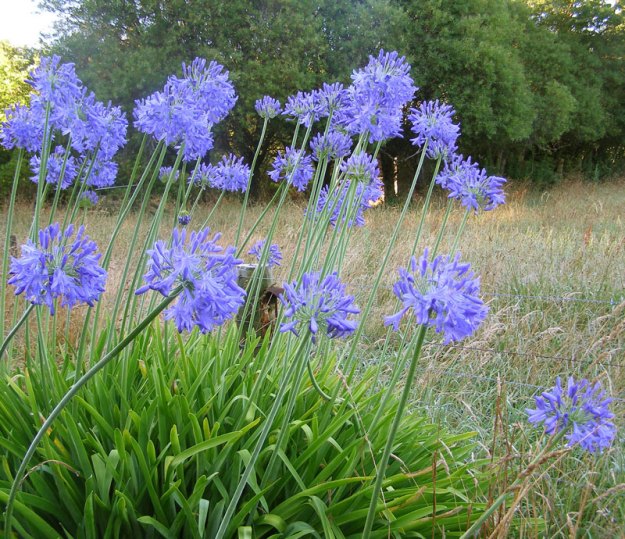
We have a bit of a love-hate relationship with agapanthus here in Taranaki and in warmer areas of this country. But as you drive around the countryside at this time of the year, most would agree that our roadsides would be the poorer if they were gone. They resemble giant blue harebells growing, well, growing pretty well everywhere if we are honest.

Agapanthus all come from South Africa and from relatively limited areas of that country. Don’t be misled by the common international name, the Lily of the Nile. They are neither a member of the lily family, nor do they grow anywhere near the Nile. Nor does Agapanthus orientalis come from the Orient. That descriptor merely means eastern, so the natural habitat of A. orientalis (probably more correctly known as A. praecox ssp orientalis) should be on the eastern side of South Africa, assuming the original plant collections and recording was done accurately.

The name comes from Greek. Agape is love and anthos is flower but whether this means the flower of love or lovely flower is unclear.

So are they a weed? These matters are rarely as black and white as they appear. On the debit side:
• Most agapanthus set seed freely and the seed germinates readily.
• Agapanthus grow well in a wide range of situations including inhospitable clay banks and shaded areas. They form a dense cover which prevents other plants from germinating – particularly desirable native regeneration. They have the potential to colonise bush reserves, national parks and native bush.
• The common agapanthus are resistant to the world’s handiest weedkiller, glyphosate (formerly known by its original brand name: Round Up). While you can take them out with stronger brush killer sprays, most of these require you to hold a spray licence.
• Digging out well established clumps takes quite some physical strength and determination because the plants cling on for grim death and the clumps can be formidable. Because they have roots which are rhizomes, if you don’t get the whole plant out, what is left behind in the soil will re-grow.
• There is no way this plant would ever be permitted into the country now. Mind you, the same thing could be said about kiwifruit.

There is a credit side and a degree of resigned acceptance by the authorities in this country which sees agapanthus treated as a surveillance pest plant rather than the hard line decision to ban it outright.
• While it seeds freely, the seeds are not dispersed by birds at all so in most cases, the seedlings pop up close to the parent plants. The big problem comes with plants beside waterways because the water can do a very efficient job of spreading them much further.
• They are a significant plant for cut flower producers and there are dwarf and sterile forms available for home gardeners which pose no threat at all. There is a large international market and agapanthus occupy an established niche in our nursery industry. Many of the named hybrids have parentage which includes one or more of the species other than praecox and this reduces the weed problems.
• They make a significant contribution to our summer landscape as a flowering plant and will tolerate harsh, roadside conditions so are favoured for amenity plantings.
• They are evergreen, tidy and suitable for using to stabilise slip-prone areas.

Basically Biosecurity and most northern regional councils would love to ban it outright but pragmatism triumphs so the aggie lives on to flower another day. Auckland has banned the larger growing forms of A.praecox (the common form), still allowing the production and sale of dwarf forms as a compromise position. The sensible position for the home gardener who lives adjacent to native forest or to waterways, would be to remove them entirely. As a back-up position, being industrious and thorough about dead heading would reduce the problem. For the rest of us, it probably doesn’t matter and they make a huge contribution to our summer gardens and landscape.
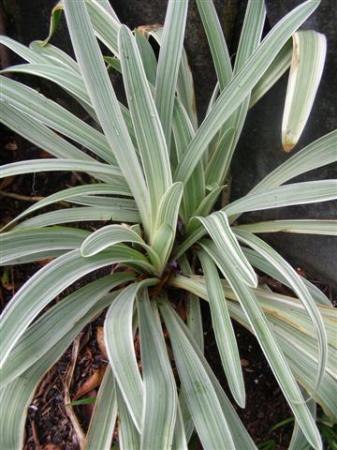
Agapanthus Tinkerbell - no weed potential here

Agapanthus Tinkerbell - no weed potential here

By no means are all agapanthus thugs. Little Tinkerbell is common in gardens though probably more noted for its very clean white and sage green variegated foliage than its flowers. It is distinctly shy on flowering, as a rule. It also has a significantly large root system for a plant without a great deal on top but it is a useful addition in the garden border. Other named hybrids are often more amenable than thuggish and have their place in the garden setting.

This is a plant family which is a great deal more highly prized overseas than here. In harsher climates, stronger growing plants are valued for their ability to survive the conditions and most of Europe and the US have much harder conditions than we have. Toughies that stay in leaf as well as put on a lovely summer flowering display are harder to come by, especially in blue. Because they don’t tolerate extremely cold conditions, additional measures are often required to get the common agapanthus through winter.

But in this country, you can’t even give away common agapanthus. Which is why we were genuinely shocked by a section in “A Green Granny’s Garden”, by Fionna Hill. I reviewed this before Christmas and I have to admit I did not read it cover to cover or that review might have been a little tougher had I come across the following paragraph referencing her attendance at a Hollard Gardens’ workshop here in Taranaki:
“Workshop participants have been invited to bring seed and other plant material to share. We pulled lots of agapanthus plants from Maggie’s New Plymouth garden that day and (we thought) cheekily we’d take the opportunity to leave a wheelbarrowful. We give the barrow to some helpful children to wheel back to the meeting shed, while we speed off down the road. I think it might not have been welcome, at that time, believing them to be a pest.” (sic). The page of self justification that follows does not mitigate the action for anybody except the author, who concludes: “I shouldn’t feel so guilty about that wheelbarrowful that Maggie and I have left as a contribution – at UK rates, the barrowful was worth about 300 pounds.” I don’t think so, dear. What you did was to furtively leave your friend’s weeds for Hollards’ staff to dispose of. You should be feeling guilty and embarrassed.
The New Zealand Garden – is there such a thing?

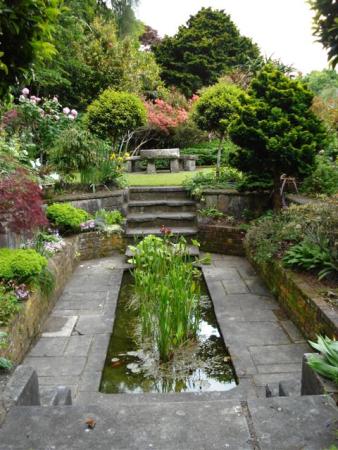
The D.I.Y. Lutyens-style sunken garden

The D.I.Y. Lutyens-style sunken garden

We have been talking about the New Zealand garden. This conversation has been given new impetus by the lack of any analysis of the nature of the New Zealand garden in the lavish new book on the topic by Kristin Lammerting, which is essentially a parade of gardens that she liked, including her own, (or maybe gardens that had been recommended to her) written up in glowing terms with fabulous photographs but zilch insight into the context. We will probably continue discussing this until we die, it being a topic of never-ending interest because it is a reflection of who we are in this long, thin country of the southerly latitudes. In the main, we are a nation of gardeners. Most residential properties and indeed commercial businesses make some attempt, however meagre, to beautify their frontages. Some do better than others but there is a shared value in beautifying our immediate environment.

So I offer up the following thoughts on defining our place in the world of international gardening, with the rider that this is by no means a definitive list.

· Size. We do big gardens here. Even our small, urban gardens are actually quite large by international standards. Our traditional quarter acre section is huge as an allocation of space for an individual family. Our major private gardens are usually several acres. Space is not a luxury confined to the wealthy in this country. It is perfectly realistic for the average home gardener to own a substantial patch of dirt.

· Despite our inclination towards large gardens, we usually do all our own gardening. Hired help is not common. Skilled and qualified hired help is positively rare. Overseas visitors are frequently astounded at how much New Zealanders routinely achieve in large gardens without assistance.

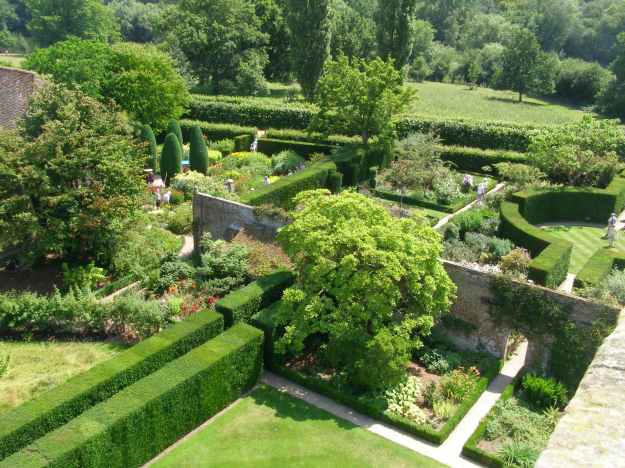
· It must be something in our egalitarian heritage which has many New Zealanders taking the ideas of the large, historic gardens – especially in Britain though sometimes from wider Europe – and attempting to re-create something similar here. We seem to be oblivious to the fact that the vast majority of the great gardens of Europe and Britain were established and maintained by the wealthy and the powerful who could afford to pay gardeners to actually do the work. So we go for high maintenance gardening styles (clipped hedges, a touch of topiary, sweeping lawns, mixed borders, buxus enclosures around statuary) – all the trappings of the gentry and the nobility which our forbears were so keen to leave behind.

· Grand designs, maybe, but on a very low budget so the D.I.Y. ethos rules supreme. In many circles, getting somebody else to design your garden for you or others to maintain it is somewhat frowned upon – a sign that you are not a true gardener. If you have wealth, you shouldn’t be flaunting it. Because very few of our gardens have a lot of money behind them, we tend to be very light on permanent structures and surfaces. It is a bit like our attitude to housing. We would not expect our wooden bungalows to be around in 300 years and the same goes for our gardens. So we don’t use a lot of stone or brickwork, leaning more to the rather short term pongas, timber (sometimes tanalised) and the utility concrete block or paver. We tend to favour grass over cobbled surfaces, keeping sealed areas for driveways and a path immediately around the house.

· What we lack in hard landscaping, we make up for in plants. Plants are cheap in this country, ridiculously cheap by international standards. Our equable climate means they grow quickly and gardening is pretty easy. We love a wide range of them, especially something new or different. We love them even more if we can multiply them ourselves and get some for nothing. So we use plants for structure, as well as soft furnishings – plants are often used instead of walls, fences and edgings. This passion for plants is quite possibly part of the British settler heritage. Most of the world’s great plant hunters (including Joseph Banks) hailed from there and even today, a curiosity for plants and a desire to stretch the boundaries of what one can grow is a characteristic of gardeners in that country. It is just easier here – we have better soils, a more obliging climate and cheaper plants.

· We did not, however, inherit a love for big trees. No danger of us taking up the champion trees scheme (where the largest specimens are identified, measured, monitored and even revered). We are more likely to chainsaw them down. Maybe it is a gut response to the somewhat intimidating nature of our native forests. I think it more likely that our houses are often cold in winter and our climate is not quite as hot as we would like so we just don’t want shade. Landscape views are common but highly prized, certainly above trees. We garden more with shrubs than trees.

· The frequent lack of a strong design element defined by permanent structure, a heavy dependence on plants for form and a dislike of big trees, all allied to a mobile population who move house frequently, means that our gardens tend to be quite ephemeral. They grow quickly. It only takes 10 years to create a very pretty tree and shrub garden here. Many gardeners regard trees of 15 to 20 years of age as mature. Never go back is the mantra of gardeners who have moved house. Odds on, the new owners will have ripped out your garden and replaced it. We don’t expect our gardens to survive past us, and very few do.

· Native plants. All our native plants in this country are evergreen and some are strongly sculptural (the cabbage tree, pohutukawa, nikau, tree ferns, even the pachystegia and tussocks). We have a huge array of indigenous flora which we generally take for granted but the integration of many of these plants into the ornamental garden is another defining feature.

· In our easy climate, most of the country gardens all year round. We don’t put our gardens to bed for winter while we retire indoors. We have flowers and foliage all the time so we don’t need to depend on hard landscaping to give winter form.

· Our reverence for immaculate lawns and the priority placed on kerb appeal are values taken more from American suburbia than Europe.

We are still magpies here – we borrow ideas from here and from there and try them out. Our settler history is still very recent. When we moved in to Mark’s parents’ house, we found the books which they used to give them ideas when planning the garden that we now own and the end result was a typically large country garden strongly modelled on the English landscape traditions, right down to the D.I.Y. Lutyens-style sunken garden pond. In the sixty years since, the form remains English but the range of plants and the way we use them are very different. It is likely that the sheer lushness of plant growth in this country will continue to define our gardening style far more than any slavish copying or reinterpretation of overseas genres.

Decoding the jargon

Setting the standard for garden rooms – Sissinghurst

A newsletter from a gardening organisation arrived a few days before Christmas and I duly read it, coming across the following statement (warning: do not let your eyes glaze and brain disconnect before the end). “Outstanding gardens manage to respond to the genius loci using borrowed landscape, natural landform and native plants – often mixed with exotics – to create stunning indigenous compositions of form, line, texture and colour.”

Borrowing the jargon, shall we unpack that statement? Though I prefer to use the term decode because it is somewhat like a secret code.

Outstanding gardens manage to – that bit is fine.

respond to the genius loci – had to get out the dictionary for this. Loci is, more or less, a place or locality. Google then helped me track down the term genius loci which apparently dates back to early Roman times and means the protective spirit of a place. Latterly the term seems to have been adopted by the landscape architecture fraternity although it might be easier to understand if they simply referred to the well known words of English poet and writer, Alexander Pope who took an interest in garden design. He put it rather more simply when he wrote in 1731 (a mere 280 years ago), “Consult the genius of the place…” which has come to be interpreted as the principle that design should always be relevant to the location and natural environment. This of course assumes that your particular location has some genius loci attached to it but it is a little hard to see how much genius loci you can lay claim to if your lot in life is a small, flat, urban section with a house, be it large or small, plonked fair and square in the middle. Some of us are blessed with quite a bit more genius loci than others.

using borrowed landscape – that is the view of the neighbours’ properties, assuming you have neigbours with views worth borrowing.

natural landform – silly me. I thought that was part of the genius loci.

and native plants – I can’t quite work out whether this is using the already existing native plants in your own genius locus extending to your neighbours’ genius loci which would be a little limiting because it then tends to apply only to those whose patch is on the boundary of a national park, scenic reserve or at least a patch of native bush. Alternatively it may be that native plants are mandatory and pre-eminent in outstanding gardens. While advocating strongly for the use of native plants in tandem with exotics, I think this statement takes the position of native plants considerably further than is common in this country.

… – often mixed with exotics – yes, we are allowed to embellish with introduced plants (exotics are the vast majority of what we grow in this country. Even our lawn grasses are heavily dominated by exotics, as are all our fruit trees and vegetables). I don’t know what the word often is in there for because you would be hard pressed to find any environment in this country, be it natural or contrived, which does not have introduced plants in it. Even our national parks are invaded by weeds.

to create stunning – stunning… hmm. There is a very emotive word. Quality can be measured and evaluated. Emotional response is a matter of individual opinion.

stunning, indigenous compositions of form, line, texture and colour. I will let the compositions of form, line, texture and colour go, though I can think of clearer ways of defining good gardening as a combination of excellent design and skill with plants. But, indigenous compositions? Puh-lease. Indigenous – occurring naturally or native to the land. Gardening, by definition, is not indigenous. It is an imposition on the landscape, occasionally a natural landscape but more often a landscape already heavily altered by man.

So what I think the original statement says is: outstanding gardens make the most of their natural environment, using a variety of plants and really good design. At least, I hope that is what it says. There is no author named so I can’t check.

The classic garden door frame and passage at Hidcote – best in a garden with plenty of space, perhaps

Just a little further on in the same piece, there is the sweeping statement: “Gardens should be a series of outdoor rooms and should have walls, exits/ entries or passages between the rooms. Rooms should be well defined so the viewer is not distracted by what is going on in the next room although they might be tantalized at some point.”

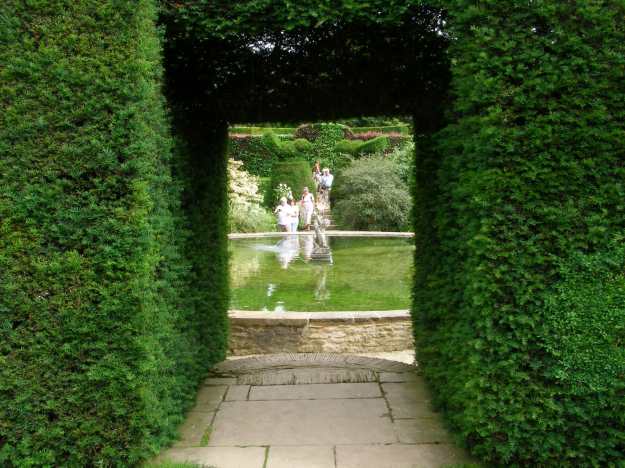
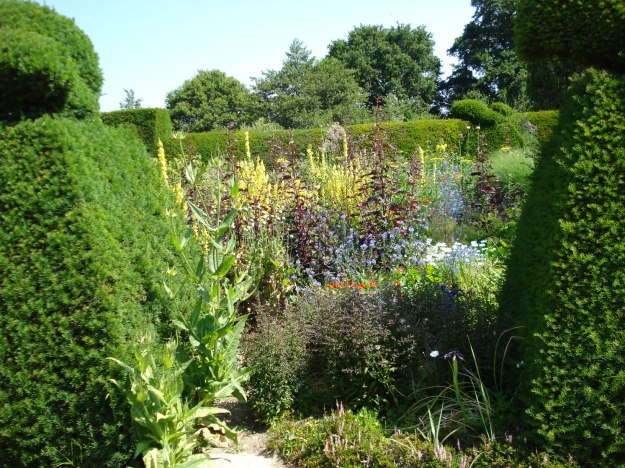
What happened to open plan living, I ask??? Are we to be forever locked in to that format of the early twentieth century evident in the great English gardens of Sissinghurst and Hidcote? Do not get me wrong. We were very impressed by Hidcote when we visited, but perish the thought that all New Zealand gardens must follow the formula if they want to be seen as very good gardens. There are other styles of garden design. A woodland garden will never be a series of rooms with tight structure. A flowing landscape garden in the manner of Capability Brown relies on open spaces, not rooms. Must a tiny town section redefine itself as an area of poky little rooms surrounded by high walls? All those walls blocking out distraction can be damned oppressive, not to mention expensive if done in permanent landscape materials like brick, plastered concrete block or stone. Or high maintenance if done in clipped tall hedging with the added problem that all those hedge plant roots reaching out into the flower borders. It is also very difficult to accommodate large trees in those rooms, let alone worrying about the place of the genius loci in such a heavily contrived design.

Must the defined spaces of garden rooms, seen here at Great Dixter, become mandatory in good New Zealand gardens?

I could not disagree more. Garden rooms are but one device, one way of achieving a desirable end point. The underpinning principle is surely that a good garden should never be revealed in its entirety at first glance. There should be surprises to be discovered, changes of mood and variations in light and shade. The design should entice you to explore further. Using different types of plants in different ways is not only practical in that you have varying growing conditions but it also punctuates the changes.

If you stand back and look at your garden and decide that it is rambling, then it is likely that you lack that sense of design and flow as well as changes of mood. If you have repeated the same plants (oft claimed as a device to give continuity but actually more often, simply dull), then you exacerbate the sense of rambling lack of form.

Just as there is more than one way to skin a cat (not that I have ever wanted to subject a poor moggy to that exercise), there are more ways to design a garden than depending on tightly defined and enclosed garden rooms. After all, a mark of a good garden is surely a degree of originality?

The pitfalls and perils of garden water features

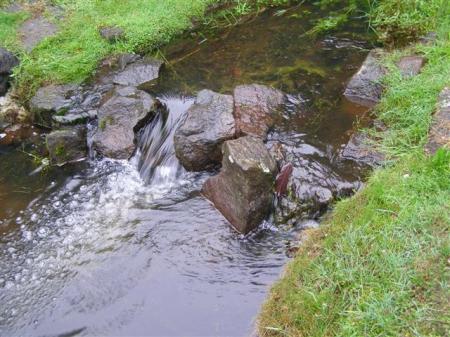
It may be a natural stream in our park but it is hardly an easy care water feature

It may be a natural stream in our park but it is hardly an easy care water feature

Water is an important inclusion in any garden, or so the common wisdom says. We laughed when Joe Swift on BBC Gardener’s World commented that he hated water features because they were rarely maintained. Water is difficult to manage well.

A natural stream might seem the best option for the lucky ones and on a fine day, the mountain brook that bounces its way through Ngamamaku Garden is indeed a source of envy for many of us. The trouble is that with our torrential downpours, natural streams can quickly become raging torrents which take out all your plantings. Tony has long since given up using treasures in his stream-side plantings. They disappear in the flood torrents. We have the upper reaches of the Waiau Stream running through our park and again, it is charming and a great asset. Because we control the flood waters by some simple but time honoured techniques (a weir and a flood channel), we don’t get the scouring but it takes constant management to prevent it all silting up and regular, heavy work to keep the water weeds under control – particularly oxygen weed and Cape Pond Weed.

Ponds – are ponds easier? Possibly the larger your pond, the more self maintaining it becomes though you generally need fish (commonly goldfish) to keep the mosquito larvae at bay. By definition here, a lake is sufficiently large to allow water skiing, or at least canoeing. If it is not of that dimension, it is a pond. Maybe a large pond, but a pond. By the time your pond has shrunk below about a metre square or round, it can’t really be called a pond any longer. A puddle, perhaps, or a basin? If you have a natural pond fed by a spring, it may stay fresher and relatively stable through the seasons. Home made ponds can be difficult. Firstly they are prone to developing leaks and that is a terminal condition unless you remedy the problem – which is never easy to do. Shallow ponds are problematic because the water heats up and that encourages algae growth. If it is too deep (somewhere about 40cm), you have to fence it. Basically a pond, by definition, is a static body of water which will therefore go stagnant. And homemade ponds are often lined in polythene which is really hard to manage so it is not visible in any way at any time – folds of polythene just look really tacky.

The formal pond that depends on pristine water quality shrieks out money. I have seen a couple and essentially they are the same as running a swimming pool – dependent on a full filtration system and frequent vacuuming. I have a few ethical issues with their sustainability and personally that swimming pool look does not strike me as aesthetically pleasing. It is all a bit too Beverley Hills. If you are going to have something that looks akin to a swimming pool, it may as well combine function with form and be a swimming pool. I also particularly dislike the hum of the pump as a background sound in the garden. To do it properly, you need a silent pump. The same goes for any water feature which relies on moving water to a part of your property where it does not naturally occur. Circulating the water does at least solve the problem of it becoming stagnant but it is a fraught activity, more often prone to lapses in taste and poor management. Fountains? A matter of taste. Repro classical fountains don’t do it for me. I have seen enough of the real thing in European gardens, which is where they belong – usually in the gardens of royalty or at least wealthy nobility. The increasing democratisation of the classic fountain hasn’t done much for its aesthetics. They are just a little “Look at me! Look at me!” in the average New Zealand garden. Leave them for Versailles.

The overseas fashion for rills or narrow canals has been slower to catch on here. I think the origins for these lie in Islamic gardens – the requirement to wash before frequent prayers. In recent years, English garden designers rediscovered them and you see the ribbon of lawn bisected with the water channel, often only 20cm wide. Hmmm. The words drainage channel and lacking in purpose spring to mind so we will say no more on the topic.

Mark has a mantra that design features in a garden need a logic to them, they need to make sense in the context. So creating a naturalistic waterfall cascading down from a dry hillside is a contradiction in itself. The fountain in the formal garden is not pretending to be natural – it is all about the imposition of human will and design on nature. The waterfall is trying to simulate a natural event so it needs to be as close to seamless as possible, not, as more often happens, a feature plonked in to “add interest” with little regard to logical context. Being able to hear the pump thrumming away as it circulates the water makes it even worse.

None of the above is to deny that it is possible to do water features well and when they are done well, they are a welcome addition to the garden, whether it be a reflecting pool, the sound of a babbling brook or cascading water, a formal design feature or a modest goldfish pond. The mistake is to think that they are mandatory and once in place, that they need no attention. And I own up to the fact that we have a formal goldfish pond which is severely afflicted by algal bloom at the moment.

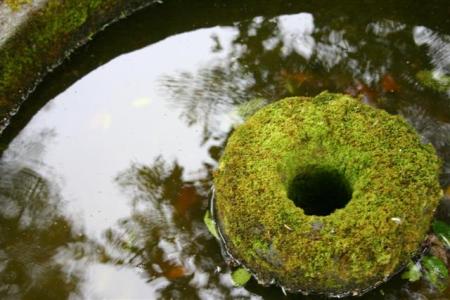
The simplest type of water feature - in this case a stone millwheel with a bung in the base so it can be drained and refilled easily

The simplest type of water feature - in this case a stone millwheel with a bung in the base so it can be drained and refilled easily

A word on safety: we have all had it drummed in to us that children can drown in as little as 7.5cm of water, which means they can drown in a puddle, really. We were told by an inspector some years ago that the reason so many little ones drown in swimming pools is because they are attracted by the blue colour that is the norm and that once in, they instinctively try to reach the bottom to stand up. Vertical sides also make it near impossible to get out. These aspects do not generally apply to garden water features but if the safety aspects worry you, it may be better to dispense with the feature altogether rather than try and net it over.

If you absolutely must have water and your garden is small, a large container with some sort of plug or bung system to enable drainage is probably the most easy-care solution. You can then replace the water when the mosquito larvae start swimming around or it all turns green and yukky. If you plan anything more ambitious, think carefully before you start and be prepared to maintain it.

How ironical is it that one of the very best examples of gardening we have seen internationally is Beth Chatto’s dry garden in the UK? The dry, gravel garden at Hyde Hall nearby is also shaping up brilliantly. Mind you, both are in very arid, stony areas. Similar plants would rot out in our higher rainfall and humid conditions. But generally it is better to garden with the conditions and not to feel that one simply must introduce a water feature to counteract the dry areas.

Ficus antiarus, rare plants and why only one plant in our garden is clearly named

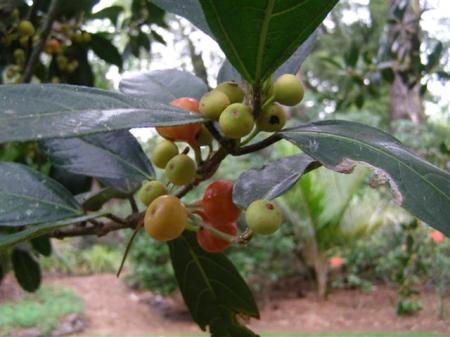
The curious fruit of Ficus antiarus

The curious fruit of Ficus antiarus

I admit to a wry smile when I read friend and colleague Glyn Church writing of the pileostegia (climbing evergreen hydrangea) He made a comment that if you are keen to buy one, alas he has stopped growing them because nobody seemed to know about them – which means nobody bought them. We were struck by them growing up huge brick walls at Hidcote in Gloucestershire and had volunteers running all over the place to find a gardener to identify the plant.

We have our equivalent of the pileostegia. It is Ficus antiarus and it is the most asked about plant in our garden. We used to propagate a few but we realised that while everybody wanted to know what it was, nobody wanted to buy it. I was a bit stunned when somebody turned up last month asking for one. She was out of luck.

Ficus antiarus is a bit of a joke here. Probably close to half our garden visitors would ask what it was. We got to the point where somebody would produce a fruit, a digi camera with a photo or start to say: “What is the tree with the strange bulbous growths…” and we would chime in quickly. “Ficus antiarus,” we would say. “An obscure fig collected by Felix, Mark’s father, in New Guinea in 1957. That was back in the days when you could still bring new plants in to the country. No, the fruit do not grow any larger than that. They turn bright red-orange as they age and presumably the birds don’t like them much because they never strip it. Yes they do appear to be edible. I have tried them and they have a vaguely figgy taste but they are not very exciting to eat. Just a curiosity, really.”

Maybe I did get a bit carried away with the sign

This year, as I was getting some signage for carparking and toilets updated, I admitted defeat and had a sign made for Ficus antiarus. I say admitted defeat because we have resolutely held out against putting name plates on plants here, despite frequent plaintive comments about nothing being named. But as Festival neared its end, Mark commented that the one sign on Ficus antiarus had probably saved us several hours of repeating ourselves. He was very taken, however, by the dry comment from one garden visitor about the sign: “The size is a bit of a giveaway.” I didn’t think it was that large, but certainly you can’t miss it.

We have been intractable on refusing to name the plants in our garden. Public gardens are different. They have a strong educative function and are impersonal spaces. But this is our home, our personal space, even though we open the garden to visitors and we don’t want to see a whole lot of signage in our garden every time we step outdoors. The Ficus antiarus sign is only justified because it is a bit of joke. Besides, we have good memories and are very good at identifying plants by description and location, even though some visitors’ descriptions leave a lot to be desired. “What is the pink rhododendron flowering behind the house?” is a little vague when in fact the visitor is referring to one plant in the five acre park which lies beyond our home. And I admit it can be a challenge when they can’t even get the plant fanily right. “The big red rhododendron” has, upon occasion, turned out to be a telopea or waratah.

We have been to gardens where all plants are labelled. One in particular had every plant named with a section of venetian blind on which was written the name of the plant, the year of acquisition and nursery who supplied it. It was absolutely fascinating and we progressed from plant to plant, analysing the data so closely that we didn’t actually look at the garden context. It was a bit like going round a museum. It would be even worse in our garden where we don’t go in for mass plantings but pride ourselves instead on growing the widest possible range of interesting plants and where many of the garden plants are unnamed seedlings from breeding programmes. I have been to other gardens where owners have used the nasty plastic display labels sold for plant retailers – the aesthetics worry me. So we have no intention of naming all the different plants in ours.

My other observation about Glyn’s pileostegia and our ficus is to suggest to readers that when you see an interesting plant or one that you have been looking for, buy it on the spot, no matter your circumstances. There is no guarantee that you will find it offered again. The range of plants being grown in this country continues to contract, certainly in the woody trees and shrubs area. The phone calls I take on our business line during the day tend to be of two types. The first is people trying to find cheap griselinia hedging (just how many kilometres of griselinia hedging are being planted these days?) and the other group are people trying to find a particular plant.

Most times I have to reply that I don’t know of anyone producing it any more. The heady days of the late 80s and the 90s (now widely referred to as The Maggie Barry Era) when gardening was the rage and nurseries flourished, have long gone. There are few, very few, specialist nurseries still operating. In fact a fair swag of general nurseries have gone to the wall in the last decade and it is so rare for a new nursery to start that you should be able to hear a collective cry of encouragement ring around the industry when it happens. The result is that you will see a continued contraction in the range of plants being offered on the New Zealand market.

Do not be like the woman who talked to Mark about Davidia involucrata during our recent festival. That is the spectacular dove or handkerchief tree and we had a few plants for sale. She really wanted one but she wasn’t quite ready for it yet. Mark shrugged his shoulders and thought, “She’ll be lucky”. The chances of her finding a davidia when she is ready are not great at all.