Category Archives: Abbie’s column

Abbie’s newspaper columns

Plant Collector: Tecomanthe montana

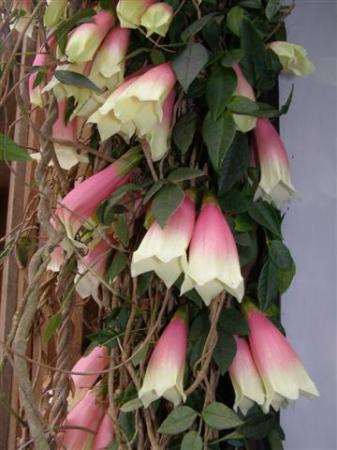
Pink and cream hanging bells of Tecomanthe montana

Pink and cream hanging bells of Tecomanthe montana

Most visitors tend to think that the dainty pink and cream trumpets mean this climber is a lapageria (Chilean bell flower) but far from it. Tecomanthe montana is a tender climber from New Guinea. We tried it in the garden and it survived a couple of years before it succumbed to winter. This plant is grown under complete cover though it has its roots in the ground. It is by far the showiest tecomanthe when in flower.

Apparently there are only five species of tecomanthe. Our own native form, T. speciosa, was found as a single plant on the Three Kings Island and has been saved by commercial production. It has much bigger leaves and is a very strong grower. Unless you train it along a horizontal frame, it tends to shoot up the tallest tree where it will produce its pale lemon trumpets right on top where you can’t see them. We also grow T. venusta under complete cover but it is even more tropical than T. montana and only occasionally flowers for us. When it does, its pink trumpets appear out of the gnarly bare wood of the climbing stems. We gave up on the Queensland species, T. hillii because it mildewed badly with us. All of the tecomanthes are forest climbers from the tropics or sub tropics. Montana came to us from former Pukeiti director, Graham Smith, who gathered the seed in New Guinea. It is not the easiest plant to get established but if you can find the right conditions, it is a winner in spring.

The Moorish Gardens of Andalucian Spain

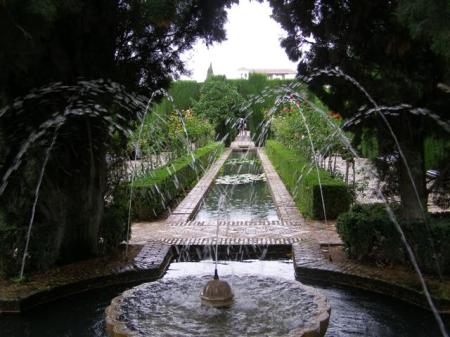
Moorish gardens of Southern Spain - the Alhambra &

Moorish gardens of Southern Spain - the Alhambra &

I didn’t really know what to expect of gardens in the south of Spain, although Glyn Church had told me that the Alhambra and Generalife in Granada was simply amazing. What really caught me unawares was the depth of history. Our country is still so much of the New World that gardens of a mere fifty or sixty years in age are often described as heritage or historic. Indeed I have heard people claiming that their garden is “mature” after about 15 years.

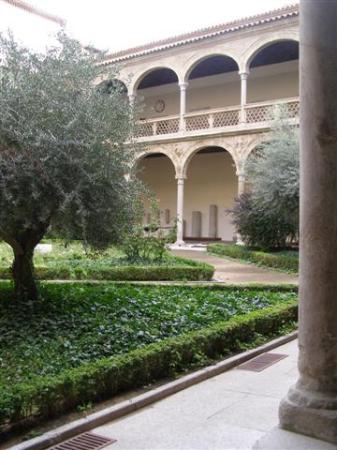
Traditional courtyard garden - this one in Toledo

Traditional courtyard garden - this one in Toledo

Andalucian gardens in the south of Spain had Roman ruins, overlaid with the Moorish exotica and wealth, reworked by the Christian kings – marching down the centuries, layer upon layer. It was the Moorish influence which was completely new to me and that, apparently, is unique to the area. The Moors were the Arabic Moslems who crossed the seas and controlled large tracts of southern Europe for many centuries before they were defeated and expelled in the late 1400s. The Spanish gardens are known for the use of small intimate spaces rather than the huge water gardens of Islamic Persia and India. Ah ha! The origin, I suspect, of garden rooms in the modern, western garden.

All the Moorish gardens are restorations. While the palaces survived, the gardens certainly didn’t though I guess a certain amount of archaeological evidence remained, along with sufficient pictorial record to enable a reasonable level of accuracy in reconstruction.

The exotic chorisia in the palace gardens at Seville

The exotic chorisia in the palace gardens at Seville

There has been no effort to maintain the original plantings and indeed these gardens don’t have a whole lot of plant interest. In Spain’s hot, dry climate (even in autumn, it was consistently 35 degrees), only a limited range of plants can be grown. There is a heavy emphasis on buxus, cypresses, citrus, roses, grandiflora magnolias and annuals for colour. The only plants to stop me in my tracks were a colourful bramble (which would likely be a noxious weed here) and the sight of chorisias in full flower in the palace gardens of Seville. Chorisias are South American (so a later introduction) and in flower rather look like trees full of exotic orchids. I have seen one flowering in Auckland though I don’t think our summers are hot enough to allow our plant at home to reach its potential.

The Moorish gardens were all about creating formal, but intimate spaces cooled by water and shade where the nobility could take refuge from the heat. So the emphasis is on structure and hard landscaping to give the form. In a climate where it is too harsh to grow lawn grasses, paths and terraces are usually paved, often with pleasingly subtle mosaics and interesting detail. What impressed me about these fine gardens were the gracious proportions and the flow from one area to another.

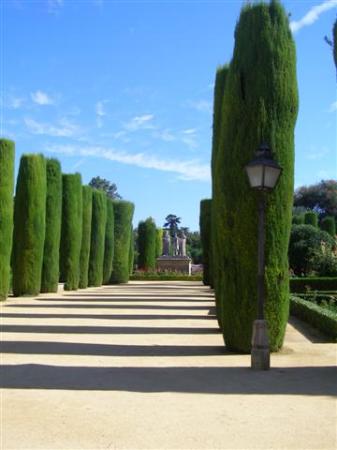
Shadows add another dimension in a country of unrelenting sunshine

Shadows add another dimension in a country of unrelenting sunshine

At the Alcazar de los Reyes Cristianos in Cordoba (that is the palace of the Christian monarchs), the majority of the gardens were much more recent but the Moorish flavour remains, just as it does in the breathtaking nearby mosque cum cathedral. In a climate where sunshine hours exceed 3000 per year, the purpose of using vertical accents (mostly cypresses) to create a picture in shadows made sense. I have seen the technique copied without much success. I think it worked in Cordoba because they have so much bright sun that the shadows are really deep and welcome, because there were wide avenues left open to frame the shadows and because even on a cloudy day, there was enough strength in the design for it to work without any shadows at all.

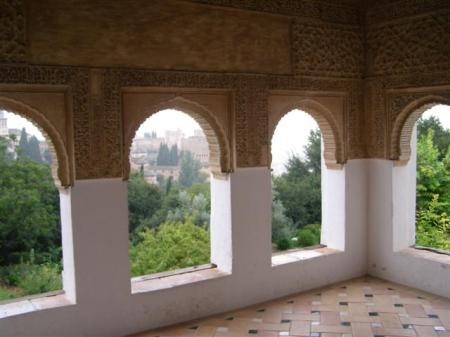
These gardens have nothing to do with the peasantry. It was all for the nobility, usually royalty with deep pockets. In such a dry climate, the use of water for aesthetic purposes is in itself a statement of power. Nowhere was this more evident than at the Alhambra and Generalife, an entire complex of palaces, forts, towers, gardens, water features and even a village, all enclosed by fortified walls. Now one of Spain’s premier attractions, gardens and palaces have undergone major restoration. Interestingly, the palaces were modelled on similar principles to the gardens. They were not huge and the rooms were comparatively intimate, user-friendly even. Small interior courtyards and gardens were a frequent inclusion, usually with a water feature – a small fountain or pool with rill. It was the open rooms and galleries that really took my fancy. These had open sides, defined by Moorish arches, and an overhead roof – presumably to keep the sun out but to encourage as much air movement as possible. What wouldn’t I give for a Moorish garden room? The Alhambra was set on a promontory with views across to the neighbouring medieval village (the Albaycin) and surrounding hills and both gardens and palaces made use of the device of framing views, of drawing the eye outwards from these intimate and delightful small enclosures.

Coping with unexpected rain - a French visitor improvises at the Alhambra

Coping with unexpected rain - a French visitor improvises at the Alhambra

It rained on the day we visited. While clearly a most unusual event (few of the visitors were prepared for rain), we felt grateful because it cooled the air temperature on what could have been an oppressively hot seven hour visit and it bestowed a misty romanticism on the vistas which took my breath away.

What can we learn from the Moorish gardens of Andalusia? First and foremost, the sheer folly of trying to emulate garden styles rooted in a completely different climate and time and on a scale we can only dream about. It is one thing to extract ideas such as the garden room and the creation of gardens as a series of intimate spaces – a technique which has had a profound influence on western gardening. It is quite another thing to try and transfer the whole genre to a modern, New Zealand setting where it is alien. Leave them in the south of Spain – Moorish arches are more likely to look naff and tacky set against a backdrop of our wooden or summit brick bungalows. Similarly, the transplanting of the idea of the rill or narrow canal to a different garden concept rarely works. These tended to have a practical role in Islamic life (washing before frequent prayers) and were part of the engineering feat of moving water around a site long before electric pumps.

Garden rooms and galleries to die for - this one at the Alhambra and Generalife

Garden rooms and galleries to die for - this one at the Alhambra and Generalife

To transpose the rill or narrow canal in isolation is to ignore the wider context. Turning your back on the lushness and range of plants we can grow here in favour of a few cliched varieties is boring. But we can learn from the old masters when it comes to understanding the importance of getting the proportions right – especially in formal gardens – of making sure that garden rooms are not claustrophobic but that they combine intimacy with an invitation to explore further, of being bold when it comes to allowing sufficient width for paths and avenues, and of valuing the quality of materials when it comes to hard landscaping. Above all, the Andalucian gardens combined form and function, underpinned by aesthetics and logic. That alone is a lesson worth learning.

My unlikely global study of outdoor furniture made from polyester resin ends in the face of corporate takeover

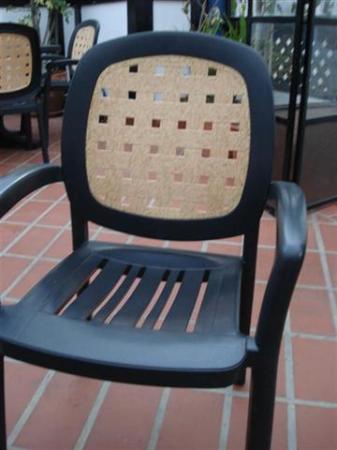
The raffia or rattan look

The raffia or rattan look

I admit my fascination with polyester resin garden furniture may place me in a small minority. My global study, superficial as it is, may make it an even smaller club. I hasten to add that this curiosity is entirely academic, or is that esoteric? I have never owned a piece of polyester resin furniture in my life and indeed have actively shunned it on aesthetic grounds but this does not stop it being a source of great amusement.

Polyester resin furniture is that cheap, plastic type which hit our stores well over a decade ago. Being low priced and functional, it pretty much took the bottom end of the market by storm as New Zealanders embraced the concept of al fresco living. In those early days, it came in three colours – white, dark green, and for those with slightly higher social aspirations, sophisticated sage green. That was it. I didn’t think about it much until we did a trip to Vietnam about eight years ago. In place of their traditional bamboo and cane furniture, there were the same polyester resin chairs and tables but not in our aforementioned colours. No, the Vietnamese ones came only in French blue and burgundy. Suddenly it dawned on me that this was a global phenomenon and somewhere, maybe, there was a little man in an office who decided which country was to get what colours. Without wishing to overstate my desultory interest, I started to take more notice. On the Sunshine Coast of Australia, polyester resin furniture was all white and cream. On the Greek islands, it seemed to come in old gold and white. Each country visited over recent years appeared to have only two, sometimes three different colours but all in the same design. So it was both a revelation and a terrible disappointment when I pursued this entirely random study in Spain and Portugal recently.

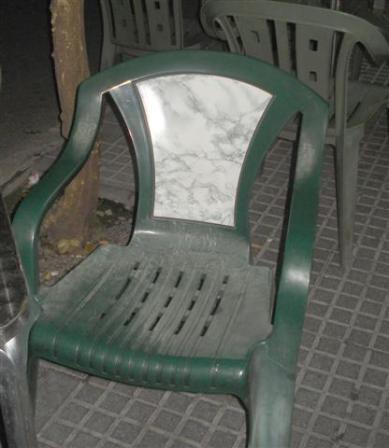
Marbelette or marbeline

Marbelette or marbeline

The revelation was the emerging sophistication. First there was the ubiquitous resin chair (in Cordoba, for those of a pedantic disposition) which came with inset mock marble seat backs. I was entranced, though I felt they should have been Italian in origin. A marbleine finish, a friend suggested, though I thought perhaps marblette. Undeniably naff, but then so is most polyester resin furniture. Is poly resin in a swirly marble design worse than the plain, unadorned poly resin?

Then there were the poly resin chairs of a cut out design which attempted to look like the white aluminium furniture forever branded with the name Enderslea which was in itself an attempt to reproduce the expensive, antique wrought or cast iron furniture we associate with the French provincial look.

I burst out laughing when I came across the poly resin furniture in a Portugese restaurant which emulated the woven raffia look. By this stage my travelling companion, who had started out somewhat incredulous at my fascination, was entering into the spirit of the quest and arranging the furniture for my photographs. Indeed, we even found some more upmarket poly resin chairs in a roadside bar in Seville. These were in a stylish and sophisticated charcoal and a square design. These, I thought, I could actually live with in my own garden but only if necessary.

The global corporate takeover

The global corporate takeover

But sadly, dear Reader, it dawned on me that my sociological study of this global phenomenon was showing too much variation for me to keep with my theory of the little man in an office determining distribution and colour. Not only that, but the true horror of globalisation and corporate sponsorship will see the end of regional diversity sooner rather later. Yes, folks, corporates like Coca Cola and Amstel have seen the possibilities of this ubiquitous furniture as cheap advertising billboards. National differences in colour are set to disappear in the face of the corporate red of Coca Cola or the Amstel colours.

Scientist daughter mentioned in passing that the production of poly resin is highly likely to be extremely unfriendly to the environment, that it is an amalgam of some real nasties and the cheaper the product is sold, the more likely it is to be produced in a country with poor environmental controls over its industry. You could argue that you shun poly resin furniture on green principles but then I always worry about how many little Indonesian orang-utan babies have been made homeless orphans by the continued harvest of Asian hardwoods so I am not sure that the bulk of outdoor wooden furniture is any more environmentally friendly. It is so very difficult to buy ethical and sustainable outdoor furniture these days, don’t you think?

The Enderslea look

The Enderslea look

The final word on this furniture came in a little garden we visited in Cornwall. The modest little afternoon tea set-up had camouflaged poly resin furniture. The tables (are they sometimes octagonal?) had pieces of hand-painted ply on top while the legs were encircled in bamboo stakes cut to size and tied together with jute. As I recall the chairs were draped in fabric and cushions. It seemed such a lot of effort to go to in order to mask the humble origins beneath but maybe she regretted the impulse which had seen her buy this cheap and practical outdoor furniture.

Almost acceptable styling

Rococo Gardening in Portugal

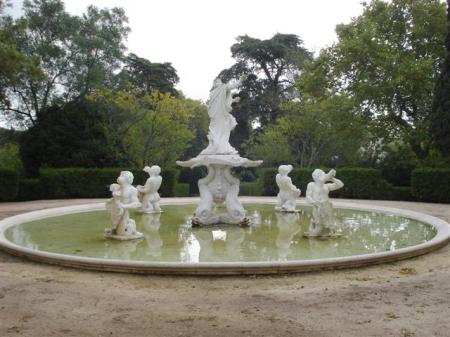
Just one of the eclectic collection of water features

Just one of the eclectic collection of water features

I had been warned not to expect too much of Portuguese gardens. That is despite Portugal having a much more equable gardening climate than neighbouring Spain. But there are only so many castles, palaces, cathedrals, ruins and medieval towns one can absorb and I am happiest in a garden. So when I reached Lisbon, I had already planned a couple of days of garden visiting. Sintra is a small town in the hills 30 minutes beyond Lisbon and it seemed the place to be with no fewer than three gardens of note in my guidebook to European gardens.

Alas the day did not go to plan. The light rain in Lisbon translated to very heavy rain and wind in Sintra. With the best will in the world, my sodden footwear, lack of raincoat and a small umbrella which was giving up the ghost and blowing inside out were simply not equal to the task. The water was teeming down the roads and visibility greatly reduced by mist. The gardens of Sintra were destined to remain a mystery though I could see why they were lusher and greener than other areas.

With intermittent showers the following day, I was not going to make the mistake of returning to Sintra but opted instead for the gardens at the Palacio de Queluz, a mere 15 minutes by train from Lisbon and hailed, in my guidebook, as “the best rococo gardens in Portugal – perhaps even in Europe”. I vaguely recalled Elton John’s garden in the UK being described as rococo and, had I thought about it, I may have conjured up a mental image of gilded cherubs and heavy decoration in the Baroque style. That doesn’t even hint at the extent if it, although there was no gilding.

Borrowing from all styles of history

Borrowing from all styles of history

Up until my visit to Queluz, Britain’s Prince Regent, George, held the crown of naff in my books with his self-indulgent, OTT royal pavilion in Brighton. Restrained good taste is not synonymous with breeding and wealth. A penchant for flamboyance will triumph and the gardens at Queluz left the Royal Pavilion for dead. To be honest, the whole thing was a little down at heel but European countries have an abundance of historic places to maintain at vast expense, and I am guessing that the palace at Queluz may be rated as less important than other premier attractions in Portugal. The palace was pink. Yes, pink and palatial in proportions, though most of it was only double storey. The whole shebang dates back to the 1700s and the royal family of Portugal used it as a summer retreat, somewhat akin to Versailles in France. The exterior of the palace itself was heavily ornamented and the gardens, the work of a French jeweller of the time named Jean-Baptiste Robillon, were designed to spread out from the front of the palace.

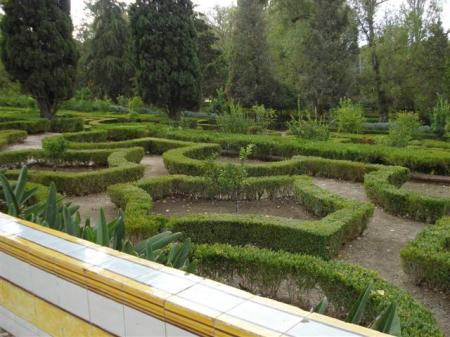
This rococo garden was all about simplicity of form overlaid with elaborate ornamentation. So there were long avenues radiating out and formal gardens, all defined by clipped buxus and pencil cypresses. Form is everything and I was struck by the importance of allowing sufficient space for wide paths. In New Zealand where we specialise in large gardens, too few demonstrate the courage of allowing generous paths, wide enough for maybe six people to walk abreast comfortably. It gives a sense of space and grace in a larger area.
More about style than plants

More about style than plants

Plants were just soft furnishing in this garden. There was nothing of botanical note – some Magnolia grandiflora from America (introduced to Europe around the 1730s but I don’t think these were original plantings), agapanthus, lindens, planes and eucalyptus. Waist high buxus hedges were of clipped sempervirens, shoulder height ones looked to be Buxus wallichiana. Formal gardens were defined by buxus hedges but often the compartments merely held a citrus tree or were left empty. In one area, clipped buxus was planted in a series of serpentine waves. It is all about form and shape, not about plant interest.

Add in the ornamentation. At every turn possible. The more elaborate and detailed the better. Goodness only knows how many statues and water features, scalloped pools, round pools, a large rock waterfall (with no water running on the day I visited and stuck in the middle of long vista so it made no logical sense and merely looked contrived), tiling, balustrades, urns – the more the better. Stylistically, the ornamentation is borrowed from pretty much every period in history. The exuberance was overwhelming.

A hint of mausoleum style in the canal garden
A hint of mausoleum style in the canal garden

Gild the lily further

Gild the lily further

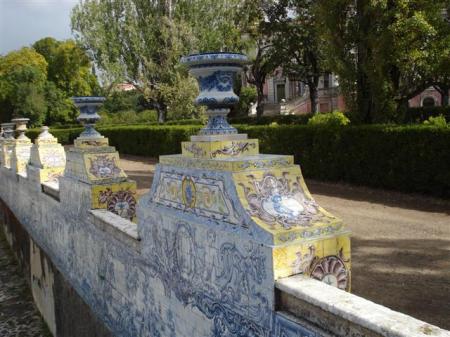
The piece de resistance were the tiled canals at the end of the garden. A natural stream had been channelled through paved canals, designed with locks so that the water could be held back to raise the level, apparently to hold barges filled with musicians to entertain the royal family and their guests. Pity the poor peasants downstream whose water could be withheld at the royal whim and then possibly released in a wild woosh.
The canals were lined inside and out with glazed tiles predominantly in blue and white (though sometimes in yellow, blue and white), depicting murals of shipping scenes, courtly matters and still life representations. These have withstood the ravages of time over several hundred years and are still in good condition and quite bright. Apparently the Portuguese, like the Spanish, are happy to gild the lily even further- in a heavily decorated scene, add some more detail – so colourful urns adorn the plinths, statues stand guard and steps are constructed and tiled in a manner reminiscent of a mausoleum. The effect was quite astounding.

This is not a style of gardening that is intended to sit easily in the landscape with boundaries between garden and nature blurring, in the style of the English romantic tradition. Nor does it have anything to do with the Japanese gardening traditions of symbolism, restraint and control. It is a long way from the Moorish traditions next door in the south of Spain which are all about restfulness, shade, cool and controlled use of spaces. This is more akin to the historic version of Kath and Kim: “Look at me! Look at me!” It is an ostentatious show of wealth with a certain frivolity within its extravagance and flamboyance. Decoration and ornamentation are the dominant features. I am not surprised if indeed Elton John has the late twentieth century version of a rococo garden.

As a final thought, when our children were little, Para Rubber used to sell a blue, scalloped shell-like plastic affair for use a paddling pool. Possibly they are still around. I hadn’t realised that these had their derivation in the rococo style, along with the hinged clam-shell style of sandpit.

In the Garden: October 22, 2010

· While Labour Weekend is the traditional time to get the The Great Summer Veg Plant Out done, the lingering cool temperatures, wind and rain have mitigated against it this year. The soils have not had much of a chance to warm up yet. Don’t rush it especially if you are in a cooler, inland area. A week or two is neither here nor there.

· Priority for planting out when conditions are suitable are the crops which require a long growing season which include aubergines, capsicums, cucumbers, both rock and water melons, kumara, tomatoes and corn. If you have starter plants of these in small pots under cover, be careful about planting them straight out in the open in either blazing sun (unlikely) or torrential ran. You may need to give them some protection while they get established. Cut off soft drink bottles can work as can plastic bags held up by sticks if you don’t have a cloche. A single sheet of newspaper will protect them from the bright sun. You can avoid this by hardening them off gradually over several days by exposing them to a few hours of direct sun only.

· If you are not planting out the little plants yet, make sure that they don’t get set back by being held in pots that are too small or by forgetting to water them. They rarely recover well from such set-backs.

· Clematis are rocketing away and most need something to climb up. If you leave them any longer, you will cause a lot of damage trying to get them to grow in the right direction. A bamboo tepee is a quick and easy solution.

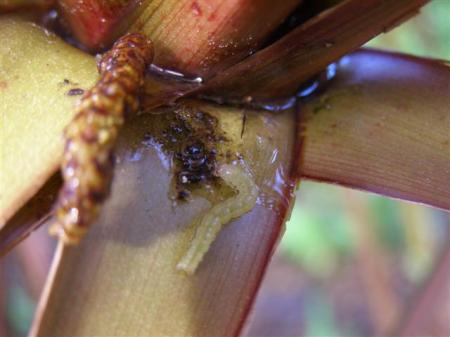
Greeblies in the cordyline

Greeblies in the cordyline

· The caterpillars that chew holes in our native cordylines (cabbage trees) are at their most active. These are the progeny of a native moth (which is why NZ cordylines overseas look so clean and smart). On small plants, running your hands up the base of the tufts of leaves can effect a good kill. On larger plants, if you want clean foliage, you will have to spray with an insecticide. If you look, you may be surprised at what other greeblies your cordyline is hiding, including slugs and snails.

· Esteemed colleague, George Fuller, tells us that it is not a rust that causes orange blotching on renga renga lilies (arthropodium) but in fact a nematode (or wire worm). These critters can build up in a patch over time so if it worries you, it may be necessary to resort to using a systemic insecticide. A systemic insecticide is one that the plant absorbs as opposed to contact insecticides which only kill with a direct hit. The nematode is actually in the plant and it is the same one that attacks chrysanthemums and black currants, answering to the name of afelenchoides ritzemabosi.

· As evergreen azaleas finish flowering, it is time to trim them. These are a forgiving plant which means you can trim back to bare wood and they will shoot again but do not delay if you plan on cutting hard because you want the plant to be flushing with spring growth to help its recovery.

· It is safe to plant both green beans and runner beans now. These are very worthwhile crops for the home gardener, giving good yields and planting successional crops of green beans two weeks apart will extend the harvest season.