Category Archives: Abbie’s column

Abbie’s newspaper columns

A hot, dry autumn in Spain and Portugal

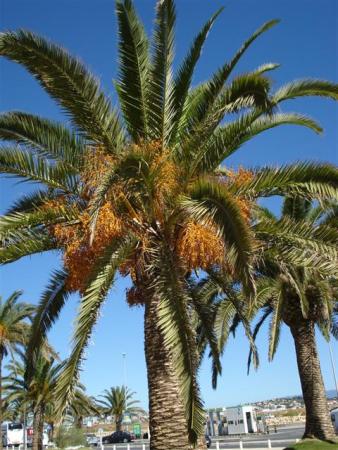
The ubiquitous date palm was everywhere in the south of Spain and Portugal

The ubiquitous date palm was everywhere in the south of Spain and Portugal

Even as September melts into October, Spain is hot and dry. Alas Professor Higgins had it entirely wrong when he made Eliza Doolittle recite that the rain in Spain falls mainly on the plain. He certainly was not referring to the plains beyond Madrid where the rain clearly falls on rare occasions at best. They are dry and arid, too inhospitable even for the hardy olive tree. Nearer the mountains (the sierras, but more hills than mountains by NZ standards), it is clear that more rain falls. There were olives as far as the eye could see. Don`t be imagining romantic old olive groves. This was monoculture on an industrial scale (viz a viz Blenheim vineyards). I had to ask about harvesting. It seemed incomprehensible that such vast acreages are still picked by hand but apparently that is the case. Teams of itinerant pickers, many of North African origin, travel the area at harvest time. I suspect I have seen the origin of all the imported olive oil on the shelves of every supermarket at home. Maybe.

The olives are usually planted in groups of three, each leaning outwards to grab its own space, and pruned to around 2.5 metres in height. Presumably this makes picking easier because the olive tree, left to its own devices, reaches higher. We are working to keep our one at home down to about 4 metres.

The olive plantations looked to be corporate farming, much as our dairy farming is headed. The era of the small family farm appeared to be over in much of the countryside that we passed through. Often there were no residences visible for considerable distances and no indications of boundaries to suggest the smaller holdings of old. It was interesting to reflect on the debate at home regarding lifestylers populating our countryside. We had been discussing it before I left and came to the conclusion that, on balance, small holdings and lifestyle blocks add a welcome diversity to the countryside. Without lifestylers planting gardens, shelter belts, home orchards and landscape trees, Taranaki could well become even more of the unrelieved green desert favoured by modern dairy farming methods. In the centre and south of Spain, it is not a green desert but red-brown dirt with multitudinous grey-green olive trees and not a lot else.

In urban areas, living is in high density housing, usually 3 to 5 stories high. I peered at balconies and roof terraces, looking for signs of green-fingered locals which is so evident in British high density housing. It is not here. I came to the conclusion that your average Spaniard does not nurture an irrepressible desire to grow plants and the G.I.Y. (that is: grow it yourself) and back to nature drive that is currently so strong in NZ, Australia and Britain is not to be seen. Any outdoor space is rare. The delightful inner courtyard or patio which has a debt to Moorish ancestors must be the preserve of the wealthy. A mere six, or maybe nine square metres of outdoor space is a privilege in many parts of urban Spain. But in a climate where temperatures can soar to 40 degrees (and stay there), a cool house is more desirable than al fresco living.

Were it not for the public plantings, this would be an even more austere environment. Fortunately, there has been a heavy investment in greening urban spaces in recent times. Not grass, which does not grow here unless irrigated. Ground surfaces are all paved but trees are being planted in abundance. Madrid has the harshest of climates – very hot and dry in summer and remarkably cold and dry in winter – so there is not a large plant palette to work with. The stately plane tree is the most dominant but it was interesting to see the number of Australian plants being used, most notably the good old gum or eucalyptus.
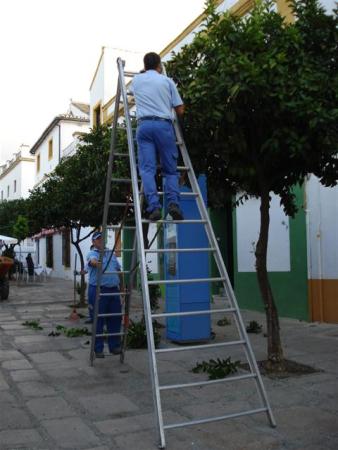
Clipping the street plantings of orange trees to lollipops in Cordoba

Clipping the street plantings of orange trees to lollipops in Cordoba

We just do not grow plane trees well at home in Taranaki (we are too wet and they are inclined to drop limbs too readily) so we don´t get to enjoy their wonderful bark. There does not appear to be any fear of large trees. The bigger the better for they provide welcome shade.

Cordoba has a milder climate and orange trees dominate as a street tree. Flowering time must be magical with the strong scent of orange blossom hanging in the air. I briefly indulged a fantasy of the entire local populace being able to gather tree-ripened oranges in season. After all, they have nowhere to grow their own. No. I was told that it is a bitter orange which is harvested commercially and shipped off to the jam factory!

By the time we reached Cadiz on the southern coast, it was the palm tree that prevailed. As far as I can work out, (and I freely own up to the sparsest knowledge of palms at best), it is almost exclusively the common date palm which Google tells me is Phoenix dactylifera. It is certainly a most handsome palm and remarkably tolerant of salt winds, growing even on the waterfronts. Mind you, it is so common that locals may well take a scathing attitude similar to Taranaki people with our adaptable pohutakawa.
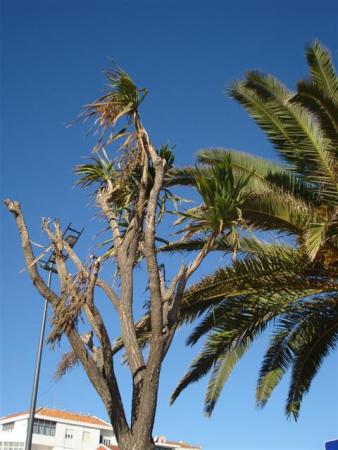
The cordyline australis had seen better days on the Algarve but had done well at some stage to reach this size

The cordyline australis had seen better days on the Algarve but had done well at some stage to reach this size

Crossing to Portugal, it became clear that more rain falls. I even saw a little green grass with no evidence of irrigation. In Lagos where I write (prounced Lagoosh and not to be confused with Lagos in Nigeria), the date palms continue but the real delight is the large number of blue-as-blue jacaranda trees which continue to flower even as autumn starts. The New Zealand cabbage trees interplanted between the date palms by the river do not look such happy campers, alas.

Yuccas and oleanders flourish everywhere – both plant families which prefer drier conditions. But just to prove that bad taste crosses all borders, the new cultivar of oleander favoured in public plantings in Seville was a thoroughly nasty novelty selection – yellow and green variegated foliage with dirty pink flowers. I think we saw a new spirea sporting a similar colour scheme in the United Kingdom last year.

Tales of the gardens I have visited will have to wait until after I return. Yes there are gardens and the historical gardens of Andalucia are rooted in impossibly romantic Moorish architecture. At the time of writing, I have yet to see the famous gardens of Lisboa and Sintra in Portugal. I have contemplated an Outdoor Classroom on the DIY Moorish garden but the prospect scared me. The likelihood of achieving something unbelievably naff is greater than the likelihood of successfully adapting such a unique and culturally distant style to home!

Just as well we don't need yew wood for longbows here

Taxus baccata fastigiata - no longer fastigiate in our rockery

Taxus baccata fastigiata - no longer fastigiate in our rockery

A little piece on yew trees in our local newspaper garden pages started us talking about them. They are a most interesting plant. It is just a shame they are not generally happy in Taranaki conditions and there are reasons why they have never featured large in New Zealand gardens and plantings.

We have one feature yew tree still surviving here, a venerable specimen of what is probably widely known as the Irish Yew – Taxus baccata fastigiata. At some point it keeled over at an angle and decided to stay there so we clip it tightly once a year and it resembles a kiwi body (minus any head) as a feature in our rockery. I say venerable, but that is venerable by New Zealand standards – as in probably 60 years old – not venerable by British and European standards where yew trees can survive for a very long time. Many hundreds of years is common and the oldest known tree at Fortingall in Scotland is thought to be somewhere between two and five thousand years old. Astonishing. We used to have many other yew trees here. Mark’s parents were as heavily influenced by English gardening traditions as others of their era and yews are an integral part of that. But over the years, many have, as we say, whiffed off which is our way of describing plants that die from root problems. If you look at where yew trees thrive, it is generally in colder, drier climates and their natural habitats in Britain are on chalk soils. We occupy the cheese side of the chalk and cheese equation – nothing even remotely resembling chalk soils here, thank goodness. We would not try planting more yews here – there are other plants we can grow better in our conditions.

Added to that, another reason why yew trees have never been a big hit in New Zealand is that we still have very strong rural roots and yews are deadly to stock. We know. The remains of our golden yew killed four of our beefies when they got into the paddock with the fire heap in it. This is not at all a suitable tree for country folk to plant here.

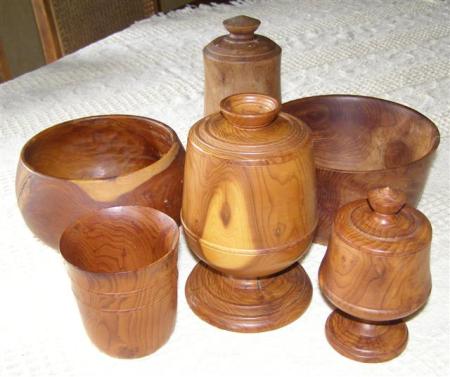
Mark's little collection of treen turned from yew

Mark's little collection of treen turned from yew

The fact we can’t grow them well does not stop them from being an interesting plant. They are pretty sacrosanct these days in Britain but if you ever come across anyone cutting down an old yew, get down on the timber. Mark pretty much destroyed a chainsaw cutting into one many years ago (it wasn’t the yew that was the problem – it was the metal stake that somebody had driven in to support the plant and left there to be hidden as the tree grew). But when he came to turn the timber on his lathe it was not only one of the very best woods he ever used – he described it as being like turning hard butter – it also had one of the richest and most varied grains and markings you will ever see. We still have an assortment of treen turned from that one tree. Unusually for timber, the pale sap wood is also durable.

While there are other yew species from Japan, Canada, China and North America, it is the European form of baccata, also known as the English yew, that is the most widely used. It belongs to the family of conifers and its leaves are needle-like. These days it is highly rated in its homelands as a garden plant for specimen, hedging or clipping because it grows slowly, doesn’t ever get too large, it sprouts from bare wood and so lends itself to long-lived topiary and formal hedges where its fine, dark green appearance acts as a splendid punctuation mark in the garden. It is one of the main topiary candidates in English gardens. It is most commonly found with a spreading habit, not upright. In fact the vertical yews which make such splendid pillar shapes, are a far more recent addition dating back just two hundred years to a mere two trees selected in Ireland. No doubt other forms have been discovered since, but the so-called Irish Yew is identified as fastigiata (fastigiate just means tall and narrow) and is traced to those two specimens.

In its natural state, the yew is dark green but it can sport to a yellow variegation and in a country with a long winter, British gardeners continue to value yellow foliaged plants for a spot of colour whereas we tend to shun them in this country. Our most recent yew to kick the bucket (and not greatly mourned) was a specimen of the Golden Irish Yew. I don’t care if yew trees are all class, I still don’t go for yellow variegated conifers.

It may be as garden plants that the yew family are valued nowadays but that was not always the case. They have a history steeped in warfare. For it was the development of the longbow that made Britain a military force and yew wood made the best longbows. As far back as the thirteenth century, England was importing yew wood from Europe and the local supplies were under huge pressure. Within a hundred years there was a serious shortage and in 1350, Henry 1V basically nationalised all the yew trees in Britain so they could be harvested to meet the needs of the royal bowmen. Not only that, but trade with Europe was dominated by the supply of yew timber and within the next couple of hundred years, Bavaria and Austria were stripped of all their native yews to supply bows for the King of England’s archers. The move to firearms at the end of the sixteenth century had more to do with a lack of adequate supplies of yew wood left anywhere in Europe, rather than technological advances. Given the warmongering tendencies of the Middle Ages, it is a bit of a miracle that any yew trees survived in the wild anywhere in Britain and Europe.

Many, if not most of Britain’s significant yew trees survive in churchyards and there are many theories abounding as to why they are such a common tree there. It may just be that a respect for the church meant these specimens could not be plundered for the making of longbows.

There was considerable angst amongst conservationists and historians when researchers first found that Taxus baccata had natural compounds which could be used in the manufacture of a new drug to treat cancer. It seemed that the future of the remaining yews could be under threat because it takes a vast amount of raw material to yield a small amount of the compound. The loyal British gardeners rose to the occasion. When the call went out for them to gather up their yew clippings to contribute to research, apparently they did so in droves. It was sufficient to progress the research to the point where the compound could be manufactured synthetically in a laboratory.

The future of the yew tree seems secure.

Taking a second look at camellias as garden plants

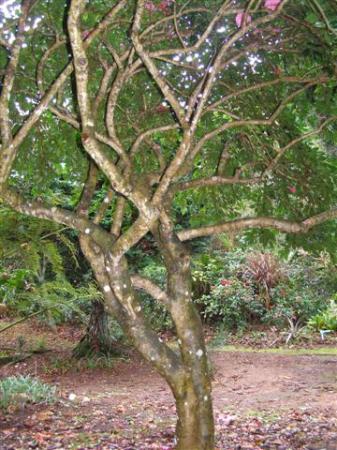
Make your old camellia bushes work at more than one level as garden plants

Make your old camellia bushes work at more than one level as garden plants

The scourge of camellia petal blight continues unabated. This was one disease we could have done without in this country and the sad thing is that when it was first discovered in Wellington, it was limited to two or three locations. Had all the infected plants been incinerated immediately, this nasty fungal ailment may have been eradicated. So if you have been looking at your camellias, particularly the most common japonica types (which takes in most of the lovely formals and the really showy blooms), and thinking that their display ain’t what it used to be, you are right.

We have always had botrytis in this country which can turn blooms to a dark mush but is generally not devastating. Modern camellias have been bred to be self grooming – in other words they drop spent flowers rather than holding them onto the bush and giving that unattractive look of some of the very old varieties still around.The trouble with camellia petal blight is that it seems to glue the flower to the plant so it defeats the self grooming process.

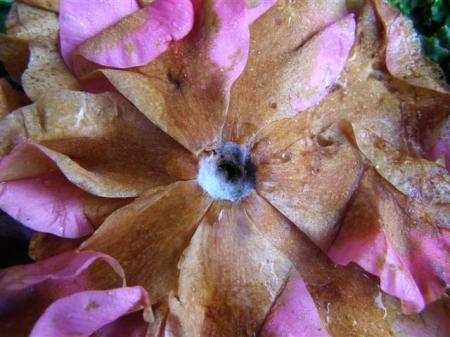
The sad sight of camellia petal blight

The sad sight of camellia petal blight

If you are wondering whether you have camellia petal blight, I would be very surprised to hear that you haven’t. It is unstoppable and untreatable. Well, you can treat your plants but you will just get reinfected. Being a fungus, the blight is spread from spore and I recall reading of it being tracked 5km on the wind. So if anybody has a camellia bush within a 5km radius of you, you are in trouble. If you go out and look at your camellias, you will likely find beautiful blooms with a nasty brown stain starting across some of the petals. Within about 24 hours, that bloom will have turned to a light brown colour. If you pull off the flower, turn it over and pull off the calyx on the back (that is the little green hat that holds all the petals together in the middle), you will find the tell-tale ring of white powdery web. That is camellia petal blight. If it is blacky-grey and the spoiled bloom is a darker brown, it is botrytis.

Camellias used to be second only to roses for the volume sold in this country. The bottom has pretty much fallen out of the market now and the volume sold is a fraction of what it used to be. I married in to a leading camellia family. Les Jury, Mark’s uncle, is still remembered internationally, long after his death nearly 30 years ago, for his huge contribution to camellias including such classics as Jury’s Yellow, Anticipation, Ballet Queen, Elegant Beauty and so many more. In his day, Felix Jury was far better known for his beautiful camellias than his magnolias – Waterlily, Dreamboat, Mimosa Jury, Rose Bouquet, Itty Bit and many others. Mark carried the mantle, encouraged by both his uncle and his father, until the day he heard that petal blight was in this country. He ceased all work on breeding camellias immediately and it is only now, well over a decade later, that he is starting to see directions he can take.

All this is such a shame because the camellia remains an enormously useful plant. It is just that we have traditionally seen it primarily as a plant to grow for its flowers. With the huge hit on its flower power, we are tending to ignore the other possibilities and positive aspects.

  • Camellias are unrivalled as a source of nectar for our tui and bellbirds through the winter. Singles and semi doubles with visible stamens will bring the birds to your garden.
  • Camellias remain fantastic hedging. They will sprout again from bare wood and most will tolerate dreaded salt winds. They only need trimming twice a year for a formal hedge and almost never for an informal look or windbreak. For our money, they remain one of the very best hedging options.
  • Autumn flowering sasanqua camellias do not get hit by petal blight. Not at all, that we have ever seen or heard.
  • Red flowered camellias still get petal blight but it doesn’t show up anywhere near as badly. The showiest displays we have had this winter have mostly been from red flowered varieties.
  • Reticulata camellias are commonly in shades of red and have such big flowers that they have sufficient weight to drop cleanly. They continue to put on a splendid display.
  • The little miniatures and single flowered types have many more buds and flowers and, by their very nature, each bloom only lasts a few days so they are usually over before petal blight gets to be unsightly.
  • Camellias are an unsung hero for topiary and clipping. If you get away from the few with really grungy colour and a tendency to turn murky yellow, most camellias have terrific foliage.

Clipping and shaping has never featured large in this country. While we may say that this is because we prefer a more natural look, gardening by its very character is an exercise in controlling and manipulating nature. It is more likely that we lack the labour force to clip extensively and we lack the cultural context to create entire scenes from clipped plants in the traditions of England, Italy, France, China and Japan. While yew and buxus are common clipping candidates overseas, the ubiquitous camellias grow so very well here that they give us an unexpected option. They are evergreen and not generally fussy. They sprout from bare wood so you can cut them back hard and they are very forgiving if you get the cuts in the wrong place. Clipping encourages bushier growth. Many people have large, mature specimens in their gardens so there is an abundance of raw material out there. The flowers then become a bonus not the prime reason for growing the plant. You will still get lovely flowers, just not as many as you used to and they won’t last as long.

If you have gone off your camellias, try getting out there and clipping before you cut them out. Balls, pillars, obelisks, clouds, free form shapes – there are lots of options if peacocks, animals and other birds do not appeal. A camellia bush can continue to justify its place in the garden if you make it work at levels other than just being a pretty flowering shrub.

Learning from the Old Country – the appeal of traditional English crafts

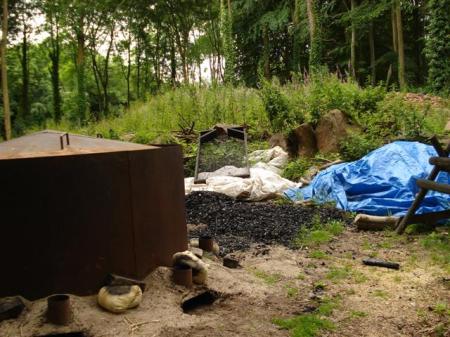
Reality didn't quite match the romantic mental image - charcoal making at Hestercomb

Reality didn't quite match the romantic mental image - charcoal making at Hestercomb

Prime Television appears more willing to deliver gardening programmes to us than TV1. Clearly the head of programming on the state owned channels is no gardener – maybe we just don’t fit the target demographic? It seems a long time since we have had any garden programme, good or otherwise, on state-owned television but Prime are currently running a doco series on the famed Sissinghurst Garden on Friday evenings.

For those of you not in the know, Sissinghurst Castle Garden in Kent is one of England’s most famed. Created in the first half of the twentieth century by a flamboyant and eccentric couple, Harold Nicholson and Vita Sackville-West, it was cutting edge in that very pretty, flowery style the English do so well, confined within tight, formal design. It certainly helps to have huge walls and castle remnants including a splendid tower. Alas it fell prey to England’s savage inheritance taxes so the Nicholson and Sackville-West progeny could not afford to keep it in private ownership in the 1960s and it was given to the National Trust with the proviso that the family be allowed to occupy the house for up to three generations. The current occupant is the grandson, Adam Nicholson and his wife Sarah. It does appear that Adam sees himself as the guardian of their dream though it is the National Trust which provides the money and the labour force to maintain the dream. The rather drawn-out series is worth dipping in to even if you don’t find it sufficiently compelling to last the full hour each week.

You need Sky and the Living Channel to tap into some of the other back to nature lifestyle programmes coming out of Britain these days. I think it was a Grand Designs episode (also screened on TV3) that finally spurred Mark in to some serious attempts to get to grips with sustainable woodlots. We watched one man hand building his house primarily from green chestnut, harvested from his sustainably managed woodland. In New Zealand we are so used to the notion of kiln drying or air drying timber to season it, that there is little knowledge about which timbers can be used freshly cut and still wet. That is what the term green oak and green chestnut refer to, though to use fresh-cut timbers you must also understand the way each different wood will react as it dries out. We are not talking pinus radiata here.

I don’t think Mark is intending to go into building, but he is certainly interested in sustainable woodlots at a lifestyle block level. We get through a lot of wood here (most of it burned for heating) and while we are currently self sufficient in firewood, we can take that principle further.

Then there is the series on Saturday evenings on the Living Channel where selected candidates learn traditional English crafts. It is hosted by Britain’s very own Expert on Many Things, Monty Don. The first programme was fine – it had the participants learning traditional methods of making furniture using green woods (naturally from a sustainably managed woodlot). The chairs they made were delightful and I would be more than happy for Mark to get back into working with wood. He used to do a lot of it in the days before we had expensive children to maintain and he had more leisure. In fact he became an accomplished wood turner and we still have his lathe in the back shed though it has lathered there in pieces for thirty years under the delusion that he will get back to it. He bought it when we lived in Dunedin and it was entirely rebuilt for him at no cost other than a couple of turned lamp stands by someone who knew someone who worked in the Hillside Railway Workshops. Back then they called such freebie jobs “foreigners”. We still recall those railway workshops most kindly though Richard Prebble’s analysis of how New Zealand Railways operated was probably closer to the mark than many people knew.

The third programme in the series was safe enough – blacksmithery or forging. Mark watched with deep fascination and commented that they made it look really straightforward but I don’t think he is going to get diverted into ironwork. Nor to weaving or leadlighting which have also been explored.

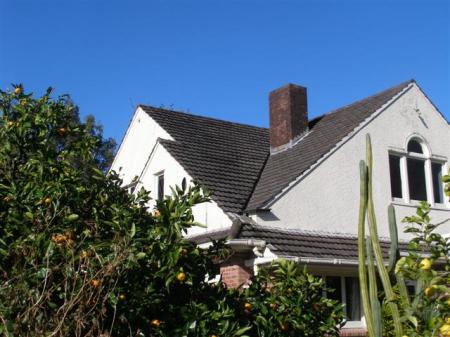
From this (1950's concrete roof tiles)....

From this (1950's concrete roof tiles)....

No, it was the second programme that is causing me some angst – thatching for beginners. Everybody knows that traditional English thatched cottages are unbelievably cute, genuine chocolate box cute. It is just so much more aesthetically pleasing and indeed environmentally sustainable than our long-run roofing iron. And the life expectancy of each layer of thatch is about the same as roofing iron – forty years or so – though finding a skilled thatching team to repair your roof is harder than finding a team of modern roofers. It should be said that apparently you don’t replace your thatch, generally you just add another layer to waterproof the roof. The principle is that the thatch is packed so tightly that it directs the water downwards and sheds it quickly.

... to this, maybe (thatched cottages at Hidcote)

... to this, maybe (thatched cottages at Hidcote)

You don’t want a house fire. I have seen a burned out shell. Once the thatched roof catches, it is impossible to quench. Beneath the more recent layers, there may be dried straw or reeds which are 500 years old. Personally I am a bit worried about spiders and mice too. And maybe other livestock. I feel that the dry and warm under-layers of thatch may be altogether too appealing for them and they might set up home en masse.

So I began to get a little worried by the level of interest Mark shows in thatching, more than a little worried when he commented that he felt our house would look a great deal more appealing with a thatched roof. He has even tried making one of the packed bundles which are the foundation of thatching. With a gleam in his eye, he announced that he could now see a use for his buckwheat straw. It was with some relief that I saw the straw recycled as mulch for the strawberries and he observed that maybe he would be better to start with a smaller project than the house, perhaps a thatched dovecote.

We have yet to get an episode on making charcoal but I am sure it will come. The British are big on charcoal and, in the near absence of the gas-fired barbecue, charcoal is still popular (though these days it is more likely to be cheap charcoal imported from defoliating third world countries). We realised that charcoal-making is undergoing a renaissance when we visited Hestercomb near Taunton last year. The garden map showed a site for the making of charcoal. We were inspired. We even bought a book on the topic – this could be the novel activity to attract additional visitors to the garden. Or so we thought, until we came to Hestercomb’s charcoal campsite. The only aesthetically acceptable aspect was the repro charcoal maker’s hut which may have been cold and drafty and minus a resident charcoal maker but it was at least quaint. No, we figured we would leave the making of charcoal to the Taranaki Regional Council. It seems a suitable activity for the folksy rebranding of their garden at Kaponga. I wonder if I should offer to loan them our book on the topic?

Beware the bangalow (Arcontophoenix cunninghamiana)

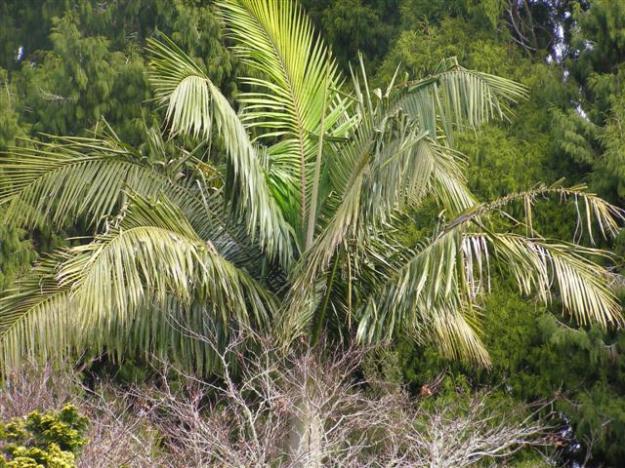
A very handsome palm in the landscape, but scary weed potential

A very handsome palm in the landscape, but scary weed potential

The newest weed in the garden here is a palm. Not the native nikau palm, although that too seeds down freely and we regularly cull self sown seedlings. By definition, we don’t regard natives seeding down as weeds. No, the offending palm is the incredibly popular and very attractive bangalow palm. We have had it in the garden here for decades but it is only recently that it has started to set viable seed. It is a bit too efficient in the seeding stakes and, being attractive to birds, it has been dispersed throughout our entire property at a scary speed.

When alarm bells were first sounded in the Auckland area about bangalow palms, the howls of outrage and denial from within the nursery industry were instant and loud. We watched with a desultory interest and felt that it might not have been our industry’s finest moment. We need to take some responsibility for what we produce and we certainly have enough noxious weeds in this country without knowingly adding more. So we should look at the facts and the information, rather than immediately assuming that out of control bureaucrats are trying to control our livelihoods. The howls of alarm were such that the proposals to ban its sale were put on the back burner and its status is part of a five year review so nothing will happen quickly.

The so-called Chinese Windmill Palm (Trachycarpus fortunei) is also under threat of reclassification as noxious weed. While it has not proved a problem here in our garden, Mark has seen it seeding down and giving rise to a thicket of babies in the Nelson area. I have just found a photograph in the Encyclopedia of Cultivated Palms showing it naturalised in Switzerland. Plants with a climatic range from Switzerland to Nelson and Northland have scary potential. Trachycarpus fortunei is enormously popular throughout the world because it is generally hardy but with that tropical and exotic look so frequently sought by gardeners irrespective of nationality. The big advantage of trachycarpus is that you need both male and female plants to set seed so if female plants were culled, it would not be a problem. Our specimens in the garden here are male so no seed is formed. And Mark’s guess is that the seed is not spread by birds because it only seems to fall to the base of the tree and sprout there, which makes it much easier to contain. The seedlings can be mown off, grubbed out or sprayed. If it was spread by birds, we would hear a great deal more about it appearing all over the place in parks and reserves.

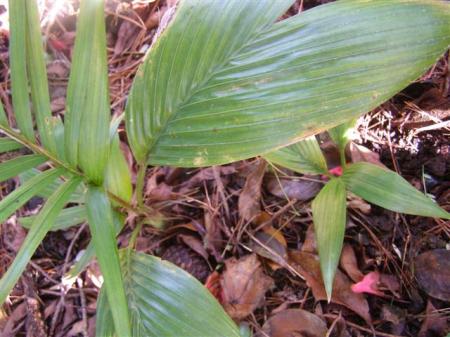
Side by side germinating self-sown bangalows

Side by side germinating self-sown bangalows

But it is the bangalow that worries us more and that is because of our personal experience. There would hardly be a square metre of our garden (which stretches across several acres) where we have not found a bangalow germinating and in those early stages, they closely resemble young nikau palms. Left to its own devices, this Aussie import will threaten our native nikau swamping out the habitat and growing at a hugely faster rate. The proper name is Archontophoenix cunninghamiana and it grows naturally in the coastal forests of southern Queensland down into New South Wales. It is a most elegant palm, tall and graceful and growing sufficiently quickly to give a fast result. It can reach 20 metres when mature, but like many palms, it takes up little space and casts little shade. It is easy to grow but it is also tougher than many palms and will tolerate cooler temperatures – light frosts, even – and damper conditions. It is that easy-going nature which has made it so popular and useful as a garden and landscape plant in relatively mild areas of this country. Alas, if it had only been dioecious, it could have had its wayward reproductive habits curtailed – dioecious meaning that you have both male and female and one of each is required for reproduction.

The bangalow seed is freely dispersed by that great seed dispersal machine that we have in our kereru or native wood pigeon. Presumably the seed casings taste delicious and the resulting guano gives the falling seed a good start after aerial distribution. And it sets a simply astounding amount of viable seed. When our specimen finally set seed for the first time, Mark just left it, noting how very decorative were the lavender flowers and bright orange-red seed hanging in voluptuous bunches. Within months, we were picking out the rash of self sown seedlings everywhere. We left one in the coldest, wettest spot in our garden just to see how it would grow. This is an area where Mark plants his treasures which need a winter chill – the deepest red hellebores, the Chatham Island forget-me-nots, trilliums and Himalayan blue poppies. Nowithstanding the fact that it comes from sub-tropical Australia, the bangalow is very happy there too, thank you. It is a worry.

It is still perfectly legal to buy and sell bangalows or Archontophoenix cunninghamiana in this country. If the prices I have seen on the net are a fair guide, you will pay around $150 for a reasonable sized one, up to an eye-watering $1700 for one already six to eight metres tall. For that sort of money, if you are starting out, our recommendation is to look at alternative varieties which don’t show the potential to be a noxious weed. It really does matter. Besides, as Mark will testify with the advantage of new information, it is an awful lot easier to plant something that will not require you getting out the extension ladder to take off the flowers and fruit when it is mature. Our recommendation, based on personal experience, is the Queen Palm, Syagrus romanzoffiana.

While on the subject of palms, which are a fantastic family of plants, we would like to pay tribute to the work done over many years by Colin Verlaan at The Palm Farm. Some readers may not realise this nursery is local but Colin has done more than anybody to make a huge range of palms available in this country at more affordable prices. Most of the palms you buy could be traced back to The Palm Farm as the main supplier. Colin has announced he is retiring and we think it might be for real this time (I am sure he has tried to retire before). While he may not agree with our opinion of the bangalow and the trachycarpus, we would certainly find common ground in admiring many of the magnificent and interesting palms he has made available. Mark has been gently building a collection of palms from him over recent years, concentrating on varieties which we think should be hardy in our conditions. He hopes to get his new Palm Walk planted sooner rather than later and is pleased he started work on it while he could still source a fantastic range locally.