Category Archives: Abbie’s column

Abbie’s newspaper columns

The perils of the monochromatic colour scheme in gardening

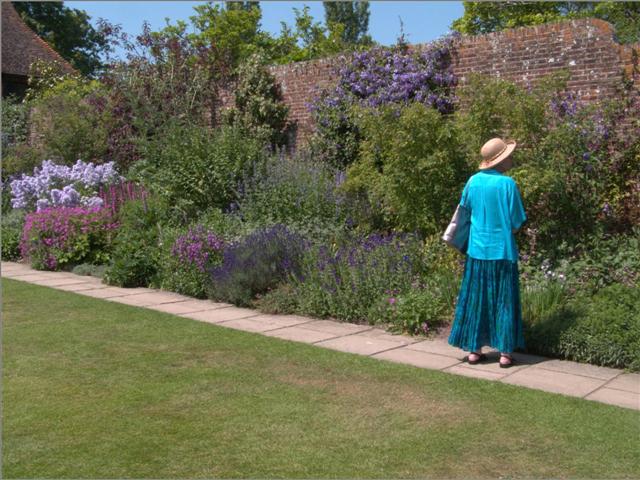
A random stranger in blue beside the blue and purple border at Sissinghurst

Back in the days when I first started writing this column and we were in the grip of seven day a week retail and mailorder plant supply, I used to despair at the numbers of well-heeled women in search of plants for their white garden. Mostly from Remmers, dear, and most had been to the ultimate white garden – designed and planted by Vita Sackville West at Sissinghurst in England. It was seen as the benchmark for restrained style and class and all wanted to emulate that standard. So all plants had to have white flowers and preferably be scented. Yellow stamens were permitted and cream was allowed but no other colour in the flowers. Fading out to white fell short and white flushed pink flowers were usually rejected as impure.

There were rules for foliage too. Green was fine, silver foliage even better. Variegations were acceptable as long as they were white and green with no yellow or red.

Apparently the secret of the white garden is revealed at night when all those pure flowers light up under moonlight to glow with ethereal beauty. Experienced gardeners realise instantly that this means it needs to be a summer garden because who wants to go out in winter or early spring to see the glowing white rhododendrons and camellias but not many white garden devotees of the early nineties were experienced. I recall reading a critique at the time that far too many of the white gardens were thrown together solely on the basis of colour. As long as it was white, it could be included. Gardens were criticised for the lack of thought given to planting combinations and inappropriate conditions for many of the plant subjects.

When we finally visited Sissinghurst, I was excited at the prospect of seeing the ultimate white garden put together with skill – where plant composition, shape and foliage combinations rule supreme, without the distraction of colours beyond white and green. Alas I was underwhelmed, disappointed. It rather looked to me like plants selected solely on flower and foliage colour bunged in together. So much for setting the standard. It may well have been different in the original days of Vita Sackville-West but in 2009 it didn’t quite cut the mustard.

Colour and flowers hide a multitude of sins. The purple border at Sissinghurst was far more successful on the day we were there and that in part could be attributed to the huge range of tones in blues and purples. There is not a lot of variation of hues of white and cream so it is harder to get visual oomph.

I suspect that monochromatic garden schemes are often the refuge of less experienced gardeners but in fact they require considerable knowledge and skill to get them looking good. They are not actually monochromatic because gardens have green as a base colour but that is generally treated as colour neutral. If you garden only with foliage or with foliage and only one additional colour, then form and texture are your tools and the plants you chose to complement each other and to fill the picture become critical. At its best, it is a restrained and disciplined approach to gardening which can be very restful to the eye. More often, alas, it is a hodgepodge – sometimes a pretentious hodgepodge – or downright dull.

The Tui NZ Fruit Garden – dear oh dear.

The latest update on this article is The Sequel, a second coming for Tui NZ Fruit Garden

Sally Cameron is attempting to punch well above her weight in her book The NZ Fruit Garden. Her main experience seems to be in food writing and cooking and she runs a catering company in Auckland. Her gardening credentials are very limited and it shows in this Penguin publication sponsored by the Tui garden products company.

There is nothing wrong with using a researcher to pull together a comprehensive book as long as the editor/publisher ring-fences her with an expert panel to review the information. There is no evidence that this was done. Alas, being a keen home gardener on the North Shore is not sufficient. There are too many errors and in places the information is simply not adequate. Even worse, there are sufficient instances of unacknowledged quotes to make me breathe the dreaded word: plagiarism.

All those multitudes of fruit trees and plants sold in the past two years need attention. Clearly the time is right for a manual. And a manual is what this book is. To be fair, it is a well-presented book designed to be used often – good-quality paper, opens flat and even has a thoughtful heavy-duty plastic cover. The majority of the book is an alphabetical listing of 58 fruits and nuts, each giving some information on the origin, recommended varieties and the where, when and how of growing them. In addition to that, the first 50 or so pages give a great deal of generic information on propagation, planting and care. At the end of the book, there is a section on pests and diseases and a monthly diary for maintenance and harvest tasks. From almonds and apples to walnuts, most of the crops you will ever want to try growing are included – along with quite a few that you cannot grow, though you are not likely to learn that from this book. Tui’s sponsorship is generally unobtrusive. Superficially, the book looks really helpful and the design is good. Sadly, looks can deceive.

I went to double-check some of the information on apricots, particularly the claim that ‘‘many people think they are subtropical’’. In New Zealand, we all know the best apricots come from Central Otago and nobody ever claims that area to be subtropical. According to Cameron, apricot trees are considered subtropical, which means they can tolerate temperatures from 0 degrees Celsius to over 35 degrees Celsius and still remain healthy. Puhlease. That is not a definition of a subtropical plant. Elsewhere in the book, she recommends them as a suitable crop for Northland. But worse was when I found the Wikipedia entry and thought it seemed familiar. It was. I had just read it in the book.

Cameron: There is an old adage that an apricot tree will not grow far from the mother tree.
Wikipedia: There is an old adage that an apricot tree will not grow far from the mother tree.
Cameron: Although often regarded as a subtropical fruit, the apricot is native to a continental climate region with cold winters.
Wikipedia: Although often thought of as a ‘‘subtropical’’ fruit, this is actually false – the apricot is native to a continental climate region with cold winters

The guava entry is a worry. Actually, it’s even more than a worry when I compared it to easily tracked online sources, to which it owes a rather large debt. Cameron: The guava succumbs to frost in any area – it is a tropical fruit after all. Even if summers are too cool, the tree will die back.

There’s a slight problem here. She is writing about the large growing tropical guava, Psidium guajava, which you may have tried eating in Asia (I found it disappointing). But what we can and do grow here – and which has similar hardiness to a lemon – is the strawberry guava, Psidium littorale. The recommended varieties and some of the photos in the Cameron book are of P. littorale, but they are included under the tropical guajava and there is no indication that Cameron knows the difference. In our 30 years of experience with growing littorale, it does not suffer from any of the hideous pests and diseases she lists at length. Added to that is the propagation information, which is bizarre. Why even mention air-layering when it is not recommended and is so rarely done in this country as to be virtually unknown? The reason: because it appears to be cut and pasted from an easily traced Californian website that was all about guajava. Had Cameron known her material, she would have explained that littorale is commonly raised from seed in this country.

Cranberries: what is grown widely and successfully in New Zealand and indeed is now branded the New Zealand cranberry is, in fact, Myrtus ugni. Most New Zealanders wouldn’t even know that it is not the true cranberry and that the fruit used for Ocean Spray cranberry juice and dried or frozen cranberries is, in fact, a vaccinium.We have never heard of proper cranberries being grown in this country, though presumably you could grow them in Southland, because they need cold temperatures and may be happy in the southern peat bogs. Presumably the author didn’t know about cranberries, because the book doesn’t even mention Myrtus ugni, which you can buy from pretty well every garden centre here, but instead is all about vacciniums. That is the problem with using overseas references without local knowledge. Even then the information given is contradictory. In one sentence, vaccinium is recommended for growing around ponds and other soggy areas. In another, it is recommended that you plant it in the coldest, wettest spot in your garden, but adds that the ground should never be waterlogged. Has the author never heard of the cranberry bogs in North America and seen the deliberate flooding of them? And honestly, what rush of creative frivolity led to the recommendation that they are suitable for growing in hanging baskets?

Gooseberries: according to this book, gooseberries need 800 to 1500 hours of chilling in order to fruit well. Really? What constitutes chilling? Is it temperatures below 5 degrees Celsius – 3 degrees, maybe – or below freezing? Nowhere is that information given, which means that it is very hard to start counting your hours of chill. And the huge range is questionable. Does the author mean that gooseberries require a minimum of 800 hours of winter chill below a certain temperature, but if your hours are much more than 1500 (which presumably takes you to alpine areas in this country), the growing season may be too short?

What the New Zealand reader really needs to know is that because gooseberries need a cold winter to fruit well, you are probably wasting your time unless you live in the centre of the North Island or from Christchurch southward. Measuring winter temperatures in hours of chilling is an American custom not usually seen in this country.

Avocados: the advice is that avocados do best inland away from ocean winds. This could be interpreted as suggesting that they will grow more successfully in Inglewood than Waitara, but we can tell you that in this part of the country, you can only grow avocados successfully in mild coastal areas. In fact, even in warmer areas of New Zealand, you can get frosts if you’re more than 5 kilometres inland. So in this country, avocados have to be grown in coastal areas. Again, I tracked the source of Cameron’s information to a Californian website.

The entry on lychees is lifted pretty much word for word from a copyrighted website belonging to the California Rare Fruit Growers (I started with Wikipedia and found it one click through.)

Under quinces, one of the photographs labelled quince blossom is in fact chaenomeles blossom. And while one of the photos of the fruit is indeed a quince, the other one is chaenomeles. And the photo by the quince header is, we suspect a crabapple. It is certainly not a quince. One is left with the uncomfortable suspicion that nobody involved with this book realised that quinces (cydonia) are an entirely different plant to japonica apples (chaenomeles).

I could keep going, listing the glaring deficiencies in this book. It is riddled with them. You can spend $45 on it if you wish and I am sure it will receive glowing reviews in other media because, superficially, it looks good. It is a book that was probably rushed out to meet a market demand and escaped anything but the most perfunctory of editing. It lacks rigour in every aspect. Near enough is close enough and it all looks just lovely, darling.

I don’t wish to be accused of going on a witch-hunt, but I turned back to Cameron’s earlier volume, The NZ Vegetable Garden, also published by Penguin and sponsored by Tui. I actually gave it a good review in this publication. I randomly inspected the garlic entry and went to check a rather odd piece of information. It took me all of two minutes to find a copyrighted website, http://www.garliccentral.com/varieties.html, which contributed at least some of the exact wording for page 116 in that book.

It should be an embarrassment to a credible publishing house like Penguin, but presumably nobody bothered to check for relevance, accuracy, or plagiarism. Looks are all in this current world of publishing and cut and paste has a lot to answer for.

POSTSCRIPT: My, but Penguin acted quickly to recall the book from sale. Given an advance copy of this column, they issued a recall within 24 hours.

Front page of the morning paper, no less.

There is life beyond buxus hedging

It is more about the lines and shapes, not the materials used.

Last week in Outdoor Classroom, I looked at some of the alternatives to buxus and came to the conclusion that there is nothing that really fits the bill when it comes to low growing hedges. And it is the low and slow Buxus suffruticosa that is the worst hit by the dreaded buxus blight and the hardest for which to find a suitable substitute. Sempervirens is the common buxus and it will make a large shrub or even small tree if you don’t clip it. Handy little suffruticosa is a dwarf form of sempervirens and the option that is commonly used when you want a little hedge around 30cm high.

Clipped hedges are essentially walls, usually green walls. Sometimes they are low walls, sometimes they are high walls but what they do is give some shape in a garden. The low, clipped box hedge is not about wind protection. It is largely about definition, formal lines and tidiness. The advent of buxus blight and the lack of an easy and cheap alternative to buxus may be a signal that it is time to look at alternative means of getting that definition. Maybe it is time to review the whole concept of tidy edgings and that is no bad thing where buxus hedging has become over-used and clichéd.

Tarting up the vegetable garden and turning it into a potager was all the rage coming up to twenty years ago and I, too, fell into the fashion trap. It took a lecture by garden historian, Helen Leach, to wake me up. She pointed out in no uncertain terms that it was completely impractical to vegetable garden surrounding by little buxus hedges. Vegetable gardens rely on constant cultivation of the ground and invading buxus roots make that impossible. Besides, the hedge provides nice, sheltered conditions for snails and slugs to set up residence and she is not wrong there. I got rid of the hedging I had inflicted on Mark and Felix and would suggest that gardeners worrying about the buxus hedging in their vegetable patch (potagers are so passé these days; the least you can do is refer to it as the kitchen garden) just rip it out and pretty up the area in other ways. Pavers, possibly used as stepping stones, are a great deal more practical to get defined lines. Raised beds can be used to define space if you want to go down that path. A spot of clipped topiary or matched vertical accents, even a pair of urns can give definition without compromising the prime purpose of the productive garden.

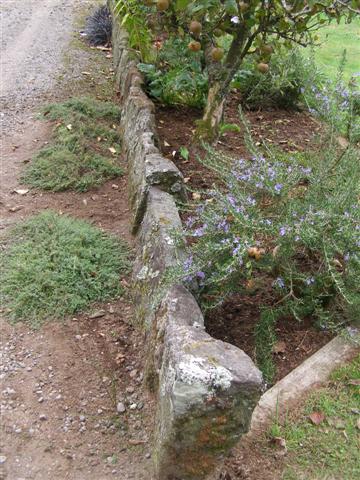
In the ornamental garden, it is a little different. Though after battling congested root systems to renovate mixed borders, I wouldn’t be wanting to use hedging as an edge- line for any gardens where I grow perennials or annuals which prefer not to compete for root space. Our preference is for more permanent materials which serve the same purpose without the maintenance and the problem of roots – in other words, low brick or stone walls about the height of a little buxus suffriticosa hedge, around 20 to 30cm. They take a bit to put in with poured footings and a mowing strip where laid beside lawn, but they are pleasingly permanent and they give the lineal definition that a low hedge also gives. Personally I prefer stone to brick, especially when it is a narrow, faced stone wall. I think it weathers better and looks wonderfully timeless without the slight garish aspect that even recycled brick can give but it is also the most expensive option in terms of time and requires a much higher level of skill to construct.
We have been laying a low brick edging this week to formalise a previously casual, rather wayward area. It is a situation where it would have been common for many to go in with a low buxus hedge but it all serves the same purpose – to channel the eye straight down to a longer view, to give definition and form to that particular border and to stop the birds from dispersing the soil and mulch as they scratch around. When we lay any concrete here, be it path or mowing strip, we tint it so that it does not dry out that stark white in the initial stages. Sometimes we will go to exposed aggregate also so the new area looks instantly weathered.

Concrete blocks laid and then plastered will serve the same function as brick or stone edging in getting the sharpest definition of line. If you are thinking to yourself that you like the softer effect of a hedge, that is what you achieve in the garden inside the edging where you can allow plants to froth over and blur the rigidity.

In less formal areas, edgings can be done with natural wood. At Te Popo Gardens near Stratford, Lorri Ellis has used the device of stacking narrow lengths of branch not much thicker than 10cm in diameter, all cut to the same length and laid with the cut end visible, modelled on a tidy wood pile. It creates a visual barrier in the same way as a hedge and Lorri has planted against it to soften the view. Even ponga logs can define an edge and last for years, ageing gracefully.

At Wisley in the United Kingdom, the long borders of classic herbaceous plantings are not edged in hedging to contain them. Instead big square pavers have been used. These guide the eye down the length of these parallel borders and protect the lawn because the exuberant plants just froth and flop on the pavers. If you are going to try the paver approach, experiment with different sizes. I suspect bigger is better unless your space is narrow.

You can edge with rows of some clumping perennial. Grasses are often used, though it is not to my personal taste. I think it looks a bit suburban in mondo grass or lirope but if we all liked the same thing, our gardens would all be very much the same.

In the end, it is not your buxus hedging that makes your garden look sharp and smart. It is the lines drawn with the hedging. So if buxus blight is forcing a re-think on you, maybe you don’t need another hedge at all. Having commented previously about the suffering from DEBBO (that is Death by Bloody Buxus Overload), I would welcome seeing some more creative and individual solutions to creating formal shapes and design in New Zealand gardens.

As a postscript to last week’s Outdoor Classroom, I would reiterate what I have said before about other forms of buxus. Overseas research says that while suffruticosa is the worst hit by buxus blight, followed by the other forms of sempervirens (which is very evident now in Taranaki), no buxus variety is resistant. So while anecdotally there are reports locally that the Japanese and Korean forms (microphylla, microphylla var. koreana and sinica) are not affected, this may be more related to individual conditions. I certainly would not be recommending spending much time or money on replacing affected hedges with Japanese or Korean buxus. The picture will be clearer in five years time but at the moment it appears you run the risk of replacing one infected hedge with another which will become infected in due course.

No bletting the chaenomeles in our climate

More ornamental than useful - chaenomeles or japonica apples

More ornamental than useful - chaenomeles or japonica apples

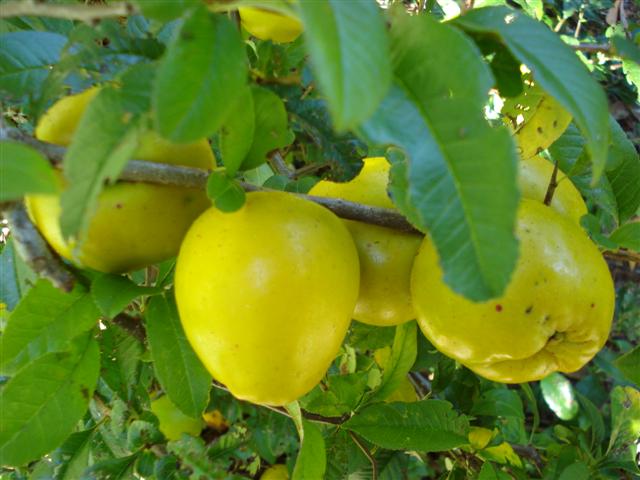
I have been harvesting the chaenomeles though harvesting is perhaps too much like hyperbole. I have been picking up a bowl of their golden yellow fruit. Most will look at the fruit and say quinces but they are not. If you said japonica apples, you would be closer to the mark. Quinces – or cydonia – are small trees from central and south eastern Europe and are closely related to apples and pears. The fruits look like golden pears. The chaenomeles are from east Asia, including Japan, and are shrubs referred to inaccurately in the past as japonicas. In fact we associate the flowering sprays of japonica strongly with Japan where the simplicity of single flowers on bare wood is evocative of that wonderful, sometimes stark, simple beauty so prized in Japanese gardening and floral art.

Back to my chaenomele fruits which are not only very decorative and long lasting, they also exude a perfume which I find pleasant. It is such a shame you have to work hard to transform the crop into something edible. The usual approach is to turn them into japonica jelly though I admit I have never tried this. My jam making efforts are limited to the raspberries these days and as it takes us about three months to get through one jar, there is a not a big incentive to be more adventurous. I did try making chaenomeles brandy one year, wooed by the delightful aroma of the fruit. I figured that I would follow the recipe for damson gin though this fruit clearly needed slicing. So I layered the slices of chaenomeles alternately with sugar in the mandatory stoneware crock, of which I happen to own several. Then I poured a bottle of brandy over it all and put it in a dark place for a year to gently steep. Yes, a whole year. Now, the damson gin recipe says that after a year, you should strain off the liquid, dilute it with another bottle of gin and leave it to mature for a second year. In my forays into damson gin, we waited the first year but never made it to the second bottle of gin and a further twelve month wait. Neither did we get past the mid stage with the chaenomeles brandy which we strained off and drank after twelve months. It was pleasant if a little underwhelming. But this is not a household where we ever drink liqueurs or indeed any sweet drinks, so perhaps our palates were just not accustomed to sweet, high octane alcohol. I prefer my brandy with lime and soda.

These days I just bring a bowl of chaenomeles into the house for aesthetic reasons. They sit for weeks without going off, golden orbs with an odd waxy coating, exuding a natural tropical perfume. So much nicer than those synthetic air fresheners marketed by Glade, I feel. The remainder of the crop hang on to the bush until their weight pulls them off and they lie below. Although the bushes are rangy, scrubby things of no merit or form out of season, in early spring the dark pink flowers are eye-catching and in autumn the fruit is a feature for a good couple of months.

In case you are wondering what a chaenomeles tastes like, I can assure you that the taste and texture does not match the fragrance. They are astringent – will pucker your mouth – but apparently in colder climates, the first frosts reduce the astringency. This is a condition referred to as bletting (there is a piece of information which you may need one day for Trivial Pursuits or quiz nights) and bletting is a key to growing good Brussels sprouts, swedes and turnips. Personally I prefer to live in a climate where we can grow oranges and avocadoes even if that means we can not have bletted crops since we never get a run of heavy frosts, or much frost at all.

Some years the chaenomeles pass me by because the good fruiting bushes (and by no means all of them fruit as spectacularly as this one) are in an area of the garden which has been a bit of a wasteland. Probably every large garden, and quite a few smaller ones, have areas where you hurry past with eyes averted because you really don’t want to address the problems there and if you ignore them, perhaps other people won’t notice them either. There comes a day when you can no longer pretend that the area does not really matter. You have to get in there. In our case, it is an area where the ever growing trees and shrubs had turned a formerly sunny position into overgrown shade forever making incursions outwards. It certainly helps to have somebody at your behest with a chainsaw and mulcher but you can get a long way with strong loppers and a sharp pruning saw. These jobs always escalate beyond what was originally envisaged as you keep penetrating onwards and inwards. We have trimmed and removed a prodigious amount of material. We have allowed sunlight into areas which haven’t seen light for nigh on a decade. We have rediscovered plants which only Mark ever knew were there. We have dug out sizeable nikau palms. It is possible to have too many self-seeded nikaus and we have more than enough. In fact we have turned dense forest or jungle into woodland.

Woodland means keeping a lighter canopy of larger plants but sufficiently open to allow reasonable growing conditions below. I haven’t finished yet but I have reached the fun stage where finally I have had the chance to try the traditional method of establishing a drift of spring bulbs. That is broadcasting handfuls of bulbs and planting them more or less where they fall. It avoids the natural tendency to plant in rows or as edgings on the margins. In this case, I have been scattering English snowdrops and interplanting with Cyclamen repandum, the last of the dwarf species to flower in spring. I have removed all the herbaceous leafy plants and relocated them. In this one patch, I don’t mind if the ground is bare for periods of the year. All I want is the higher canopy and a natural build up of leaf litter with small bulbs popping up in season.

Attractive in season but prickly and nondescript at other times

As I moved futher outwards to the sunny area again, I reached the chaenomeles and that is a bit of a challenge. Not only is it battling quite creditably with the competing growth, it seems to be attaining mammoth proportions. A mere two metres high, but it arches and layers over an area more than four metres long. I didn’t mention it is somewhat spiny and prickly, did I? It is just as well it has pretty flowers and very decorative fruit or it might have gone the way of other prickly plants – into the waiting mulcher.