Category Archives: Abbie’s column

A touch of Africa in Waitara

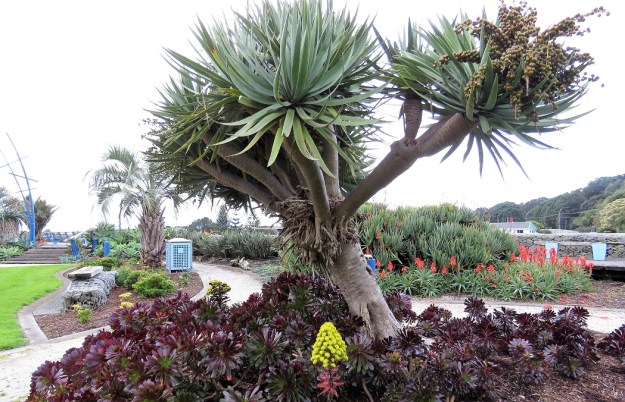
Aeonium arboreum ‘Zwartkopf’ and Dracaena draco, both from the Canary Islands

When I was photographing the Magnolia ‘Felix Jury’ plants in my local town of Waitara on Thursday, I stopped to photograph this small public garden by the river. I remember thinking when it went in about 15 years ago that it was a most unusual and extravagant planting by the Council. Local authorities are always strapped for cash and, when money is short, Waitara has a history of coming off second best to more affluent areas which are better at lobbying and demanding quality. The money, as I recall, came from a charitable trust and I am guessing an outside designer had a hand on this project.

Some red flowered aloe that neither of us could name

It was the mass of red flowering aloes that particularly caught my attention this week but I have thought about this planting on and off for years. Culturally, with its heavy African influence, it is like a fish out of water. But logically, is it any more culturally alien than the gleditsias planted down the main street, the bedding plants around the clock tower or indeed the magnolias I had just photographed? Would I have raised my eyebrows had it been a more conventional planting of cherry trees from Japan, daffodils and tulips, maybe with kowhai (our native sophora)? Most of our plantings in this country, be they public or private, are a mix of exotic and native plants.

Our own Aloe plicatilis have never reached this stature

And there are plenty of native plantings nearby – opposite on Manukorihi Hill, the pohutukawa that we managed to save from the ravages of the flood engineer downstream (as I recall, we lost about 29 to the chainsaws but saved over 80), extensive mixed native plantings upstream on the river flats. Literally a few doors down the road is a little pocket park that has been lovingly and just as carefully landscaped in natives.
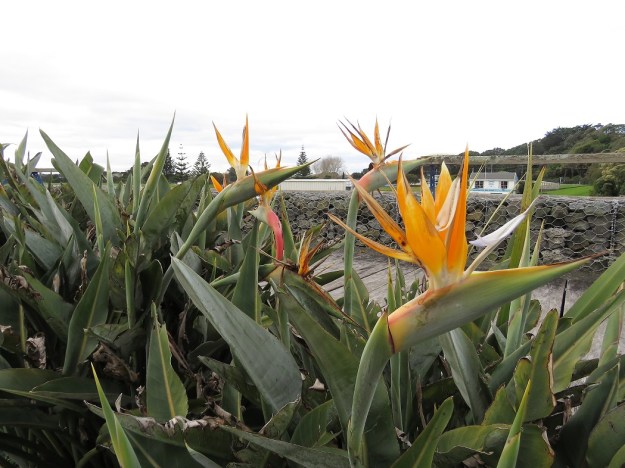
Strelitzias from South Africa with the rock gabions visible behind as part of flood protection. The river is just behind the gabions.

There is no arguing that in this free draining, frost-free, sunny situation on the riverside, very close to the sea, these African plants are thriving. The stone gabions in the background are the latest addition to the stopbanks to get additional height to hold back floodwaters. Like much of coastal NZ, large parts of Waitara have been built on the flood plain and that is looking increasingly precarious these days. And this planting has prospered in a maintenance regime that is public sector, so not intensive and it will be a lot less intensive than bedding plants.

Mark tells me it is a Butia capitata which is actually South American. Looking terrific with a bed of native libertia at its feet. 

The attempt to incorporate our native nikau palm is not as successful in such an open situation. Many of our native plants have evolved to grow in close company.

I was discussing this with Mark and he made a comment that was like a lightbulb moment for me. “Well, it hasn’t been vandalised in all those years.” He is so right. Vandalism of public plantings is a larger issue than people stripping pretty flowers or stealing plants. Maybe this one just looks too prickly?
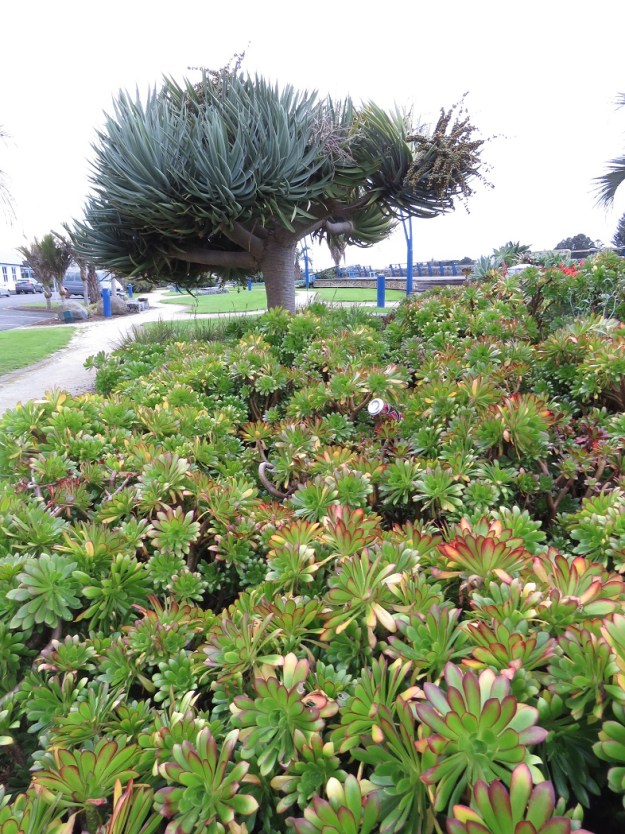
More aeoniums (with the only piece of litter I saw – spot the can) and Dracaena draco again

While it may strike me as slightly incongruous in its local context, this exotic planting owes much to the style of landscaping favoured at the time for upmarket, domestic gardens in the big city of Auckland. The interesting thing about it in this situation is how well it has done in the conditions and how it has matured gracefully over the years. Fifteen years without anything more than routine maintenance is like a lifetime in public plantings.

Agave attenuata is actually Mexican so this is quite an international planting. Like Aloe plicatilis, it is way more impressive in this open, coastal situation than in the sheltered conditions of our inland garden.

I am not so keen on the blue painted seats, lights, rubbish bins and the like but that is my personal taste. I prefer the plants to star rather than the man-made conveniences. The planting is not pretty in the conventional sense, it lacks all cultural context* – but it works. And it is undeniably different to every other public planting I have seen in our district.

*When I mention cultural context, it may perhaps help if I explain that the ONLY building of architectural significance that I can think of in Waitara is the meeting house on Ōwae Marae, the most important marae for Te Āti Awa, one of Taranaki’s pre-eminent Maori iwi, or tribes.
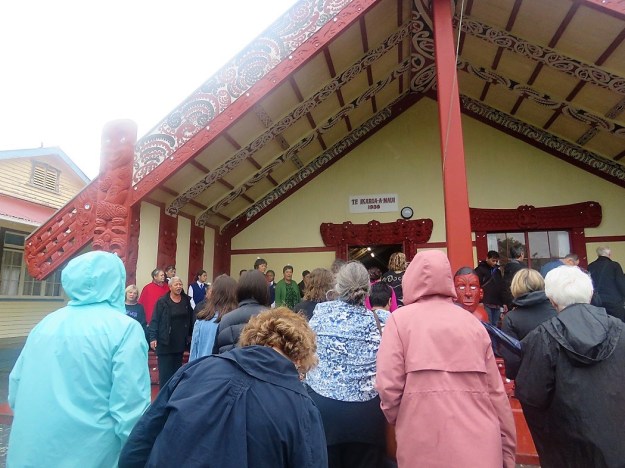
Photos at Ōwae Marae taken earlier at a government select committee hearing


The trouble with daffodils

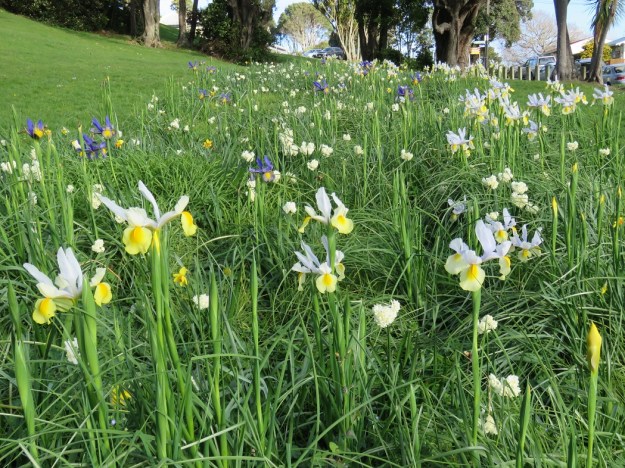
The bulb meadow on Marsland Hill

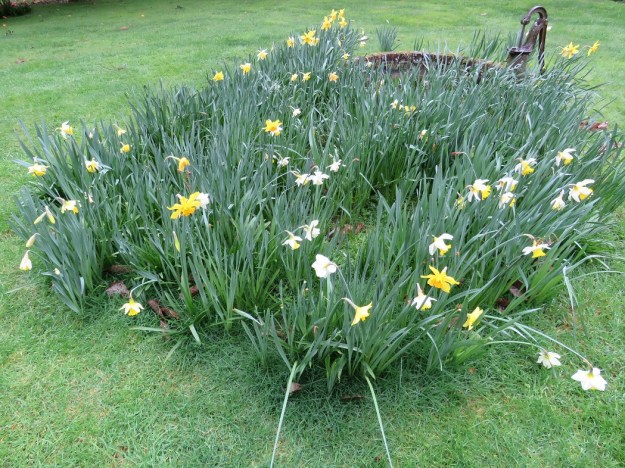
I headed back to see the bulb meadow in town that I wrote about a fortnight ago to see how it was evolving. My friend Susan had told me that this and another beside the race course opposite New Plymouth Boys High School had both been planted by Fiesta Bulbs about four years ago. The first year, she said, they were absolutely glorious. The second year, there was so little flowering that she thought ‘well that was a one season wonder’. But now they are at least staging some repeat blooming .

Where purple meets yellow – I really don’t like those murky brown tones 

The clear blue that was also used is my preference

The Marsland Hill planting is being carried by the Dutch iris. They are simply splendid and I think I need more of these easy-care bulbs to carry some of our own larger scale meadow plantings. I still particularly dislike the purple and yellow variety with the brown tones (sorry, pcsecretary who left a comment disagreeing with this assessment but at least I found out that you should be able to source it from Fiesta Bulbs, if you live in NZ) but there was also a clearer blue one being used and the pastel variety didn’t look so anaemic with many more of it in flower. So a big ups to the Dutch iris.

Too much leafage! Poor light conditions but you can see what I mean in the planting by the racecourse

But the daffodils – too much leafage. This was even more the case on the racecourse plantings where fewer Dutch iris were used. This is why Mark has never been a daffy fan when it comes to garden plants. Dwarf narcissi – yes, in abundance. Big full-on daffodils, no. The foliage swamps them and the flower heads are too heavy to hold up well in the spring wind and rain.

Pretty enough at home but still too high a ratio of foliage to flower. And the outer blooms all fall over in the weather. 

I came home and looked at my patch on the back lawn and thought yes, there is too much foliage there for the number of flowers. And I don’t think the ratio of blooms to leafage is going to get better.

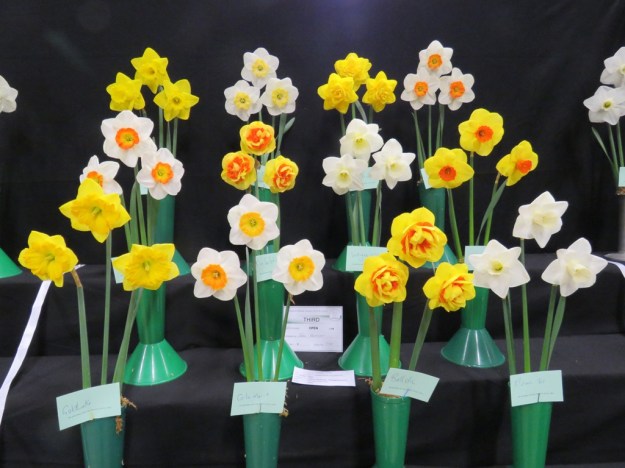
Big daffs are best as show blooms and cut flowers 

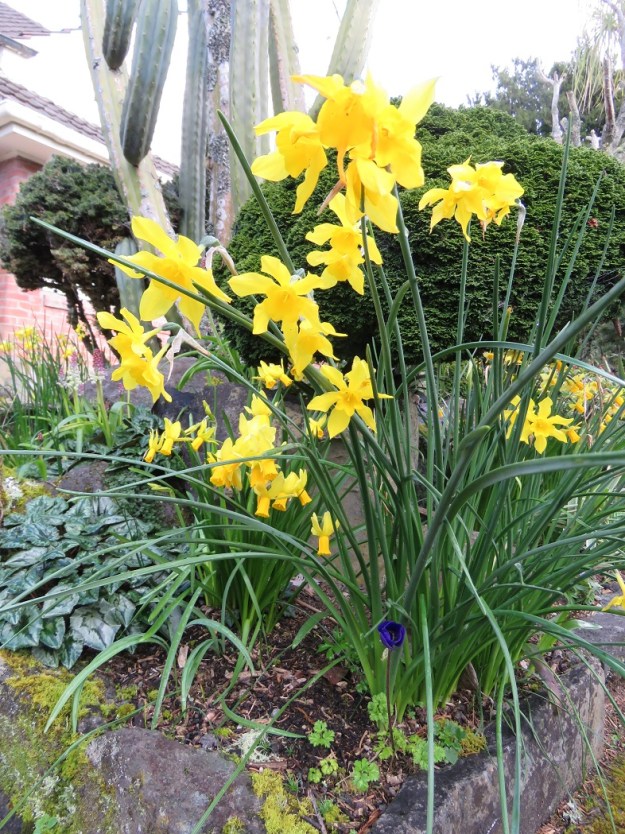
Narcissus x odorus never drowns in its foliage but its season in bloom is brief

The big daffodils are better as show blooms and cut flowers. But as meadow plants, not so much. I looked again at the narcissi we are growing at home. Narcissus x odorus (N. jonquilla x N. pseudonarcissus) is gorgeous, fragrant, does not have a lot of foliage to drown in but its flowering season is brief.  ‘Tête-à-tête’ (I assume it is meant to have the French accents) is a great performer which keeps on blooming well even when left undisturbed for many years – most narcissi respond brilliantly to being lifted, divided and replanted but stop flowering as they get congested. Ditto ‘Twilight’ and most of the cyclamineus types we grow. Bulbocodiums are not so good for meadows because you can’t pick the foliage from grass when it is coming through.

I rather think that meadows may be better with alternative bulbs like ixias, strong growing lachenalias, sparaxis and tritonias. And Dutch iris. Daffs are not compulsory.

Maybe a N. pseudonarcissus hybrid rather than a straight species selection

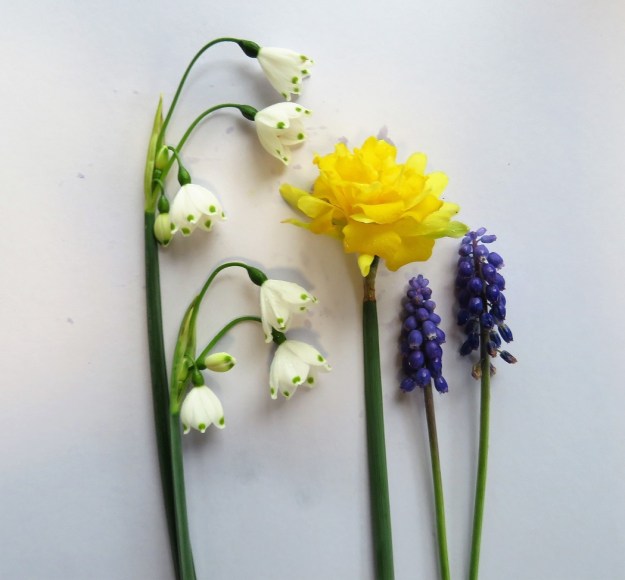
A Facebook friend posted a photo of her double daffodil which was most likely a form of the wild N. pseudonarcissus. I asked Mark if this one flowering in woodland conditions here was too. He didn’t know on that one but directed me down to the old orchard area established by his great grandmother, where the old classic is growing. Okay, there weren’t many flowers but that patch has been there, undisturbed, for anything up to 140 years, which is quite amazing really. It is the common old double that is often found growing wild alongside snowflakes (leucojums) on the sites of original early settler cottages. N. pseudonarcissus is a wild daffodil throughout the UK and Europe, more commonly single but the double has long been prized as a garden plant. It has the same problem of the weight of the head dragging the flower down but at least this one has some personal history for us.

Great grandmother’s flowers – snowflake (leucojum, not snowdrop), double daffodil (wild N. pseudonarcissus) and grape hyacinth (muscari, not bluebell)

The upshot of all this is that it is entirely understandable that, in this day and age, Council would contract a commercial bulb supplier to come in and plant a designated area. But if you want to establish a bulb meadow at home that has greater longevity, there is no substitute for spending some time observing and researching. And shun selections that are best as cut flowers – unless they are Dutch iris which seem to be able to fill both roles.

Learning botanical art in practice

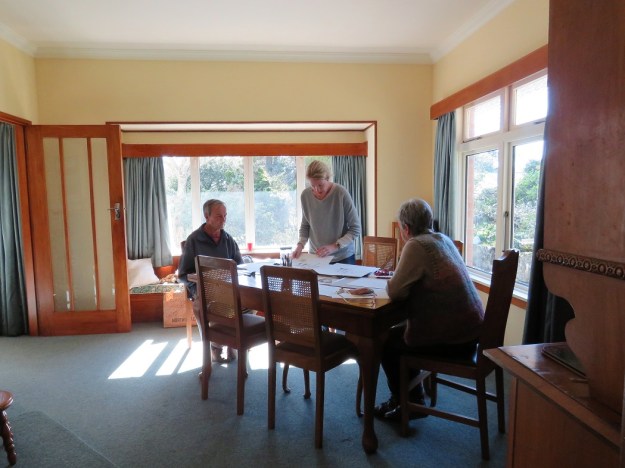
I mentioned the introduction to botanical art workshops being offered in the garden here during the annual Taranaki Garden Festival. For the past two Sundays, Dr Tabatha Forbes has given private lessons to Mark and a friend. This is not my field at all so I spent the time gardening but it was great to see Mark picking up pencil and paintbrush again after a hiatus of about 35 years – and getting a result even I am not going to embarrass him by reproducing here.
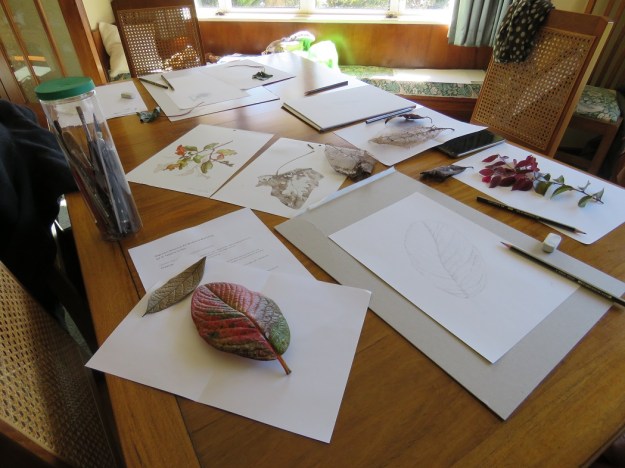
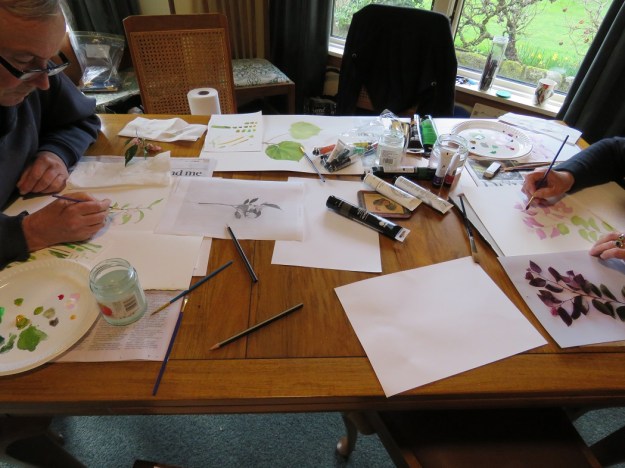
I would be misleading you if I didn’t mention that the festival workshops will not be in our dining room (we don’t have enough space there), but I thought some readers might be interested to get some insight into the approach Tabatha takes.

The first day was spent drawing leaves in pencil, refreshing basic drawing skills.

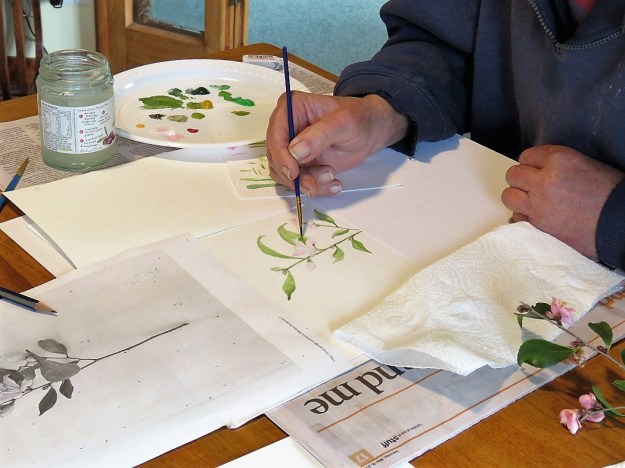
The second day was painting. Tabatha prefers acrylics because they lend themselves to building up layers of colour. By the end of that day, both Mark and our friend had their first painting more or less completed. Mark painted a small spray of Camellia ‘Tiny Princess’, our friend painted a spray of Loropetalum ‘China Pink’.

Work in progress

My earlier post gives more information here.

Brief details are:

When: Saturday 2 and Sunday 3 November from 10am -3pm each day for beginners.

November 9 and 10 –  going on to the next level – berries and fruit.

Where: here in our garden at Tikorangi

Cost: $100 per two-day workshop. All materials provided.

For more information contact Tabatha at drtab72@gmail.com


Tikorangi notes: narcissi, garden edgings and a happy plant breeder

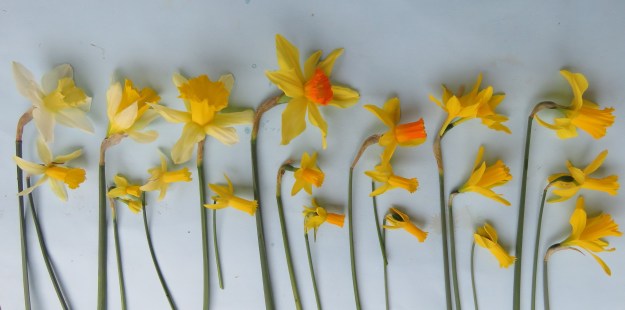
The snowdrop season is all but over already. It is charming but brief. The narcissi, however, have a longer season, at least in part because we can grow a much wider range of species and hybrids. Yesterday felt like a winter’s day – the last gasp of winter, I hope – so I headed out to pick one each of the many different varieties in flower. We don’t grow many of the larger ones at all, preferring the charm of the littlies, the dwarf ones. Bigger may be better when it comes to magnolias – at least in our eyes – but daintiness wins with the narcissi. Most of these are named varieties though Mark is also raising cyclamineus seedlings to build up numbers for planting out and to get some seedling variation within them. The cyclamineus are the ones where the petal skirt sweeps back, sometimes completely reflexed, giving them a slightly startled appearance. He was intending to plant many of these down in the park but hadn’t got around to it so offered them to me for the new grass garden.
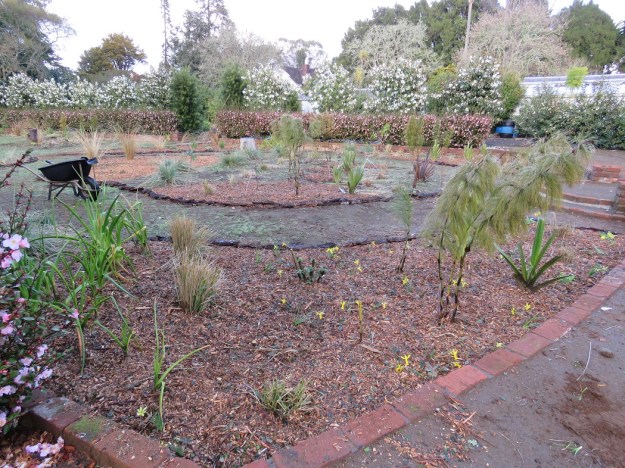
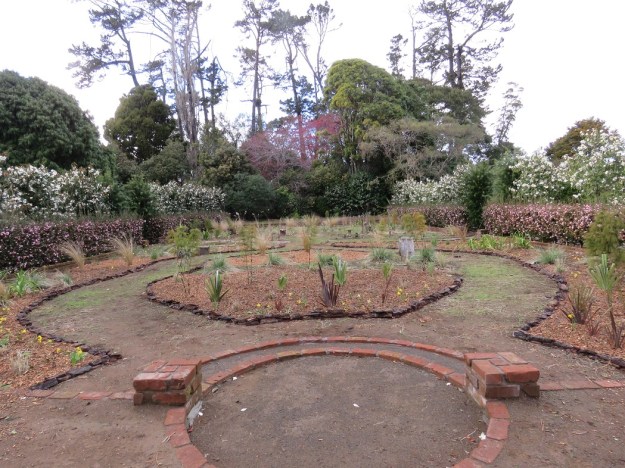
Drifting dwarf narcissi through the new grass garden. Camellia Fairy Blush hedge and Fairy Magnolia White edge the garden on both long sides. 

I have now compromised the big, bold, chunky planting in waves that is the hallmark of the new grass gardens by drifting hundreds of dainty, dwarf narcissi through them – though far enough out to escape being swamped by the large plants, for several years at least. It adds seasonal interest to an area that will not come alive again until later in spring.

Informal bark edging and bark and leaf mulch define the garden area

After much consideration as to how we wanted to complete the grass garden with regard to edging, mulch and path surfaces, we have gone for the casual, organic and local options. As soon as I started to load in the wood and leaf mulch that a local arborist delivered, I realised that the beds would need an edging to hold the mulch from spilling over. My idea of a seamless transition between bed and path was not going to work. We have pine bark to hand – left over from getting the firewood out from a fallen pine tree so I am constructing small edges out of that. It lasts for many years. The paths are still bare earth (we will probably use granulated bark on those) but as soon as I made the edgings and laid the mulch, it took on the appearance of a garden. It is a casual look but one that sits easily with us with the benefit of being low cost and, as Mark keeps saying, the use of organic materials adds carbon to the soils.

I am laying the mulch on fairly thickly – around a forefinger in depth which I measured to be about 7cm. Because it is fluffy, it will compact to less than that but if I see any weeds coming through, I can top it up.

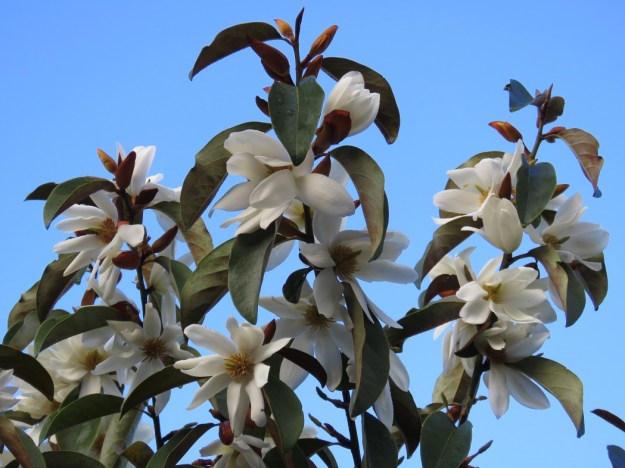
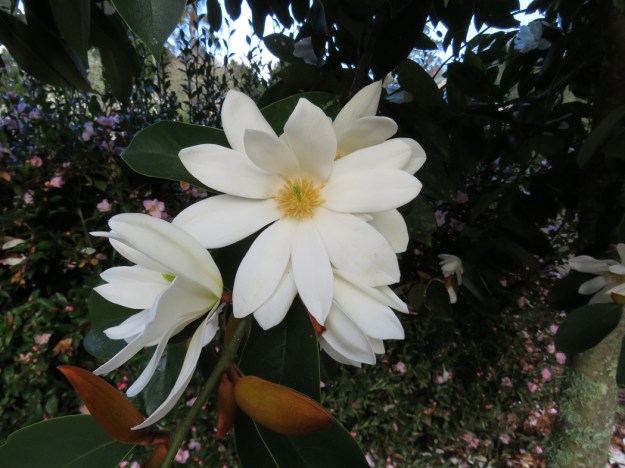
Fairy Magnolia White – not only a beautiful flower form but a very long flowering season, beautiful velvety buds, good foliage and perfume

Mark is a quiet man, not given to blowing his own trumpet, but sometimes I hear him murmur a comment of deep contentment at a plant he has bred and named. So it was this week as we looked at the avenue of Fairy Magnolia White and Camellia Fairy Blush. “I picked White because it had a pretty flower,” he said. And it does. In a world of floppy white and cream M. doltsopa flowers, Fairy Magnolia White stands out with its beautiful star form. There were a lot of very similar sister seedlings to choose from in that cross and as a breeder, he always worries whether he picked the best one. I think he finally decided that he had indeed chosen the best which is just as well, when you think about it, because he will only ever name and release one of that cross

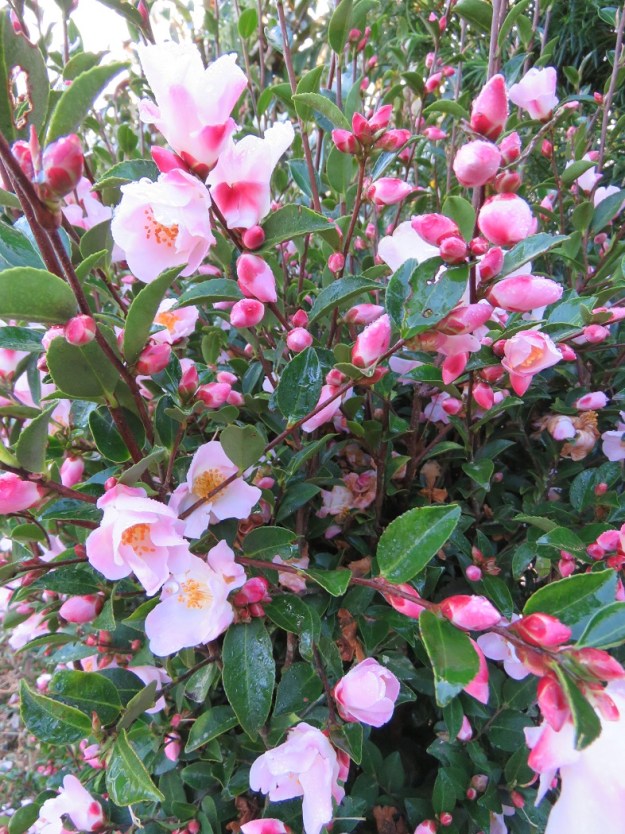
Camellia Fairy Blush also has a long flowering season, drops its spent flowers cleanly and clips well

Camellia Fairy Blush, planted as a hedge beneath the two avenues of Fairy Magnolia White, is also a continuing source of satisfaction and delight to us, even if it is a constant reminder of a missed commercial opportunity. It was the first camellia he ever named and sold. Back in those days, protecting a plant as our intellectual property was not even on the radar and now Fairy Blush is sold widely throughout the world and few know that it originated here and was Mark’s selection. We have even seen it branded overseas with other nursery names but we know it is ours. That is life and it is a very good camellia and continues to be a source of pride and pleasure to the breeder.

Fairy Magnolia White and a very blue spring sky

From cob to cracker

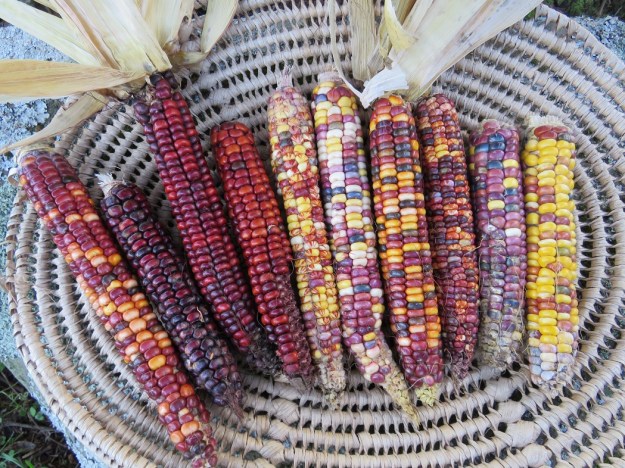
Indian corn or flint corn

Really, I wanted to show the photo of Mark’s pretty corn cobs. This is commonly called Indian corn or flint corn. It is maize, not sweetcorn so not suitable for eating as corn on the cob. Modern sweetcorn is a very different crop after a great deal of selection to get strains with very high sugar content – so much so that I often find them too sweet.  I think Mark just grew the Indian corn out of curiosity the first time. This year he put in a bigger row of it because we used all the previous crop and he is looking for grain crops that we can grow, harvest and use here.

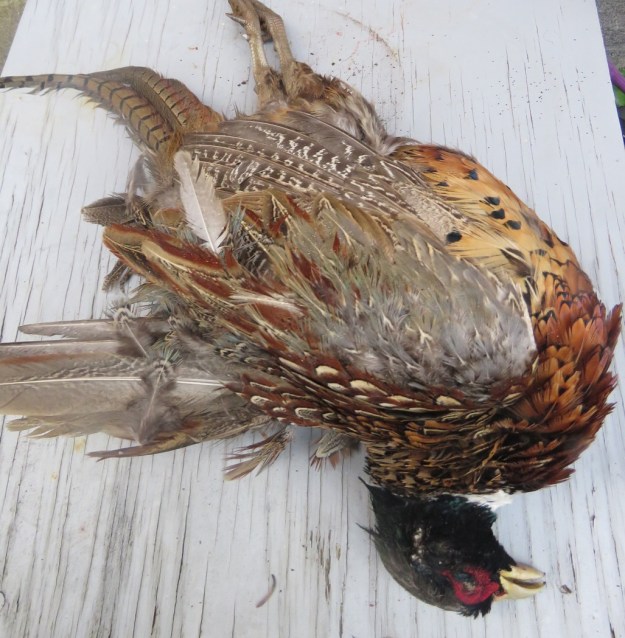
I only have a photo of dead pheasant. We found two which had been hit on the road but he counted more than that in the patch.

He was loving the presence of the growing population of beautiful pheasants in his cropping area across the road until he realised they had quietly consumed about a third of the Indian corn. We are still delighted to have a local population of exotic-looking pheasants but he hastily harvested the remaining cobs.

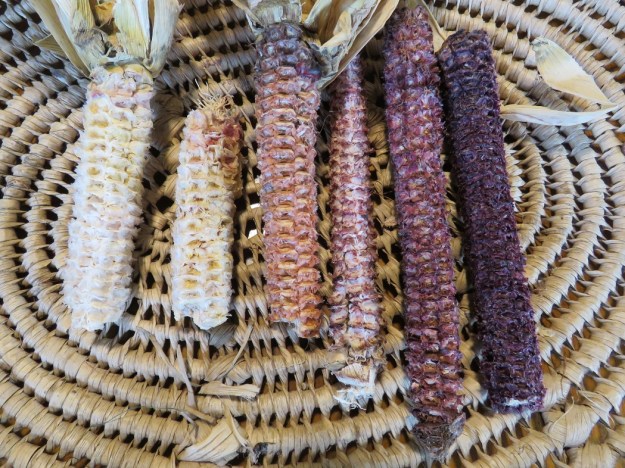
Curiously, when I dehusk the dried cobs, the remaining core also shows colour variation. Red kernels usually mean a red or purple cob.
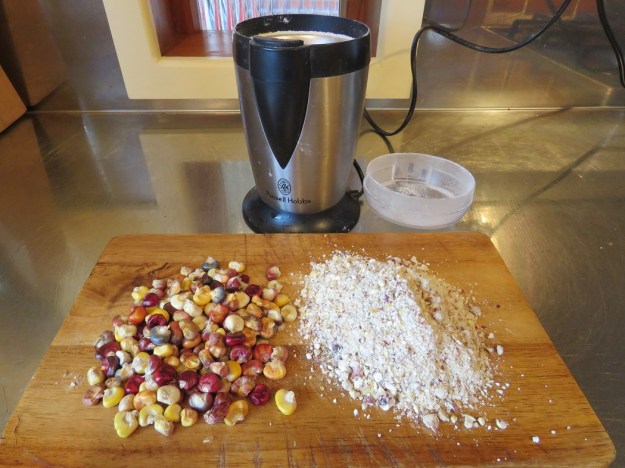
Kernels, maize flour and the handy old coffee grinder I kept in case it was needed again one day

What do we do with the corn? Home made corn crackers! I first tried grinding the kernels in the food processor and it had to work hard to achieve a fairly coarse result. I worried the meal may crack tooth fillings. Then I remembered the old electric coffee grinder I put away in a top cupboard when we upgraded to a burr grinder for coffee beans. It does an excellent job. The texture is not completely consistent and I don’t think I can manage the process to get polenta meal out of it, but it is fine for crackers. I have stopped buying corn chips and taco shells. My thin crackers make a more than acceptable substitute, though I would be lying if I said they tasted the same. I have learned that the kernels need grinding immediately before they are used because the flour goes mouldy really quickly.

I doubt that many readers have a crop of maize or Indian corn sitting around waiting to be used, but just in case, I offer you my recipe which I adapted from a great recipe I was given for making seedy crackers.

About 1 ¾ cups of fresh ground maize flour

¾ cup of spelt flour

2 tbsp chia seeds

1 tsp salt

1/3 cup olive oil

½ cup water

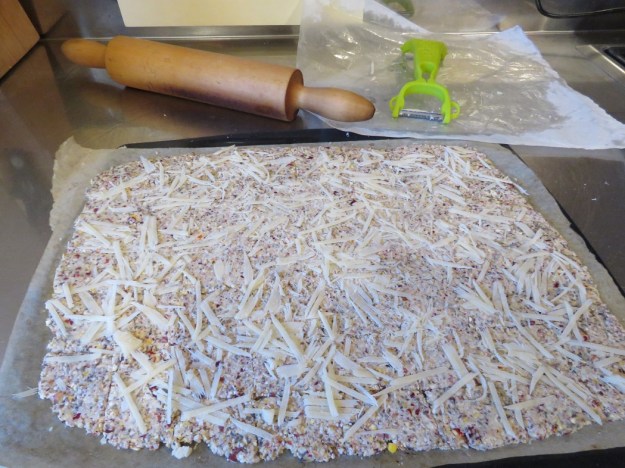
Mix and then roll out thinly on baking paper with another sheet of paper on top. Sprinkle the top with coarse salt flakes and grated parmesan cheese or similar (I used grana padano because that was what I had) and cut the sheet of cracker into suitable sized squares but leave it as a sheet.

Bake in a medium low oven (about 130 on fanbake) until it is golden brown and crisp (about 30 mins but keep an eye on it).

That is it. From grinding the corn to getting crispy, tasty crackers out of the oven takes about 40 minutes. We ate them this evening with chilli beans (homegrown, of course) and will continue to eat them during the week as a snack, with or without toppings.

Rolled and ready for baking 

The finished crackers