Category Archives: Plant collector

flowering this week, tried and true plants

Plant Collector: Daphne genkwa

Daphne genkwa - as lovely as a flowering shrub can be

Daphne genkwa – as lovely as a flowering shrub can be

We only grow a few types of daphne in gardens although there are many more known species. Most are grown for their fragrance, rather than any spectacular display. D. genkwa is different. Once established, it is as spectacular as any flowering shrub in the garden and in a most unusual hue of lilac blue. Because it is deciduous, all you see in late winter or early spring are arching branches smothered in the prettiest of displays. The individual flowers don’t even look like the usual daphnes, being larger, more delicate and of different form with a long corolla or tube.

What it lacks is a strong scent. In fact I didn’t realise it had any scent at all until I put my nose right amongst the flowers. This one is grown for its looks. Genkwa is renowned for being difficult to propagate so is not widely available. It is generally done from root cuttings. If you can find one, plant it somewhere with plenty of space to grow – maybe two metres all round to accommodate its arching growth. I killed an established specimen by trimming it after flowering one year so the replacement plants, bought at some expense, will be left entirely to their own destiny. It has fine, light foliage so when not in flower, is just an anonymous border shrub.

First published in the Waikato Times and reprinted here with their permission.
Plant Collector: Magnolia Manchu Fan

Magnolia Manchu Fan

Magnolia Manchu Fan

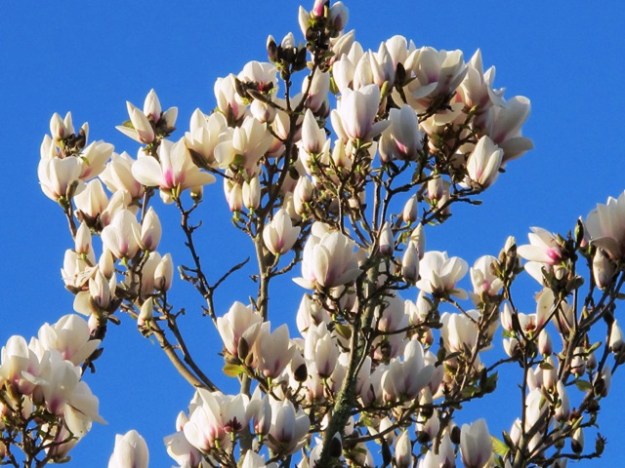
The most spectacular flowering trees of the early spring season must surely be the magnolias. But not everybody has room for a large, spreading tree festooned with enormous blooms. Manchu Fan has long been one of our recommendations for a smaller growing white variety. It is not that the individual blooms are drop dead gorgeous and showy. They are just white goblets with a pink blush at the base but they have heavy textured petals (or tepals, as magnolia petals are more accurately described) which withstand weather damage. And there are lots and lots of them, produced on a small growing, upright, narrow tree that will fit in urban gardens.

Manchu Fan was bred by American hybridist, Todd Gresham, in the middle of last century. There are a fair number of his selections named – enough to be referred to internationally as ‘the Gresham hybrids’. Of the ones we have grown, Manchu Fan is the standout performer. After maybe 20 years, our plant is 5m high by 3m wide without any trimming or shaping. In overall performance, it is not hugely different to the better known M. denudata but, because it flowers later in the season, it escapes frost damage and the tree will remain smaller in the long term. It also has a longer flowering season.

Manchu Fan is in commercial production in this country and available on the market. For the purists, its breeding is (M. soulangeana ‘Lennei Alba’ x M. veitchii).

First published in the Waikato Times and reprinted here with their permission.

Plant Collector: Aloe ferox

Aloe ferox - very orange and loved by waxeyes at this time of year

Aloe ferox – very orange and loved by waxeyes at this time of year

The waxeyes are delighted by the flowering of this aloe and the vertical flower spikes are often populated by at least half a dozen of these cheerful souls. This is a particularly spiky aloe, coming, as many do, from the coastal areas of South Africa. As such, it prefers a dry climate, warm temperatures and sandy soils. None of these apply here, so presumably it is fairly forgiving but it will rot out without excellent drainage. It is a very heavy plant on top so what is happening below ground is important. Wikipedia tells me that each fleshy leaf can weigh up to 2kg when it is harvested. And why is it harvested? It is not just the better known Aloe vera (or ‘ello, ‘ello, ‘ello Vera as we refer to it here) that has useful attributes. A. ferox also has medicinal and cosmetic properties and is a commercial crop. With its fiercely spiky leaves, you would want to be wearing leather gloves at harvest time.

There is nothing rare about A. ferox, except in the wild where it is endangered. It is widely available in the marketplace. In optimum conditions, plants can reach 3m tall, but after many years ours still sits at half that height. We may have problems if it reaches its potential.

Aloes are a very large family of flowering succulents from the African continent. Many are winter flowering, presumably triggered by seasonal rains.

First published in the Waikato Times and reprinted here with their permission.
Plant Collector: Rhododendron ‘Pukeiti’

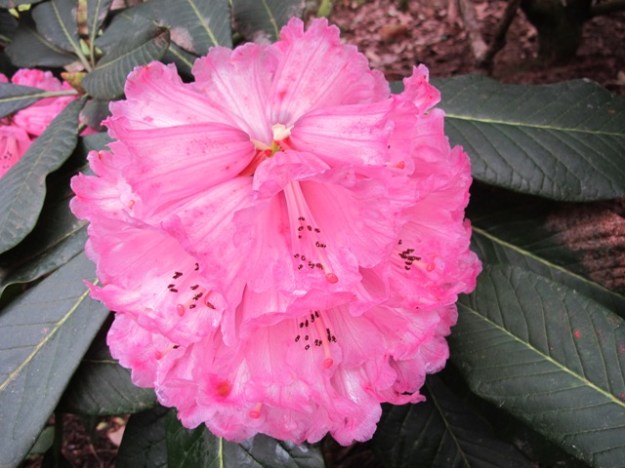
One of the big leafed rhododendrons, "Pukeiti" (otherwise known as R. protistum var. giganteum)

One of the big leafed rhododendrons, “Pukeiti” (otherwise known as R. protistum var. giganteum)

This is the iconic plant of Pukeiti, the rhododendron gardens set near Mount Taranaki. It is one of what is widely referred to as the big leafed rhodo group, grown in those gardens in the Valley of the Giants though this plant is on the cold hillside of our park here at Tikorangi. In the rhododendron world these are big – big leaves can be up to 50cm long and big flower trusses on large growing plants which, over time, can reach 5 metres tall by about 8 metres wide. These are not plants for the urban garden. While the plant itself is hardy, an untimely frost can turn the blooms to something resembling caramel icecream.

“Pukeiti” is a selection of R. protistum var. giganteum which itself a straight species. It was grown from seed collected by the intrepid plant hunter, Kingdon Ward, in the highlands of North Burma in 1953. It has a deeper colour than most of the other big leafed types we grow, with a big full truss of 30 individual blooms. These are described as funnel shaped and campanulate in form – slightly flattened, tubes which flare out to a frilly edge in non-technical language. The display this year is particularly good. We are hoping we don’t get a late frost.

First published in the Waikato Times and reprinted here with their permission.
Plant Collector: vriesea

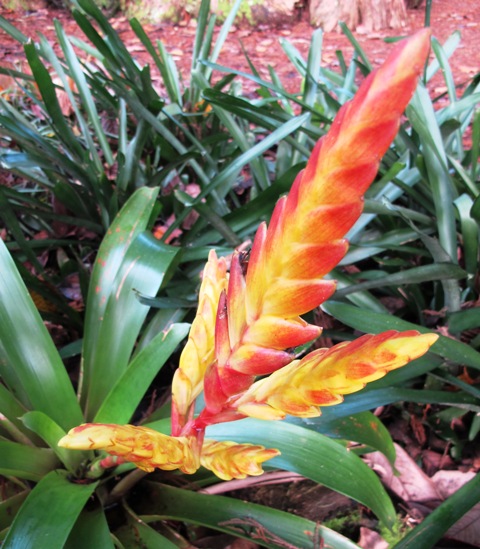
A vriesea, but we are not sure which one

A vriesea, but we are not sure which one

In the depths of winter, most of the bromeliads come into flower – an exotic counterpoint to wintery gloom. Bromeliads are a surprisingly diverse plant family. The best known brom is the pineapple but fewer realise that tillandsia or Spanish moss is also a member. The vast majority come from the warmer climes of Central America. This one is a vriesea. It will be a named cultivar but we lost the labels in the mists of time. Unlike many in the family, it is not prickly. Its foliage is just an anonymous looking green rosette, really, which holds water and also traps an abundance of falling leaves and debris. Then it puts up this flower which lasts for many weeks, stretching into a couple of months. The bloom is like a flat wax cast, almost two dimensional and of such heavy substance that it is unaffected by the weather.

Like many bromeliads, the vriesea is epiphytic and generally self sustaining. It draws all the sustenance it needs from the air and rain and will grow perched in the fork of a tree or on an old stump. This one is in the ground but it will never develop much of a root system.

We grow most of our bromeliads in protected woodland conditions with high shade from evergreen trees. It can get cold for them, but they never get any frost. We go through and pluck out debris and remove dead leaves from time to time and in return, they are totally undemanding and surprise us with the most wonderfully exotic blooms.

First published in the Waikato Times and reprinted here with their permission.