Category Archives: Plant collector

flowering this week, tried and true plants

Plant Collector: Narcissus bulbocodium citrinus “Pandora”

The first narcissus of the season - N. bulbocodium citrinus 'Pandora'

The first narcissus of the season – N. bulbocodium citrinus ‘Pandora’

Always the first little narcissi to flower in winter, these lemon hoop petticoats are pretty as a picture at the moment. I guess they gained their common name because they resemble those wired underskirts from times past. The bright yellow bulbocodiums flower later in the season. In contrast, the citrinus are very early, coming out with the snowdrops. These are easy bulbs to grow. In fact this clump is naturalised in hard conditions where our gravel driveway meets an elevated concrete path – which is why the flowers show some splash and wear. There is no mollycoddling involved with them but they do need good drainage and full sun. N. bulbocodium is native to the south of France, Portugal and Spain so will occur naturally in relatively hard conditions. Given that the foliage is distinctly grassy in appearance, you just need to make sure you are not mowing it off in the early stages.

Daffodils go far beyond the common big King Alfred types and we like a range of them so we can have them in flower for many months. We prefer earlier flowering ones overall because they are generally finished by the time the dreaded narcissi fly is on the wing. It lays its eggs in the crown of the foliage and each bulb becomes home to one fly larvae (big, fat creamy grub) which spends a year sustaining itself by eating the bulb from the inside out, only to metamorphose and repeat the cycle. A breeder told me that narcissi only need 65 days of growth to build up strength in the bulb for next year’s flowering so you can remove foliage early if you need to beat the fly. We also favour the littlies, the dwarf varieties, which are much more compact and showy in the garden.

Bulbocodiums increase readily by division and some will set viable seed.

First published in the Waikato Times and reprinted here with their permission.
Plant Collector – Helleborus orientalis

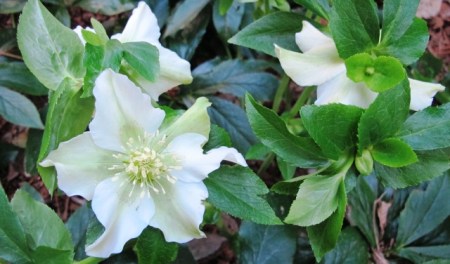
Helleborus orientalis - quiet and undemanding stars of winter

Helleborus orientalis – quiet and undemanding stars of winter

Hellebores are quiet heroes in the winter garden. I have never seen a strident one. By far the most common hellebore is H. orientalis – though it is not from the Orient, being native to northern Turkey and Greece. It is a perennial which keeps its leaves all year round but in our experience it is not one that appreciates being dug and divided. Plants subjected to this routine can sulk for a long time afterwards. You are better to salvage some of the many seedlings you get around plants if you want more.

Given their origins, it is not surprising that these plants are happy to lead their quiet existence in fairly tough conditions, coping with root competition and shallow soils. This makes them ideal for semi shaded, dry areas beneath trees where it is not always easy to find suitable plants. However, they won’t appreciate dense shade. Lift the canopy of overhanging trees and shrubs to get more light.

Most hellebores come in shades of dusky pinks, reds, greens and white – or sometimes in blends of these colours and they often change colour with age. There are some highly desirable deep red and slate colours – the latter bringing blue-purple tones. However the performance of these appears to be temperature related. The colder your conditions (and these are cold hardy plants), the better colour you will get. The best ones we have seen were in Taupo and the UK where winters are considerably chillier.

If you have prized cultivars, keep them separate if you are hoping to raise seedlings. They are promiscuous plants and will cross readily. That said, to my mind, hellebores look best in big patches or drifts. Interplant with winter and early spring bulbs (bluebells, snowdrops, smaller growing daffodils are our preferences) to add interest.

First published in the Waikato Times and reprinted here with their permission.
Plant Collector: bilbergia

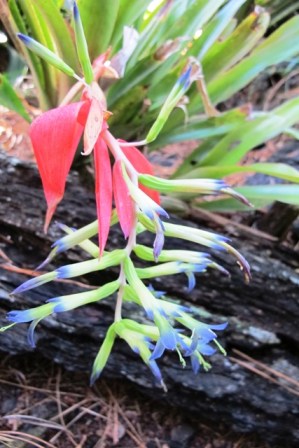
Bilbergia flowering in the winter woodland

Bilbergia flowering in the winter woodland

On a chilly mid winter day, there is nothing more exotic than a bilbergia flowering in the garden. It is a bromeliad, in case you can’t recognise it, and bromeliads can flower through winter when they look impossibly out of context and wonderfully bizarre.

Easily the world’s best known bromeliad is the pineapple, introduced to Europe from South America by none other than Christopher Columbus. All bromeliads are native to the Americas from Virginia south to the northerly reaches of Argentina, with most bilbergias coming from Brazil.

We have never had names on our bromeliads. This one may be Bilbergia distachia – although equally it may not. There are a fairly large number of species and named cultivars to choose from. Bilbergias often have quite a deep cone of foliage and their flowers are pendulous. The downside is that the flowers usually only last a few weeks instead of the months of some other types.

We like them through our evergreen woodland areas which remain frost free. Most are epiphytic, holding water in their vase shaped leaf rosettes and they are a really easy care plant. In more shaded areas, the foliage tends to become more muted but a plainer green backdrop highlights the exotic flowers wonderfully well.

Collecting bromeliads can become quite addictive. If you get keen, there are two comprehensive books on the topic by NZ author, Andrew Steens. Bromeliads for the Contemporary Garden will get you started, then you progress to Bromeliads, The Connoisseur’s Guide. We have a strong preference for using them in mixed plantings so there is not a whole stretch of just bromeliads looking spiky and alien. We find they combine well with clivias, ferns, orchids and other lush shade loving plants which provide a foil to show off their exotica.

First published in the Waikato Times and reprinted here with their permission.
Plant Collector : Luculia gratissima “Early Dawn”

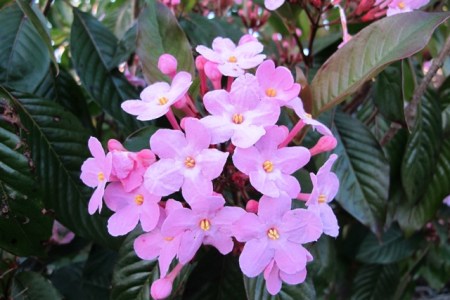
Luculia gratissima 'Early Dawn'

Luculia gratissima ‘Early Dawn’

To be honest, this is not my favourite luculia but it is the one that you are most likely to find offered for sale and it stays somewhat smaller than the other types we grow.

Do not let the fact that this winter flowering shrub hails from the Himalayas lull you into thinking it is hardy. It does not like frost at all and much more than a few degrees will cause short term damage to the foliage and possibly take out the winter blooms for the year. A heavy frost may kill it. However, you can learn a lesson from the fact that it is a forest tree in the Himalayas. If you have areas of the garden with good overhead cover from larger, evergreen trees, you may succeed with this plant, even in frosty inland areas. And it looks a great deal more attractive, in my opinion, when grown as a woodland plant.

The common practice in this country is to plant Early Dawn in full sun in the open and to keep it hard pruned and therefore more compact. It then covers itself in its rather harsh candy pink flowers (which are at least sweetly scented), shouting “Look at me! Look at me!” Its foliage develops a red tinge in cold temperatures and if an untimely frost catches it, you then have this rather unsightly, little shrub with shrivelled leaves. The plant we have in our woodland, however, is tall (2.5m), willowy, graceful and the sugar pink flower heads contrast well with all the greenery. It is a very different picture to the one we have in the open. Get it into woodland, is my advice, into ground rich in litter and humus. Then it may cheer up a bleak winter’s day.

First published in the Waikato Times and reproduced here with their permission.

For my preferred luculias, check out the white Fragrant Pearl and the pretty almond pink Fragrant Cloud (scroll down to the photo).

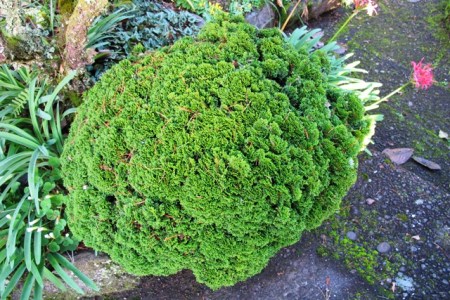
Plant Collector: Chamaecyparis obtusa ‘Caespitosa’

Chamaecyparis obtusa 'Caespitosa' is a little honey bun of a plant... after 50 years

Chamaecyparis obtusa ‘Caespitosa’ is a little honey bun of a plant… after 50 years

I can’t help but think that if conifers had user-friendly common names, they might have staged more of a revival as desirable plants. There is nothing easy about this name. Even the pronunciation of ‘Caespitosa’ is problematic. But it is the cutest little honey bun of a plant. We once produced a line of these to sell. After about 7 years, they measured no more than 10cm across. It is difficult to sell tiny gems like that. After 50 years or more, the ones in our rockery are about 40cm high and 50cm wide. They are like dense mushrooms and have never been clipped or shaped in any way. I sometimes clean out some of the dead debris in the middle and I clip off the occasional larger leafed stem but that is all the care these plants get.

The reason I clip off any odd looking foliage is because this is a bit of a freak seedling derived from what was a timber tree in its native Japan – commonly referred to as the Hinoki Cypress, though it would be more correct to refer to it as the Hinoki False Cypress because chamaecyparis are known as false cypress. It is obviously highly variable and prone to throwing sports because there are a host of different named selections. Such sports can revert to larger and stronger growing forms which is why it pays to clip out any peculiar, larger foliaged branches on a dwarf like this.

This is such a wonderfully tactile plant. The instinct is to pat it as you pass and it completely dense and firm. ‘Caespitosa’ was raised from seed before 1920 in England so it has been around for a while. It is still seen as a gem for alpine gardens. Cold climate gems that also tolerate the mild humid conditions that have here are not common.

First published in the Waikato Times and reprinted here with their permission.