Category Archives: Plant collector

flowering this week, tried and true plants

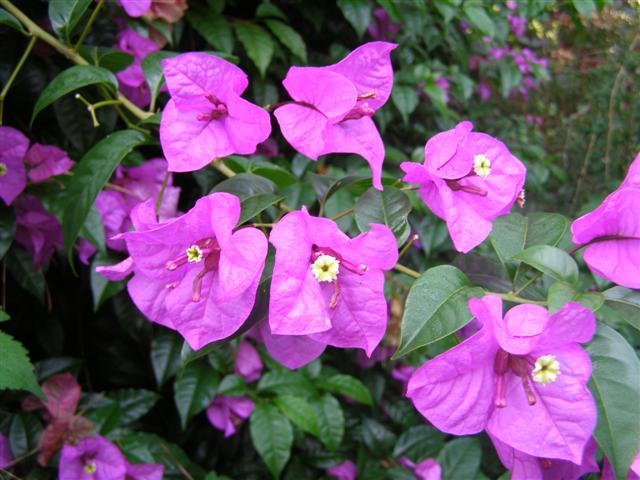
Flowering this week – our rather rampant bougainvillea

Decidedly rampant, extremely spiny but quite spectacular - the bougainvillea

Decidedly rampant, extremely spiny but quite spectacular - the bougainvillea

Not, as we assumed, originating in the Bougainville Islands, but named for the French explorer, Louis Antoine de Bougainville and hailing from South America. We think this form is glabra, from Brazil. There is nothing rare about these scrambling climbers and they are appreciated throughout the temperate and tropical world for their display which can be all year round in latitudes close to the Equator. Here they peak in summer to autumn. It is not the insignificant flowers that make the show but the coloured bracts which surround the flowers and hang on for a long time. The colours range from the royal purple of this variety through cerise, red, pink, lilac, orange, gold and white. Left to their own devices , these can be formidable plants. Ours smothered a dead tree to around ten or fifteen metres high, and a little shy of that figure in both width and depth until the host tree rotted and fell over bringing down most of the bougainvillea with it. It then became a major mission because one of the other characteristics of this genus is its many sharp thorns.

Most of what are sold now are hybrids and they are not left to their own wayward habits as we have done. They are easy enough to trim and shape when small, sometimes trained as standards. We saw some really interested topiary specimens in Bali where three different colours had been grafted onto one stem and then trained to shape as a curious container plant. They are also recommended for hedging and with their thorny ways, they may be just the ticket to deter burglars in crime-prone areas with a mild climate.

Flowering this week: Camellia brevistyla

The simple charm of the species, Camellia brevistyla

The simple charm of the species, Camellia brevistyla

Little Camellia brevistyla is in flower already, even before the sasanquas are showing colour. Individual flowers only last a day or two because they consist of a single row of between five and seven soft petals which pass over quickly but as they are tiny, measuring about 2.5cm across, they disintegrate quickly and there are plenty coming on. And the pristine white contrasts well with the dark green, small leaves. Brevistyla is a great candidate for clipping but it is also one of the best camellia options we have seen as a replacement for buxus hedging. It suckers and layers a bit which helps to make a dense hedge and it sets abundant seed so if you can find somebody with one plant, you could gather their seed (and probably seedlings) and raise your own hedge at no cost. While you will get some variations amongst the seedlings, these will be minor and barring the occasional freak (possible but unlikely), they won’t look different to the parent. While it is recorded as growing relatively tall in the wild in its native habitat of Taiwan and parts of mainland China, the plant we have in the garden hasn’t got much over a metre in a decade.

We have Camellia microphylla as well which has to be closely related to brevistyla and have raised microphylla seed as our replacements in reserve, should our buxus hedges become blighted. It grows a little taller than brevistyla but it wasn’t until Mark got out with a magnifying glass and analysed the subtle variations in the stigma length that he worked out the difference between the two species. Both make delightful autumn pictures with simple white flowers and dark foliage.

Flowering this week: Colchicum autumnale

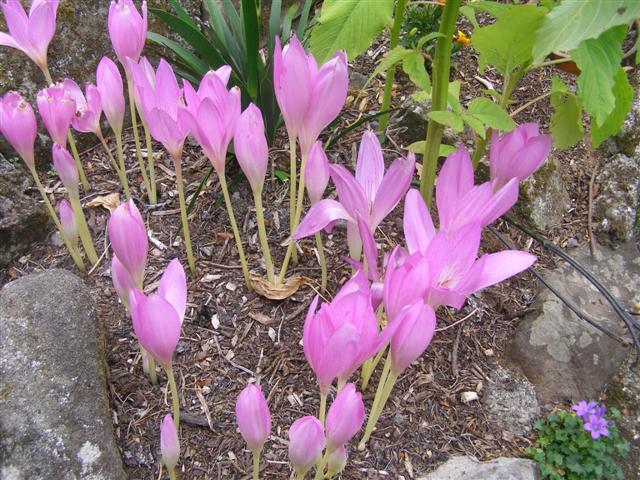
Autumn flowering colchicum, robust growing bulbs suitable for the garden or naturalising

Now that the temperatures have dropped noticeably and I am reconciled to the thought that summer has been and gone for another year, I am prepared to welcome the sight of the colchicums in flower. These are often called the autumn crocus because their simple six petalled cup-like flowers resemble those bulbs but they are distant relatives at best. They have their very own botanical family which is colchicaceae. Their flowers are considerably larger than most crocus and they flower well before their foliage appears. Because they have very large bulbs and grow quite vigorously, they are not shy delicate little things you will lose in a garden situation. In fact they can be naturalised in grass. The flowers are more lilac than pink and are hardly long lived but you can get a succession of them from a single bulb. When the leaves appear, they are relatively large, lush and green but the downside is that the foliage hangs on for a long time into early summer by which point it no longer looks attractive at all. Autumnale is native to quite large areas of Europe.

Colchicums are the source of colchicine, a controlled pharmaceutical of considerably potency used in cancer treatments and also to cause mutations in living cells, which is sometimes advantageous but does need to be handled with care. These bulbs are also the true Naked Ladies though we more commonly refer to belladonnas as bearing this politically incorrect epithet.

Flowering this week: Lapageria alba

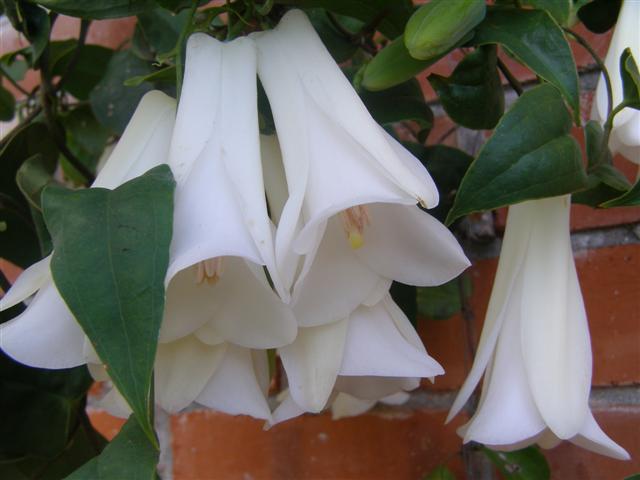
The perfect white waxy bells of Lapageria alba

The perfect white waxy bells of Lapageria alba

The lapageria is commonly known as the Chilean bellflower and is the national flower for that country where it is called copihue. In the wild, reddish pink is the dominant colour though there are pure white forms, pretty pale pink forms and apparently even picotees in cultivation. The white form, Lapageria alba, is particularly prized in this country, but rare because it does not set seed to itself. You need two different clones to get viable seed. In fact all lapagerias are fairly hard to source these days because they are not an easy nursery crop. Young plants can sulk and do nothing at all for several years. They will then send out a strong fresh tendril and some wayward snail will choose that very time to pass by and eat off the long awaited fresh growth. If you see plants offered for sale, don’t set your heart on a particular colour – just take what is available.

They are evergreen climbers which, like most climbers, appreciate a cool position for their roots and their heads into the light. Being forest dwellers, they will take colder temperatures but not frost. Once established, they are enormously satisfying because they are almost never without flowers. And the flowers are beautifully simple waxy bells, reasonably long lived and apparently good for floral art. We have some huge granddaddy vines in red, white and soft pink which have been growing in the cold, narrow back border of our house for several decades where they gently flower on and on and on.

Flowering this week – Rhodophiala bifida

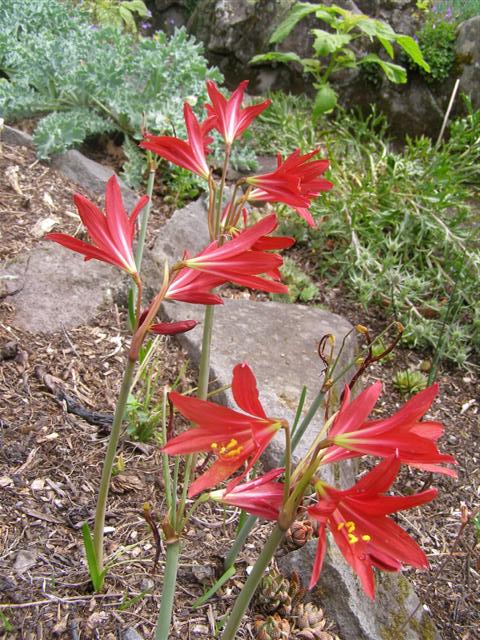
An ephemeral late summer delight - Rhodophiala bifida

An ephemeral late summer delight - Rhodophiala bifida

Markers, perhaps, of late summer or harbingers of autumn, rhodophiala are not well known in this country. They are bulbs again, but this time from South America (Uruguay and Chile, in fact) and closely related to hippeastrums. We used to know them as Hippeastrum bifida and they do resemble a smaller flowered hippeastrum. However, they are certainly not as touchy and particular as some of their exotic cousins and they are hardy. The stems shoot up and pop up heads of up to six trumpet flowers each before there is any hint of foliage. The colour is in shades of rich deep pink to maroon red with contrasting yellow anthers. When the leaves follow, they are modest and strappy.

Rhodophiala have to be increased by seed because the bulbs rarely if ever set offshoots (though there is apparently a Texan variant which sets multiple offshoots). They also have the characteristic of finding their own depth in the soil, pulling themselves down deeper to a level where they are happiest. Gloriosas do the same thing. In all honesty, I have to admit to admit they are a fleeting seasonal pleasure with each bulb only putting up a single flower spike which passes over reasonably quickly. But they don’t take up much room at all and they are a transient delight.