Category Archives: Tikorangi notes

Tikorangi Notes: the virtues of little green apples

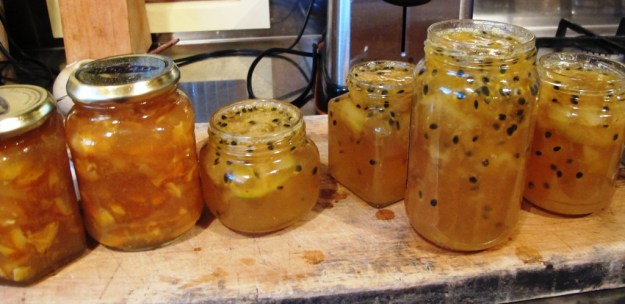
The latest efforts are ginger and tangelo marmalade (in apple base) and feijoa and passionfruit jam.

The latest efforts are ginger and tangelo marmalade (in apple base) and feijoa and passionfruit jam.

I have never been a great maker of jam. I used to try. Raised by a mother well versed in the traditional skills, I would put on the jam pan and make an excessively large amount of one type of jam. If the stars were in alignment, this jam would set adequately. If not, the jam pan would boil away for ages while I valiantly added additional sugar and lemon juice to try and reach setting point. At the end of it, the jam would be brownish in hue and there would be far too many jars of less than stellar jam.

My late mother-in-law was a superb jam maker and my efforts never came within cooee of matching her delicious jams. Her fruit salad jam was my all time favourite but I recall her Sultan plum and cape gooseberry jams being exceptionally good, too. I got rid of my jam pan and would buy the occasional jar at the supermarket. We are not big jam eaters, I reasoned.

But I am a born-again maker of jam due to three recent discoveries. The first was the realisation that jam tastes best when very fresh and that it is therefore logical to make smaller quantities at a time.

The second was the discovery of Chelsea jam sugar. It costs more than ordinary sugar with its added pectin but reduces the time needed to boil the jam down to as little as four minutes before the setting point is reached. This means the jam keeps its bright colour and fresh flavour, while the fruit stays nice and chunky.

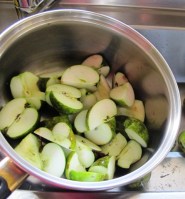
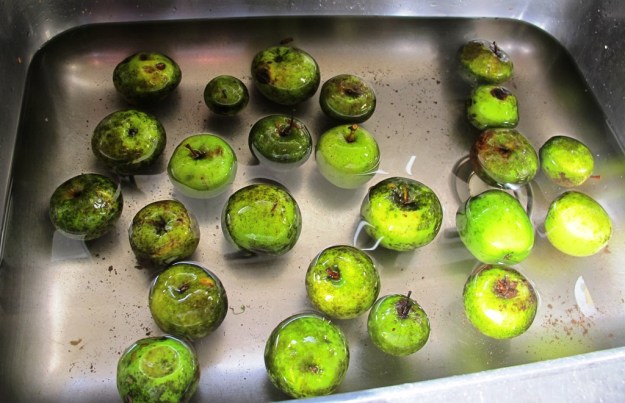
Unripe windfall Granny Smiths

Unripe windfall Granny Smiths

013
The third discovery was about little green apples, but in the autumn time. I had read about using green apples to make one’s own pectin but didn’t try it until this year. It works! It works a treat. Combined with jam sugar, I think I have rediscovered a (minor) passion for jam. I just wash the apples, cut them in bits and remove any bad bits, codling moth or similar before boiling them up. Once strained off, there is a liquid base which lends itself to the addition of any manner of fruit.

The latest efforts are ginger and tangelo marmalade (in apple base) and feijoa and passionfruit jam. Having frozen some apple liquid, I anticipate continuing to make mixed fruit jams which may even be said to rival those of my very late mother in law. There is much more incentive when the process of making the actual jam becomes a 10 minute job with guaranteed results.

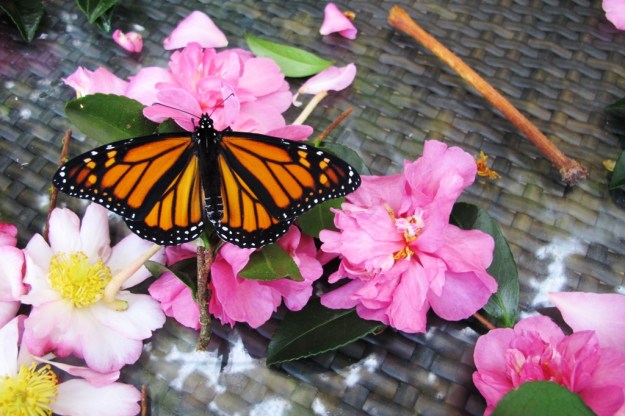
Her last butterfly (of the season)

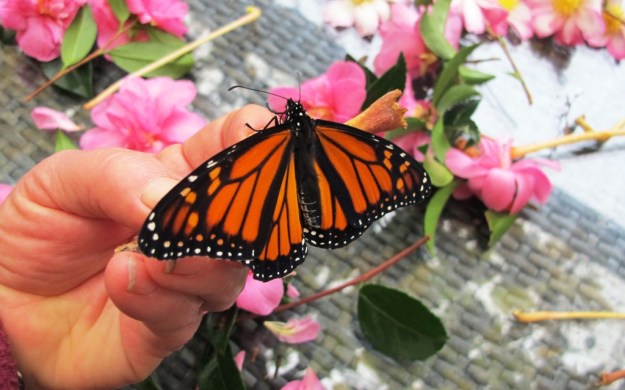
018It is a somewhat gloomy grey and damp day here today, brightened by a knock at the door. There stood a woman, slightly abashed. She had read a piece I wrote recently about monarch butterflies and decided that we were better placed than she was to offer a good home to her last monarch of the season. It had hatched last night and was yet to fly. This little delivery involved a drive of at least 20 minutes to get here (and presumably the same to get home again) but we are not going to discuss the carbon footprint.

What a lovely ray of vibrant colour this butterfly offers, perched on the discarded sasanqua camellia flowers I was photographing yesterday. When he is ready to fly, he will find some friends over on our butterfly hillside. I was charmed.
002

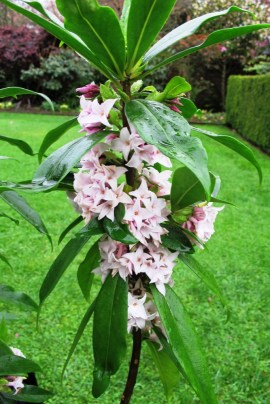
Introducing (drum roll please) Daphne Perfume Princess

Mark's Daphne Perfume Princess

Mark’s Daphne Perfume Princess

By the time a new plant bred by Mark finally gets released onto the market, it has been a part of our lives for so many years that it no longer feels new or exciting to us. Mark has long since moved on to the next generation of plants. But we remain excited by this daphne, named Perfume Princess.

Perfume Princess to the left, centre is a large flowered D. odora 'Grace Stewart', right is a normal sized Daphne odora

Perfume Princess to the left, centre is a large flowered D. odora ‘Grace Stewart’, right is a normal sized Daphne odora

It is “just a daphne”, as Mark is wont to say, but what a daphne. For starters, the flower is significantly larger than comparable odora types. The flowering season is also a great deal longer. This is both the first and the last daphne to bloom each year in our garden. The plant itself is noticeably more robust than other odoras. It looks like a particularly healthy odora – and many gardeners will know that the common daphne is not remarkable for vigour, health or indeed longevity so any improvement in that area is welcome. It smells like a daphne and is that not why we grow them?

But it also has the capacity to flower down the stem when growing strongly. I describe it as the eucomis look. This characteristic adds a great deal to its flower power. So yes, even we are still excited by this new daphne.
046The eucomis look


Back around 1996, Mark was taken to meet UK breeder, Robin White. Some readers will know him for his Daphne Eternal Fragrance although back then, it was his work on the Party Dress series of double hellebores that fascinated Mark more. However, that visit inspired Mark to renew his efforts with daphnes after he had been disappointed with initial efforts. It was not to be as straightforward as other plant genera he works with. The progeny were few. Poor Perfume Princess was nearly lost before she ever got to show her strengths and that, we think, would have been pity.

Please, admire my restraint in not using a naff heading such as “Birth of a Princess”. Any coincidence with the arrival of the British royal baby was just that – coincidence.

Perfume Princess was released in New Zealand last weekend, launched in Australia at the Melbourne Flower Show and is available in UK and Europe. It has yet to be released in North America. It is managed on our behalf by Anthony Tesselaar Plants. We do not handle the production or distribution so any enquiries regarding availability need to be directed to them.

The April garden – vireya rhododendrons

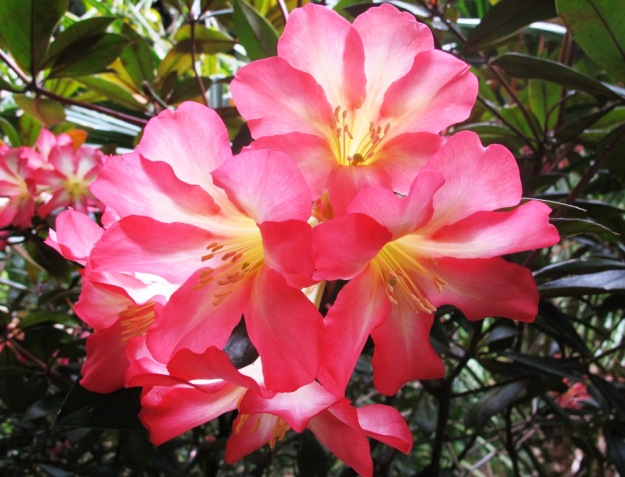
Pink Jazz, one of Mark’s hybrids that is standing the test of time here as a healthy garden plant. It was named for our elder daughter, Jasmine, who had a passion for hot pink in her teen years.

Pink Jazz, one of Mark’s hybrids that is standing the test of time here as a healthy garden plant. It was named for our elder daughter, Jasmine, who had a passion for hot pink in her teen years.

Gardening is as driven by fashion and trends as many other pursuits. It is vireya rhododendrons that brought this to mind. Back in the late 1980s and 90s, they were a seriously hot ticket item. Because they are really easy to propagate, the market was saturated with small plants surrounded by big hype and an endless stream of new varieties being unleashed on an eager buying public. The big luscious looking ones with heavy, felted foliage and big, fragrant trumpets were the most sought after. Here was tropicalia at home even though New Zealand does not have a tropical climate.

Back then, we had a commercial nursery and vireyas were one of our big lines. We produced thousands of them every year and Mark had a full scale breeding programme running on them, naming new cultivars at a cracking rate. I can tell you that they were one of the easiest lines to propagate with the highest success rate from cutting, taking half the time to get to a large grade than the hardy rhododendrons and camellias. It was all downhill from then on. They needed the most intensive spray programme of any plant we produced and even so, there was a high death rate before we ever got them to the market. They are vulnerable to almost every disease that is going, they have pathetically small root systems to support quite abundant top growth, they are frost tender and needed full-scale frost protection in commercial production – even under shade cloth – and they can die almost overnight.

I recall the odd visitor asking the names of certain plants and Mark would toss off that it was a Vireya wiltanddieonyou. Because so many did just that – wilt and die. The species were particularly touchy along the big luscious ones that everybody wanted.
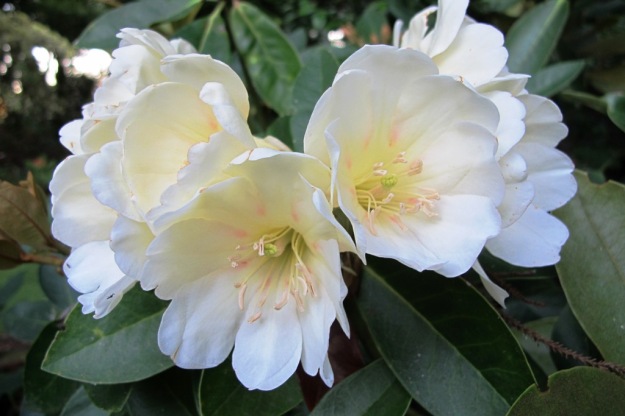
R. konorii is a species with the desirable traits of large flowers, strong fragrance and heavy foliage but the resulting hybrids are not always easy to keep growing well. This is an unnamed one of Mark’s that is still doing well in our garden.

R. konorii is a species with the desirable traits of large flowers, strong fragrance and heavy foliage but the resulting hybrids are not always easy to keep growing well. This is an unnamed one of Mark’s that is still doing well in our garden.

But we would not be without them in the garden. If you have enough of them, you can guarantee that there will be vireya rhododendrons in flower all year round. They don’t get large. They fit in well to subtropical woodland conditions and they don’t need a whole lot of attention. We accept that some will suddenly die, even after many years and we don’t expect every plant to thrive. Those that do, make a worthwhile contribution.
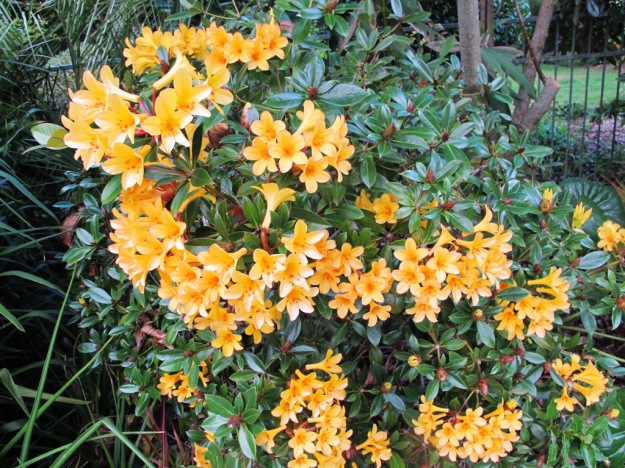
 The late Os Blumhardt had a major breeding programme on vireyas and gave us a number of his seedlings, including this good performing one in our swimming pool garden. It is reliable and healthy rather than outstandingly showy


The late Os Blumhardt had a major breeding programme on vireyas and gave us a number of his seedlings, including this good performing one in our swimming pool garden. It is reliable and healthy rather than outstandingly showy

Because vireyas originate from near the equator where day and night length remains pretty even all year round, their flowering is not triggered by changes in day length. This is why they tend to flower randomly and for extended periods, at times many months although we get the best blooming in autumn and spring and that will show up from this month on. With our free draining volcanic soils, we just grow them in the ground.

Common wisdom, particularly in Auckland, was that vireyas are epiphytic so best grown either as an epiphyte on established trees or in containers with their roots tightly confined. Ponga pots used to be rage, maybe still are in some circles. While it is true that in the wild, many species are ephiphytic, the vast majority that are sold are modern hybrids with a distant connection at best. What they want is excellent drainage without getting too dry. Only hard frost will kill a vireya faster than wet roots in a heavy, clay soil. But if you have the roots heavily confined, they can dry out too much and start to look hard done by and scruffy.
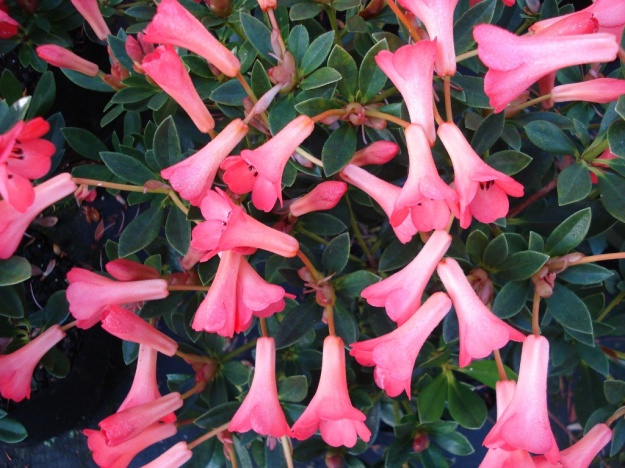
Jiminy Cricket is another of Os Blumhardt’s hybrids and is a sister plant to Saxon Glow and Saxon Blush which are widely available

Jiminy Cricket is another of Os Blumhardt’s hybrids and is a sister plant to Saxon Glow and Saxon Blush which are widely available

These days, we rank ongoing survival, good bushy growth and an abundance of bloom above other characteristics – often features of the smaller flowered, less extravagant looking cultivars. These are the ones that are standing the test of time as garden plants. The oldest vireya in our garden is the plant of R. macgregoriae that Mark’s father, Felix Jury, brought back from New Guinea in 1957, kickstarting the breeding programme. Astonishingly, it is still alive and healthy when many others have fallen by the wayside.
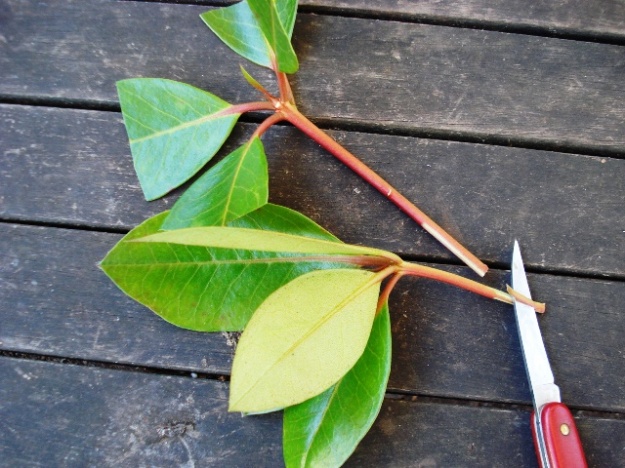
???????????????????????????????If you want to try growing plants from cuttings, vireyas can root without special facilities and equipment. You need to use green stems which are firm, not floppy. Cut off a sliver (called “wounding”) on two sides of the stem of the cutting, extending for 2 – 3 cm. Unlike most plants, the roots will form from the wound or callous, which is why you want two to get a balanced root system. Cut the leaves in half to reduce water loss and stick in potting mix. Keep the pot in shaded conditions until roots start to form – usually within about six weeks.

First published in the April issue of NZ Gardener and reprinted here with their permission.
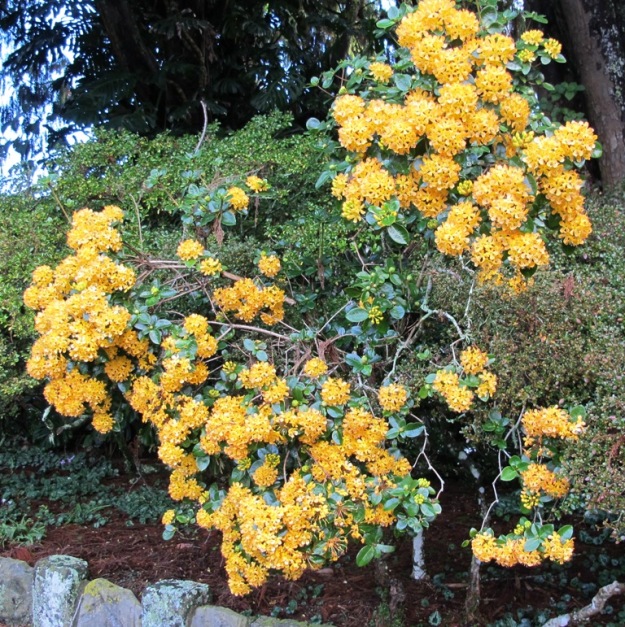
R. macgregoriae is still going strong in our garden after 60 years

R. macgregoriae is still going strong in our garden after 60 years
More harvest than festival

???????????????????????????????After picking flowers, I couldn’t resist laying out some samples of the autumn harvest. I didn’t get too obsessive. There is much that I forgot to include – a good potato crop, sweet corn, another year’s supply of dried beans (not sure we have finished the 2013 bean harvest yet) and I forgot entirely about the show-off avocados which we have in such abundance that we are giving them away by the supermarket bag full.

What I can tell you, as we personally move more to a diet dominated by plant-based protein rather than one heavy on animal protein, is that anyone who says that you can be relatively self sufficient in food on a few metre square raised beds and an hour or two of work a week hasn’t actually done it themselves! With a lifetime of experience, it takes Mark a great deal of time and space to generate a wide range of food that we want to eat. Most of it is organic and we are also interested in the whole issue of nutrient density – more on this another time.

We are swapping surplus tomatoes and melons with a friend for eggs and pumpkin and appreciative friends also reciprocate with jars of preserves made from our surplus produce. It is a satisfyingly simple way of life that we followed in our twenties in our hippie days and we are enjoying rediscovering decades down the track.
The melons – both rock and water – take some effort here. Mark starts them early under a cloche in almost pure compost. The cold, wet spring meant that stone crops were sparse this year but the abundant melon crop is an indication of a good summer.

The yellow fruit by the melons are chaenomeles (japonica apples). I have boiled some down and strained off the liquid to use later for some conserve or jelly. The green fruit, for non New Zealanders – is the feijoa, a South American fruit we have almost made our own here. The oranges are one of our staple fruit here – we can harvest all year round, especially from the Lue Gim Gong tree.

Sadly, while we can grow sapotes, macadamia nuts and other marginal crops, mango and papaya are never going to grow here. We do still buy some extra fruit and vegetables.

I have even made Cape gooseberry jam again this year.

I have even made Cape gooseberry jam again this year.