Category Archives: Tikorangi notes

Tikorangi Notes: Friday June 8, 2012

Latest posts: Friday 8 June, 2012

A distinct flurry of new posts this week.

1) In praise of ornamental oxalis (or wood sorrel, if you prefer). Contrary to popular opinion, not all oxalis are bad.

2) In the garden this fortnight – mostly about bulb meadows.

3) Pruning roses made simple. We may not spray our roses here but I do prune them.

4) The Bad Tempered Gardener from the Welsh borderlands. An interesting book by a contact made on Twitter. Truly, I am so delighted that my time on Twitter is not all in vain.

5) I had been wondering (in a somewhat desultory way, as one does) what would be the next hot vegetable trend when the penny dropped: Cavolo nero (Tuscan black kale) of course.

6) Plant collector this week are the inverted icecream cones of Picea albertiana ‘Conica’.

7) At last, a reference on organic gardening without the smoke and mirrors. It us just a pity it is geared to English gardening conditions. Organic Gardening Bible by Bob Flowerdew reviewed. Does not the author have a wonderful name?

9) Nothing to do with gardening and all to do with food with lashings of history and culture: The Food of Spain by Claudia Roden.
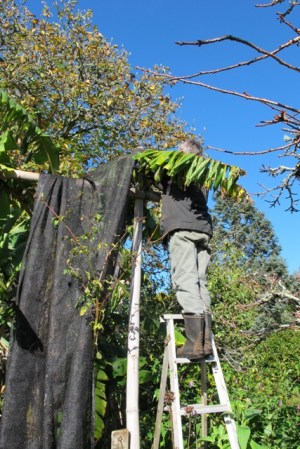
Two weeks from the shortest day - time to cover the banana

Two weeks from the shortest day – time to cover the banana

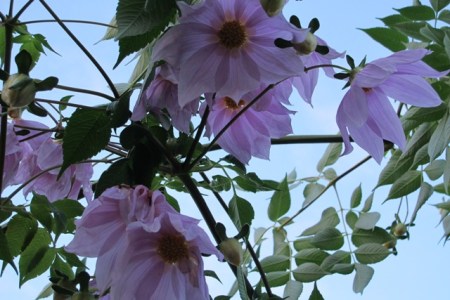
While it is only two weeks until the shortest day, winter has yet to bite here as can be seen from the lilac tree dahlia at the top. Indeed when it snowed heavily in Christchurch a few days ago, our temperature was still in the warm teens (Celsius, dear American readers, we measure our temperatures in Celsius). But in anticipation of cold snaps that we know will come, Mark has finally got around to re-erecting his Theatre of the Banana. This particular fruiting banana is the one and only plant we wrap up for winter. Really we are not that warm but he tells me that there are a few fruit forming on it and I am sure he is aiming for us to achieve self sufficiency in bananas at some time in the future.
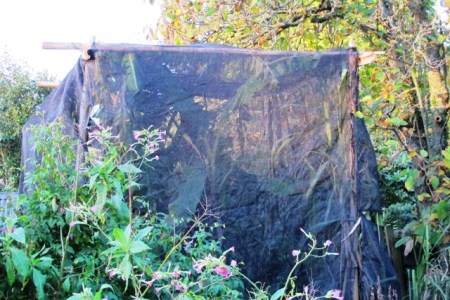
Done. I call it the Theatre of the Banana

Done. I call it the Theatre of the Banana
Tikorangi Notes: Friday June 1, 2012

A true blue verbascum - Blue Lagoon (Photo: Thompson and Morgan)

A true blue verbascum – Blue Lagoon (Photo: Thompson and Morgan)

Latest posts: June 1, 2012
1) Astoundingly, a blue as blue verbascum. Currently only available in the UK, as far as I know, but we seriously covet it for our garden. Abbie’s column.
2) The last nerine for the season, N. bowdenii, standing up to late autumn with brazen pinkness.
3) Grow it yourself – a bay tree. It is easy.
4) And, nothing to do with gardening, but a slew of new reviews on http://runningfurs.com – children’s books this time (mostly picture books) with three really good ones amongst them.

After last week’s column about reviewing our mixed borders, I have been having such fun reworking some of the borders. But I think my concept (and practice) of unifying the underplantings is on a somewhat different page to that of the author, Anne Wareham, who motivated me in this direction. True, in one border, I drifted the blue corydalis, yellow polyanthus and blue lobelia, but also retained the Rodgersia aesculifolia and Mark’s showy arisaemea hybrids. I cast out the dreadful mondo grass which seems to inveigling its way in everywhere (compost heaps are so useful) and figured that the interesting Manfreda maculosa would be better being interesting somewhere else. Same with the burgundy eucomis and a few other plants. But I was always bound to fall off the simplifying wagon. It being the coldest border we have in the upper gardens, I simply could not resist trying some meconopsis (blue Himalayan poppies) to see if they would like the spot. Ditto, some Higo iris, because we are looking for the right conditions for these.

The proof of the pudding is in the eating. We will see how my border looks in the spring and then for the next two or three years. There is little dross left but I realise it is just not in my nature (nor, indeed, in Mark’s) to switch to simple, unified plantings. We just have to work harder at getting the combinations better and establishing different looks so they don’t all start to meld and look the same.

Tikorangi notes: Friday 25 May, 2012

Latest posts:

1) Reviewing our mixed borders (and why the old fashioned activity of reading books can have quite an impact).
2) Iochroma grandiflorum (blue tubular trumpets non-stop for the past seven months or more).
3) Grow it yourself: rosemary
4) It has not been a good year for monarch butterflies in the garden – our garden diary from the Weekend Gardener.
5) Revisiting garden mulch options in Outdoor Classroom.

I can’t think I have ever written about maples (except maybe Acer griseum which is notable for its superb bark). Part of the reason could be that I have never got to grips with names of the cultivars we grow here. I recall Mark and I taking a tour of the British Hardy Plants Society around the garden one time. They were a knowledgeable crew but they also collected plant names as some collect autographs – it didn’t matter if they could never grow the plant in the UK. Every plant had to be recorded. Between us, Mark and I could name everything except… the irises and the maples.

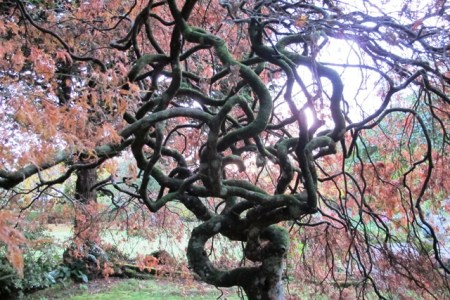
At this time of the year, the maples come into their own. Some have lovely autumn colour. Most have a lovely form which comes into sharp relief as the foliage colours and falls. They are pretty in fresh growth in spring, and fit in very well over summer (as long as they are well sheltered from wind), but it is the bare form that I like the most. They clean up very well with a little pruning and grooming to make excellent skeletons in winter.

Tikorangi Diary, Friday 18 May, 2012

Latest posts: Friday 18 May, 2012.
A mere three new posts this week.

1) Cyclamen purpurascens – one of the most rewarding of the species cyclamen in our garden.

2) Differing shades and grades of organic purity in gardening. Like being a part-time vegetarian here.

3) Grow it yourself – aubergines (if you can – there are easier crops to grow and timing is everything).

Tikorangi Notes; Friday 18 May, 2012

Back in summer, I wrote about my battle with the water weeds. Now it is time to own up and say that when I reached the first of the ponds, I retired. Mark has persevered and has now reached the point where he has all the sludge now accumulated in the lower large pond. It has reached the point where he needs to hire the sludge pump to finish the job once and for all – or rather once in a decade or maybe slightly longer.

Narcissus bulbocodium citrinus "Pandora" - the first in flower this season

Narcissus bulbocodium citrinus “Pandora” – the first in flower this season

At least we are both back into the garden though it was pretty disappointing when the magic autumn weather staged an exit this week and the temperature dropped. Writing and publishing garden advice and thoughts every week is an exercise in keeping us focussed but it doesn’t always mean we get around to following our own advice. This can make us feel a bit of a fraud at times. The hellebores still need to be cut down (getting urgent), the major project in the rose garden has yet to be started and Mark’s vegetable garden is severely under producing at the moment – though we should be able to hold famine at bay with potatoes and dried beans. But at least we are enjoying the autumn flowering of the massive evergreen tree hydrangea is in flower, looking decidedly impressive (pictured above). The earliest of the narcissi, N. bulbocodium citrinus “Pandora” is coming into flower. Before we know it, June will be upon us and the magnolia buds will be fattening.

Tikorangi Notes: Friday 11 May, 2012

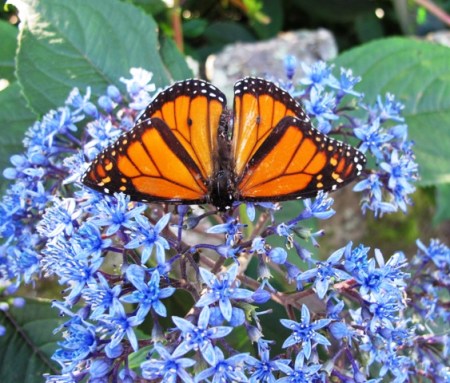
Monarch butterfly on Dichroa versicolour

Monarch butterfly on Dichroa versicolour

1) Garden diary – in praise of cheering pink sasanquas and being grateful for living in a mild climate.
2) Step by step instructions on how to prune raspberries – Outdoor Classroom revisited.
3) Passing the sniff test – fragrant and scented plants.
4) Metasequoia glyptostroboides Such a difficult name for a magnificent tree. It is no wonder it is oft referred to as the dawn redwood (a living fossil).
5) Grow it Yourself – cape gooseberries or, more correctly, Physalis peruviana.
6) Nothing to do with gardening, but there are new reviews on my book site (http://www.runningfurs.com) including three cookbooks – Jax Cooks, Dulcie May Kitchen and Nadia’s Kitchen – and assorted children’s picture books including a couple of exceptionally good ones.

I have an admission to make – the monarch butterfly was in fact dead. They’re easier to photograph that way and we have an alarmingly low number of live monarchs this year (blame the wet and cold summer – more on that topic later). There were not enough fluttering around for me to snap with the camera. In fact we still have an abundance of swan plants which are now interplanted with stinging nettle. Why stinging nettle? Because we are besotted with butterflies and we won’t get the beautiful red and yellow admirals in the garden unless we have their host food which, unfortunately, is stinging nettle.