Category Archives: Tikorangi notes

Tikorangi Notes: September 3, 2010

Latest posts:
1) It is a sign of the times when reticulata camellias in New Zealand become collectors’ plants.

2) Garden hints for the first official week of spring in the garden here.

3) Counting down to our annural Taranaki Rhododendron and Garden Festival which draws ever closer.
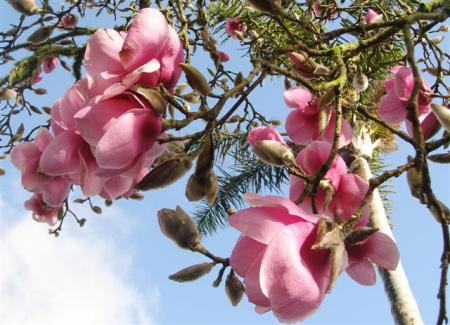
The pink and white blooms of Iolanthe are more to our taste

The pink and white blooms of Iolanthe are more to our taste

4) I do not, I admit, read women’s magazines as a rule. My experience is largely limited to visits to my doctor – an event that occurs about once a year. And it is clear that the surgery is on a permanent economy drive because their waiting room magazines are usually two to three years old and the recipes have long since been removed. But I actually bought the latest issue of the NZ Women’s Weekly at a massive spend of $4. This was because I wanted to see the gardening feature on rhododendrons which I knew quoted me and used a photo I had supplied.

But what really took my attention was the astounding craft section. Written by someone about whose identity I will preserve a dignified silence, this woman gives step by step instructions. Now, we give step by step instructions every fortnight in our Outdoor Classroom. But never, I hope, have we plumbed such depths as this step by step guide as to how to construct (should you ever need to) … wait for it… a basket for fresh eggs on your kitchen bench fashioned from a chrome deep frying basket and no fewer than 500 pink and white plastic drinking straws. Need I say more? I think not. You may prefer our step by step guide to how go about moving a large plant though admittedly we thrashed the Aloe thraskii in the process: Outdoor Classroom.

5) Camellia Diary 5 for the season.

PS – Sally Ridge, in case you are dying of curiosity as to who is responsible for the pink and white monstrosity described above.
Latest posts, Friday August 27, 2010:

1) The pristine purity of a pure white flower, and sweetly scented too: Rhododendron veitchianum.
2) Britain’s very own Expert on Everything and traditional country crafts of England – Abbie’s column.
3) Is it fair to describe bonsai as the bondage and discipline sector of the plant world? A bonsai demonstration (not by us) and other tasks in the garden this week.
4) Our annual garden festival draws closer by the week – counting down around the province.
5) The hardiest vireya we know – the saxafragoides hybrids of Jiminy Cricket, Saxon Glow and Saxon Blush – tried and true plants.
6) Sometimes optimistically referred to as the money plant, or the jade plant, Crassula ovata a tried and true option here.

Tikorangi Notes – a blue sky day in Taranaki

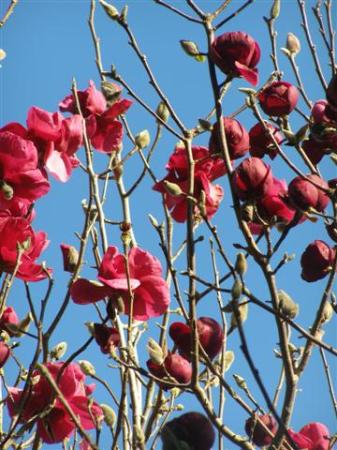
Magnolias Black Tulip and Felix Jury on a blue sky spring morning in Taranaki, Monday August 23, 2010

Magnolias Black Tulip and Felix Jury on a blue sky spring morning in Taranaki, Monday August 23, 2010

We tend to take our blue as blue skies for granted here, especially in mid winter or early spring as it is now. New Zealanders also tend to take red magnolias for granted, not realising that the sheer intensity of colour we can get here is unsurpassed elsewhere and that most of the breeding of red magnolias has taken place in this country – in fact much of the work was done in this very garden here – Jury Magnolias charts the journey.

Tikorangi Notes: August 21, 2010

Magnolia Serene by the pool, 2009

Magnolia Serene by the pool, 2009


The photograph much admired by radio host and landscaper Tony Murrell on Radio Live this morning was the end of season snap of Serene taken last year. We might equally describe this as a fine example of why you do not plant a magnolia beside your swimming pool although in our case, it is why building the swimming pool beside the original Magnolia Serene was not such a brilliant idea of ours. The tree was there first. (Magnolia Diary 13).
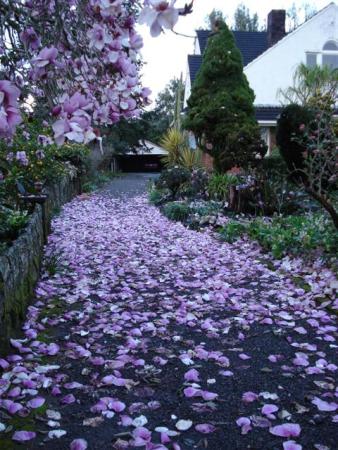
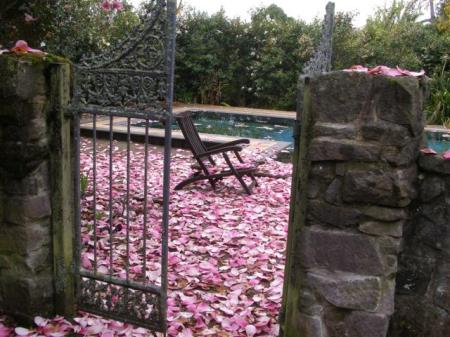
Iolanthe, after a storm

Iolanthe, after a storm

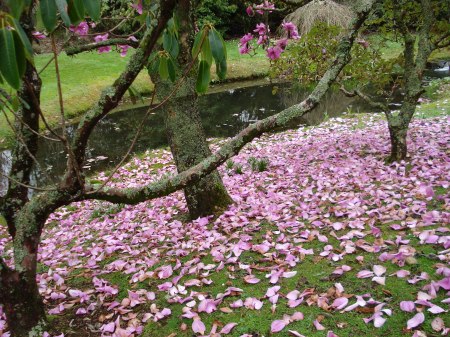
Magnolia Lanarth is the first to drop its petals

Magnolia Lanarth is the first to drop its petals

Personally, I prefer the post-storm image of the original Magnolia Iolanthe (Magnolia Diary 9), planted beside our driveway although Lanarth (Magnolia Diary 4) dropping its petals more tidily and conveniently in our park is also a favourite.
Lanarth petal drop

Lanarth petal drop


All this is a little premature this season as we are just entering the new magnolia flowering season – there should be a splendid display out by next weekend.

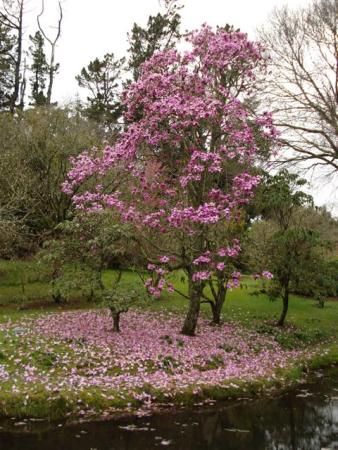
And as a footnote, the petal drop around our lollipop Fairy Magnolia Blush is a regular delight still in store for this season as the first buds are just opening. (Magnolia Diary 12).

Circles of Fairy Magnolia Blush petals

Circles of Fairy Magnolia Blush petals

Tikorangi notes: Friday August 20, 2010

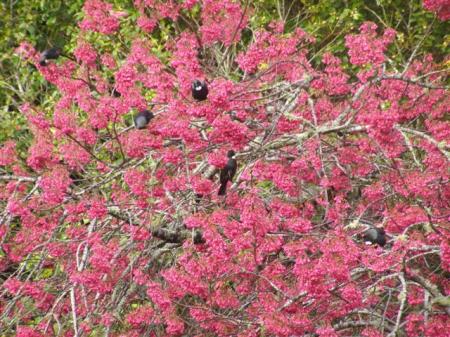
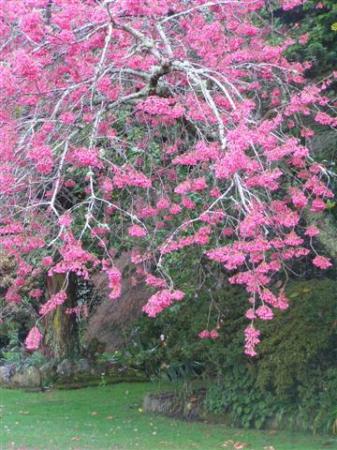
Nectar-feeding tui in a Prunus campanulata

Nectar-feeding tui in a Prunus campanulata

LATEST POSTS:
1) Breeding woody trees and shrubs like magnolias and camellias is a long term commitment over many years, so it was an absolute revelation to Mark in the mid nineties to be taken to visit hellebore breeder, Robin White, to see just how far and how fast you could get with a whole new type – the double hellebores.
2) In the garden – our hints for garden tasks this week and more on the topic of killing moss with washing powder.
3) Grow It Yourself Vegetables, by Andrew Steen. At last, a new book in this country where the author is actually writing from more than just one year of experience in growing vegetables. Enough from ingénues and novices – we would rather learn from people who actually know what they are writing about and have extensive background experience.
4) Planting an easy-care hanging basket using succulents was certainly not part of our own repertoire of experience, but neighbour Chris (wife of our garden right hand man, Lloyd) was keen to demonstrate how simple it is in the latest Outdoor Classroom.

Campanulata for the tui

Campanulata for the tui

TIKORANGI NOTES:
One of the unspoken conventions of garden one-upmanship in this country is how many tui you can boast of in your garden, particularly in spring. The tui (one tui, two tui – the plural does not have an s added) are native nectar feeding birds distinguished by the white tuft of feathers at the throat (along with a disconcerting ability to mimic other sounds). At this time of the year, we can number ours in scores as they move back from wherever their winter feeding grounds are to feast, particularly on the campanulata cherries and the single camellias. Being a territorial bird, they will bicker and squabble over prime spots and indeed over ownership of an entire tree. While I was out with the camera looking at this tree, the big, bully senior tui flew in and gave very short shift to the dozen or fifteen already ensconced. They were not going to argue the point and moved on quickly. No matter where we look at this time of the year, we see them feeding in the garden – tui will come if there is plenty for them to feed from but in order to keep them around, you need a succession of nectar producing plants.