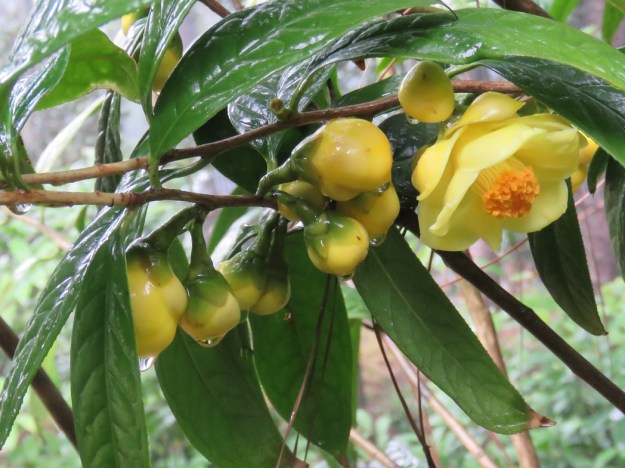
It was raining at Foshan Institute of Forestry Science where they have extensive plantings of yellow species, mainly C. nitidissima. It is thought that the flowers face downwards and are nestled beneath the foliage to protect them from the heavy raindrops they would receive in their forest habitat.

There was a fine specimen of C. nitidissima in the Confucian temple gardens in Dali. The heavy textured buds look more like hanging fruit than emerging flowers. Our plant at Tikorangi has never bloomed this freely.
While we talk about yellow camellias, in China they refer to golden camellias, often in tones of reverence and awe.

Camellia Jury’s Yellow on the honours table at the national camellia show in Dali
By the time Mark Jury (yes, my Mark) started breeding camellias, his renowned camellia-breeding uncle, Les Jury, was quite elderly and happy to share his experience and goals. It seems remarkable that 45 years after he first registered ‘Jury’s Yellow’, it is still widely grown and sold and we even saw it on the honours table at the National Camellia Show in China in February. ‘Gwenneth Morey’ and ‘Brushfield’s Yellow’ are Australian camellias of that era also heading down the yellow camellia path, but it seems that Les’s version is the one with staying power.
None of these breeders of the 1960s and 70s had access to yellow species. They would not even have known of their existence, but always there is that quest to extend the colour range. Les explained to Mark that he thought it might be possible to get the golden stamens to bleed colour into the petaloids (the tiny petals that comprise the centre of an anemone-formed camellia). It worked. These early three yellows all have pale lemon coloured centres with the outer circles of petals remaining white. They were colour breaks in their time but they all originated from white japonicas. The trouble was that there really was nowhere else to go from there, in breeding terms, to try and intensify the yellow.
Enter the yellow species. Even I can remember the waves of excitement in the camellia world when C. chrysantha became available. Suddenly it appeared that there would be a huge range of new directions in camellias. Don’t hold your breath. It ain’t that easy and it is not for want of trying. After maybe fifty years and probably hundreds of thousands of crosses, there haven’t been many encouraging results out of China. Japanese breeders have been very active without many results and we have never heard of anything coming from other international breeders.

The Best in Show award went to a yellow hybrid
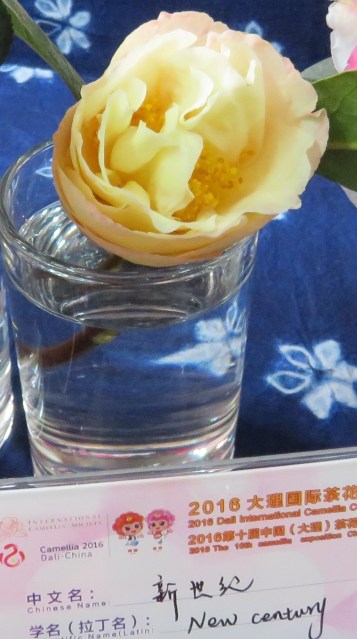
‘New Century’ shows good colour but it was not possible to tell if the bloom opens more than this specimen in the show
True, the Best in Show award at the Chinese nationals went to a fine yellow hybrid and there was another promising yellow coloured bloom called ‘New Century’ on the table. But those are cut flowers looked at in isolation. There are many other factors to be taken into account to determine garden worthiness. We also saw a few other results from breeding programmes – one flushed palest yellow with pink on the outer petals. It was a hybrid but not of great note. Others just seemed to throw to the japonica parentage. Kunming camellia breeder, Shen Yunguang, said that she was crossing the yellows with a white japonica – the latter will be to get greater size and floriferous characteristics – but the yellow species do not appear to be keen to cross with other types.
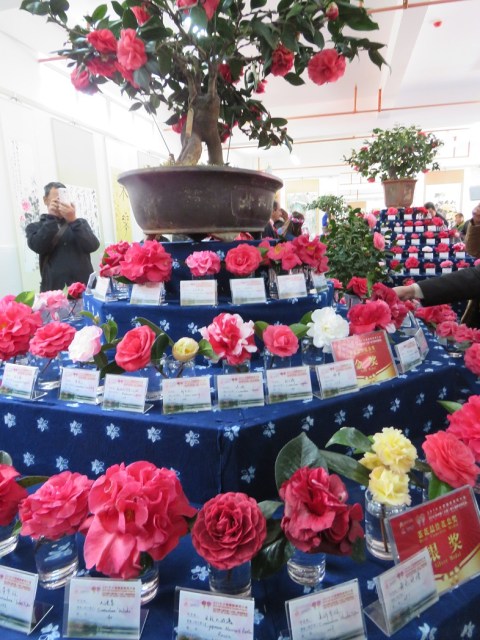
The Chinese national camellia show was staged in a temple in the heart of Dali Old Town. The yellow cultivars stood out amongst the more usual pinks, reds and whites
If it is possible to get a range of good yellow hybrids, the Chinese will do it but I doubt that it is imminent. What about orange ones? Can the next generation look forward to yellow camellias being crossed with red ones, to give a new colour altogether? International yellow camellia expert, Dr George Orel is pretty sure it can’t happen because of the incompatible genetic codes between the yellows and the reds. I am sure it is not for want of trying but the yellows are notoriously difficult in hybridising.
I asked Mark if he saw breeding potential in the new species that are still being discovered. He shrugged his shoulders and said, from his point of view, no. They are tropical, too tropical for New Zealand. He is also realistic enough to know that if the Chinese and major international breeders from other countries have found them hugely difficult to cross with other camellias, it will be a fluke if a minor breeder in another part of the world comes up with something worthwhile. It is just as well he doesn’t want the newly discovered species because with our closed borders, bringing in a new species of anything is devilishly expensive and difficult.

Camellia nitidissima (or chrysantha) – the one good flowering we have had on our plant in 2011
Chrysantha or nitidissima?
The most common yellow species in the west and, I understand, the one widely used for flower tea in China was originally distributed under the name of Camellia chrysantha. It is now more usually named as C. nitidissima syn chrysantha – in other words, you can use either name but nitidissima has precedence. We bought it from Neville Haydon at Camellia Haven as soon as it became available. It has handsome bullate foliage – heavily veined and textured leaves – but in all the years since we have had it, I think it has only flowered well once. It wasn’t helped by a pear tree falling upon it but it has reached quite a large size and is now at least 20 years old, if not more. The other yellow species we have here have never bloomed. This is not to say that they won’t bloom in other parts of the country, at least further north.
Collectors’ plants vs good garden plants
The yellow species are what I would call collectors’ plants – really interesting to have and exciting when they flower. But good garden plants? Not so much. All the species I saw had small flowers and not that many of them at any one time. The flowers usually face downwards and are on the underside of the branches. They are also quite picky about growing conditions and many were sparse in foliage. A good garden plant is a reliable performer that will delight your average home gardener and, with camellias, that means a reasonably long season of mass blooming. This is why there is so much interest in creating good hybrids. If you want to grow any of the yellow species, remember that these are understory plants of the forest, growing in humus-rich soils. They need overhead shade but also sufficient light to enable them to set flower buds.
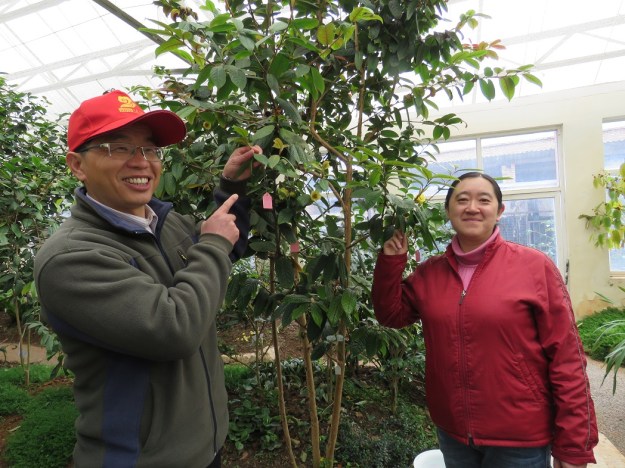
Shen Yunguang is responsible for managing the covered house that contains the yellow camellia species at Kunming Botanic Gardens, where it is too cold to grow them outdoors. While it appears more usual to use the yellow species as the pollen donor, she is also trying to cross using them as seed setter. The hanging pink labels mark her crosses. To the left is Professor Wang Zhonglang from Kunming Botanical Institute

C. chuongtsoensis (photo by Tony Barnes)

C. longzhouensis (photo by Tony Barnes)

C. impressinervis (photo by Tony Barnes)
Camellia nitidissima was first described and named in 1948. In 1960, a wild population was found growing near the southern border of China with Vietnam and it was named C. chrysantha (hence the two names). It wasn’t until the 1980s that the west realised there was a yellow camellia species and it remains the only one commercially available in any significant numbers.
However, since the 1980s, there has been an explosion of interest in yellow species and modern day plant explorers are continuing to find new ones, particularly in Vietnam. It is a fluid situation. There appear to be anything between 28 and 60 different yellow species. It is likely that some will be reclassified as variants on existing species while new ones will continue to be identified. There are at least six notable public collections of yellow camellias in Chinese institutions. I visited the one at Kunming Botanic Gardens where they are grown under cover. We also saw extensive outdoor plantings in Foshan near Guangzhou. The differences in flower form between species are not great to the untrained eye. All appear to have small blooms around 4cm across, usually semi double (two rows of petals) with a large boss of golden stamens in the centre. The heavy substance of the petals is remarkable, making them look waxed and solid.

Tea made from the golden flowers was served to us on a number of occasions and is very pretty

Drying the flowers and buds for tea in Foshan
When we talk about new species being discovered, we should remind ourselves that this is being discovered by botanists. Local residents will have known about these plants throughout history. Tea made from the golden camellia flowers is widely served on ceremonial occasions and is now a commercial venture. It seems unlikely it only dates back to the 1980s.
What does golden camellia tea taste like, you may wonder. Subtle, is all I can say. Beautiful to look at, with a subtle floral aroma and taste.
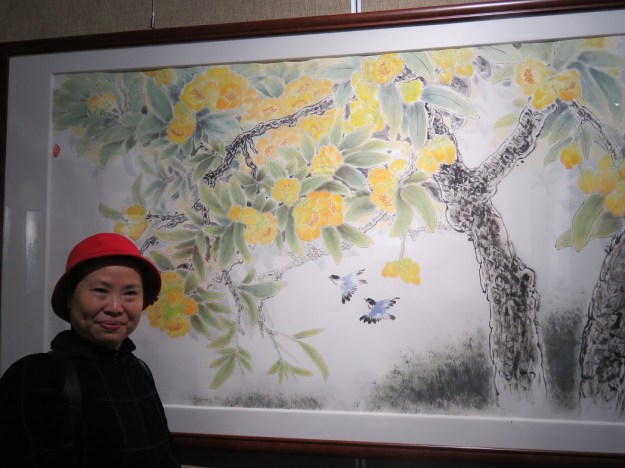
Artist Xinger Li with her lovely painting titled (in English) ‘Chinese Camellia with Dense Dew”
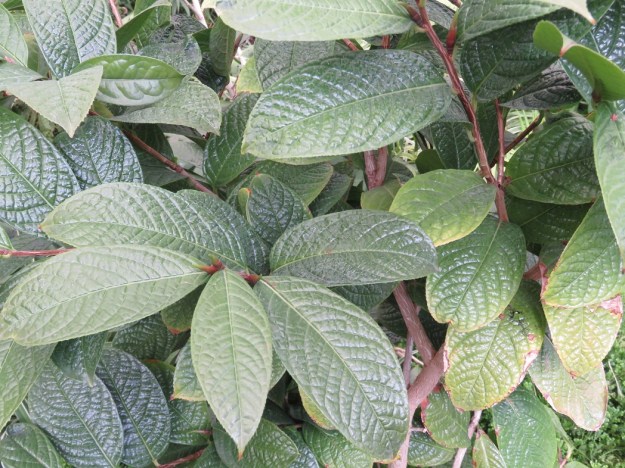
The foliage on C. impressinervis, as on C. nitidissima and some of the other species, is heavily veined and textured (called bullate)
First published in New Zealand Gardener and reprinted here with their permission.
Stop press: one of our other yellow species in the garden here has set flower buds for the first time, after maybe fifteen or twenty years. We will be watching it closely and now we just have to try and unravel which species it is. The label has long since gone.

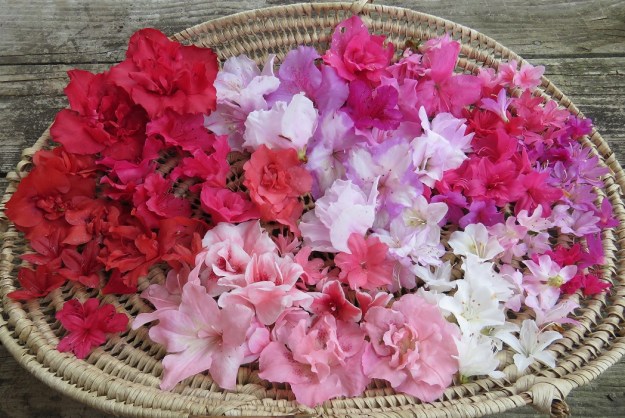
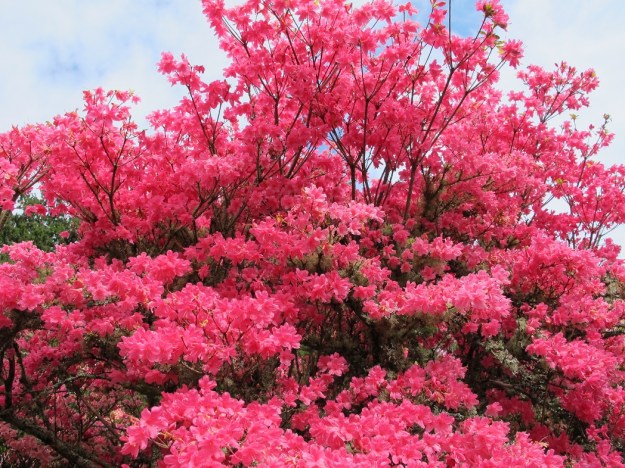 I am on the ‘Mission of 78 Azaleas’. Some years ago, Mark did a cuttings run from plants here and they had reached the point where they really, truly did need planting out. I found homes for about half of them last spring, but there are still 35 sitting out under the shade cloth, looking reproachfully at me and begging to be given permanent homes this winter.* I shall do it this very month. I swear I will. From this, you may deduce that azaleas are one of our backbone plants in the garden, threaded through quite large areas.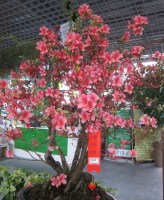
 I like to tell the story of a knowledgeable Japanese garden visitor. He came from Kurume and we have a fair number of very small leafed, small flowered Kurume azaleas. He had no English and we have no Japanese, but he managed to convey to us that our Kurumes were simply astounding in their stature and shape but that we needed to take better care of them. He was pointing to the grey lichen infestation in the canopy of a patch growing in full sun. While it is often recommended that you spray for this – lime sulphur or copper is the usual treatment – it is no mean feat to spray above your head height and we are consciously trying to avoid spraying. So I am on a long term campaign – year three into what may be a five year project. In late spring, I manoeuvre my way around on the ladder to take out maybe 20% of the old growth which is most heavily infested, without losing the canopy effect. They do look better for it, but I am grateful that it is only one area that needs this attention.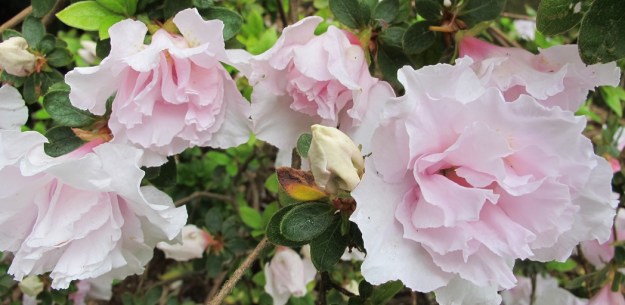

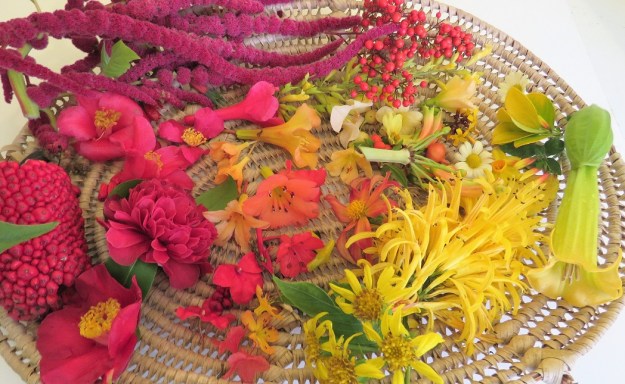 Winter can be very pink, here. Or so I have often declared. I hereby move my position. Late winter and early spring can be very pink – all those camellias and magnolias. In late autumn to mid-winter, the dominant colours are more inclined to the oranges and yellows with a smattering of reds.
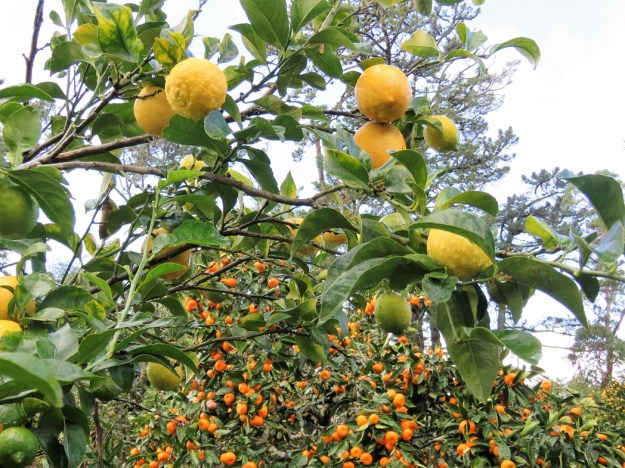 I could of course have added in fruit. The citrus trees add a glorious blaze of colour in the depths of winter – just a common old lemon and a very productive mandarin tree in this photo, but the orange trees we have scattered through the ornamental gardens are also indubitably orange and a very cheerful sight for that.
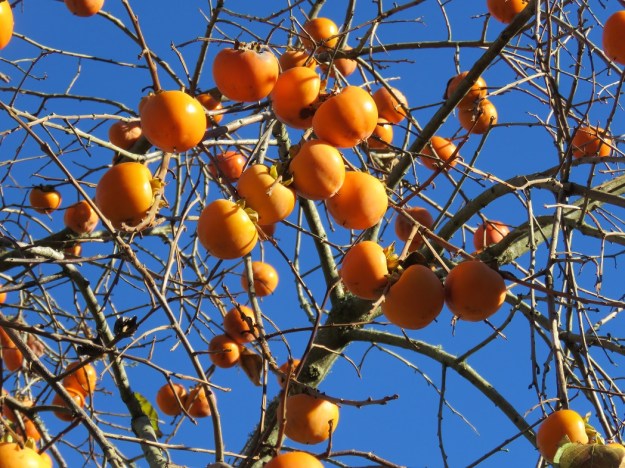 And it is hard to ignore the glory of the persimmon tree, be the sky grey or blue. It is a feature of our climate that we have high sunshine hours and bright, clear light even in mid-winter, albeit interspersed with the rain. We don’t get many days when it is irredeemably grey and gloomy, without spells of clear skies.
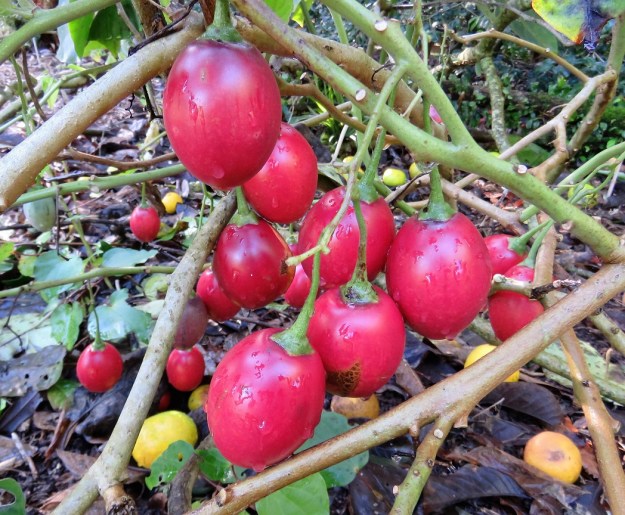 The tamarillos are also hanging decoratively. These used to be known as ‘tree tomatoes’, botanically Solanum betaceum. Apparently the ravages of the potato psyllid have hit commercial production hard, but our plants just continue on in a regime of benign neglect. The fruit is usually stewed with sugar but stewed fruit is not part of our diet. I enjoy them more as a fruit cordial. Mark’s father used to like eating them sliced on wholemeal bread with a little raw, chopped onion. The yellow fruit beneath are windfall grapefruit.
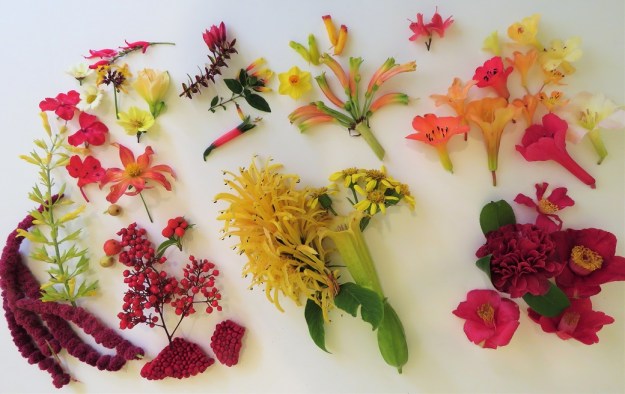 But to the flowers. On the left, we have the vestiges of autumn – salvias, impatiens, tree dahlia hybrids, daisies and Oxalis peduncularis. At the front are a few berries and seeds – baby figs from
 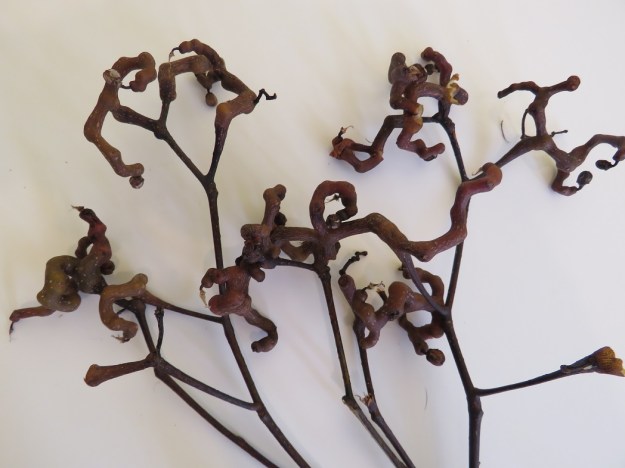 Finally I offer you… the ‘fruit’ of the Japanese raisin tree, Hovenia dulcis. I am guessing that as our plant is maybe 20 years old and planted in a somewhat out of the way position, we just haven’t noticed these before. They are actually the swollen tips of the stems and are edible. They even taste fruity, in a raisin-ish sort of way. Apparently drying them makes them even more raisin-y. It is more a curiosity than an edible essential, but we like these odd additions to our diet here.
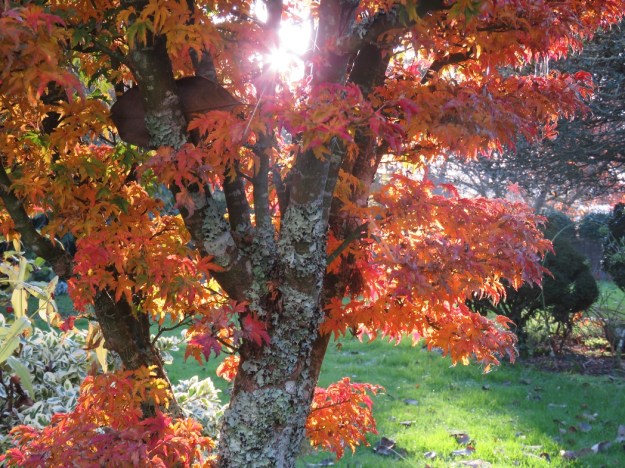 ‘tis the winter solstice today. This marks the point where the days will start to lengthen again, which is always encouraging. However, it usually marks the point where we descend into the worst of winter weather from here through July. But I tell myself that a winter so brief is not too bad, really. We are still enjoying plenty of autumn colour – which is more early winter colour here – and more camellias are opening every day. The spring bulbs are pushing through the ground.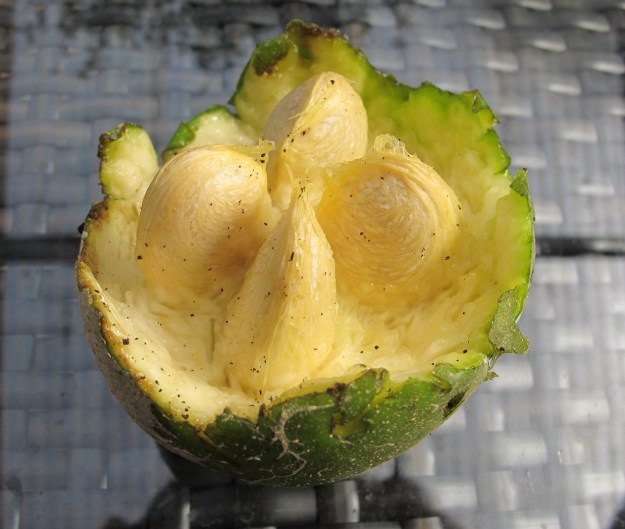
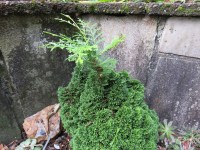 I had been meaning to photograph this reversion on a dwarf conifer. Many plant selections, especially amongst the conifer families, are sports or aberrations on a parent plant. Part of plant trialling is to test that sport for stability but even so, you may often see reversions to the original plant. Generally, it is going to be much stronger growing so if you don’t cut it off, over time it will dominate. A quick snip with the secateurs was all that was required on this little dwarf in the sunken garden. The major growth that Mark removed from the top of the variegated conifer in the centre of this photo required a tall ladder, some tree climbing and a pole saw.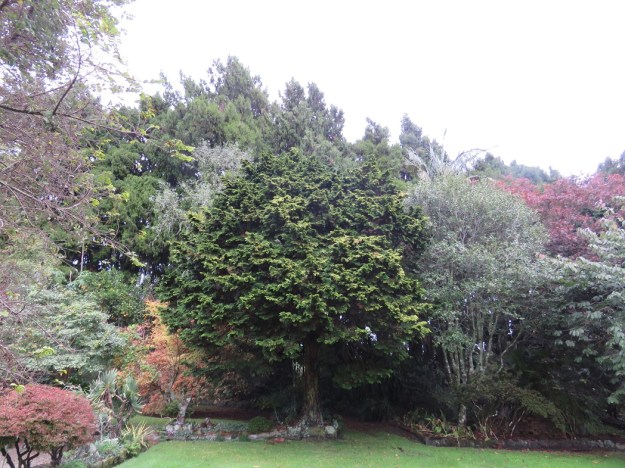
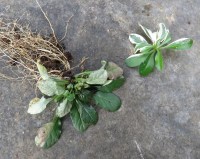 Reversions are also apparent in these perennials. The silver leafed ajuga to the left is showing reversion to plain green. While that particular ajuga is not my favourite (the silver reminds me a bit much of thrip-infested foliage on rhododendrons), it is better than the boring green which barely blooms. I weeded out an ever-growing patch of the plain green. The other little groundcover must have a name but I have no idea what it is. The clean white variegation is sharp and smart but it has a definite inclination to revert to its plain green form, which is much stronger growing. The same rules apply where variegated hostas are reverting to a plain colour. If you want to keep the variegated form, cut out the reversion or you will end up with just plain foliage.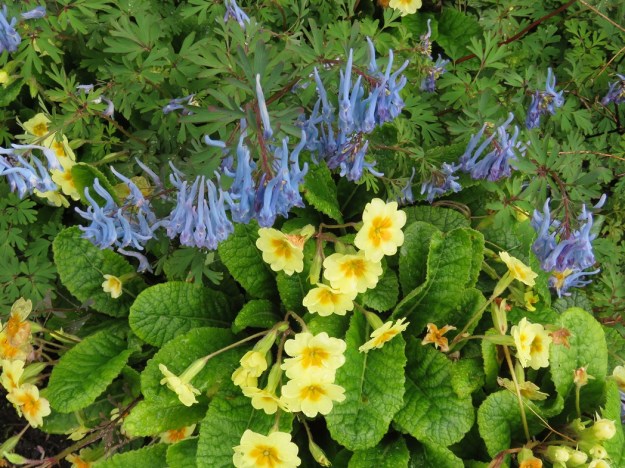
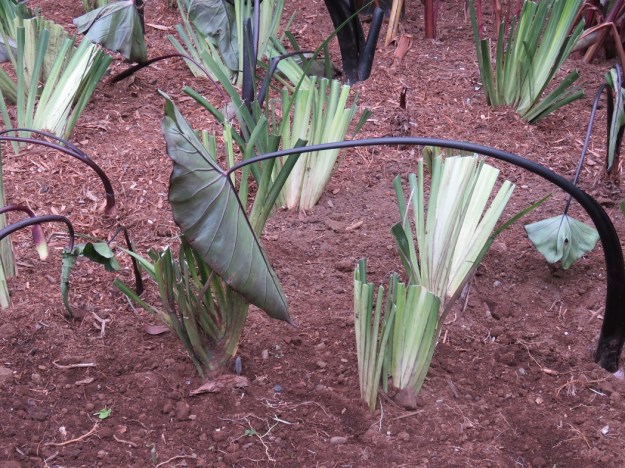
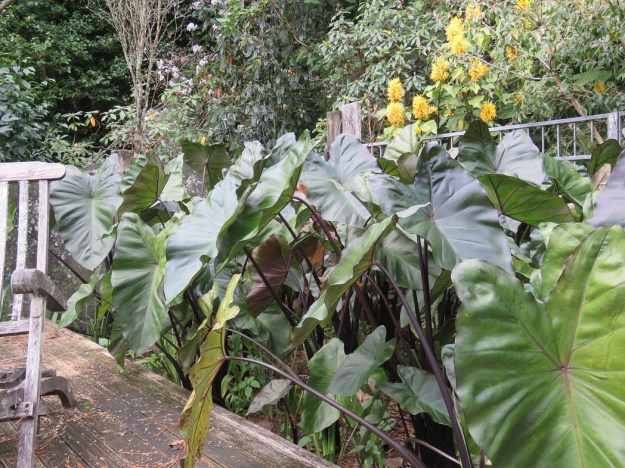

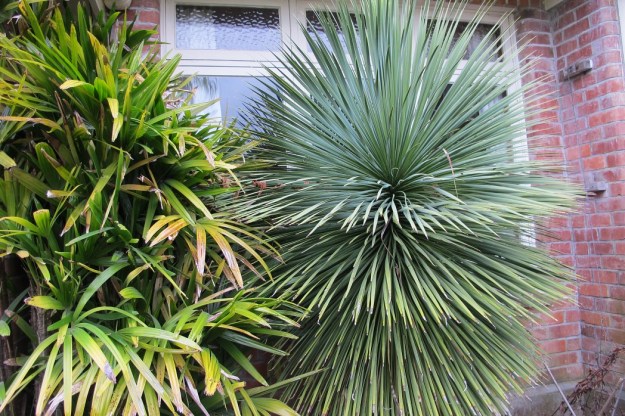
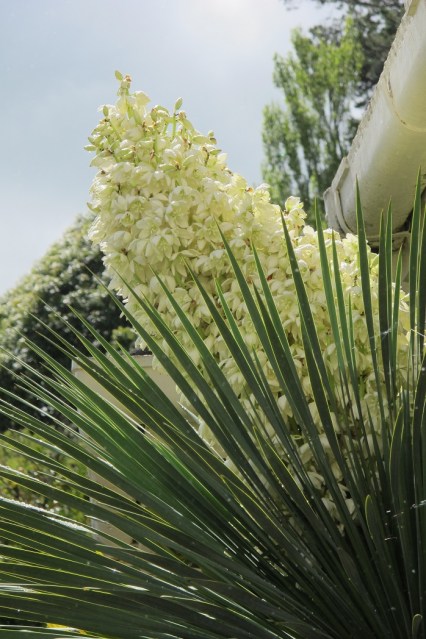
 Our ever handy man on the spot, Lloyd, cut back the concrete in anticipation of the move. That was on June 14, 2012. But time passed and other jobs always seemed more urgent. Towards the end of 2014, we spotted a flower spike forming. That was pretty exciting, given that the plant was over 25 years old and had never bloomed before. Moving it was out of the question.


 Tikorangi The Jury Garden