Clivias, with a sidetrack onto green flowers.

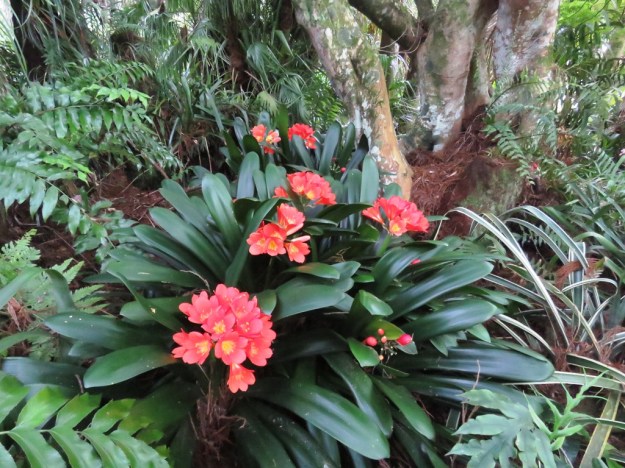
IMG_5576Clivias sure do light up a dark spot at this time of the year, for those of us who live in climates where they grow. This is not a family that will take much at all in the way of frost, though their preference for shaded, woodland conditions gives some protection against cold.

I used to quote Mark’s quip that if somebody wanted to be an expert in a particular plant, hellebores would be an easy family to choose. But as long as you are patient, clivias beat them hands down for simplicity. There are only about six different species to learn and they are dead easy to grow and care for, presenting few technical challenges. The drawback is that it takes much patience as they take several years before they reach flowering size. So if you are wanting to try and hybridise for different blooms or even just to raise plants from seed, you need to be prepared to wait.

Most of the plants in our garden are C. miniata seedlings and this is by far the most common type of clivia available. It is what gives the big heads of blooms.  We have quite a few, and almost as many again hanging around in pots waiting to be planted out. Less resilient plants would be dead by now. While I think they are wonderful focal points of colour in shady areas which are lush and green, I think one can have too many orange clivia, even too many clivia. But then we have always gone for the mix and match of a variety of plants to create a more natural effect rather than uniform blocks of one colour as favoured by mass planting landscapers. They combine particularly well with ferns.

IMG_5596I headed out with my flower basket to gather a single flower from a range of plants around the garden, feeling a little as if I was doing a geriatric Milly-Molly-Mandy impersonation. Given that ours are almost all seedlings, I was a little surprised at how consistent the flowers are when I started sorting them by colour. The variations are… subtle, shall we say?
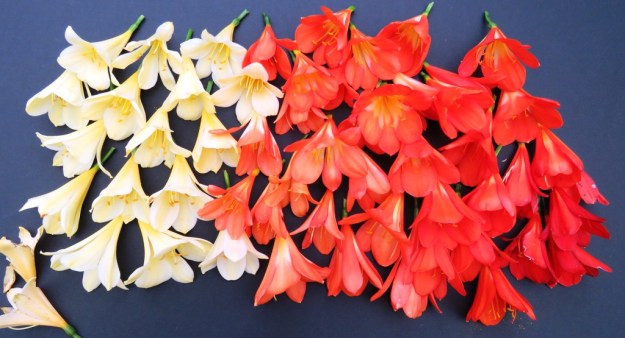
IMG_5601IMG_5598To the right, we have the ones that age to red. Do not be like the novice gardener I heard of who ordered a swag of expensive red clivia for a mass planting in her ‘designed’ garden. They opened orange, so she dug them all back up again, complained and wanted them replaced. We have not seen clivia that actually open to pure red – some age to red.

IMG_5597On the left, very battered by bad weather, are a couple of examples of blooms heading to what are called the peach tones. Like many other clivia enthusiasts, Mark has been playing around crossing different plants to try and extend the colour range and the peachy ones are certainly different to the yellows which are the comparator. We have yet to acquire any of the green throated clivia which would add a worthwhile variant.

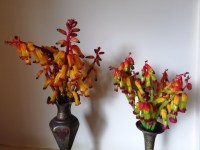
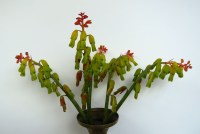
A recent newspaper article referencing the very recent green clivias had Mark snorting. He is not a fan of green flowers at all, but a net search for images shows that they are more white clivias with green markings which is a great deal more interesting.
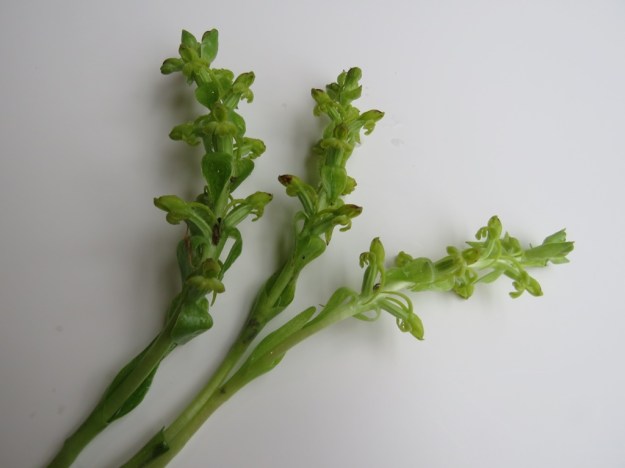
Satyrium odorum - green flower insignificance

Satyrium odorum – green flower insignificance

Why is Mark sniffy about green flowers? It is because he is first and foremost a gardener so he assesses plants on garden performance and appearance. And when the most dominant colour in a garden is invariably green, he sees no merit in green flowers. They meld into the surroundings. Take the green orchid, Satyrium odorum. I had to pick them because I had no hope of getting a clear photo of them in the garden. They have an interesting, strong, cinnamon scent but are insignificant as garden plants. If we hadn’t been given a whole lot of them, I wouldn’t be bothering with them.
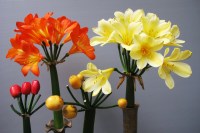
068Earlier articles include a step by step guide to how to dig and divide clivias and a short piece on seed colour and future flower colour. To save you having to google the basic details, clivias are native to southern Africa and Swaziland, evergreen, used to growing with low light levels and belong to the Amaryllidaceae family. Over time (many years), they can get quite large – well over a metre in diameter and the same in height. Clive-ea or clivvia? We pronounce it clive-ea because it was named for a member of the Clive family, but it is probably optional.


TV gardening

Mark coined a new word for our gardening lexicon – to monty, a verb meaning to fluff around in one’s own garden with more pleasure than urgency. I do a lot of montying.

British gardeners will recognise instantly that this is a tribute to Monty Don, the lead presenter of BBC’s long-running Gardeners’ World. Sure we are watching the 2013 series on NZ television (Choice TV, Fridays at 10pm) but eventually we may catch up? Unlikely. It took us a while to warm to Monty who is quintessentially British. We felt very sorry for poor Toby Buckland, the previous lead host, when he was axed. Toby had earned our respect with the depth of his knowledge and his ability to convey sound information in an unhurried manner. But it appears he lacked the class craved by the audience and, we must admit, the episode involving peeing on your compost heap may have been a step too far. Now we have settled into the groove of watching Monty who so clearly enjoys pottering around in his own garden called Longmeadow, and he is backed up by very capable and knowledgeable co-presenters from around the country. It is light years ahead of any home-grown gardening programmes here. Sure vegetable growing features, but so does aspirational, higher level gardening that is concerned with aesthetics, the environment, interesting plants and design. And Monty is a dedicated organic gardener.

While there is a great deal of critiquing that goes on about Gardeners’ World in the UK and on social media, I just think the Brits do not know how lucky they are. The running commentary on each programme (the 2015 series has just finished) often appears on my Twitter feed under #shoutyhalfhour. It was here I picked up the very funny series of tweets about Monty’s recent attire. My prize for the best tweet went to @milominder: “Monty Don wardrobe update: nonchalant actor in relaxed interval mode at a production of The Three Musketeers”. Monty’s dog Nigel is also a huge hit.

But the viewer who tweeted: “I like Monty Don but with my small garden most items from his vast plot just do not translate. Time for a change?” should consider moving to New Zealand where our only TV gardening is aimed at the lowest common denominator, pretty much lacking in anything of interest to more experienced gardeners.

In fact, I could suggest that we have the Tui Garden infomercial vs the Yates Garden infomercial. How many of the sponsors’ products can be worked into each short segment? The focus morphs into an exercise where the selling of branded product to a gullible public with deep purses takes precedence over fostering good gardening.

I don’t blame the presenters at all. I have met both Lynda Hallinan and Tony Murrell and have a great deal of respect for them. Both are genuinely keen, knowledgeable, experienced and professional. I would love to see them given the freedom to generate quality content that goes beyond that most basic level and using the sponsors’ branded products.

I blame the producers who have kowtowed to horticultural supply merchants, apparently with unsophisticated marketing staff who think endless repetition of the company name and hawking of often unnecessary product will increase their sales and profile. It makes me flick the channel switch to escape.

Tui is arguably the worst of the two.  Kiwi Living on Friday evening on TV1 is quite an engaging lifestyle programme. The fashion makeovers, food and architecture sections are interesting. So too is the interior design, even if it is not to my personal taste. The continuity scenes with the hosts, sitting chatting on the couches, are not too embarrassing or forced. And then there is the Tui Gardening Infomercial, masquerading as the garden segment. In case you miss the Tui product when it is mentioned, it is also flashed up on the screen for you to see. So too with the Yates products on the Get Growing Roadshow, but they also work on prominent product placement in the filming and they have a wider portfolio of sponsors to serve.

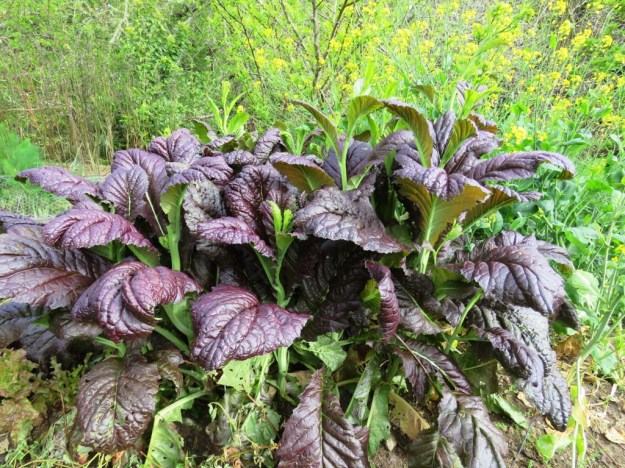
Mustard, in lieu of kale here

Mustard, in lieu of kale here

We gardeners deserve better and these presenters could certainly give us better if the shackles of the sponsors were loosened. There are folk who garden outside Auckland, who are not absolute beginners under the age of 40 and who do not wish to grow tomatoes, basil or kale.

You don’t see Monty Don and his team of highly professional presenters forever promoting the sponsors’ products. I like the gentle pace of BBC Gardeners’ World. It suits my montyesque gardening style.

An abundance of spring bloom

IMG_5588Starting with a small brag photo: michelias used to be white, in the main. At least the hardier varieties are generally white. Sure the tropical M. champaca is orange and M. alba is creamy yellow, but they have not shown compatibility with the hardier varieties and don’t have enough virtues to warrant using them as breeder parents. I did a little round-up of Mark’s current seedlings that we have flowering here. It has taken him 20 years of work to get to this colour range and there is a long way to go yet. A good garden plant is much more than just an interesting bloom. There are a huge number of variables when it comes to selecting a new variety for commercial release. But even I was impressed by the range of colour, flower shape and flower size that he has achieved in this line up.
IMG_5502
I see I optimistically posted in August on the early blooming lachenalias. I may at the time have thought there would be two or three posts charting the lachenalia season, but we are now entering the final stage so I thought I had better do a round up. From left to right we have arbuthnotiae, pallida, contaminata, orchioides var glaucina (2) and the attractive end one we have as rosea. I missed several varieties during the mid season, but one reason I missed them is that they are not fantastic performers in our conditions.
IMG_5434Glaucina is our stand-out blue, and we once gathered as many different blues as we could. It is variable in colour and somewhat frost tender, but it does at least stay within the blue spectrum (some of the other alleged blues faded out to cream or very pastelle mauve) and it increases well for us.
Lachenalia contaminata with the rockery behind

Lachenalia contaminata with the rockery behind

L. contaminata is one of the last in the season to bloom, very easy to naturalise, scented, feeds the bees (I have personally observed this) and generally under-rated.

Earlier season L. aloides and aloides quadricolor

Earlier season L. aloides and aloides quadricolor

L. aloides tricolor

L. aloides tricolor


L. aloides var. vanzyliae

L. aloides var. vanzyliae

L. aloides is pretty interesting as a species. I mentioned aloides quadricolor and the common form in New Zealand which may be aloides bicolor in my earlier post. Aloides tricolor then comes in much later, predominantly green but with enough red and yellow to make it visible. When these three forms of the species are so easy and reliable for us, why oh why is the most striking L. aloides var. vanzyliae so very difficult? It is a mystery to me and it was a bit of a surprise I managed to catch the small patch (which does not get any larger) when it was in flower.

Quite how I achieved this stylish, albeit over exposed image, I am not sure.

Quite how I achieved this stylish, albeit over exposed image, I am not sure.

IMG_5533
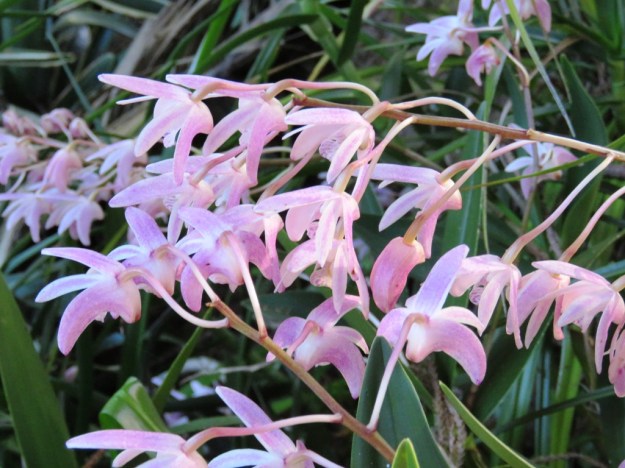
We are big fans of the Australian dendrobium orchids and they are at their peak right now in the woodland areas of our garden. I did a little round up of the different ones in the garden and was surprised to find the range was somewhat greater than I had thought. Somehow we do not think of Australia having such pretty and delicate wildflowers.
IMG_5547
Tomorrow, if the rain continues, I shall return with… clivias. Big, bright and bold.

A glut. Yes, a glut of avocados.

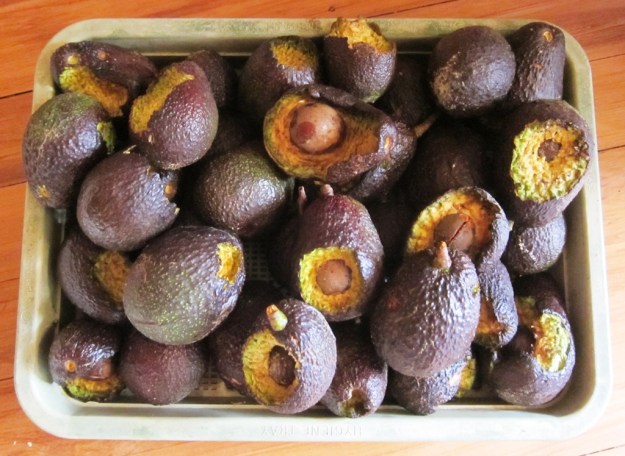
IMG_7063I mentioned the superb crop of avocados in an earlier post. I can report the avocado crop continues to astound and Dudley Dog is getting ever plumper. Though he is not responsible for all the chomped fruit in this tray. That represents a day or two of windfalls. It is hot competition out there between the dog, possums, birds, rats and humans.

We only have three trees but this year’s crop is all from the one specimen. The Fuerte comes in first but is a rather watery and insignificant taste compared to the ever reliable Hass. We start harvesting soon after Christmas and this year it is still going strong as we near the end of October. Basically, the one tree has kept about four households going in avocado this year, with enough left to give supermarket bags full to other friends, the postie and random visitors. We have to enjoy them because there is NO crop at all for next year. Avocados are often alternate croppers and we are growing them in marginal conditions this far south and 5km inland from the coast.

The third tree is also a Hass but it is looking poorly. Root problems. Avocados are terribly sensitive in their roots, being prone to phytopthera when drainage is anything less than perfect. We can but wait and see if the tree recovers.

It takes about 18 months for an avocado fruit to mature on the tree. Although it reaches full size straight away, it takes time for the oil levels to build up in the tissue of the fruit. If you have been deeply disappointed in the quality of fruit you have bought in the shops, it is likely that they have been harvested too early and the oil levels have not developed. Shun fruit where the skin is starting to darken but has a coppery sheen to it. In our experience, that is a sure sign of a fruit picked too early. Very small fruit which is often packaged in multiples and specialled off cheaply is low grade, reject fruit which will be inferior. If you lack friends like us with a well producing tree, it is probably worth paying top price for good fruit to avoid disappointment.

Mark heard or read somewhere that it is possible to mash ripe avocado and freeze it, using it later to make guacamole. He is trying this, thinking that if it does not come out of the freezer in a state that is palatable to humans, he can at least supplement the dogs’ food with it. It will be interesting to see, though as we are currently eating avocado every day, either in salads or as guacamole, we are not going to need the frozen stuff any time soon.

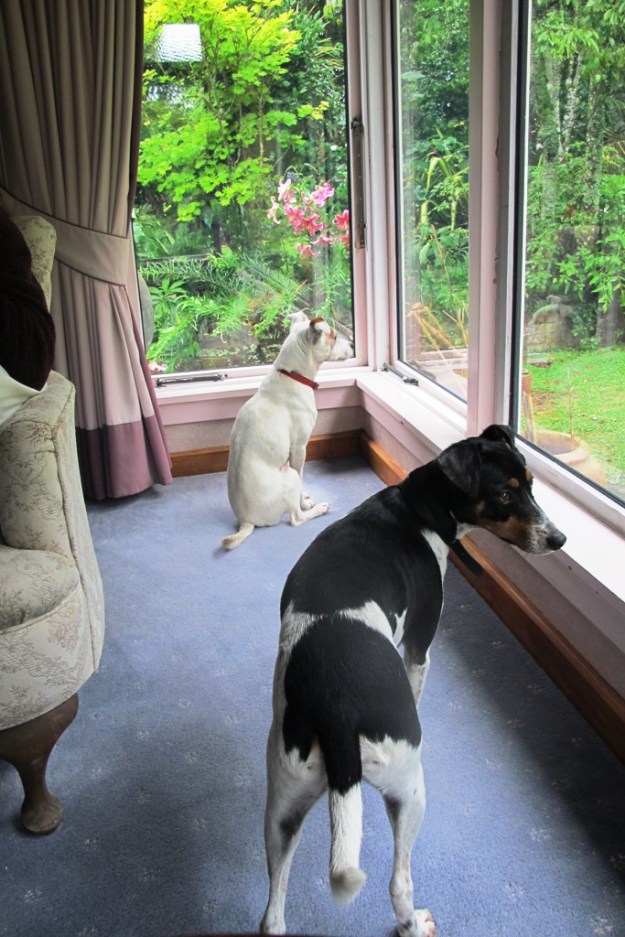
Plump, avocado eating Dudley and the much lighter Spike - our two rescue dogs

Plump, avocado eating Dudley and the much lighter Spike – our two rescue dogs

Exotica in the shade

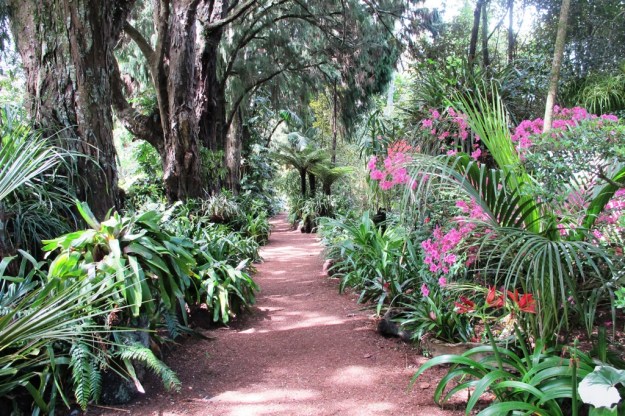
Shade gardens we have a-plenty

Shade gardens we have a-plenty

Glory be, but I do love spring.  This month subtropical bulbs and orchids shout out to be noticed.

We have extensive shade gardens. It is an inevitable result of a large, mature garden with many evergreen trees dating back as far as 1870. We do a lot of what we call lifting and limbing – taking off lower branches and keeping areas open to the light, for there are not a lot of plant options when it comes to deep, dark shade. Beneath the mighty tree canopy, it is dry but frost-free with dappled light. Over the decades there has been much trial and error to find what will thrive in these conditions and the plantings have become increasingly complex.

Dendrobium Bardo Rose

Dendrobium Bardo Rose

By this time in spring, we are over peak season for cymbidium orchids but the Australian dendrobiums are a delight. These are much smaller and more mounded or clumping in appearance and they take care of themselves. We have found the Bardo Rose group to be particularly obliging and free-flowering in woodland conditions. Ours all came from the local Orchid Society, an organisation that we have found combines generosity with superior technical knowledge.

Pleione orchids in the woodland

Pleione orchids in the woodland

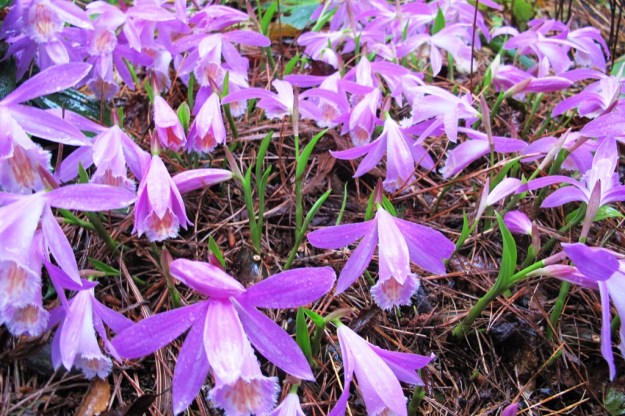
Pleione orchids do not last as long in bloom as many of the other orchids. Their flowers are soft rather than waxy but oh my, they make such a pretty carpet. It is easy for them to get swamped so we try and keep the area around them open but beyond lifting and dividing every few years, we just leave them alone. In our experience, the lovely yellow varieties do better in a climate where they get more winter chill. I think all our yellows have died out now but we have plenty in shades of lilac, purple and pure white. Most of our successful varieties came from the late George Fuller, orchid expert and former curator of Pukekura Park, and seem to have formosana in their parentage. If you want to build them up, a single bulb will usually set 2 offsets each season so you can double them every year.

Calanthe orchid - CopyThe calanthes are ground orchids and we have big clumps now because these obliging plants can just be left to quietly increase in size. These are fully evergreen and somewhat frost tender but they are a delightful sight through spring and they combine very well with clivias, ferns and even hostas.
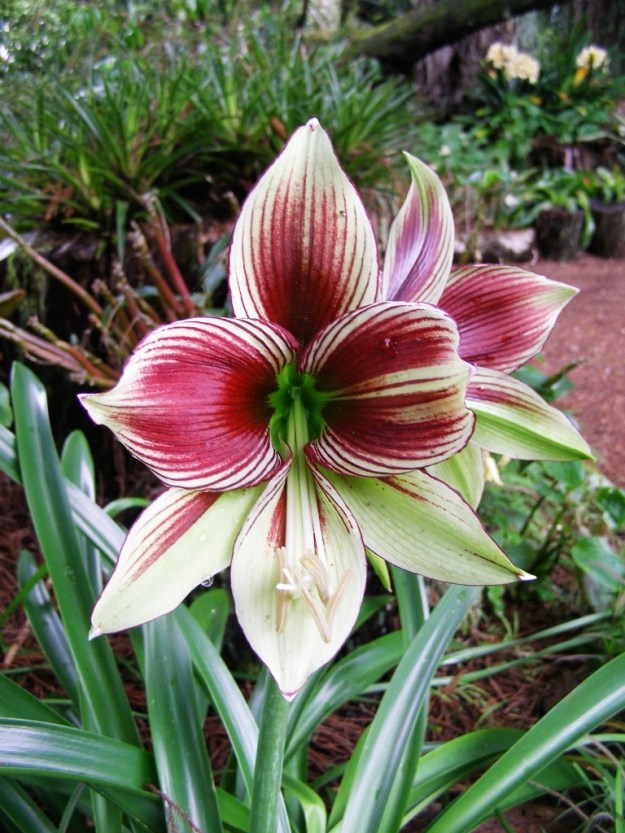
Hippeastrums are a plant family that has been much hybridised but I am not entirely convinced that has been to their advantage. It is two species that we rely on, both South American. It was by chance we found they settled happily into woodland conditions. In full sun, they were ravaged by narcissi fly but in high shade they are fine. Apparently nazi flies, as they are often called, don’t like shade. H. aulicum is one of our early to mid spring mainstays, flowering consistently year in and year out while multiplying most satisfyingly. To me, they look like beautiful Jacobean lilies in the woodland.

Hippeastrum aulicum, one of our woodland mainstays

Hippeastrum aulicum, one of our woodland mainstays

Hippeastrum papilio has been a more recent acquisition for us and it is certainly spectacular, looking more like an orchid than the butterfly for which it was named. It is offered for sale but be prepared to pay a lot for a single bulb – maybe $30 if it is flowering size – because it takes several years to get to that point. I can’t think that we would have started with more than just one or two bulbs at that price. I see with a bit of dividing and replanting we now have about sixty but not all are flowering size yet. Mark has done some hybrids of aulicum x papilio to increase numbers and get some variety, but they have yet to bloom.

Hippeastrum papilio

Hippeastrum papilio

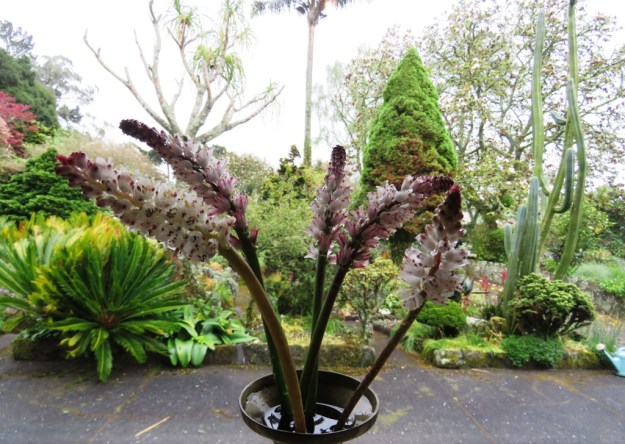
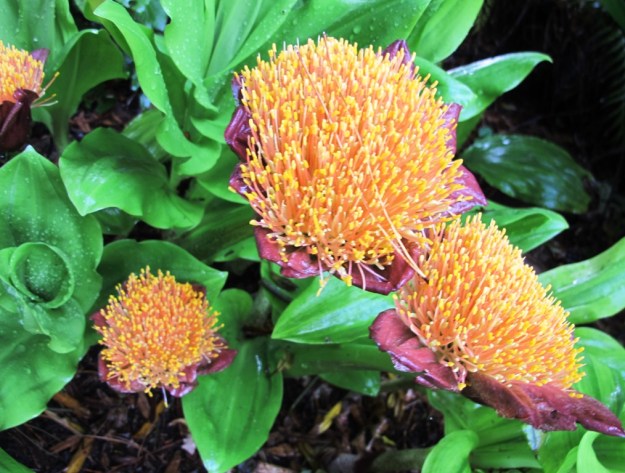
I will have to leave the arisaemas, trilliums and the Paris polyphylla for another time but will finish with Scadoxus puniceus from South Africa. Many readers will be familiar with the summer flowering red S. multiflorus ssp. katherinae, especially in the Auckland area because it was, and maybe still is, much beloved by landscapers. It is a mainstay of our summer woodland, but in spring it is the lesser known S. puniceus that is the showstopper. Growing from large bulbs which are slow to increase, the foliage is lush and the large blooms are curious rather than beautiful. S. puniceus is not widely available, but if you can find somebody with it, it is easy enough to raise from fresh seed as long as you are willing to wait quite a few years to reach flowering size.

The rewards are there for patient gardeners.

The lesser known Scadoxus puniceus

The lesser known Scadoxus puniceus

Text first published in the October issue of NZ Gardener and reprinted here with their permission