Pink and yellow. Together.

Bright yellow kowhai and cerise campanulata cherry at Auckland Botanic

Bright yellow kowhai and cerise campanulata cherry at Auckland Botanic

Two of the three plants on my most-disliked list are pink and yellow combinations. The first was a nasty spirea we saw in the UK several years ago. It was clearly a recent release as it was everywhere – a murky pink flower with yellow foliage. The second was a variegated oleander spotted in Spain, sporting the same colour combination but the foliage was a yellow variegation which may add yet another layer to the colour crime. The third is Rhododendron ‘President Roosevelt’ which also sports similarly freakish, variegated yellow foliage but it is more red-toned than murky pink. We are not fans of variegated foliage here, as a general rule.

Pink and yellow in Beth Chatto's garden

Pink and yellow in Beth Chatto’s garden

In that magical garden that Beth Chatto has created, I did notice on our last visit that she quite often combined pink and yellow in combinations that would worry me in my own garden. So when I saw a bright campanulata cherry in full bloom at Auckland Botanic Gardens last week with a strong yellow kowhai planted in front, my reaction was to do a double-take. It is just not a colour combination that pleases me. As an aside, I did notice that the feeding tui much preferred the campanulata to the kowhai – which is to say that there were none in the kowhai but a whole mob coming and going in the campanulata. I take this as proof that tui lack political correctness and fail to appreciate that they are letting the side down by preferring the import to the native plant.

Pastel hued tulips at Eden Gardens

Pastel hued tulips at Eden Gardens

Pink vireya but with pastel yellow tulips

Pink vireya but with pastel yellow tulips

Because I was already thinking about that pink and yellow combo, the plantings at Eden Gardens immediately grabbed my attention. And there, the pink and yellow pleased me and I am sure that is because they were pastel and the pinks were clean hues. It is the combination of either cerise pinks, purplish pinks or muted Paris pink with bright yellow that worries me most, I decided. It is not that it should be avoided at all costs (unless it is yellow variegated foliage with murky pink flowers!), but that it fails more often than it works. A pale yellow is much easier to combine. Bright golden yellow needs more care – unless it is a narcissus. Vibrant orange needs even more caution.
Magnolia Felix Jury with colour-toned tulips at Eden Gardens

Magnolia Felix Jury with colour-toned tulips at Eden Gardens


It was Peak Tulip at Eden Gardens. I have planted some tulips this year, but nothing on the scale of Eden. It is the inner conservationist conservative in me. My instincts are too frugal to be willing to buy in fresh bulbs each year, treating them like annuals to be discarded after blooming. I don’t even plant annuals. I expect my tulips to earn their keep and return each year, gently multiplying. This is, apparently, too optimistic for tulips, although I planted them deep in the soil with hope. I enquired at Eden Gardens and was told they start again with fresh bulbs each season which is why they were so showy. Away from pink and yellow, the colour-toned planting beneath Magnolia Felix Jury as one enters the garden was restrained and impeccable though it lacked the zing that can be achieved with more adventurous colour combinations.
001 (6)

Garden lore – three hedging ideas for 2015

“My garden sweet, enclosed with walles strong,

Embanked with benches to sytt and take my rest:

The knots so enknotted, it cannot be exprest,

With arbors and alyes so pleasant and so dulce.”

George Cavendish (1499 – 1561).

IMG_4441

How to punctuate the end of hedge with panache and style in 2015.

I was taken to see the gardens at The Kelliher Estate on Puketutu Island in Auckland last week. When we say island, it is connected by a causeway. No ferry crossings were required. The gardens have been undergoing a major renovation in the last few years. There is a difference between a restoration and a renovation. The former attempts to recreate the gardens as they were in their glory days. In our climate with rampant growth and a heavy dependence of woody trees and shrubs, restorations are somewhat ill-conceived, in my opinion.

Renovations are a reinterpretation of a garden and in public gardens can range from pedestrian to insensitive, from ego-driven (the modern gardener determined to ‘make his or her mark’) to compromise by committee. Occasionally they are carried out with genuinely creative flair and there were indubitably elements of this showing in the gardens at the Kelliher Estate.

IMG_4438

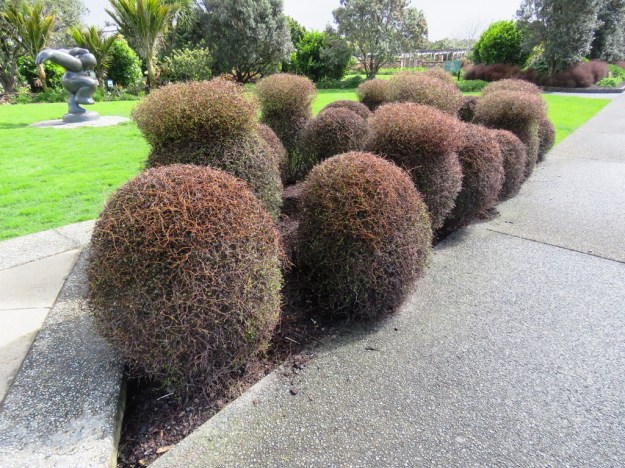
I was simply delighted by the reworking of the formerly overgrown lilly pilly hedge at the entrance – cloud pruned. With panache. I am no expert on lilly pilly. In fact it is more akin a yawning gap in my knowledge, especially as there are a number of plants which carry this common name. But I am guessing that this particular lilly pilly was the Australian myrtle also known as Syzygium smithii syn Acmena smithii (see footnote). If you are going to try something like this at home, take your time. You can’t rush the process of finding the natural shape of each individual plant. And trim flush to the stem. Nothing looks worse than nubbly elbows poking out all over the place where you have lopped off branches.

IMG_4467

Finally the wave hedging is a device I have seen in UK and Europe but not in this country before. It echoes the natural shapes of the landscape but gives some form without the regimented and straitjacketed predictability of the usual flat topped, formal hedge.

The one key element to remember if you decide to get more adventurous with your own hedges is to ensure that they will tolerate hard pruning and resprout from bare wood if you are going to reshape. Not all hedging plants do and conifers can be particularly touchy.

Postscript: Social media can be very helpful. The following more knowledgeable comment on lilly pillies was made on the garden Facebook page by Andrew from Twining Valley Nurseries
“You’re not wrong with the naming of Lilly Pilly. I’ve been to garden centres and seen the same plant labeled with three different names!
The correct taxonomic names for the 3 most commonly grown Lilly Pilly’s in NZ are-

Waterhousia floribunda (Old name: Eugenia ventenatti or Syzygium floribundum) Common name: weeping Lilly Pilly
Syzygium australe (Old name: Eugenia australis) Common name: brush cherry or Australian rose apple and is the most common.
Acmena smithii (Old name: Eugenia smithii) Common name: Lilly Pilly (or weed!)”

Thanks Andrew.

Do we take the award for the prettiest roadsides this week?

Looking along Tikorangi Road

Looking along Tikorangi Road

I was mooching around down at our corner yesterday afternoon. It being Sunday, there was little traffic but there are plenty of magnolias in bloom. With the large white michelias alongside, scent lies heavy in the air. Most of the roadside plantings are seedlings from Mark’s breeding programmes. He is always looking for space to site good plants and all our boundaries are ringed with flowering trees. Every year, the display gets more spectacular.

You will just have to imagine the fragrance from all that bloom

You will just have to imagine the fragrance from all that bloom

IMG_4154Generally speaking, people talk to us about our boundaries full of flower and scent because they really like them. Indeed we often hear vehicles slowing down to get a better view at this time of year.

So I admit I am still scarred by the local resident who accused us last year of causing a traffic hazard with our overgrowth and ‘debris’. In terms of insults, this just might go down in our history as the worst ever levelled at us. I get that some folk will drive past without even noticing. Indeed, yesterday as I was on the road with my camera, a truck driver stopped to ask me if I was photographing the undermining of the corner by the recent flood. It has still not been repaired nine weeks on but we don’t mind because it means the heavy traffic is a lot slower and more careful when it comes to turning that corner.  He looked a little surprised when I said no, I was photographing our trees.

IMG_4159

But to want to see this planting removed as an alleged traffic hazard? That I find simply beyond comprehension. Goodness, even our little herd of beef cattle show more appreciation of our planting efforts than that local farmer. Maybe in time, I will get over the shock of his comments.

Looking back up Otaraoa Road

Looking back up Otaraoa Road

Pretty hellebores

IMG_3914Sunday was wet and gloomy so I picked hellebores to photograph indoors. And what a wonderful subject for photography they are. All I did was collect one representative bloom from a number of plants. This was more illustrative in intention than artistic endeavour.

IMG_3922

Too often the reality of the hellebore plant can look like this

Too often the reality of the hellebore plant can look like this

These are all H. orientalis or orientalis hybrids, a mix of plants in the garden and some selections Mark has raised. We have been talking about them recently because our main 30 metre hellebore border is in dire need of major work. It has passed over from being a pretty, low maintenance area to being patchy and underperforming with too few blooms and too many of those are murky colours. We plan to gut it, replace some of the soil and replant with strong, new plants – each standing in its own space rather than aiming for the uninterrupted carpet look. This is because we have noticed that the plants we have thriving in other areas are in well cultivated soil, each on its own and not competing with its neighbours for space. We will fill the gaps between bulbs – Cyclamen hederafolium, narcissi and bluebells all combine well with hellebores.

IMG_3896Mark has been raising hellebores in the nursery, in preparation for the upgrade. And he is interested in whether he can get better performing selections for our conditions. Generally, hellebores like a colder climate and the best ones we have seen are in areas with much more winter chill. The very dark flowered ones with bluish tones – referred to as slate – are not exactly booming here. Similarly, the doubles that we, and every other keen gardener at the time, rushed to purchase don’t seem to get much larger and showier than they were when we bought them over a decade ago. Mark’s seedlings may perform better though the wonderfully large pink with petaloids is probably blown up by nursery conditions. In the garden, the flowers may scale down.

The merits of longer stems

The merits of longer stems

What he is most keen on is getting strong stems which hold the flowers above the foliage. So far, that seems to be one of the most desirable features of the recent releases out of the UK – Anna’s Red and Anna’s Pink. They display their blooms well. Because the reality is that when you pick hellebores and display them face up, they are hugely charming as seen in photos. But more often, they are nodding downwards and barely visible in the garden. You could of course follow the lead of a hellebore enthusiast we once met who had a mirror on a long pole so he could view the flowers without bending. Or you could glue mirrors to your shoes – but take care, gentlemen, never to wear such footwear to town lest the reason for the mirrors be misconstrued.
IMG_3909We have worked out that the desirable dark colours display far better as garden plants with the contrast of white flowers alongside. We will also banish all the murky ones to the compost heap. While clean pastel pink and green can be a charming combination, in hellebores these often lean to muted shades which are frankly of no merit. We also want plants that will fade gracefully and not to that dirty greenish brown which does not lift the soul.

We would like the hellebore border to shine again with the gentle charm that this plant family offers.

Earlier posts about hellebores include:
Hellebore Anna’s Red
The autumn trim (removing all the old foliage)
Helleborus x sternii – one of the few green flowers Mark is happy to accommodate here.
The double hellebores.
IMG_3911

Full o’ beans

IMG_3803The bean mountain started modestly enough. It was just the surplus from the summer crops that Mark didn’t want to waste a few years ago. Dried beans had not featured large in our diet. Homemade hummus yes, but always with bought chickpeas. At least I started with dried peas and not the instant tinned version. Beyond that, we had never really moved on from the trendy mixed bean salads of the late 1970s. But the beans started to mount up at a faster rate than we were eating them.

At the same time, we made a conscious decision to reduce our meat intake. That started as one vegetarian meal a week, growing to be alternate evening meals of meat and vegetarian. Soon we found that the vegetable content dominated and meat-centred meals became rare. We are not vegetarian by any manner of means – I still use meat flavourings – but the meat content has become minor and often entirely absent. This change in eating habits has been driven both by environmental concerns and also evidence that as we age, a vegetable-centred diet is a great deal healthier. Bring on the beans!

Our beans have zero food miles and a very low environmental impact when it comes to production. I have nothing to do with the growing of them. That is entirely Mark’s domain. Fortunately he does the cleaning too. Sometimes I catch him sitting on a stool in the shed podding the dried beans while he listens to music. The compressor blows the detritus away from the beans in the 2015 take on winnowing. Having time for such simple activities is surely a sign of quality of life.

Borlottis are both decorative and excellent croppers

Borlottis are both decorative and excellent croppers

The one key element to increasing our bean consumption has been the discovery that soaking beans for a long time improves digestibility considerably. Our normal pattern is to soak for three days, changing the water twice daily. We took to adding the whey from yoghurt, acting on advice read from a moderately reputable source. It was only recently that I did a net search and found that whey is simply an acid and that vinegar or lemon juice can also be used. It is all about breaking down the troublesome oligosaccharides – complex sugars that the body can have trouble digesting.

I had NO IDEA that soaking beans was such a controversial topic until I did that net search. The internet is full of experts – hot soaks, cold soaks, soaking too long, not soaking at all, adding whey and/or other acids, adding baking soda, soaking on the bench or in the fridge, distilled water, rain water, soft water, added kombu. You can find whatever opinion you want. Alas, the one site I have failed to find again is the one I failed to bookmark – a scientific explanation in simple language, minus the woowoo and snake oil, explaining why soaking in several changes of water works.

All I will say is that we have found long soaking works for us. It also means that the cooking time is very short.

Variations on Phaseolus vulgaris with a little cross contamination

Variations on Phaseolus vulgaris with a little cross contamination

We have fava beans (broad beans), white beans, brown beans, an abundance of Borlotti beans and peas. For flavour, we favour the fava but without the addition of Chianti and body parts. They are also the most bother because each bean has to be individually de-husked. Generally, I cook them lightly (after the long soak) and then peel while warm. You get a feel for the timing and it is much easier if you get this right. Undercooked and the bean doesn’t pop out, overcooked and it breaks up. I am still trying to perfect the snack fava beans I tried in Malaysia – cooked then baked in the oven with a light spray of oil and a few flavourings. Bar snack style. I have reached the “these are quite nice” stage but not the “yum, these are delicious” goal. More often I use the fava beans for baked falafel.

There are a gazillion recipes out there but the other two standbys that I will mention are hummus and bean bread. Hummus does not have to be chick peas. Any bean will do. White bean hummus is probably my favourite. These beans can be a little bland in other dishes but are creamy and as tasty as any in hummus. Cornbread has become a favourite here, especially to accompany soup in winter, but required buying tins of creamed corn. Creamed beans, I found, are a perfectly acceptable substitute. I just whizz the cooked beans in the food processor with a little of the cooking liquid.

This is the blue pea but Mark is unconvinced by either crop yield or flavour so will keep to more traditional green varieties this season

This is the blue pea but Mark is unconvinced by either crop yield or flavour so will keep to more traditional green varieties this season

Peas are somewhat less versatile and a quick look on the internet tells me that most dried pea recipes are of the pea and ham soup genre or Indian curries. That said, apparently hummus from dried peas is just as successful as from beans but with a different taste. Once the soup season has finished, I will try that.

Botanically speaking, most beans are phaseolus and the largest number of beans grown by the home gardener are Phaseolus vulgaris. They are just variants within the same species although runner beans are P. coccineus. Soy beans are Glycine max (not such a productive crop here) and broad beans are Vica faba. Mark is planning to up the lima bean crop this year – these are P. lunatus. When beans become a staple in your diet, it is nice to have a variety of different types.