A specious and fallacious argument

Native, but not native enough, some say

Native, but not native enough, some say

“Those pohutukawa aren’t worth saving. They not even native to the area.” So runs the latest argument for cutting out the Waitara riverbank pohutukawa. This simplistic argument is just wrong on so many levels but those who espouse the line think it sounds right.

Apparently they think (though I fear they do not in fact think at all, except how to trump those they decry as *environmentalists* – or The Green Taliban, even – with what they think is an appropriate argument) that only vegetation that existed in pre-European days should be saved. Trouble is, there’s precious little of that left in this country and none in this particular area of the Waitara River.

Pohutukawa are of course native to New Zealand. In fact their pre-European spread has been traced to the Mimi river-mouth area which, as the crow flies, is maybe 15km north of the Waitara River. Not close enough, apparently, for those who decry the trees we are trying to save. No matter that 200 years have passed and the natural spread southwards would likely have continued without human intervention. And let us not factor in the small matter of evidence that Maori recognised the use of pohutukawa for river bank retention and deliberately took steps to spread the plant further. Nope, they are not native to the Waitara so they can be felled with impunity.

The logical extension of the argument is that NO tree is worth saving unless there is incontrovertible evidence that it occurred naturally in that particular location in pre-European times and has the correct provenance. That could have dramatic ramifications for significant trees all round the country.

The chainsaw brigade see the predominantly African planting in the foreground as being of more value than the established pohutukawa seen in the background

The chainsaw brigade see the predominantly African planting in the foreground as being of more value than the established pohutukawa seen in the background

No matter that the planting adjacent to the threatened pohutukawa is predominantly exotic South African, full of aloes, agaves and succulents. I am sure these folk will think that is worth preserving because it cost good money.

No matter that the Waitara River bears no resemblance at all to what it must have been like in 1800. The oh-so modern engineer is determined to render it a bare, grassed canal as testimony to his engineering skills. You know, using grasses that aren’t even native to this country. There is no plan to restore the plantings to how they were before human intervention. In fact, these folk who decry the existing trees as “not even native to the area” are almost certainly totally ignorant of what was native to the area.

Do these proponents of ecological purity ensure that any plant they choose for their own garden is an eco-sourced native plant? Nah. All they are trying to do is to discredit those who wish to retain the trees by using an argument that they think sounds frightfully clever.

The trees behind are to be clear felled. Removed entirely.

The trees behind are to be clear felled. Removed entirely.

Because, according to local Community Board member Joe Rauner, it is going to “look amazing” when these trees behind the concrete wall are felled soon. Note the supports going into the top of the concrete wall (the Berlin Wall of Waitara or the Graffiti Wall as some of us call it). That is to be overhanging security fencing which always means barbed wire. Visualise the backdrop without a single tree left. That is what is coming.

Postscript: I wonder if these naysayers who claim “not native enough to warrant saving” would use the same argument against protecting and valuing the kauri trees growing around our area. By their definition, they are even lower value than the Waitara pohutukawa because they certainly did not grow anywhere near this far south in pre-European times.
Human design vs nature’s ways

I have been waiting for an opportunity to use this photo - see the final paragraph below

I have been waiting for an opportunity to use this photo – see the final paragraph below


“… he relays a story … about living with the American landscape architect Dan Kiley on the shores of Lake Champlain in Vermont in the late 1950s, and of the Kiley’s eight children, ‘living wild like an independent tribe’. Kiley once got his children to help him with tree placement for a project by giving each one a rubber or metal stamp with a different tree on it, then telling them them to bang their stamps down wherever they chose across a large sheet of paper until told to stop. The different tree types were mixed and dispersed in a way that avoided any of the tired symmetries of classical, beaux-arts garden planning: Kiley was ‘looking for actions that didn’t look contrived’.”

Allan Smith, What I learned from Momo: or, When is a house a stand of trees? (reprinted in Tell You What: Great New Zealand Nonfiction 2015).

It was a light-bulb moment for me when I read that paragraph this week. Not because it was an attempt to get away from the rigidity of classical symmetry, but because I am guessing that Kiley realised how very difficult it is for people to recreate genuinely random sequences in gardening.

I first became aware of this when I asked one of our nursery staff to plant out the surplus black mondo grass as a carpet beneath an orange tree. She felt the need to create a pattern, to plant in an arc. I sighed and replanted it myself, putting this down to her inexperience.

Years later, I visited a gardening friend to whom I had given a large surplus of hosta divisions and in her informal woodland, she had instinctively planted in straight rows alongside the path. So it is not inexperience that leads many, if not most, to plant in an orderly fashion, even in informal settings. I think it is more visceral than that – a human instinct to impose order on wild and random nature.

I was recently asked for ideas to under plant a tightly defined, quite formal planting of fruit. As the owners had mentioned they had a beehive on order, I suggested bee and butterfly food – a mix of lower growing annuals and perennials with simple, single flowers. My mental image was of a froth of artfully casual bloom which would teem with insect life, contrasting with the formal structure and permanent plants. As soon as the owner mentioned going to buy punnets of annuals, I knew. I just knew that when I return, I will see a mix of plants spaced at regular intervals and in patterns. Rows perhaps, or worse – alternating two varieties along a row. No artful casualness is likely. The Victorian bedding plant genre and the French parterres still have a lot to answer for when it comes to suburban-style planting in the new millenium.

The advice when planting bulbs in a carpet or meadow situation is to scatter them by hand and then plant where they land. This should give genuinely irregular spacings, mimicking nature, and avoid the serried rows of commercial production (think tulip fields, for an example of the latter). It is more problematic to do this with anything but bulbs – hence the Kiley approach. I would hazard a guess that if Kiley sent his workers out to plant the trees in a random fashion, they would instinctively revert to a grid or phalanx.

Not unrelated, perhaps, is the compulsion so many gardeners have to use edging plants. How curious that this imposition of human will and order on random and wayward nature is such an instinctive response for many.

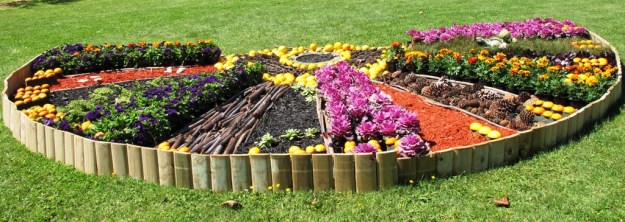
About the photo at the top: I think it was a temporary floral art exhibit. Even that cannot be said to redeem it in any manner.

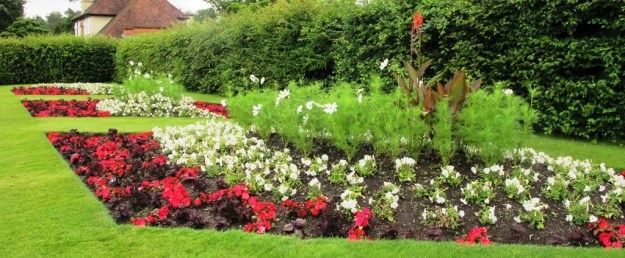
I lack many photos of bedding plant schemes, hence this one from Wisley.

I lack many photos of bedding plant schemes, hence this one from Wisley.

A brief diversionary activity for moments of extreme boredom

Monet-ish or Monet-esque. Perhaps.

Monet-ish or Monet-esque. Perhaps.

Should you need a minor diversion in your life, may I introduce you to the brief amusement of the DIY Monet site offered by our national museum, Te Papa? The site is quite old and no longer appears to be fully functioning so I had to call upon the skills of a more technically-inclined friend to save my image. He did it by a screen capture and then cropping in, in case you want to save your DIY Monetesque photograph.

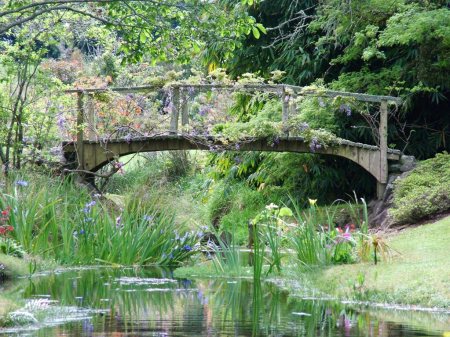
Our bridge is weathered timber, not the synthetic green shade favoured in Monet’s own garden at Giverny so far less distinctive as a landscape feature. But no matter, we like it in real life. We made the pilgrimage to Monet’s garden in Giverny last year.

The Monet bridge - one of two at Giverny

The Monet bridge – one of two at Giverny

Our own bridge, pre- Monet-ising

Our own bridge, pre- Monet-ising

Garden adornment

Soaring herons

Soaring herons

The owners of this garden admitted to me that they were very nervous about what I would think of their garden, given my strong opinions about over-ornamentation. This did not stop them from urging me to visiting. They are opening their garden to the public for the first time this spring and want all the input they can get because they are determined to do things properly and ensure they deliver an exceptional visitor experience.
026
The garden is still having a lot of work done on it but the garden sculpture and decoration were a revelation. They have some really lovely pieces. I even coveted some myself and ,from an under-ornamented gardener, that is something. What made me stop in my tracks was the exceptional skill shown in placing these pieces so that they enriched the scene without dominating and without the transparent connivance of creating the dreaded “focal points”. To place an eclectic collection of art works so that they enhance and belong in the location is a rare skill. It made me realise that it is not that I don’t like sculpture or decoration in a garden. It is that it is rarely placed well to benefit the garden and the location as much as the work itself.

I think both garden owners (and they are clearly a close team) have an exceptional eye. A working life spent in upper-end retail must have assisted in developing skills in display and design. They also give credit to their architect son and placing these decorative pieces is clearly a matter that warrants considerable thought.
016029
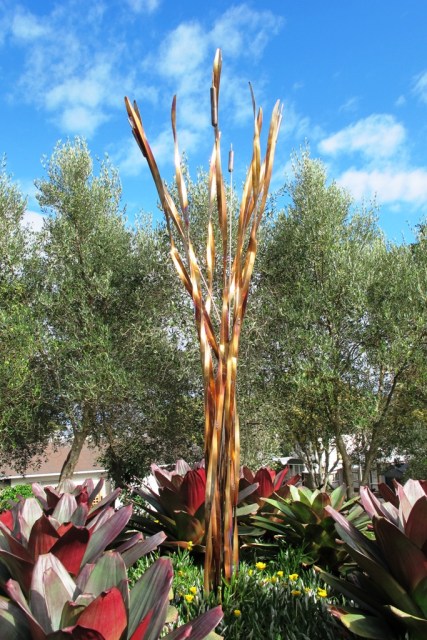
The one piece I really coveted was this structure from super-heated stainless steel. The reflections and colours were simply lovely. I would have this in my garden. I could also be be mighty tempted by the herons above. “Tell me you don’t have coloured ceramic balls,” I said. Over the years, I have developed considerable dislike for the use of these mass produced and thoroughly useless items from the villages of Asia which are widely sold in this country by purveyors of cheap ornaments. Blue has always been the most popular colour in the area where I live, but you can have red or orange, too, I found. I am unconvinced that these items justify the grandeur of a plinth but it all comes down to personal taste in the end. Yes, these people did have colour balls but they were not at all like this threesome I photographed in other people’s gardens

Hirst Cottage (3)042049

Theirs were considerably larger, hand crafted, detailed and placed discreetly.

019

008The ceramic detail amongst the simple planting of Ligularia reniformis, set against a stark white wall, added an understated detail that enhanced an otherwise predictable scene.

021The large lego man was a pretty strong statement and not, I admit, one I could ever imagine in my own garden. But the owners love it. As parents of five children – all now adults – lego featured very large in their lives and this sculpture is placed in an intimate and enclosed section of garden which opens up from the family living area. Its placement was superb and it brought great delight to the owners.
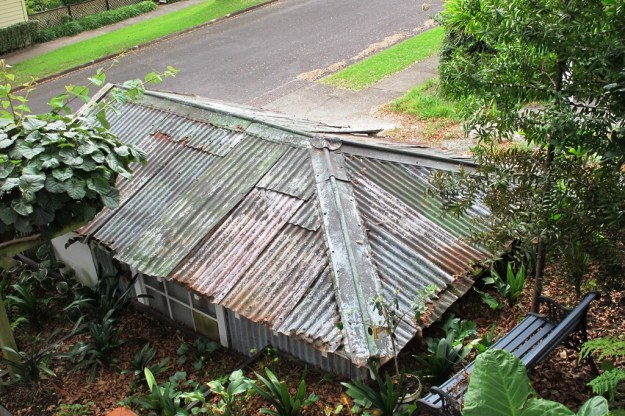
In a setting with a large, modern, sharp-edged, architecturally designed house and a heavily structured garden, the decision to leave the old rusted garage in place as an installation was simply inspirational. It gave a tension to the scene which anchored the modern into its past. The owners commented that people either responded with horror at them leaving something so old and scruffy or they were delighted as I was.
025
This garden is open for the Powerco Taranaki Garden Spectacular in the first week of November this year. Visitors might like to go and learn from their skills in integrating sculpture and ornamentation into the garden. It is done as well as I have ever seen and considerably better than most.


Garden lore – the autumn trim of the hellebores

???????????????????????????????I am cutting all the old foliage off the Helleborus orientalis and I am pleased I have my timing right. Few plants are putting out their new foliage yet. We never used to do this. Indeed, for decades, the main hellebore border (about 30 metres long) was just left to its own devices. Then I read about NZ hellebore expert, Terry Hatch, cutting off all the foliage – even putting a lawnmower through them, though you would have to get your timing absolutely right to carry out this approach.
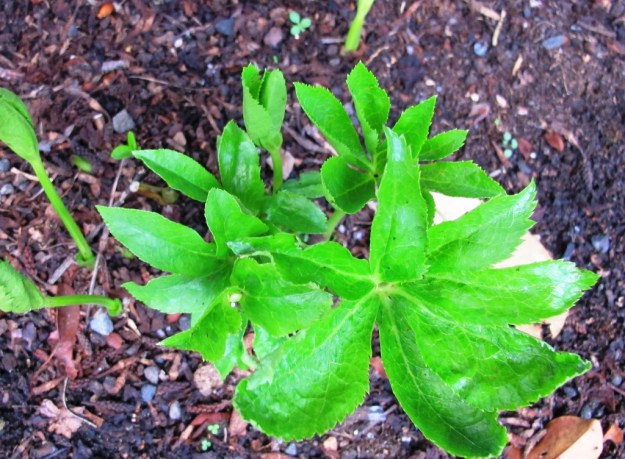
I tried it and the hellebore display was hugely more charming in winter because the flowers were visible and the fresh foliage was light and bright. It also gave more light to bulbs beneath the plants and cleared out the aphid infestations we can get in the foliage. While about it, I weed out the multitudes of seedlings we get beneath. We do not need yet more hellebores in this area which is already quite congested.

Last year, Mark demurred. He wondered if cutting off all the foliage from evergreen plants would weaken them over time. Fortunately, when we headed over to England on our summer garden trip, we stayed with a new friend. Diana is one of those wonderful English gardeners – an amateur enthusiast but with a specific technical knowledge allied to practical experience which exceeds that of many professionals. We were happy to accept her opinion and indeed she does clean off all the old foliage.

I get dirty knees and do it all with grape snips. One year we tried putting the strimmer or weedeater over the bed. While it was speedy, I didn’t like the chewed stems it left and it didn’t do the weeding either. The trick is all in the timing. Leave it much later and it takes much longer because it involves trimming carefully around fresh new growth. The rewards will come in a few weeks because I can see fresh growth and flower stems starting to push through. We used to follow up with a compost mulch but the soil is now so rich in humus that this is no longer necessary.

I only carry out this extreme trimming on H. orientalis. The other species we grow just need an occasional trim of spent stems.
???????????????????????????????