 It being autumn, ‘tis the season of sasanqua camellias here. Ever since camellia petal blight arrived to wreak havoc on the later flowering japonicas, we have been a great deal more appreciative of the sasanquas. What they lack in flower form, they make up in performance.

Gay Border on the left, Navajo to the right
On a grey and somewhat bleak day, I thought to entertain myself with photographing the flowers but became sidetracked onto comparisons. When we had our nursery in full production, Mark would regularly make calls as to which cultivars we would propagate and sell. Would it be Navajo or Gay Border? We chose Navajo. It is not just the flowers that are the deciding factor. The habit of growth, foliage, size, performance and ease of propagation and production were also considered although the decisions were often a little ad hoc. When it came to Sparkling Burgundy and Elfin Rose, we chose the latter because its foliage looked better.

Sparkling Burgundy left, Elfin Rose right
We felt that it is not helpful to a customer to look at a range of plants with very subtle differences. “The man on the galloping horse” test, Mark calls it – the differences should be obvious, not just subtle variations. As far as we were concerned, we were professionals and customers had a right to expect us to do some filtering in selections and to pick good performers.
When it comes to naming his own cultivars from his breeding programme, Mark is hugely more rigorous and restrained. A new release has to be significantly different, distinctive or a major improvement. He has only named four of his own deciduous magnolias so far and that is out of many, many hundreds – maybe into the thousands – of seedlings he has raised. This restraint is somewhat unusual in the world of plant breeding.

Honey Tulip top left with other named cultivars. Might we have seen this as a breakthrough in flower form?
When we released Magnolia Honey Tulip, we received an email from an overseas self-appointed expert acknowledging that Mark was extremely – excessively, some may say – restrained about the new selections that he named and released but he should not have released a yellow magnolia. The world has enough yellow magnolias already, he loftily told us. Right-o then. We knew what he meant – there are many yellow magnolias named which all look very similar, but apparently it had not occurred to him that Mark, with his self-imposed restraint, may actually have managed to breed one that was a breakthrough and very different. We did not reply.

Anybody can raise seedlings of Black Tulip but are they then all worth naming? We think not.
A plant breeder, by our definition, does more than just raise open pollinated seed. Not so the gentleman who visited us (again from overseas). He loved Mark’s Magnolia Black Tulip which sets seed. So he raised a whole batch of seed and spawned a whole lot of similar looking flowers which he then named and insisted on showing Mark all the photographs. None looked to be distinctive, a breakthrough or an improvement. They were just subtly different, as seedlings usually are. That sort of willy-nilly approach is not helpful to the plant and gardening world but we see it often.
That is why we have never coveted a National Collection – of anything really. The UK is very big on national collections. The parent website states:
“Plant Heritage’s (NCCPG’s) mission is to conserve, grow, propagate, document and make available the amazing resource of cultivated plants that exists in the UK….
Our main conservation vehicle is the Plant Heritage National Plant Collection® scheme where individuals or organisations undertake to document, develop and preserve a comprehensive collection of one group of plants in trust for the future.”

Camellia brevistyla left, microphylla right. They look mighty similar to us.
It is one thing to collect species – that is important for biodiversity and many are endangered in the wild. Mind you, we remain unconvinced that Camellias brevistyla and microphylla are actually different species. It looks more like seedling variation to us.

“For I have seen the national rhubarb collection”
Also the compilation and maintenance of a wide genetic pool is important when it comes to crops like fruit and veg. “For I have seen the National Rhubarb Collection”, I tweeted when we visited Wisley. It seemed such a random and esoteric plant to collect, which is not meant in any way to deride its worth. And it was certainly a beautifully maintained collection.
But a National Collection that takes in many named hybrids? We have seen too many inferior and indistinct hybrids named to ever want to start a collection of any plant genus. We would rather have plants that are selected on individual merit in our garden.
Plant collecting is like stamp collecting, Mark explained. The search for a particular named cultivar may be challenging, rewarded by the thrill of acquisition. Whether the plant was actually worth acquiring – whether it warranted naming in the first place – becomes irrelevant.
Postscript: we don’t like to dwell too much on the travesty of our Cordyline Red Fountain and the ring-in Cordyline Burgundy though this was not, we think, motivated by misplaced breeder pride but by much baser motives indeed.

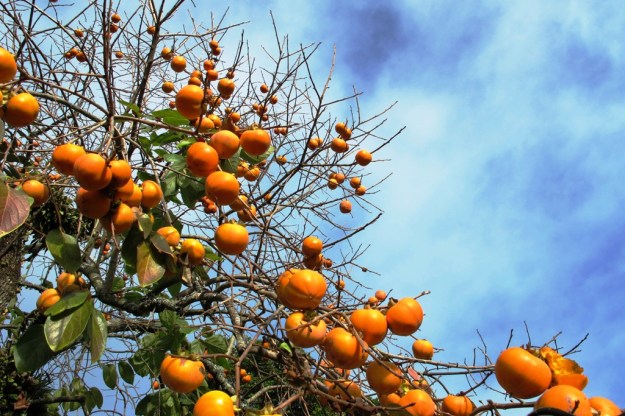 Persimmons. These are a glorious sight in autumn but more decorative than useful here. Ours is an old astringent variety – mouth-puckeringly so until it is super ripe and then I really only like the jelly-like centre segments. We don’t eat many of them. I tried buying the fruit of the non-astringent recent introductions, which can be eaten at the crisp stage like an apple. I was a little underwhelmed – I preferred apples.
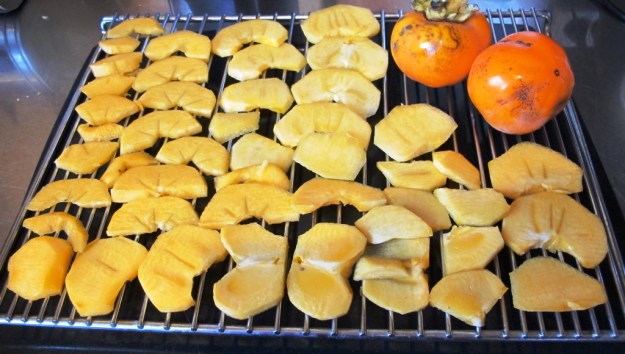 I recently read that persimmon fruit dry well and even the astringent types can be picked before fully ripe, sliced and dried and they will lose their astringency. Truly, we were very sceptical. But it works. It really does. The first batch I sliced, skin and all, and dried on a rack over our woodburner. It was a bit hot for them and the skin was a little tough. This second batch I used a sharp knife to remove the skin – which wasn’t difficult – and then sliced and put in the oven on fan bake at a very low temperature for several hours. They aren’t fully dried so I will store them in small packages in the deep freeze lest they go mouldy in our humid climate.
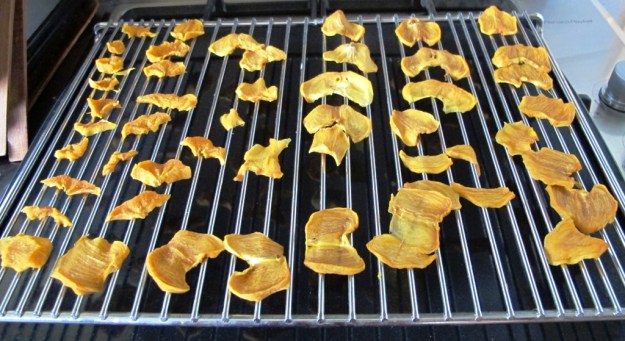 If you like dried fruit or eat muesli, they will make an excellent addition. I plan on using them as a substitute for dried apricots. They don’t taste the same but they will fill the same role. As with any dried food, they shrivel away to very little. I doubt that my forays into dried persimmons are going to make much of an inroad to our total crop – I won’t be drying hundreds of them and there is a large crop on the tree. But we are always interested in adding variety to our diet and dried persimmons take little effort to utilise a crop that we would otherwise waste.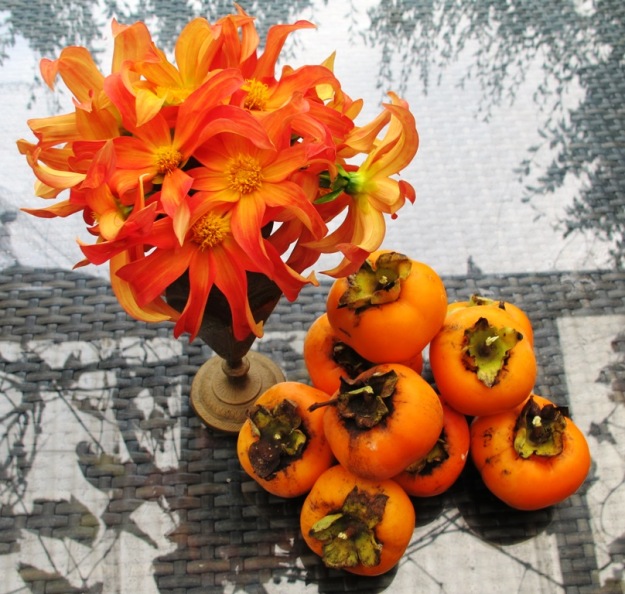
 It is a somewhat gloomy grey and damp day here today, brightened by a knock at the door. There stood a woman, slightly abashed. She had read a piece I wrote recently about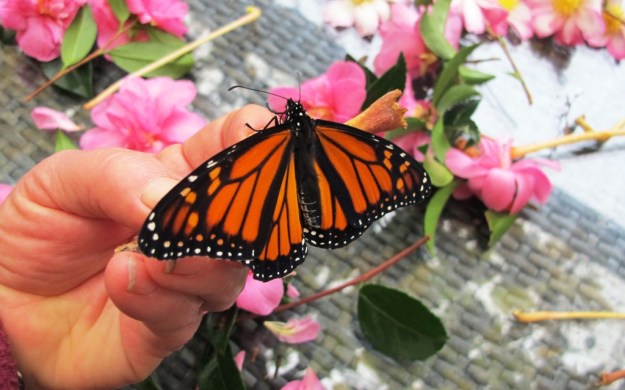


 First published in the May issue of NZ Gardener and reprinted here with their permission.
  Tikorangi The Jury Garden