
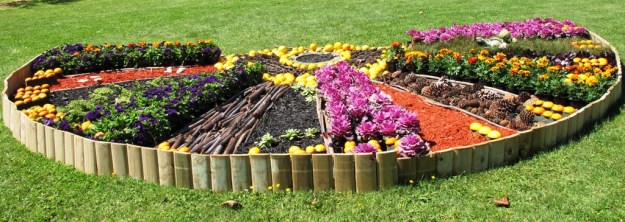
I have been waiting for an opportunity to use this photo – see the final paragraph below
“… he relays a story … about living with the American landscape architect Dan Kiley on the shores of Lake Champlain in Vermont in the late 1950s, and of the Kiley’s eight children, ‘living wild like an independent tribe’. Kiley once got his children to help him with tree placement for a project by giving each one a rubber or metal stamp with a different tree on it, then telling them them to bang their stamps down wherever they chose across a large sheet of paper until told to stop. The different tree types were mixed and dispersed in a way that avoided any of the tired symmetries of classical, beaux-arts garden planning: Kiley was ‘looking for actions that didn’t look contrived’.”
Allan Smith, What I learned from Momo: or, When is a house a stand of trees? (reprinted in Tell You What: Great New Zealand Nonfiction 2015).
It was a light-bulb moment for me when I read that paragraph this week. Not because it was an attempt to get away from the rigidity of classical symmetry, but because I am guessing that Kiley realised how very difficult it is for people to recreate genuinely random sequences in gardening.
I first became aware of this when I asked one of our nursery staff to plant out the surplus black mondo grass as a carpet beneath an orange tree. She felt the need to create a pattern, to plant in an arc. I sighed and replanted it myself, putting this down to her inexperience.
Years later, I visited a gardening friend to whom I had given a large surplus of hosta divisions and in her informal woodland, she had instinctively planted in straight rows alongside the path. So it is not inexperience that leads many, if not most, to plant in an orderly fashion, even in informal settings. I think it is more visceral than that – a human instinct to impose order on wild and random nature.
I was recently asked for ideas to under plant a tightly defined, quite formal planting of fruit. As the owners had mentioned they had a beehive on order, I suggested bee and butterfly food – a mix of lower growing annuals and perennials with simple, single flowers. My mental image was of a froth of artfully casual bloom which would teem with insect life, contrasting with the formal structure and permanent plants. As soon as the owner mentioned going to buy punnets of annuals, I knew. I just knew that when I return, I will see a mix of plants spaced at regular intervals and in patterns. Rows perhaps, or worse – alternating two varieties along a row. No artful casualness is likely. The Victorian bedding plant genre and the French parterres still have a lot to answer for when it comes to suburban-style planting in the new millenium.
The advice when planting bulbs in a carpet or meadow situation is to scatter them by hand and then plant where they land. This should give genuinely irregular spacings, mimicking nature, and avoid the serried rows of commercial production (think tulip fields, for an example of the latter). It is more problematic to do this with anything but bulbs – hence the Kiley approach. I would hazard a guess that if Kiley sent his workers out to plant the trees in a random fashion, they would instinctively revert to a grid or phalanx.
Not unrelated, perhaps, is the compulsion so many gardeners have to use edging plants. How curious that this imposition of human will and order on random and wayward nature is such an instinctive response for many.
About the photo at the top: I think it was a temporary floral art exhibit. Even that cannot be said to redeem it in any manner.
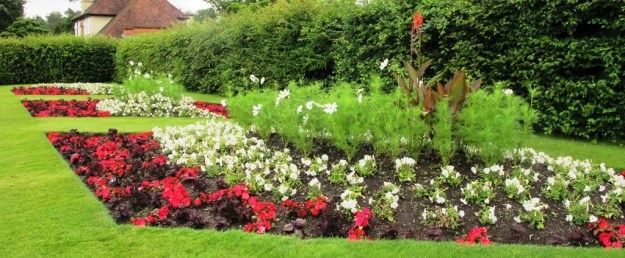
I lack many photos of bedding plant schemes, hence this one from Wisley.


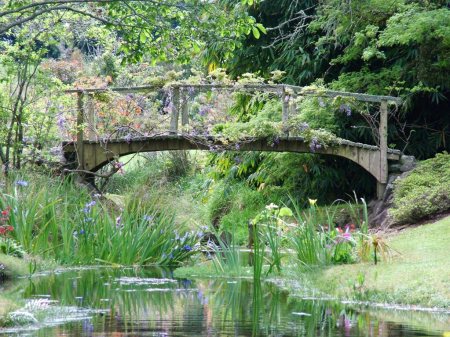


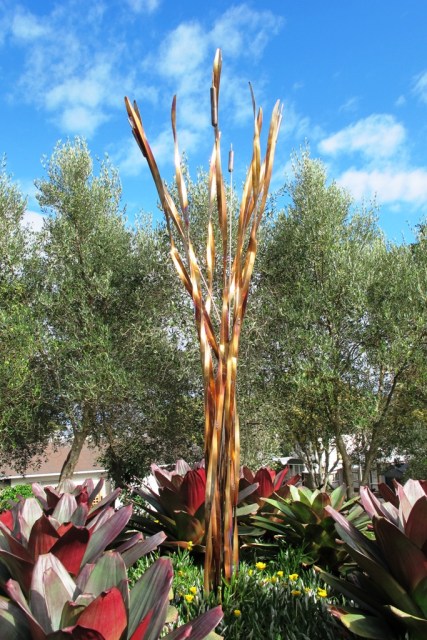





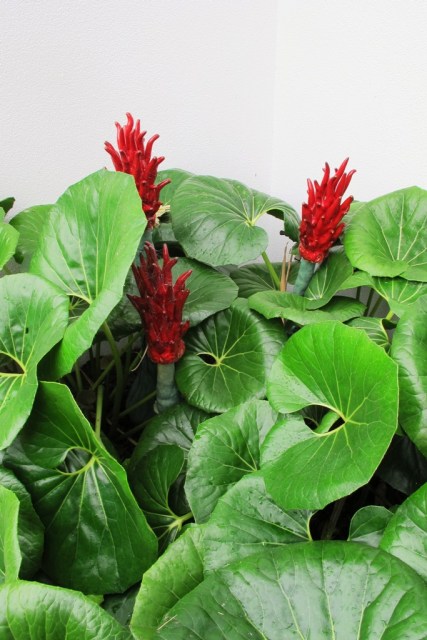 The ceramic detail amongst the simple planting of Ligularia reniformis, set against a stark white wall, added an understated detail that enhanced an otherwise predictable scene.
 The large lego man was a pretty strong statement and not, I admit, one I could ever imagine in my own garden. But the owners love it. As parents of five children – all now adults – lego featured very large in their lives and this sculpture is placed in an intimate and enclosed section of garden which opens up from the family living area. Its placement was superb and it brought great delight to the owners.
 I am cutting all the old foliage off the Helleborus orientalis and I am pleased I have my timing right. Few plants are putting out their new foliage yet. We never used to do this. Indeed, for decades, the main hellebore border (about 30 metres long) was just left to its own devices. Then I read about NZ hellebore expert, Terry Hatch, cutting off all the foliage – even putting a lawnmower through them, though you would have to get your timing absolutely right to carry out this approach.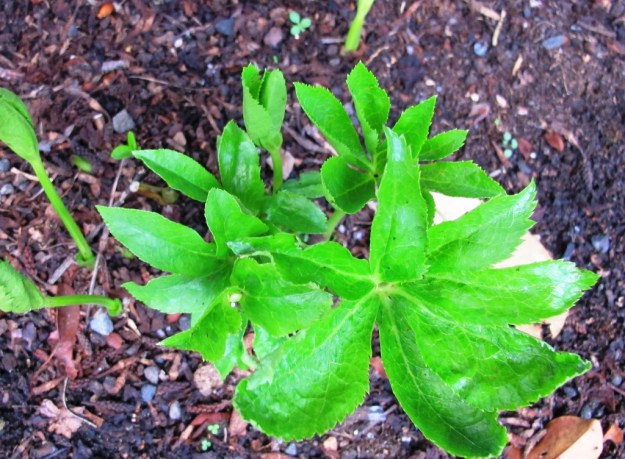
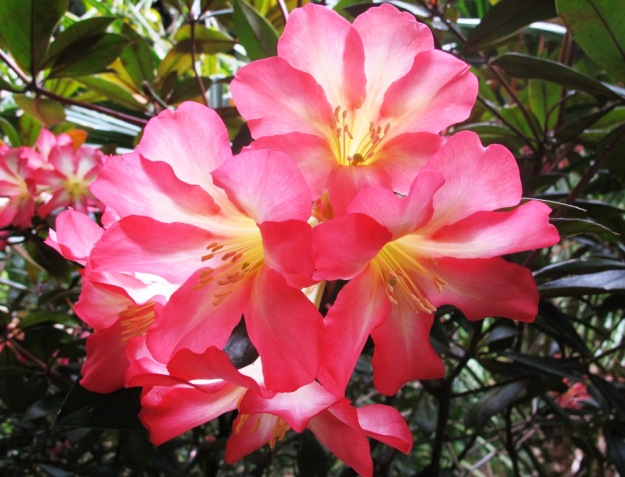
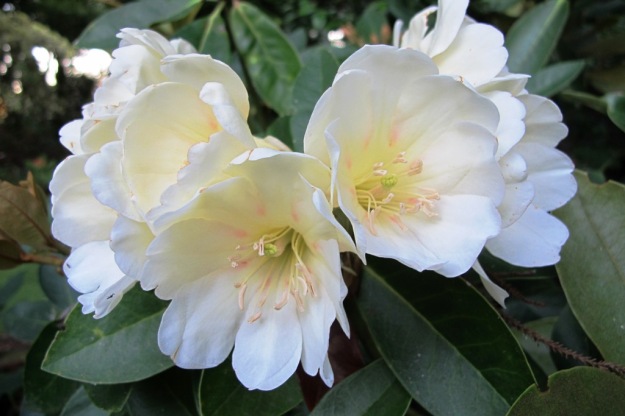
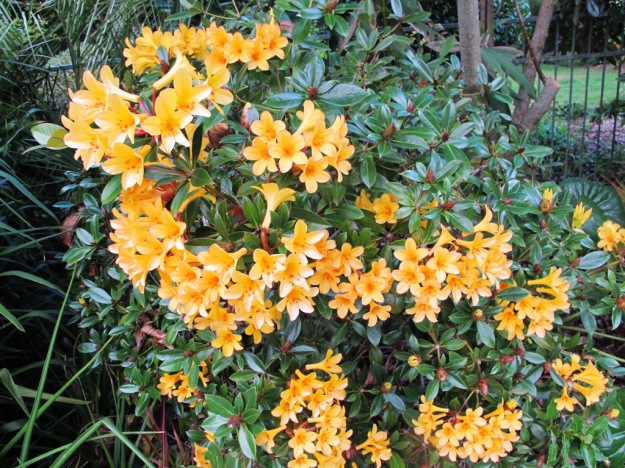
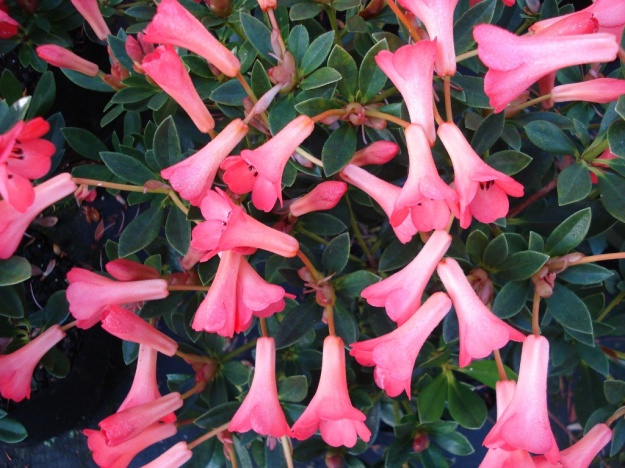
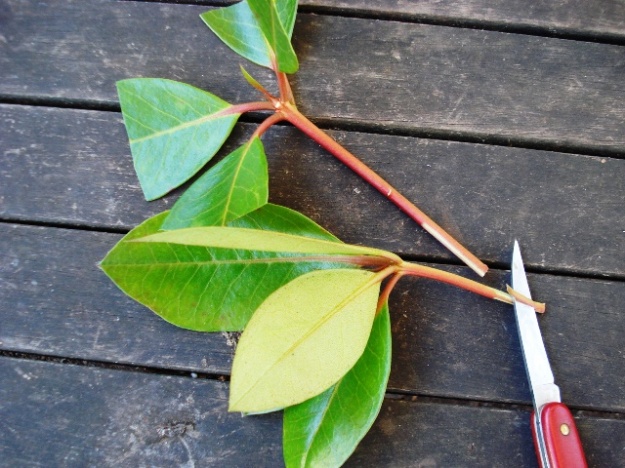 If you want to try growing plants from cuttings, vireyas can root without special facilities and equipment. You need to use green stems which are firm, not floppy. Cut off a sliver (called “wounding”) on two sides of the stem of the cutting, extending for 2 – 3 cm. Unlike most plants, the roots will form from the wound or callous, which is why you want two to get a balanced root system. Cut the leaves in half to reduce water loss and stick in potting mix. Keep the pot in shaded conditions until roots start to form – usually within about six weeks.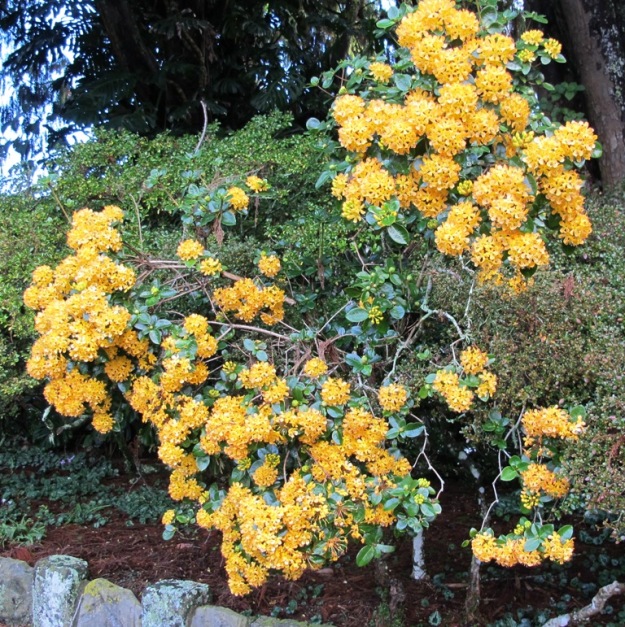
 Tikorangi The Jury Garden