
Auratums and pink lobelia
We were lucky that Mark’s parents had the foresight to plan the garden so there is a different view from every house window and we have plenty of flowers in sight all year round. The lilies are different. In summer I love to bring in huge stems to scent the house. They are big. They are bold. They are beautiful. Lilies define our summers.
You need quite a lot of lilies to justify cutting the entire stem off and, after many decades, we have a few. Mark’s father Felix started breeding auratums maybe four or five decades ago and Mark has continued. This was never for commercial reasons. It was to build up plants for the garden, to extend the colour range and the season and particularly to get outward facing blooms rather than the upward facing ones which are preferred in floristry. Constantly replenishing with newly raised plants is also a safeguard against the potential ravages of lily virus. Not that we have had a problem with lily virus and disease, but if we ever do, we are prepared.

The lily we scorned at Wisley
People were admiring it and but Mark took one look and said: “Gross. No good as a garden plant. Look at those upward facing blooms waiting to mark.” Not only are the upward facing blooms more vulnerable to weather damage, but the pollen falls internally and spoils it sooner. So I photographed it, but not for the same reason as the admirers. It was showy but we wouldn’t give it garden space.
Although you can to leave auratum lilies in the ground year after year, lifting and replanting deeper on a regular basis saves having to stake every stem. They work their way upwards over time. In our free draining soil, if I put them anything up to 20cm down, they are much better at holding themselves upright. The other technique to save forever staking (and then de-staking at the end of the season) is to grow them through shrubs which can act as supports. Apple trees and azaleas work well for us. When I do have to stake, I prefer to harvest my own bamboo lengths and leave the leaf axils in place to grip the flower stem. It saves tying to a smooth stake.

Just another unnamed seedling (or JAUS, as we call them here)
This is why they are usually sold in bags of sphagnum moss or sawdust. Always try and buy them as soon as they come into garden centres in early winter and get them into the ground as soon as possible.
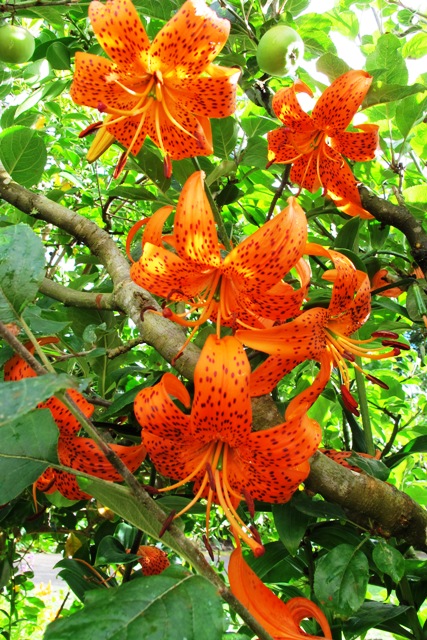
Orange tiger lilies growing through the espaliered apple trees
or Lilium
regale from China. It even Others sometimes refer to L.
longiflorum as the Christmas lily. It is typically pure white and hails from Japan whereas L.
regale has deep pink petal backs fading out to white. The orange tiger lilies with their reflexed petals follow soon after. They lack scent but they are a showy addition to the summer garden and very easy to grow. Next we get the aurelians – scented trumpet lilies in pretty gold and apricot shades. Most of ours have been raised from seed. They have a lovely elegance to them both in the garden and as a cut flower. You will notice their trumpets face outwards and downwards.

Aforementioned JAUS
– the glory of the auratums which take us through January and well into February. There is nothing subtle or understated about the flower power. Their common name is the “golden rayed lily of Japan”. How lovely is that?
 First published in the New Zealand Gardener and reprinted here with their permission.


 Garden Lore: standard bay trees
 If it were of any use, every day the gardener would fall on his knees and pray somehow like this: “O Lord, grant that in some way it may rain every day, say from about midnight until three o’clock in the morning, but, you see, it must be gentle and warm so that it can soak in; grant that at the same time it would not rain on campion, alyssum, helianthemum, lavender, and the others which you in your infinite wisdom know are drought-loving plants – I will write their names on a bit of paper if you like – and grant that the sun my shine the whole day long, but not everywhere (not, for instance, on spiraea, or on gentian, plantain lily, and rhododendron), and not too much; that there may be plenty of dew and little wind, enough worms, no plant-lice and snails, no mildew, and that once a week thin liquid manure and guano may fall from heaven. Amen.”
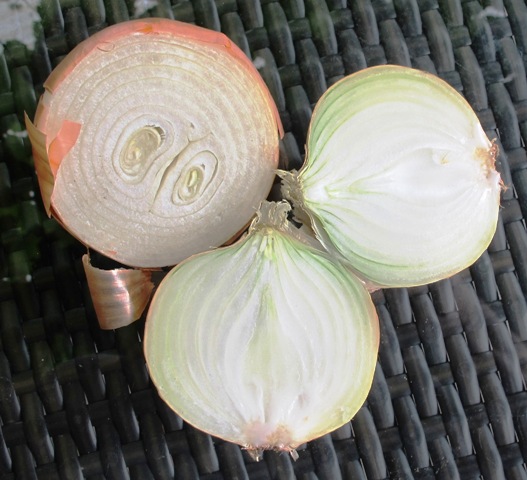 1) Twin scaling is a way of increasing the number of bulbs more quickly than by other usual methods. A single bulb can yield up to 30 or more baby bulbs (bulblets) over a period of a season. It only works with proper bulbs – not corms, tubers and rhizomes. Bulbs need a base plate and a layered construction to be twin scaled – eerily similar in form to the common onion shown here.
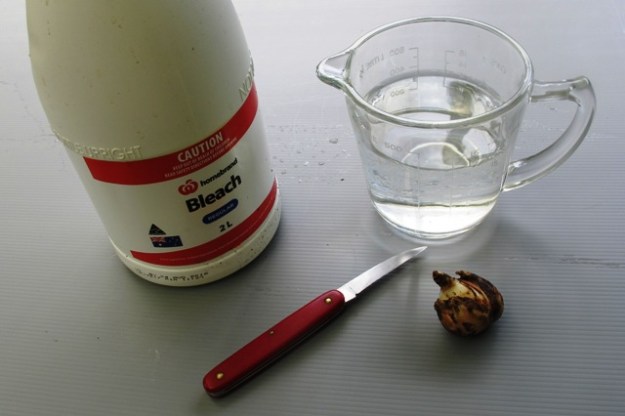 2) Twin scaling works well for bulbs such as narcissi (daffodils), crinums, galanthus (snowdrops), nerines, amaryllis, hippeastrums, lachenalias and some lilies. Wash the bulb and remove any outside coating and old roots. Make up a weak solution of household bleach – about 1:10 bleach to water – and dip the sharp knife and bulbs. Clean working conditions and hygiene are important to prevent disease and the transfer of any viruses.
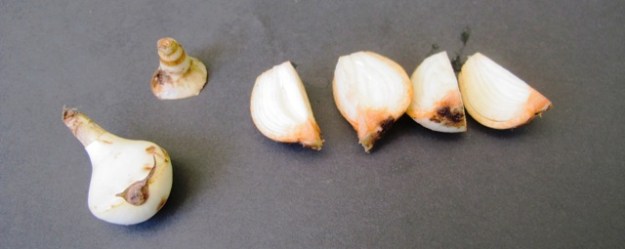 3) Remove any offsets already formed, making sure you keep some of the base plate with them. The base plate is where the roots grow from. Cut the top third off the bulb (both offset and top are visible to the left in the photo). Cut the main bulb into quarters or eighths, depending on the size of the bulb. Each piece must have some of the base plate remaining attached. The larger the bulb, the more sections you will get.
 4) Peel off two scales together, attached to some of the base plate. Keep your knife clean and sharp so you can cut through the base of each section more easily. It does not matter if you have three or more scales but if you do not have part of the base plate, the process will not work. A bulblet will form between the two scales on this base plate.
 5) Plant the scales in a pot or tray filled with seed raising mix. Press them down deeper than in the photograph until just the tip is visible. Water them in and keep the tray in a warm, reasonably dark position. The bulblets will form through the autumn and grow away in spring so it is best to twin scale when the bulb is freshly dormant. It is too late to twin scale autumn flowering bulbs because they are already starting to grow but you can do the spring flowering ones which includes narcissi such as this bulb.
 6) If you lack the confidence to take each section down to two scales, you can stop at step 3 where you have cut the bulb into quarters or eighths. As long as you look after them, most sections will grow away into healthy, independent bulbs. It is probably easiest to start with a large bulb while you gain confidence. Most bulbs propagated by twin scaling will take at least two years to reach flowering size, sometimes longer.
  Tikorangi The Jury Garden