
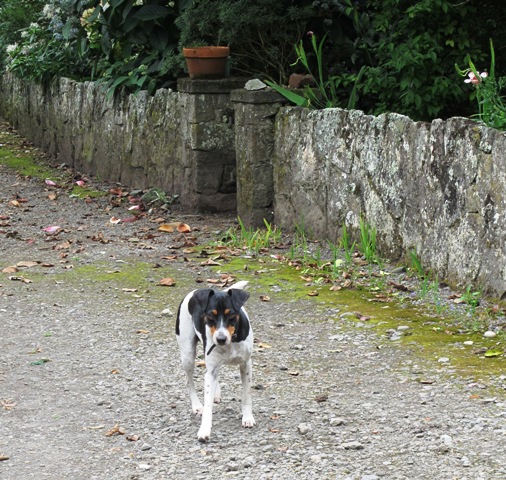
New dog Dudley lacked application when it came to searching for his missing tennis ball in the shrubbery
Our new dog Dudley was the unwitting catalyst. Dudley, or Dudders to give him his cricketing nickname, is a four year old fox terrier – a re-home from the SPCA (as opposed to a rescue dog). He was clearly a much loved dog but a townie dog and it has been a steep learning curve of liberation for him to move to the country and space. In his nine short days with us, he has won a place in our affections already and settled in better than any of us ever anticipated. Dudley plays and therein lies the connection. Yours truly was never a sporty gal at school and my ball skills were always a little lacking. Out entertaining Dudders on the lawn with a tennis ball, I hurled it into the shrubbery in error. He quickly gave up the search.
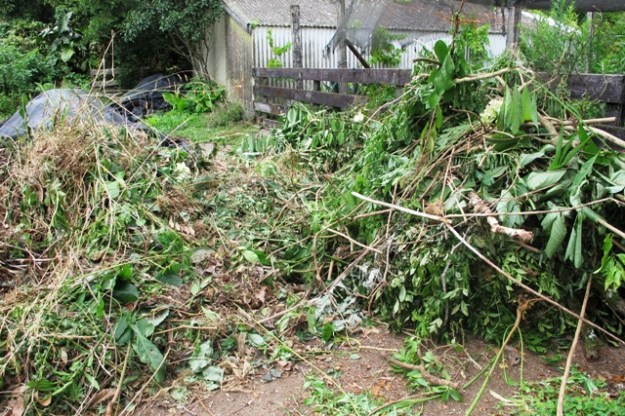
I have removed a prodigious amount of material – to the left for compost, to the right to be chipped and then composted
I have long thought that shrubberies are one of the lowest maintenance forms of gardening and they probably are but even they need a major clean out once every five years.
 In the garden it is still all about lilies. Big, blowsy, over the top auratum lilies. I am not picking the ones in the garden but in a small area of Mark’s new vegetable garden is a congested block of his seedling auratums, raised in anticipation of our new summer garden. There I can pick by the armful and oh, how I love these extravagant blooms. Auratums are a strong argument for the vigilant border control we have in this country. We do not, repeat NOT, need the lily beetle here. It is a nasty critter that takes up residence on auratum lilies and covers itself in its own excrement. We have seen it in the UK where it is an unwelcome arrival which has all but destroyed the auratum display in some areas.
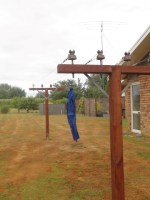

 Following my final photo feature for the Waikato Times on the topic of washing lines, Times reader Carol Lodge sent me a lovely email of appreciation and sent me photos of her new washing line which struck me as genuinely creative and resourceful. She says: “The insulators and stays for the washing line came from a trade with the power board gang who were replacing poles down our road- morning tea in return for the insulators…. My husband is a radio ham and apparently , and not by coincidence my clothesline is tuned to the 80 metre band.”
It is a bit like the final word on washing lines, isn’t it? But I am off garden visiting with friends in Auckland this weekend at the Heroic Garden Festival. It appears to have lost many of its heroic origins now – become “straightified” a gay friend observed – but I may well find additional examples of washing lines and other ideas to share from these smaller urban gardens.

I have ALL the lilies

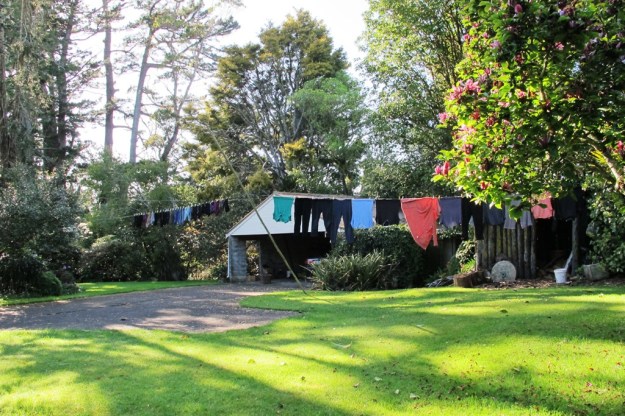 1) This is my own washing line, dating back, I assume, to when the house was built in 1950. I like the giant bamboo prop we use to hold it up. I think it is what Kevin McLeod of Grand Designs would call “honest” or maybe “unpretentious”. Old fashioned, certainly, it offers excellent drying but you do need space and you have to walk up and down it rather than standing in one spot to peg and unpeg.
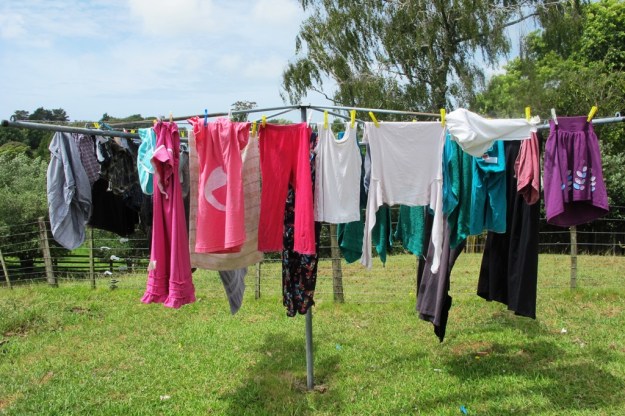 2) The rotary clothesline, often referred to as the Hill’s Hoist, is an Australasian phenomenon which features heavily in suburban backyards of both Australia and New Zealand. There is no doubt it is practical but it also lacks any aesthetic at all. Is there a sadder sight than a barren backyard with nowt but a weed infested area of broken concrete and a Hill’s Hoist washing line?
 3) Presumably in an attempt to hide the heavy visual presence of the Hill’s Hoist, there seems to be strong interest in wall-mounted lines which can often folded down discreetly when not in use. I would guess this one was advertised as having 20 metres of line space (10 wires by 2 metres each) but it isn’t really 20 metres of usable space and it won’t hold large sheets without folding them in on themselves. It lacks the air circulation of the first two options so will not offer such efficient drying but the wide eaves give some protection from rain.
 4) For property-proud people, the service areas needed for a household may be screened. Here the washing lines join the Sky dish, heat pump units, and probably the wheelie bins and recycling bins. The trade off is the reduction in sunshine hours on the shaded side of the house as well as reducing the air movement which dries washing more quickly. I have seen this done in a small garden but the screening was much closer to the washing line which created more shade and reduced air movement even further. Keep some distance if you can.
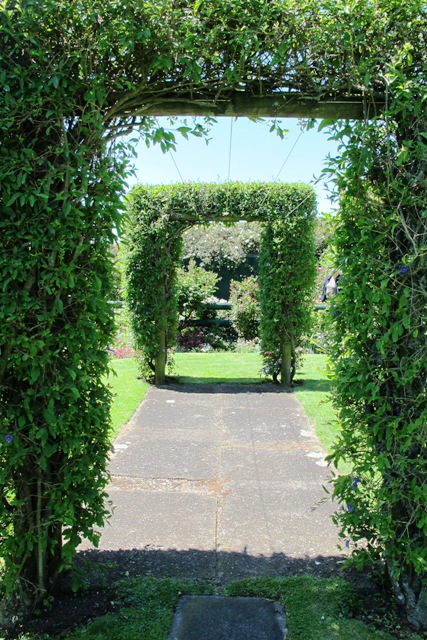 5) As a D.I.Y. compromise, I photographed this fixed line which is free standing in full sun but softened by the frames at either end which are wreathed in a flowering climber – one of the solanum family but I am not sure which one. Paving beneath gives reflected heat and keeps fallen items cleaner. This is the best example I found for a town section where the owner wanted a more discreet but still efficient washing line. It also took the award for the prettiest clothes line I found.
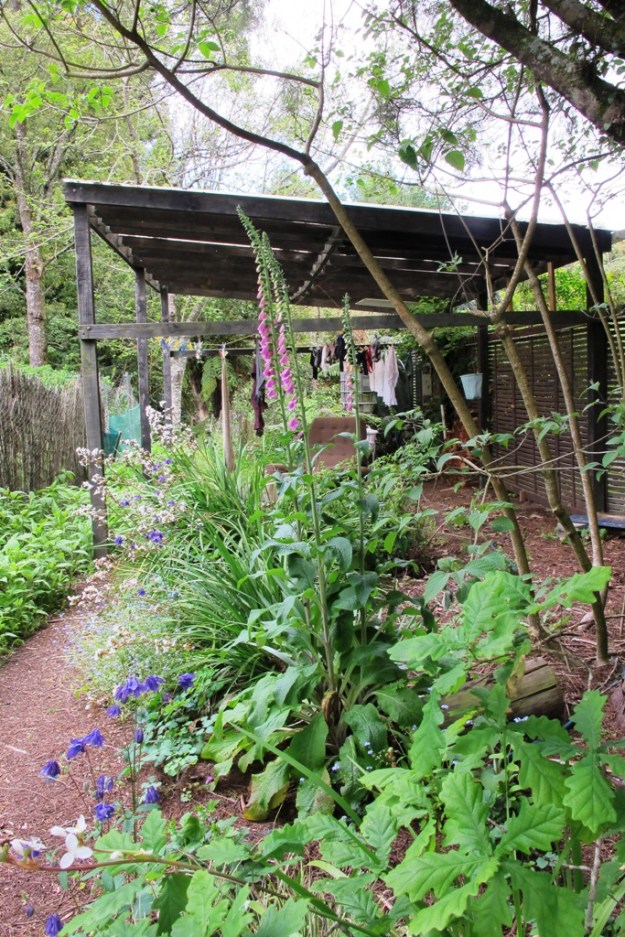 6) I spotted this line on a large country property where winters can be a little cold and bleak. It is under cover but the roof is high. It incorporates screening from view without sacrificing air movement. It is on a property with accommodation units and the owner told me there was sufficient line space to hang all the washing from the four units. She loved her washing line and, where space allows, it struck me as remarkably practical.
  It is time for me to bid farewell to Waikato readers. This will be my last garden page. The new-look garden page will be rolled out next Saturday but I will not be part of it. I have really enjoyed writing for this publication over the past 3 ½ years and would like to thank readers for reading it. Thank you also to those of you who have emailed and even written proper letters and cards.
 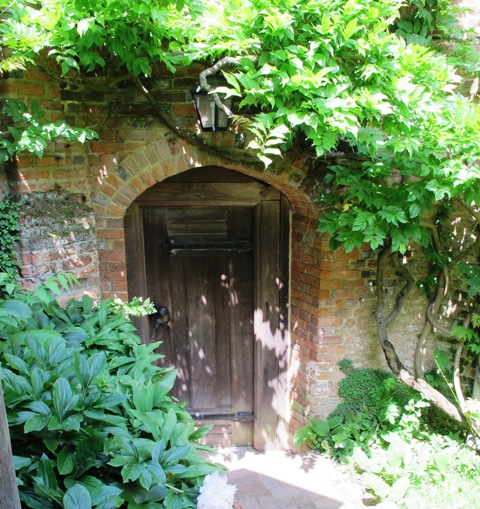 “I shall stop being queer,” he said, “if I go to the garden. There is Magic in there – good Magic, you know, Mary, I am sure there is.”

 Tikorangi The Jury Garden