
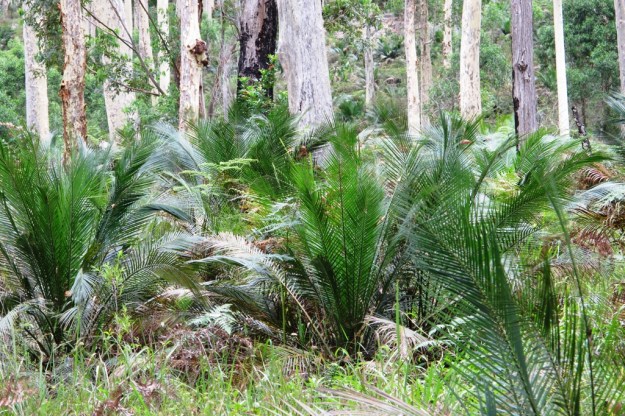
I admit not everybody will find a woodland understory of native cycads exciting but we were pretty taken with this natural phenomenon
We drove through a cycad forest. It was so exciting – in a low-key sort of way. Most of us have gardens which are the botanical equivalent of the United Nations. While some of us may know in theory where at least some of the plants originate, to see them in their natural habitat can be a thrill.
Our New Zealand bush is thick, dense and verdant. Overseas visitors are frequently amazed by our ferns, particularly our tree ferns which we take for granted. Our dicksonias (the common pongas) are particularly highly prized overseas. When we had the garden open, I used to like shocking overseas visitors by commenting that they just seed down here and we chainsaw out those that are in the wrong place. Familiarity can breed contempt.
The Australian bush is different. It is much more open in character but it had never occurred to us to consider that of course their native cycad, Macrozamia communis, must have its natural habitat somewhere. At least one place is in the eucalyptus woodland heading inland from Bateman’s Bay on the coast south of Sydney.
We know the cycads as expensive, designer plants much favoured by Auckland landscapers in recent decades. Most are very slow growing plants and they show little seasonal change so they fit well into the near-static designer garden mode favoured by some. They have always been expensive because you are paying for the years of growth to get them to a large enough size to have visual impact.
Botanically, they are even more interesting, having undergone little evolutionary change down the centuries. These are ancient plants, traced 200 million years which takes them back considerably earlier than the dinosaur era. Individual plants can be long lived too – anything up to 1000 years. While they are often grouped with palms and there is a certain passing resemblance in form to some ferns, there is only a remote botanical connection to either at best.
Many cycads are rare and endangered around the world but not Macrozamia communis. It is common enough in New Zealand gardens because it is a species that can adapt to our cooler temperatures. We have several in our garden where they thrive.
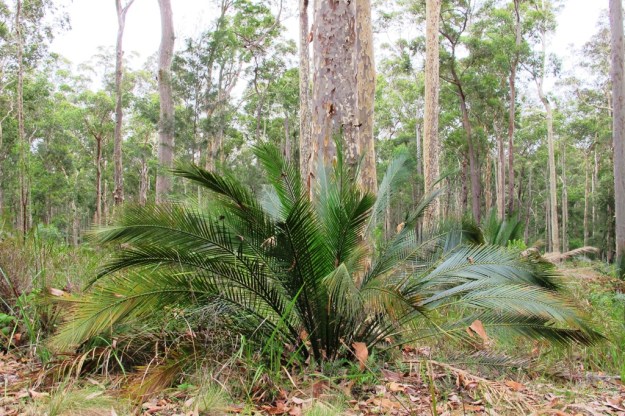
In the wild, eucalypts and Macrozamia communis near the coast south of Sydney. Notice the lovely mottled bark on the gum tree
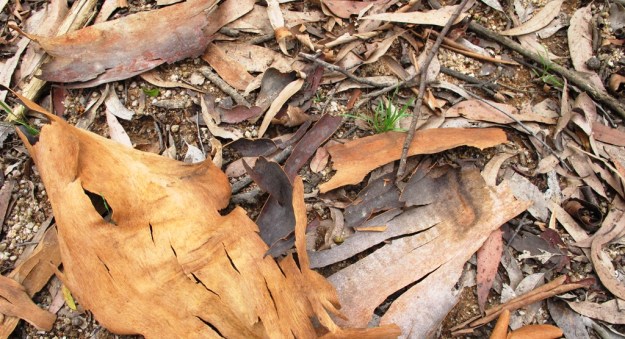
A carpet of bark, leaves and debris from the top layer of eucalypts creates conditions which discourage many other plants
I have a treasured memory of seeing natural bluebell woods in Scotland. Mark got all excited finding Helleborus niger and hepaticas growing wild in their homelands in Northern Italy. The cycad woodland of south eastern Australia ranks up with these experiences.

The macrozamia is equally popular as a garden plant
First published in the Waikato Times and reprinted here with their permission.

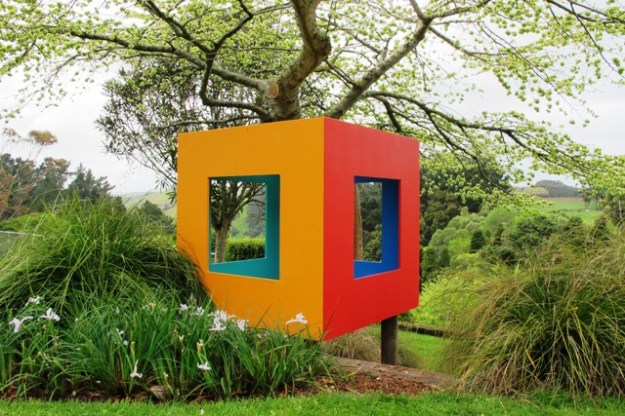 1) The box with its flat planes of colour is by Coromandel-resident artist Michael Smither and has found its permanent home at Puketarata Garden near Hawera. It has echoes of a child’s play house but the simplicity is deceptive. So too is the placement. It becomes the absolute centre of attention in the middle ground but is also successful in drawing the eye to the large landscape beyond.
 2) In a similar vein, the whimsical pavilion created by garden owner, Clive Higgie at Paloma Garden near Whanganui makes an undeniable statement as a focal point in an otherwise natural environment. The reflection is an integral part of the picture. As with the Smither box, it is the combination of a vibrant creation with thoughtful placement which makes this a successful installation. What appears to be a blue ceramic ball topping the roof is arguably the best use I have seen of one of these mass produced decorative items.
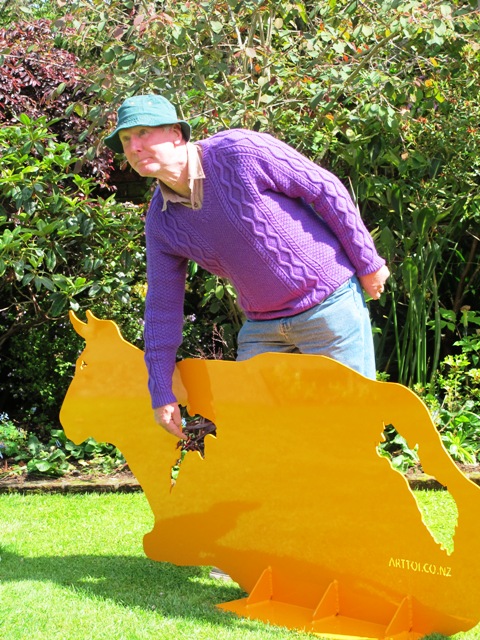 3) The freestanding, two dimensional yellow cow was on temporary display in our garden, the work of Joep from Arttoi (www.arttoi.co.nz) so we won’t mention the placement. The gentleman in the very purple jersey posed so willingly, adding a certain ambience, I felt. The cow may or may not be to your personal taste (I would have preferred it without the map of New Zealand). The purple jersey, the man’s wife told me, had been found in a skip and became an instant favourite for the wearer. Each to their own.
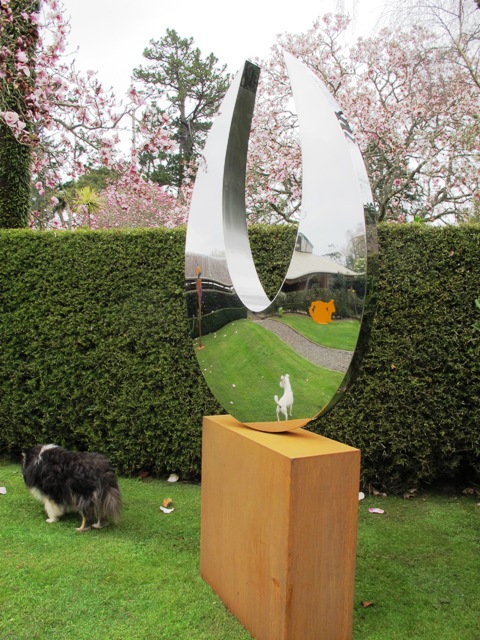 4) At the same temporary installation of Joep’s work, the stainless steel sculptures were beautifully executed and caught my fancy. The reflective qualities of the highly polished stainless steel were a great deal more subtle than a garden mirror. While there is a tendency to put this type of work in a hard-edged, minimalist, modern garden, I admit I was surprised by how well they fitted in to our own setting which is anything but that. We placed them in positions with relatively plain backgrounds where they could star and the reflections made it a two way interaction with their surroundings.
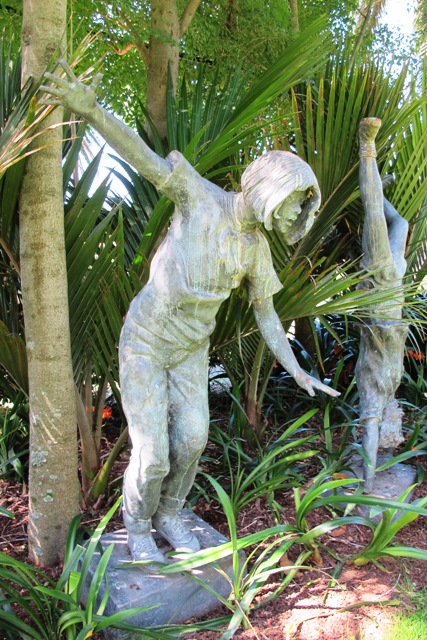 5) While not keen on reproduction classical statuary in a New Zealand garden context, these modern interpretations made me smile. In a very family-oriented garden, they fitted thematically. The frozen moment in time captured with the balance of their poses gave the contrast of tension with the subtle placement against the nikau palms. I could see these ageing gracefully down the decades.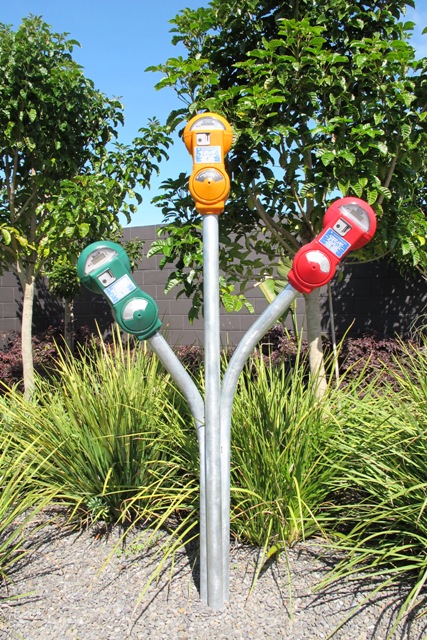
 6) When out and about garden visiting in spring and I could not help but notice a plethora of parking meters as garden ornaments. I am sure this was a result of the market being flooded with old meters in this particular area, which had moved to an electronic sensor parking system. The customised triple meter installation was perhaps more witty and striking than those single ones which had simply been placed as a relic of the past decade.
 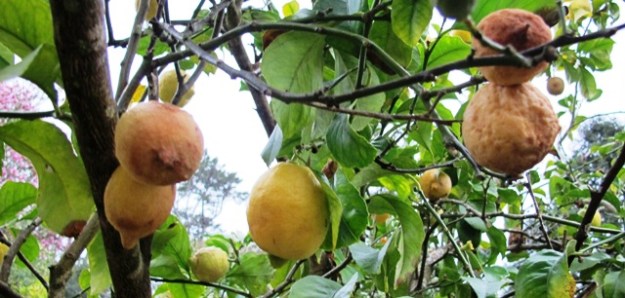 Garden lore: lemon problems
  Tikorangi The Jury Garden