Stumperies for shaded areas

???????????????????????????????
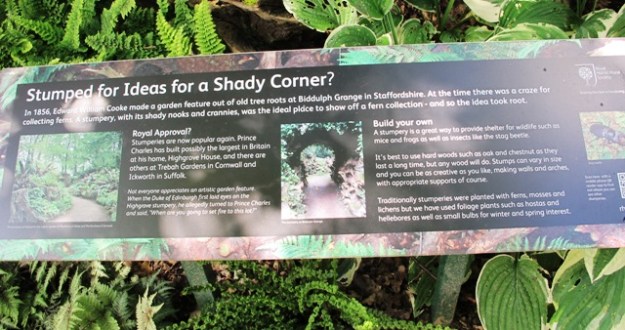
“Not everyone appreciates an artistic garden feature. When the Duke of Edinburgh first laid eyes on the Highgrove stumpery, he allegedly turned to Prince Charles and said, ‘When are you going to set fire to this lot?’”
Spotted on an information board at Wisley Gardens, England (2014).
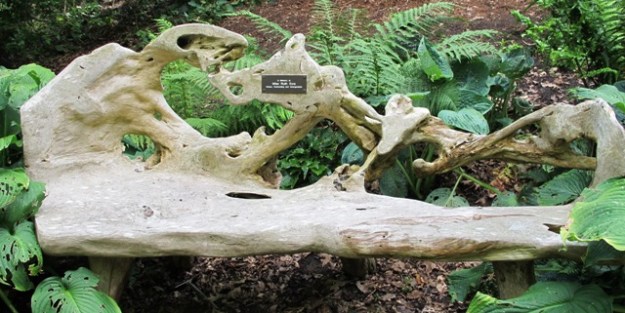
Not our seat as you can probably tell from the dedication plaque to Miss Ruth Ezra who was, apparently, ‘Unique, Outstanding and Unforgettable’, but a fine example of a bench seat constructed from a weathered tree trunk.

Not our seat as you can probably tell from the dedication plaque to Miss Ruth Ezra who was, apparently, ‘Unique, Outstanding and Unforgettable’, but a fine example of a bench seat constructed from a weathered tree trunk.

Stumperies. I first saw the term used in a garden description locally and it did sound a little pretentious – ‘admire our stumpery’, it may have said. It is not a term that has ever appealed to me – too close to stumpy and dumpy – but it is an established term. Why, even Prince Charles has one at his famous private garden named Highgrove, as you will see from today’s quote.

The origins apparently date back to 1856 when the owner of Biddulph Grange in Britain created the first recorded instance of a deliberate construction using old tree roots and stumps in order to display a fine collection of ferns, but I suspect that incidental stumperies must have occurred throughout garden history. Mark pointed out to me that our rimu avenue gardens are in fact a stumpery, though the creation of a garden beneath those trees only dates back to the 1950s.
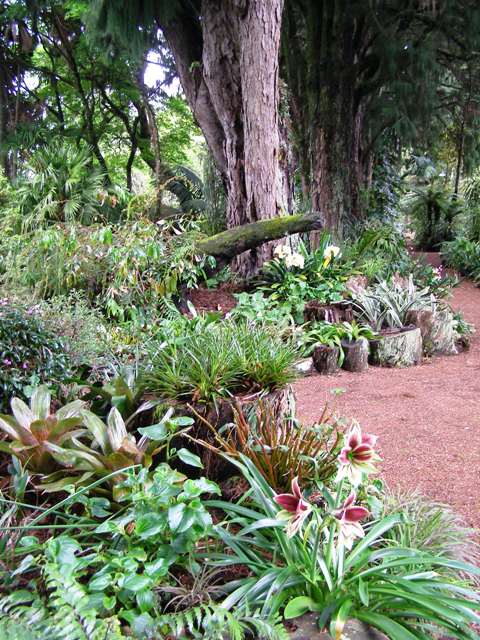
The addition of wood in this garden is for both decorative purposes but also to enable the soil levels to be built up so that plants will thrive despite competition from tree roots

The addition of wood in this garden is for both decorative purposes but also to enable the soil levels to be built up so that plants will thrive despite competition from tree roots


Our newest stumperies in the garden here are a pragmatic solution but one with which we are happy to work. When large trees fall – and this happens from time to time here – the initial mess can be daunting. But once the superficial clean-up has been done, it is always amazing how little long term damage huge trees actually cause when they fall – as long as they miss buildings and do not bring other trees down with them.
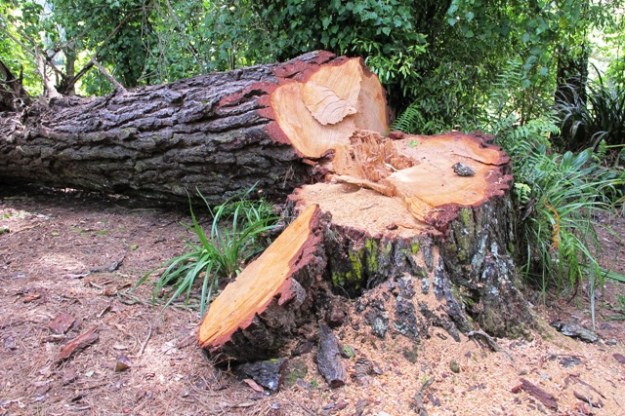
A recently fallen pine tree needed some chainsaw work to tidy up the remains but the trunk will be left to lie where it is and we will garden around it

A recently fallen pine tree needed some chainsaw work to tidy up the remains but the trunk will be left to lie where it is and we will garden around it

But to turn around and remove the main trunks of these trees would cause damage beyond description. Not only would we have to get heavy machinery in but contractors with massive chainsaws are not going to carefully pick their way around garden treasures. Big boots can do considerably more damage than the original event. Besides, we have plenty of firewood already. It is simply not worth the effort and damage, being far easier to leave them in place and to garden around them.
This is fallen poplar and it has only taken a few short years for Nature to move back in and colonise what remains. Poplar is a soft wood that will break down quickly.

This is fallen poplar and it has only taken a few short years for Nature to move back in and colonise what remains. Poplar is a soft wood that will break down quickly.


Who needs a trendy little insect hotel when you have a natural environment which is the equivalent of an insect estate? These fallen logs quickly become entire ecosystems in the space of a few short seasons. The rawness soon blurs and the first colonising mosses and ferns take hold. It is all part of the cycle of nature and fits with our philosophy of trying to garden with nature, rather than in competition. Mind you, the initial clean-up is what makes the difference. We remove or mulch the smaller side branches, anything broken and much of the foliage. We clear paths and basically leave just the main trunk to gently decay.
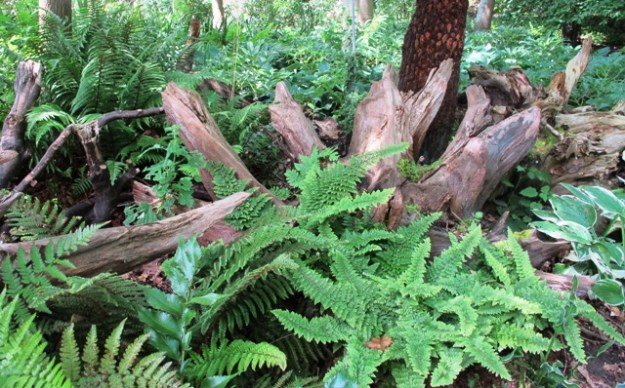
The stumpery style can be adapted to narrow house borders on the shaded side and will give a low maintenance option

The stumpery style can be adapted to narrow house borders on the shaded side and will give a low maintenance option

If nature fails to deliver you an instant stumpery in the form of fallen trees, you can create your own version and it is usual to pick a shady spot. If it is possible to get an exposed root system and lower trunk of an established tree, it is more stumpery-ish than merely using logs or bits of wood but space will determine the appropriate size and scale. Many town properties have awkward, narrow passage-way spaces down the shaded side of the house. These often accommodate the rubbish and recycling bins, garden hose and other bits. Any garden borders are almost always difficult, being narrow, shaded, cold and often dry. It may be perfect for a small stumpery.

Just don’t ever think that sawn timber boards are going to give you the right effect. Worse is the very idea of tanalised or treated timber. The whole concept of a stumpery is creating a healthy ecosystem based on gentle decay and natural change while creating pockets to display plants. There is nothing gentle or healthy or natural about tanalised timber. It has its place and purpose, but a stumpery is not one.

First published in the Waikato Times and reprinted here with their permission.
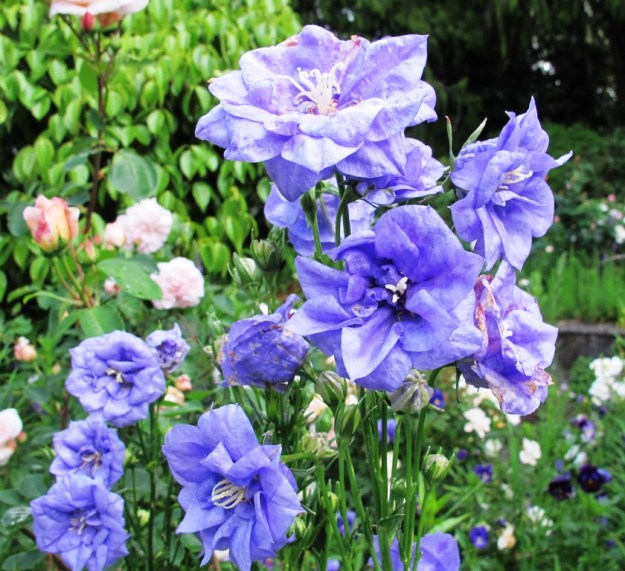
Plant Collector – campanula

???????????????????????????????
I was given this campanula some years ago and if I ever had a cultivar name for it, I have long since lost it. But is it not pretty? I am particularly fond of blue flowers so this one, combined with pastel roses, has been delighting me. Looking on line, it may be Campanula La Belle but there are quite a few double selections available so it may not be. The flower spikes in late spring to early summer stand maybe 60cm high and don’t need staking. For the rest of the time, it just forms a neat plant, low to the ground with longish, narrow pointed leaves lying nearly flat. I will have only been given one plant but lifting and dividing it from time to time has now given me enough to cover a good area.

There are many different campanulas though I had no idea how many until I looked up the plant family. Some 500 different species count as quite a few, especially when one adds in subspecies, variants and hybrids. We have a charming one that grows in flat mats in the rockery and various different ones in other locations, including the form that is commonly known as Canterbury Bells. Some are annuals, some biennial (in other words they flower in the second year, set seed and die) and some are fully perennial. They are northern hemisphere plants spread across a huge range of conditions from alpine to subtropical. Blue is the most common colour, often with a lilac tinge, but there are pink or white options as well. In the wild, the vast majority will flower single. Double forms such as mine will have been selected out as unusual.

First published in the Waikato Times and reprinted here with their permission.

Garden lore: Friday 26 December, 2014

???????????????????????????????
Growing hostas from seed
Swathes of hostas can look effective in the shade garden but are expensive if you are buying a large number of plants from a garden centre. Raising them from seed is not difficult and most varieties will set seed, so keep an eye open as summer progresses. Hostas do not grow true from seed and even if you start with a variegated one, the vast majority of seedlings will have solid coloured leaves because they will revert to their originating plain variety. The multi-coloured and quirky hostas are all sports from plain ones. Seedlings will also vary from each other even if the seed is all from the same plant. If you want the uniformity of identical plants, you will have to either buy them or divide existing plants and be patient while they establish. We like the seedling variation which adds subtle detail and interest.

When selecting seed, choose plants with desirable characteristics, including some resistant to slug and snail damage. The finer and thinner the leaf, the more likely it is to be eaten.
Thicker, tougher leaves are clearly not as delicious. Wait until the seed has ripened and then pick it and sow it in pots or trays. While you will sometimes find that plants seed down in the garden, it is hit and miss whereas raised in a tray, you should get the majority to germinate and grow. If you bulk up with seedlings, you can then go and buy some truly spectacular ones to feature amongst their more modest cousins.

First published in the Waikato Times and reprinted here with their permission.

December in the garden

Kevin and Sharon - the reindeer - at the base of the toetoe Christmas tree

Kevin and Sharon – the reindeer – at the base of the toetoe Christmas tree

December is the month of rituals for us. It is all about countdown and preparation. Will there be new potatoes, fresh peas, strawberries and raspberries ready for Christmas Day? I think we have only ever missed one set of homegrown new potatoes. If my memory serves me right, it was an advanced season and we had eaten all the first crops and hit a lull.

???????????????????????????????

Peas are more problematic and require some precision of timing and management. I adore fresh peas though I lose interest when they are podded and boiled. Browsing from the plant is my preference, followed by raw in salads. Peas generally do better in cooler climates. I admit the ones in the photograph are English. Ours never crop that heavily. In fact they take up quite a bit of space for a meagre to moderate crop here. There are more productive options where space is limited, not the least being beans. But nothing can replace the taste delight of fresh peas. We never have a Christmas turkey here, but we do peas if we can.

???????????????????????????????

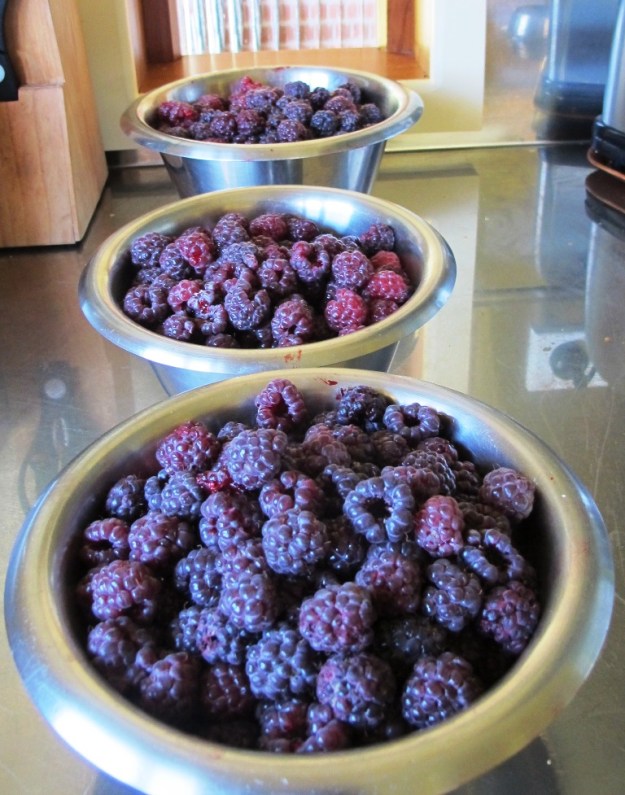
Some years, the raspberrries will ripen in time for Christmas Day. The week or two after Christmas they come on stream at an alarming rate, needing to be picked every day but whether those early ones make the deadline for dessert is entirely beyond our control. Even with our raspberry cage, it is an ongoing battle between humans and birds, mostly blackbirds. The pie seems a fairly good option for the birds, in my opinion. They will scout out the slightest weakness in the cage, squeezing through tiny gaps in their determination to help themselves. The wretches will also breach the cloche defences to take out the strawberries we guard for Christmas breakfast. It is a war out there as Christmas approaches.

Christmas trees, we’ve had a few. The DIY ethos rules unchallenged. We have never bought a tree and never had a tinsel one. Generally we have wildling pines harvested from the property. If we are lucky, Mark has preselected the wildling pine and actually given it a couple of trims to get the growth denser than usual. More often, he resorts to wiring in additional branches in a vain attempt to create something akin to the commercially trimmed pines, or the Northern European abies with their wonderful conical shapes. The thought is there even if the reality is a little different.

By far our most creative tree was the one our second daughter made out of toetoe a few years ago. Home from London, she was inspired by an illustration she had seen of one created from the plumes of pampas grass. No pampas here. It is on the absolutely banned list as a noxious weed. But toe toe (which used to be a cortaderia but has now been reclassified as an austroderia) is our native substitute.

Should you wish to try this at home, be warned. It takes many more toe toe plumes than you think. Many, many more. They will moult through your car boot, even more in the construction area and they will then gently shed in the house all Christmas. But then so do pine needles and they are a more difficult to vacuum up. The toe toe tree was a tour de force. It had a certain Pacifica vibe going, combined with European style. If you want to try it yourself, there are step by step instructions on my website. https://jury.co.nz/2010/12/24/construct-your-own-christmas-tree-with-abbie-camilla-jury/

???????????????????????????????

All this is entirely academic for us this year. After more than three decades of building our own family traditions and keeping them the same as assorted offspring migrated home for Christmas, this is the first time we will not be celebrating at home. We are heading over to join the Australian-domiciled daughters and their families this year. I guess it may even be prawns on the barbie. It will be different as the next generation build their traditions for the festive and family season.

First published in The New Zealand Gardener and reprinted here with their permission.

Oh Christmas tree, oh Christmas tree

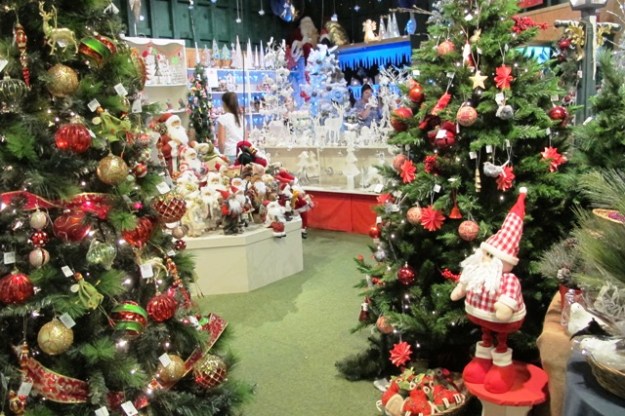
???????????????????????????????1) I have not made a great study of artificial Christmas trees but from what I can see, there is a vast range and both quality and price are equally variable. They are not as easy to customise as a living tree (or a dying tree, to be precise, if you have one without roots). There is a certain danger of ending up with one that looks similar to a shopping centre tree, especially if you opt for decorations that are restrained and unified as is favoured by many designers. For many, much of the charm of the traditional tree lies in the mishmash of family decorations passed down the decades.
002a - Copy002b - Copy
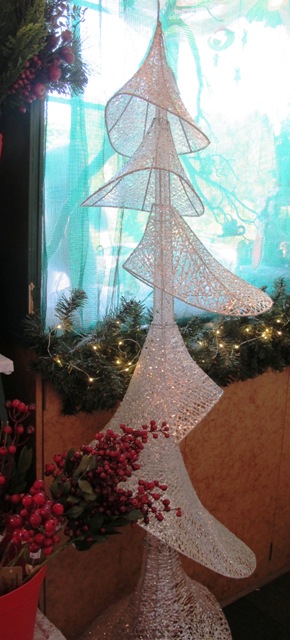
2) Where space is limited – I am thinking of small urban apartments or similar shoe-box living – I was very taken by this tall, narrow tree which I spotted in Trade Aid. It comes with built-in star and could be stored easily at the back of a wardrobe for the other 49 weeks of the year. Add a string of lights and a few small angels and birds, and you have an instant feel of festive cheer amplified by the knowledge that your purchase is supporting fair trade. The spiral tree that looks as if it is a variant on stacked sunhats was in a specialist Christmas store and has a somewhat sophisticated ambience for the minimalist decor.
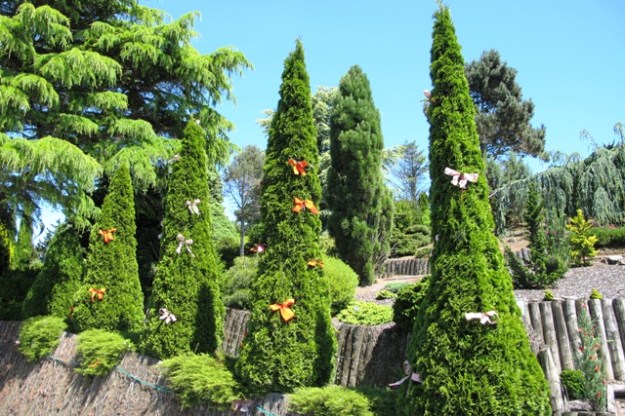
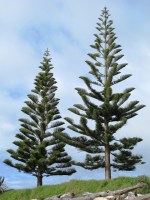
??????????????????????????????????????????????????????????????3) If you have a suitable tree outdoors, decorating it with expendable decorations can be a festive greeting to be shared with passers-by. These are thujas. Norfolk Island pines look magnificent with a star on the top if you can work out how to reach their elevated heights. I have seen it done, though I am not sure how one would manage without a cherry picker or a tree-climbing monkey in the family. But folk are sufficiently enterprising to festoon their houses in Christmas lights (and pay the power bill) so no doubt there are some quite capable of decorating trees outside.
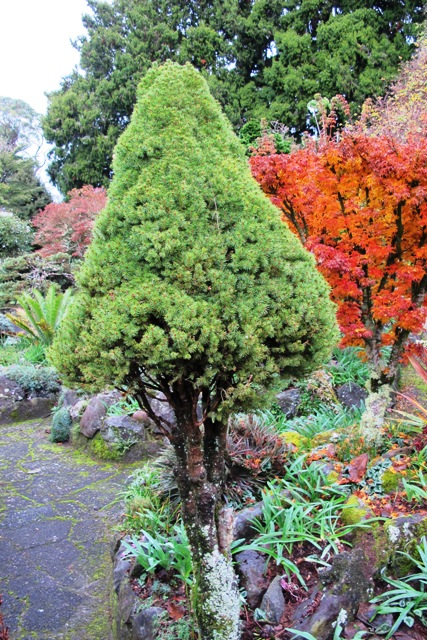
???????????????????????????????4) Our cute little Picea albertiana conica died. I have wondered about shaking all the dead foliage out of it and recycling it for the next few years as a skeleton Christmas tree. It is the perfect size and shape and could be stored in a shed. However, I recall one year using a large yet shapely dead branch which I spray-painted white. The children were young at the time but they were distinctly underwhelmed by their mother’s creativity and just wanted a proper Christmas tree such as other families had.
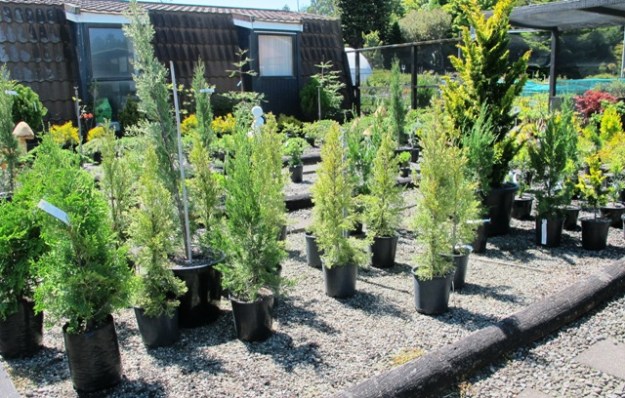
???????????????????????????????5) If you want a living tree, you need to set your sights small and choose a dwarf if you are intending to keep it alive for several years. Conifers have relatively large root systems and will not thrive on benign neglect when kept in a pot long term. However the very small growing varieties can be kept for many years with just the usual care that container plants require. They get more characterful with age, though not necessarily a whole lot larger.
???????????????????????????????6) At the risk of repeating myself from previous years, I offer up our two variations. Both use a handy, permanent, metal frame I was given. The toe-toe tree was spectacular but a one-season wonder. It had a unique Pacifica vibe which was a nice cross-cultural connection given the European history of the Christmas tree (16th century Germany). The woven grapevine version is durable, makes no mess and is very easy to decorate. ???????????????????????????????

First published in the Waikato Times and reprinted here with their permission.