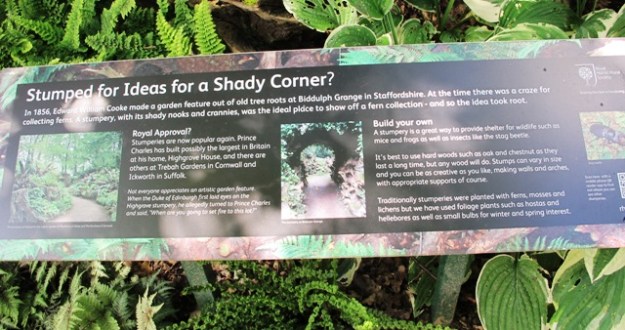
“Not everyone appreciates an artistic garden feature. When the Duke of Edinburgh first laid eyes on the Highgrove stumpery, he allegedly turned to Prince Charles and said, ‘When are you going to set fire to this lot?’”
Spotted on an information board at Wisley Gardens, England (2014).
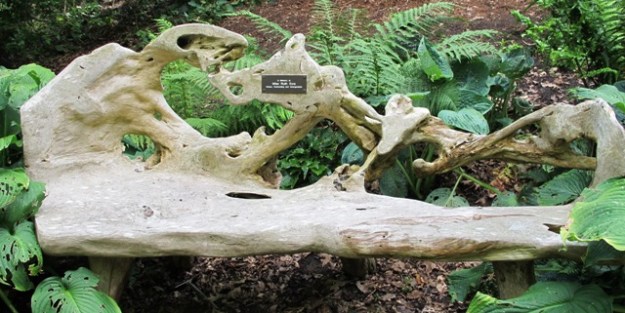
Not our seat as you can probably tell from the dedication plaque to Miss Ruth Ezra who was, apparently, ‘Unique, Outstanding and Unforgettable’, but a fine example of a bench seat constructed from a weathered tree trunk.
Stumperies. I first saw the term used in a garden description locally and it did sound a little pretentious – ‘admire our stumpery’, it may have said. It is not a term that has ever appealed to me – too close to stumpy and dumpy – but it is an established term. Why, even Prince Charles has one at his famous private garden named Highgrove, as you will see from today’s quote.
The origins apparently date back to 1856 when the owner of Biddulph Grange in Britain created the first recorded instance of a deliberate construction using old tree roots and stumps in order to display a fine collection of ferns, but I suspect that incidental stumperies must have occurred throughout garden history. Mark pointed out to me that our rimu avenue gardens are in fact a stumpery, though the creation of a garden beneath those trees only dates back to the 1950s.
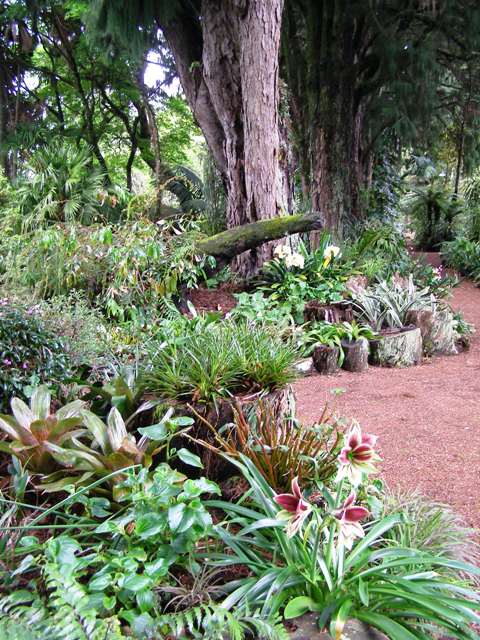
The addition of wood in this garden is for both decorative purposes but also to enable the soil levels to be built up so that plants will thrive despite competition from tree roots
Our newest stumperies in the garden here are a pragmatic solution but one with which we are happy to work. When large trees fall – and this happens from time to time here – the initial mess can be daunting. But once the superficial clean-up has been done, it is always amazing how little long term damage huge trees actually cause when they fall – as long as they miss buildings and do not bring other trees down with them.
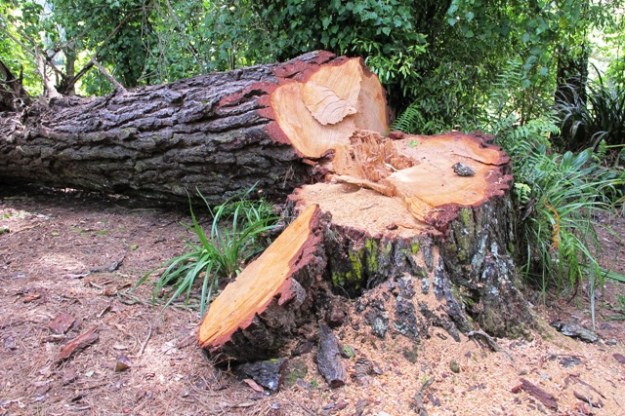
A recently fallen pine tree needed some chainsaw work to tidy up the remains but the trunk will be left to lie where it is and we will garden around it
But to turn around and remove the main trunks of these trees would cause damage beyond description. Not only would we have to get heavy machinery in but contractors with massive chainsaws are not going to carefully pick their way around garden treasures. Big boots can do considerably more damage than the original event. Besides, we have plenty of firewood already. It is simply not worth the effort and damage, being far easier to leave them in place and to garden around them.

This is fallen poplar and it has only taken a few short years for Nature to move back in and colonise what remains. Poplar is a soft wood that will break down quickly.
Who needs a trendy little insect hotel when you have a natural environment which is the equivalent of an insect estate? These fallen logs quickly become entire ecosystems in the space of a few short seasons. The rawness soon blurs and the first colonising mosses and ferns take hold. It is all part of the cycle of nature and fits with our philosophy of trying to garden with nature, rather than in competition. Mind you, the initial clean-up is what makes the difference. We remove or mulch the smaller side branches, anything broken and much of the foliage. We clear paths and basically leave just the main trunk to gently decay.
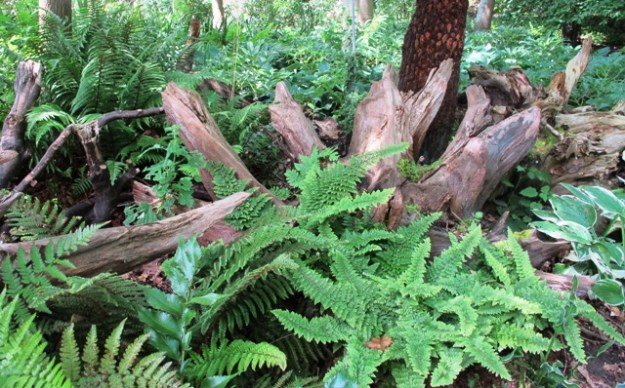
The stumpery style can be adapted to narrow house borders on the shaded side and will give a low maintenance option
If nature fails to deliver you an instant stumpery in the form of fallen trees, you can create your own version and it is usual to pick a shady spot. If it is possible to get an exposed root system and lower trunk of an established tree, it is more stumpery-ish than merely using logs or bits of wood but space will determine the appropriate size and scale. Many town properties have awkward, narrow passage-way spaces down the shaded side of the house. These often accommodate the rubbish and recycling bins, garden hose and other bits. Any garden borders are almost always difficult, being narrow, shaded, cold and often dry. It may be perfect for a small stumpery.
Just don’t ever think that sawn timber boards are going to give you the right effect. Worse is the very idea of tanalised or treated timber. The whole concept of a stumpery is creating a healthy ecosystem based on gentle decay and natural change while creating pockets to display plants. There is nothing gentle or healthy or natural about tanalised timber. It has its place and purpose, but a stumpery is not one.
First published in the Waikato Times and reprinted here with their permission.

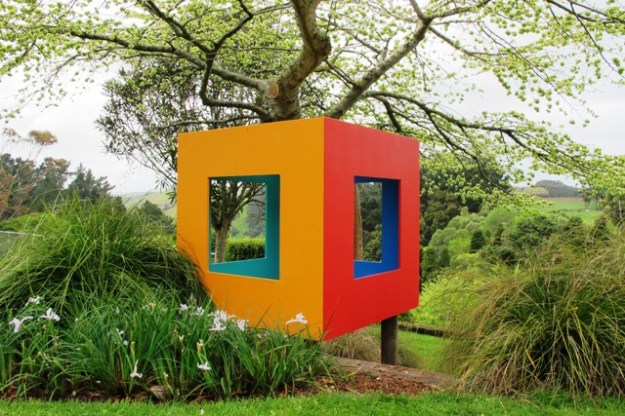 1) The box with its flat planes of colour is by Coromandel-resident artist Michael Smither and has found its permanent home at Puketarata Garden near Hawera. It has echoes of a child’s play house but the simplicity is deceptive. So too is the placement. It becomes the absolute centre of attention in the middle ground but is also successful in drawing the eye to the large landscape beyond.
 2) In a similar vein, the whimsical pavilion created by garden owner, Clive Higgie at Paloma Garden near Whanganui makes an undeniable statement as a focal point in an otherwise natural environment. The reflection is an integral part of the picture. As with the Smither box, it is the combination of a vibrant creation with thoughtful placement which makes this a successful installation. What appears to be a blue ceramic ball topping the roof is arguably the best use I have seen of one of these mass produced decorative items.
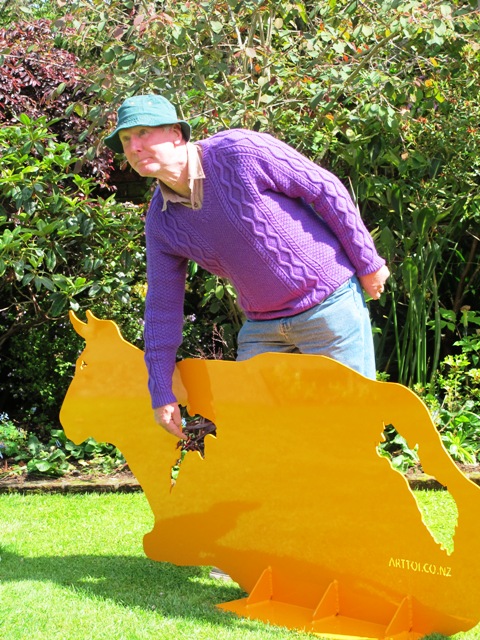 3) The freestanding, two dimensional yellow cow was on temporary display in our garden, the work of Joep from Arttoi (www.arttoi.co.nz) so we won’t mention the placement. The gentleman in the very purple jersey posed so willingly, adding a certain ambience, I felt. The cow may or may not be to your personal taste (I would have preferred it without the map of New Zealand). The purple jersey, the man’s wife told me, had been found in a skip and became an instant favourite for the wearer. Each to their own.
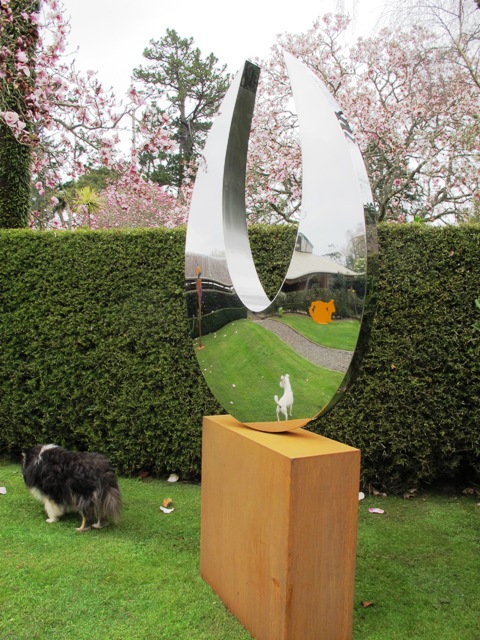 4) At the same temporary installation of Joep’s work, the stainless steel sculptures were beautifully executed and caught my fancy. The reflective qualities of the highly polished stainless steel were a great deal more subtle than a garden mirror. While there is a tendency to put this type of work in a hard-edged, minimalist, modern garden, I admit I was surprised by how well they fitted in to our own setting which is anything but that. We placed them in positions with relatively plain backgrounds where they could star and the reflections made it a two way interaction with their surroundings.
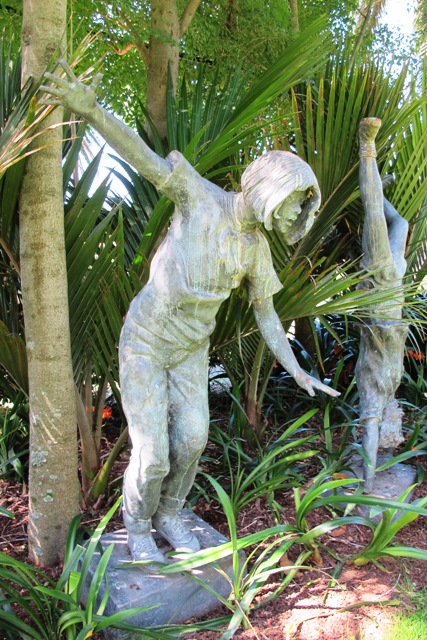 5) While not keen on reproduction classical statuary in a New Zealand garden context, these modern interpretations made me smile. In a very family-oriented garden, they fitted thematically. The frozen moment in time captured with the balance of their poses gave the contrast of tension with the subtle placement against the nikau palms. I could see these ageing gracefully down the decades.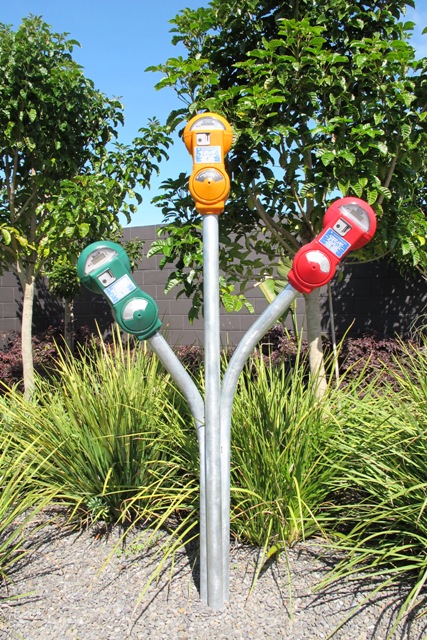
 6) When out and about garden visiting in spring and I could not help but notice a plethora of parking meters as garden ornaments. I am sure this was a result of the market being flooded with old meters in this particular area, which had moved to an electronic sensor parking system. The customised triple meter installation was perhaps more witty and striking than those single ones which had simply been placed as a relic of the past decade.
  Garden lore: lemon problems
 Tikorangi The Jury Garden