
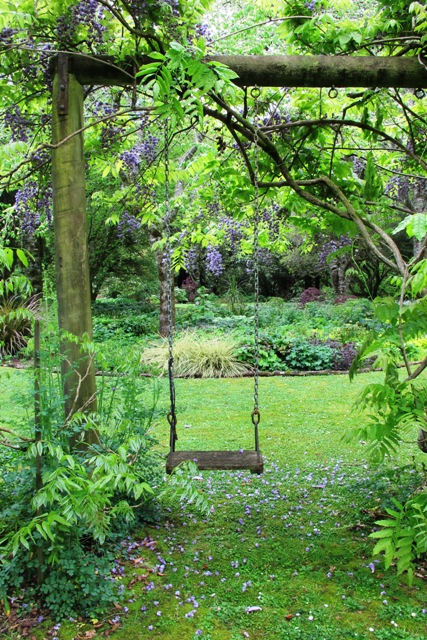
Te Popo is a cool climate, woodland garden on a large scale inland from Stratford with a romantic feel that I love.
Only old friends know that the man to whom I am still married was once a rock and pop drummer. A teaching colleague of mine roped him into playing in the orchestra for two musicals. While Joseph will be forever referred to in this house as he of the “bloody technicoloured nightmare”, the magic of “Man of La Mancha” did not pall over time and has entered our personal lexicon. I have to explain this because it is the irrepressible optimism and personal vision, drive and conviction that we see in what we now refer to as Don Quixote gardens.
This is a syndrome I know well because I am married to one such gardener so I recognise it in others. Don Quixote gardens are grand visions but personal visions of an individual. Let us rule out immediately those gardens – and I have seen a few – where the owners have set out to create what they think will be an impressive garden in order to impress other people. That is status symbol gardening.
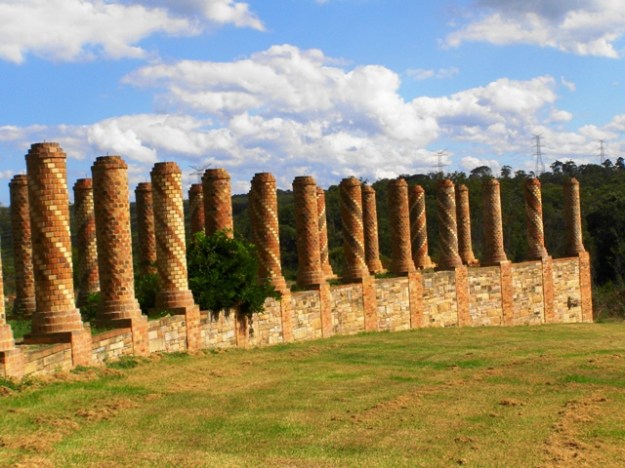
These are only half the columns at Paradise. The other half of the crescent is already wreathed in plants as a completed section of colonnade.
Don Quixote gardens are personal creations but on a bigger scale than most people contemplate, usually against the odds and without the corresponding budget that allows a small army of trained but subservient gardeners to follow in one’s wake. There is bravery, passion and a steadfast determination common to these garden creators. And a compulsive passion for both plants and landscape. Generally, Don Quixote gardeners would like it if you liked their garden, but they are not going to feel a failure if you don’t because they haven’t made it to impress you.
Let me give you a few examples. If you have ever been to ‘Paradise’, the extraordinary creation of Bob Cherry (assisted by Mrs Derelie Cherry) in New South Wales, you will know what I am talking about. It is an enormous garden, with some simply astounding brickwork and structure combined with a remarkable plant collection. Bob Cherry will be known to many New Zealanders as the originator of the Paradise sasanqua camellia range, but his plant knowledge and interest go well beyond this. As the saying goes, he has probably forgotten more about plants than others have ever known.
I think it unlikely that ‘Paradise’ will ever be finished. And I do not think that matters.
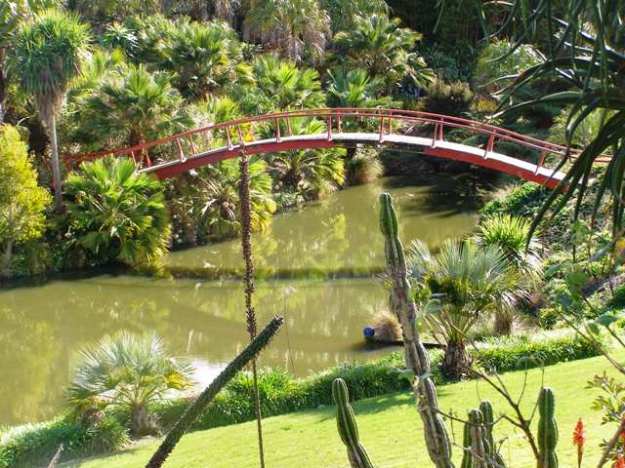
Paloma is unique amongst New Zealand gardens in design, plant content and genuine creativity, aided the boundless energy of its owners
Closer to home, it is far too many years since we last visited Trelinnoe, the garden built by John and Fiona Wills near Napier but I think that probably fits the Don Quixote genre. Paloma, the extraordinary garden of Clive and Nicki Higgie near Wanganui is another. One of my favourite Taranaki gardens is the woodland garden of Te Popo – the work of Lorri and Bruce Ellis. It is big. It is soft-edged rather than tightly manicured but maintained to a very high standard without a big budget and primarily as a result the owners’ personal passion for the place and Lorri’s willingness to spend every day in the garden.
These are not places where the owner says airily: “We don’t want to be slaves to the garden. It only takes us about two hours a week to maintain.” Don Quixote gardens are created by people who would rather be in their garden than anywhere else.
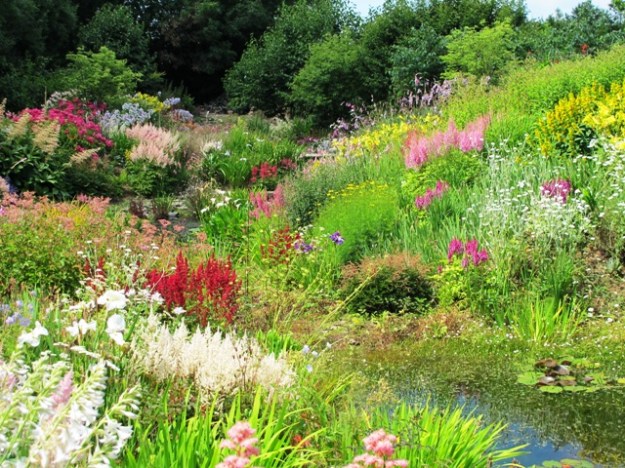
Wildside in North Devon was different to any garden that we have seen and we were quite simply entranced
I have mentioned before the inspiration we gained from visiting Wildside in North Devon but I have yet to write about it in detail. Sometimes it takes time to mentally process an experience. This was another such garden, and the garden owner, Keith Wiley is a splendid latter day Don Quixote. He took an almost flat cropping field and created a landscape. The scale of the earthworks involved in sculpting the land is difficult to comprehend but he created a rise and fall of more than twelve metres before he even started planting. It is a work in progress by a man who is not only possessed of huge energy and vision, but also a pre-eminent plantsman. I did laugh when he told us his artist wife had drawn a line of demarcation beyond which she would not garden. Any additional area beyond that line, he is to manage on his own. He will, I am sure.
Truth be told, these are not Don Quixote gardens, so much as Don Quixote gardeners, characterised by heroic visions backed by hard graft and above average knowledge – well above in some cases. These are people who will never say “my garden is full” or “my garden is finished” for, should that stage be reached, one might as well be dead. These Don Quixote gardens are about as far as one get from an urban courtyard, a contemporary designer look or a suburban back yard. They are not for the faint hearted or the uncommitted gardener.
First published in the Waikato Times and reprinted here with their permission.
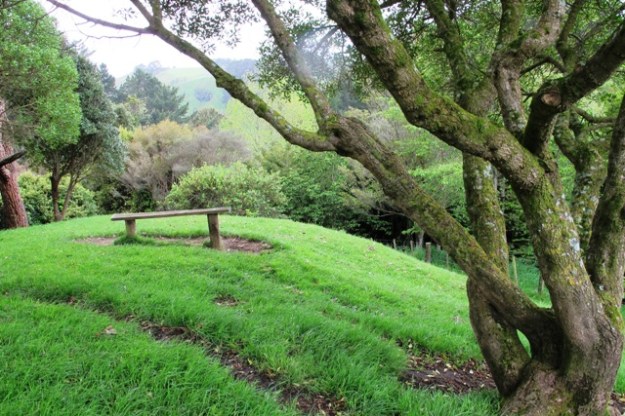 1. Sometimes it is the setting, not the seating which is the important feature. A simple bench is all that is needed to draw attention to the beautiful long vista, inviting you to take the time to sit and look. You need tanalised timber of course and farm posts are the most practical option. Make the bench long enough to hold two people and their coffee mugs without having to be too close, but not so long that it sags if somebody sits in the middle. This lovely scene is at Puketarata Garden near Hawera.
 2. How could I not include this example from Wairere Garden in Gordonton? Obviously there are a few practical issues when it comes to sitting on this hand crafted bench which looks as if it has been made from old fence battens. With that length it would only be suitable for a single person or two young lovers. I really liked the sense of enclosure with it being placed inside a curved hedge and the contrast between the lichen-encrusted, rough simplicity and the clipped formality behind.
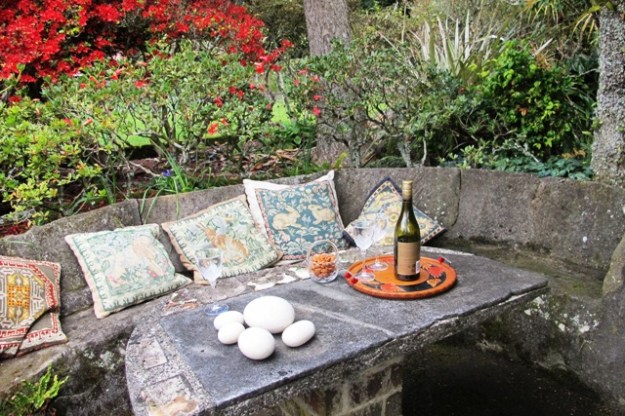 3. This is one of our own favoured seating areas, especially in summer when there is dappled light through the trees above. It is comfortable enough even without the tapestry cushions made by my late mother. The curved bench seat is stone, the table concrete on a brick plinth. I am guessing it was Mark’s mother who inset the vintage tiles around the edge of the table to add detail although few remain now. It does not always come equipped with the bottle of wine.
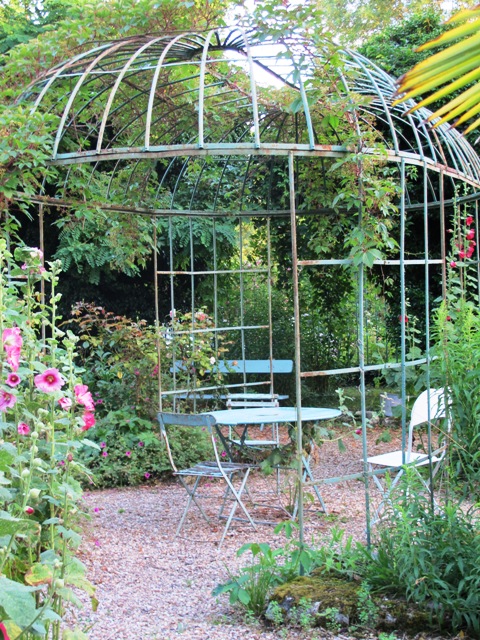 4. From home to away – the garden out the back of Restaurant Baudy in Giverny (where Monet himself used to dine with friends and you can repeat the experience to this day) applied casual French deshabille style to the outdoors. You would not want to be of large stature and trust to this outdoor setting, but the hollyhocks and gently rusting iron are the epitome of what is sometimes styled shabby chic in modern parlance.
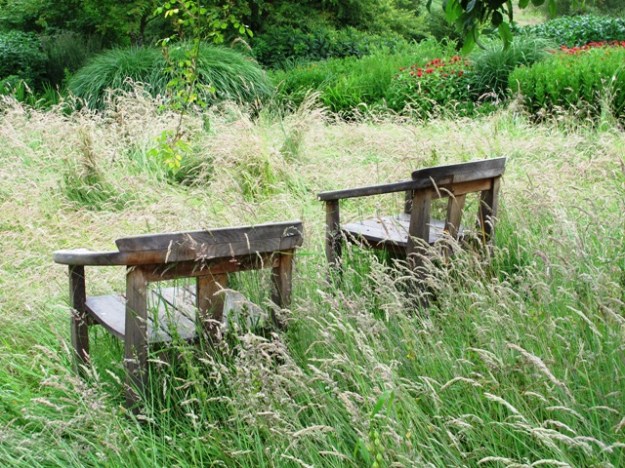 5. Let’s be honest, you would not be wanting to sit on these chairs when the grass is wet, but then if it has been raining, outdoor seating will be wet too. The absence of worn track marks to the chairs suggested that they were not in great use when we visited this garden near Stratford on Avon. But that long grass, meadow look is very charming. And at least if the seats are sited in the long grass, the legs will not be making holes in the lawn and you don’t have to move the furniture to mow.
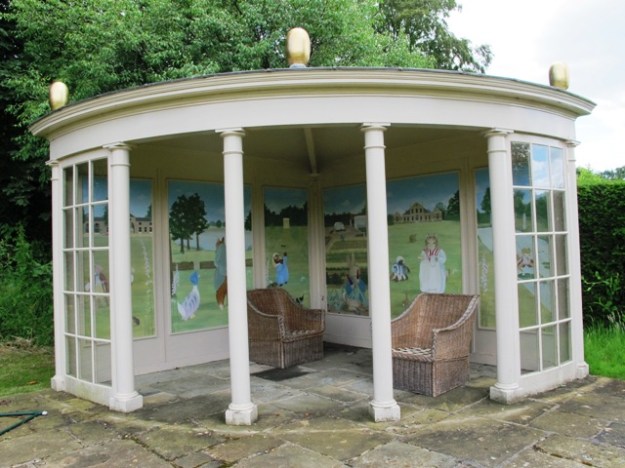 6. This is in a private Yorkshire garden and is, believe it or not, the children’s pavilion though I doubt that the comfortable cane chairs are there for the children to sit upon – far more likely for adults. Traditional cane needs to be under cover. It is only the all weather modern synthetics that can be left out in all weathers but modern or old, I have yet to meet outdoor seating that is more comfortable than cane. Personally I covet a little semi-enclosed pavilion like this one – with or without the Beatrix Potter wall paintings. In a climate which is never quite as warm as I would like, this type of outdoor room seems eminently practical.
 Tikorangi The Jury Garden