Garden Lore

“Hollyhocks are very aspiring Flowers.”
The Flower Garden by John Lawrence (1726)

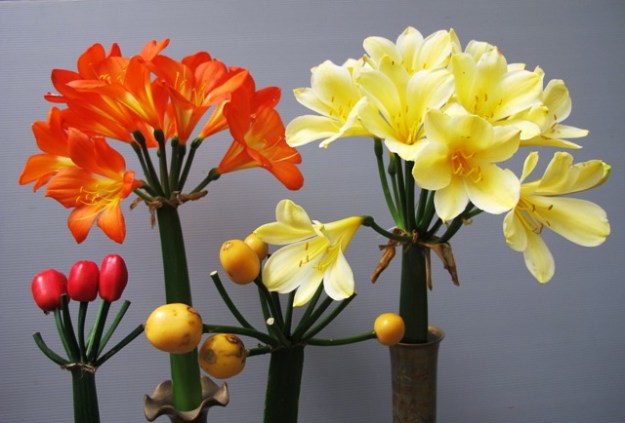
Clivia seeds and blooms

Clivia seeds and blooms

In the world of wonderfully random bits of gardening information, I thought I would demonstrate to you that red and orange clivias have red seeds while yellow clivias produce yellow seeds. Is that not an interesting fact? These seed are from last year’s blooms. They take a long time to mature. While you can, as we often do, leave them to seed down naturally where they are, picking them and sowing them in trays in more controlled conditions will usually give you a higher percentage.

The reason why clivia plants are often expensive has nothing to do with their being difficult to grow or propagate. It has to do with the time it takes for them to grow and reach flowering size. In this age of instant gratification, people want to buy big plants which will fill a space now and flower beautifully but all for $15, thank you. That is fine if it only takes three months to produce the plant but when it may be four years, you have to be prepared to either pay more or to buy small and be patient. If you have access to an established clump, these are not difficult plants to dig and divide.

First published in the Waikato Times and reprinted here with their permission.

Plant Collector: Doronicum orientale

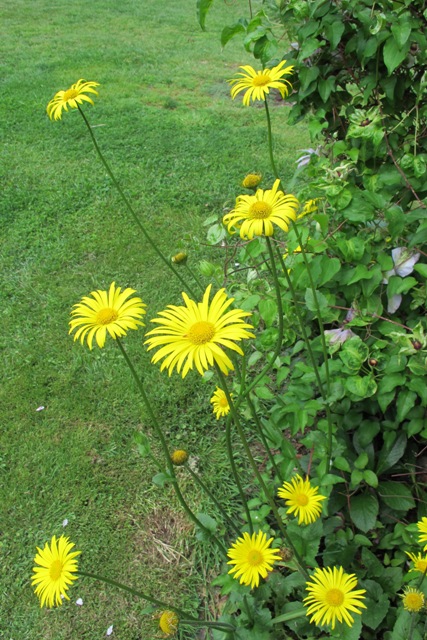
Doronicum orientale, not as was fixed in my mind, a geronicum

Doronicum orientale, not as was fixed in my mind, a geronicum

Who knew that the daisy family – or asteraceae – is one of the largest extended plant families in nature? Rivalling even the massive orchid group, in fact, with somewhere over 23 000 different daisy species. But really, it is the apparently simple charm of the daisy form, as with the poppy, that makes many of us smile. The sunny yellow doronicum has been lighting up the garden these past few weeks. To my embarrassment, I thought it was a geronicum but no, somewhere it had bedded into my memory under the wrong name. It is in fact Doronicum orientale, widely referred to in the UK by its common name of leopard’s bane. It is one of the earliest daisies of the season. The almost flat rosette of leaves grow from a small tuber below the ground and the root system is generally small and shallow. The flower stem can push upwards to about 50cm high and sets multiple blooms in succession. When it has finished, it gently fades back down and goes into a state of semi or total dormancy by late summer. This doronicum is native to southern Europe and the Middle East which may explain the timing of its dormancy period.

Botanically speaking, daisy flowers are not so simple after all. What we call petals are often individual ray flowers, with the fertile disk flowers being clustered in the centre (the bit that looks like a pincushion).

???????????????????????????????

First published in the Waikato Times and reprinted here with their permission.

The October Garden

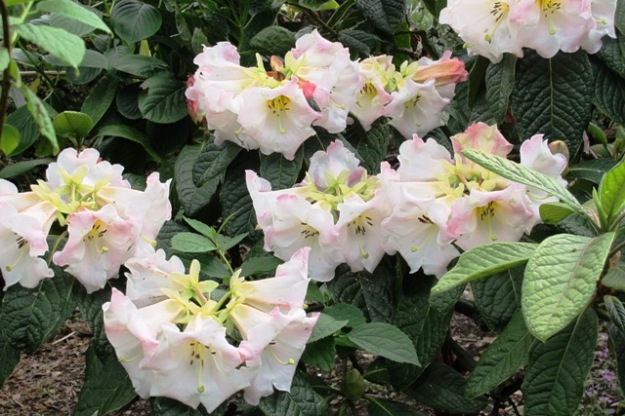
The glory of the sino nuttallii rhododendrons

The glory of the sino nuttallii rhododendrons

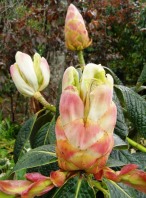
Floral Legacy in bud

Floral Legacy in bud

Rhododendons may no longer be the elite fashion item they were for so many decades, but we still love them.

When we started in the plant business back in the early 80s, rhododendrons were a hot ticket item. We were but one of several rhododendron nurseries in Taranaki and to survive, we needed to find our own niche. To this end, we grew a different range, specialising in varieties that would perform well in warmer climates – like Auckland. After all, even back then, one in four New Zealanders lived in greater Auckland and we figured that if we were going to sell them rhododendrons, we might as well sell them ones that would do better for them. Mark’s father just happened to have done some breeding to find varieties that were more resistant to thrips, didn’t get that burned and crispy edging to their foliage and were predominantly fragrant as well as floriferous. It gave us a good place to start.

Nowadays there are no specialist rhododendron growers in Taranaki at all and the demand has melted away. I no longer have to try and convince people that not all rhododendrons have a big full truss in the shape of a ball but many have loose trumpets in curtains of bloom instead.

Rhododendrons are one of the backbones of our garden and we wouldn’t have it any other way. While they have a relatively short season in full bloom, the anticipation of fattening buds stretches out the weeks with the promise of delights to come. They are as fine a shrub as any we grow here and a great deal more spectacular than most.

The nuttalliis! Oh the nuttalliis!

The nuttalliis! Oh the nuttalliis!

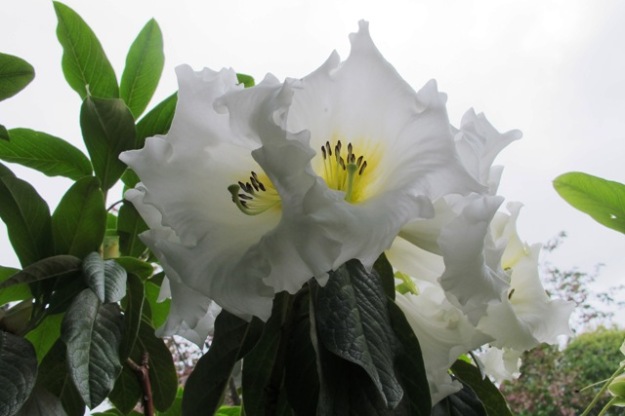
The nuttalliis. Oh the nuttalliis. Peak nuttallii season doesn’t start until closer to the end of the month, taking us into November but some varieties have already done their dash for this year. If we could grow only one type of rhododendron, we’d choose a nuttallii and even more specifically, the sino nuttallii from China. You can keep your big red rhodos (most people’s favourite pick). We love the fragrant, long, white trumpets which look as if they are made from waxed fabric, the lovely peeling bark and the heavy textured foliage. These are rarely offered commercially now so grab one if you ever find it for sale.

Thrips!

Thrips!

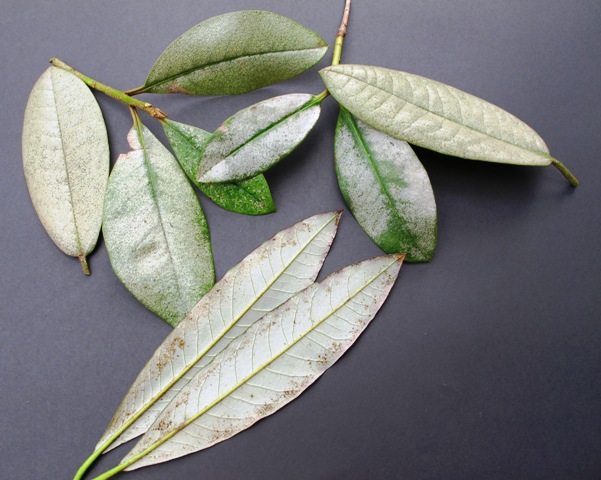
It is, by the way, nasty little leaf-sucking thrips that turn foliage silver and no, you can never turn those silver leaves green again. If you look at the underside of the leaf, you can see dark thread-like marks – these are the critters that do the damage. All you can do is to try and prevent the new season’s growth from getting similarly infested. We are not at all keen on spraying insecticide these days and you need a systemic insecticide that the plant absorbs into its system to get a thorough kill. If you must go down this path, spray in mid November, early January and late February for maximum effect. Others praise Neem oil instead but we haven’t tried it.

We favour choosing more thrip-resistant varieties, keeping them growing strongly and opening up around them to let more air and light in. Thrips prefer shade and shelter. Unless it is really
special, if it is badly thrip-prone, we replace it with a better variety. Not every plant is precious.

In the longer term, plants come and go in the fashion stakes. Goodness, even red hot pokers are having a resurgence of popularity. We don’t worry about the fashion status of the rhododendron and Mark continues hybridising for better performing cultivars. If there is no commercial market for the results, it doesn’t matter. We will continue to enjoy them in our own garden.

First published in the New Zealand Gardener and reprinted here with their permission.

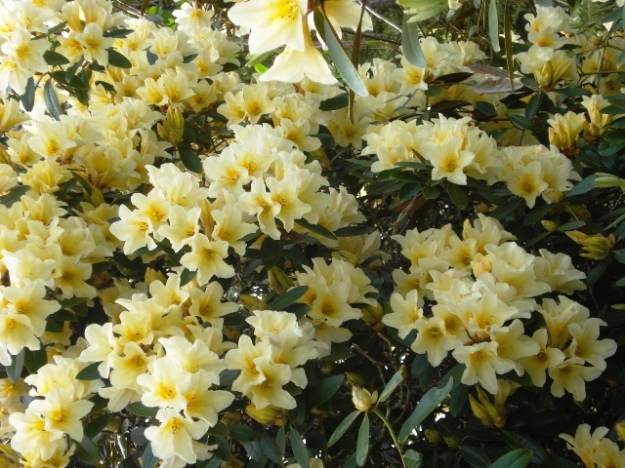
Rhododendron Barbara Jury - one of Felix's  hybrids

Rhododendron Barbara Jury – one of Felix’s hybrids

The Romantic Garden (part 1)

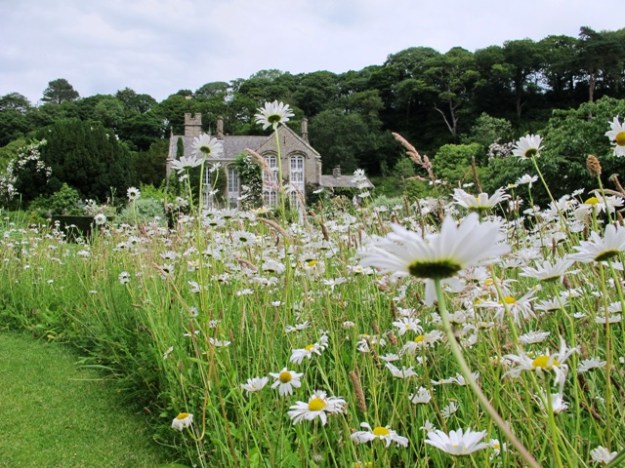
Good bones help but the contrast of plants and the simplicity of the daisies would work even without the hall in the background.

Good bones help but the contrast of plants and the simplicity of the daisies would work even without the hall in the background.

We have been talking about romantic gardens here. Not that commercially packaged ‘romantic’ imagery of twilight, candles, a bottle of wine and two glasses. No, we are looking back to the European Romantic period from the late 18th century onwards blended with what is often called naturalistic and gardenesque styles of gardening, but in the 21st century.

The gentle, at times sentimental soft focus of ‘The Secret Garden’ by Frances Hodgson Burnett has stayed with many of us all our lives. It was something of an anticlimax to me when I finally discovered that the history of those walled gardens in Britain has rather more to do with growing fruit and vegetables than roses. So too have I never forgotten the image of Elnora Comstock in ‘A Girl of the Limberlost’ though I admit I mentally had her in an arbour, not beneath a willow tree*.

Gresgarth offered many small pictures of subtle detail.

Gresgarth offered many small pictures of subtle detail.

How does this translate to gardening? Forget the twee, the naff, the contrived sentimentality. That is romantic gardening in the hands of the wannabe. It started to fall into place for us when we visited Arabella Lennox Boyd’s garden called Gresgarth in Lancashire, north west England. The pictures today tell the story. It was wildly romantic though not, I would guess as a deliberate contrivance. Lady Lennox Boyd is renowned as both a highly skilled garden designer and a plantswoman. This is her private garden and a reflection of her personal tastes. Unfortunately she was away the day we visited. We would have liked to have met her because we loved her garden.

It was not a show garden designed to impress. We have seen enough of those to pick them instantly. This was a garden with soul, underpinned by a very deft hand and eye. There were many detailed little pictures as well as the grand views, a marriage of formality and informality with areas of gentle abandon. It was a garden which served multiple purposes including supplying the house with produce and replenishing the soul. It wasn’t perfect. There were a few areas which were certainly not above criticism. In short, it was a garden to be lived in.

It wasn’t until later that we came to the conclusion that the best descriptor was “romantic”. This was despite the coach load of visitors and others who were there at the same time. I can tell you that garden coach loads do not vary a great deal whether they are in New Zealand or overseas. There is a certain herd tendency to tour groups. But even their intrusive presence did not detract from our enjoyment.

I think it was the gardener’s cottage in days gone by, located in the walled garden.

I think it was the gardener’s cottage in days gone by, located in the walled garden.

Gresgarth gave us a reference point as a romantic garden. Even if the handsome residence and the old stone and brickwork were stripped out, it would still retain that sense of romance because it lay in the garden, not primarily in the wider architectural or landscape context. Though it certainly makes life easier if you start with some good bones, as they say.

Romantic gardening is pretty much at the far end of the spectrum from hard-edged contemporary garden design with shiny stainless steel, matt black and sharp white structures and plants selected solely as soft furnishings. It is also well away from austere, classically derived formality although it may have some formal elements.
It wasn’t all pastel and white at Gresgarth.

It wasn’t all pastel and white at Gresgarth.

What else defines it other than that distinctly nebulous and subjective description of having ‘soul’? We are still unravelling this here but romantic gardening brings together a number of threads we have been discussing in recent years – sustainability, support for natural ecosystems, better environmental practices in gardening, a respect for nature which involves a cooperative relationship, some level of prettiness, often a celebration of simplicity rather than grandeur. None of this is a surprise when you consider that the Romantic era originated as a reaction against the Industrial Revolution and the elevation of science and reason above nature.

Maybe it is time for Neo-Romanticism or maybe the Romantic Revival as a response to the elevation of economics and self interest above nature and community? Only time will tell.

* “One afternoon early in July, Ammon came across the fields. He inquired for Elnora at the back door and was told she was reading under the willow. He went around the west end of the cabin to her. She sat on a rustic bench they had made and placed beneath a drooping branch. Ammon had not seen her before in the dress she was wearing. It was clinging mull of pale green trimmed with narrow ruffles and touched with knots of black velvet; a simple dress but vastly becoming.”

A Girl of the Limberlost by Gene Stratton Porter (1909)

First published in the Waikato Times and reprinted here with their permission.

Garden Lore: Friday 17 October, 2014

The red cubes are evergreen azaleasLook! The red cubes are evergreen azaleas. We were driving along and I made Mark stop the car so I could photograph this border from the street because it was eye catching. The azaleas appear to be all the same variety. Each rhododendron in between is a different variety. We decided that what lifted this border above the usual alternating planting – which I have been known to refer as the vaudeville or circus tent look – is the fact that it utilises formality without slavishly trying to make all the plants look identical. Each red cube is actually a different size.

One of the problems of strictly formal plantings is that the symmetry is ruined if a plant fails to thrive or dies. This is a common problem because plants are living organisms and may not conform to your requirement that they obediently stay identical to their neighbours. Here is a practical solution to that conundrum, giving structure, form and unity by overall impression, rather than exact detail. When not flowering, the azaleas will just be green cubes instead. Should one die, it will not ruin the entire length of the border if it is replaced with a younger, smaller plant.

I am not so keen on the sharp contrast of the white fence at the front, but that is entirely personal taste. Notice how the dark fence behind the border makes it recede into the distance rather than drawing attention to the straight lines of the boundary with the neighbour.

First published in the Waikato Times and reprinted here with their permission.