A host of golden narcissi

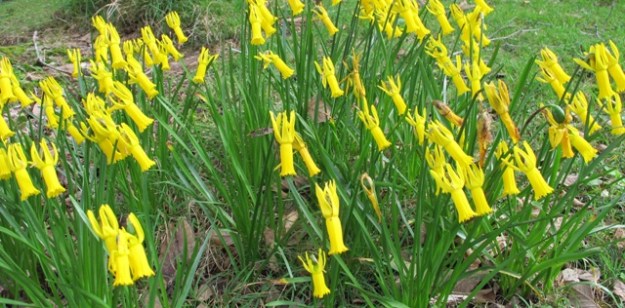
Some narcissi are better than others when it comes to naturalising. We are having some success with the cyclamineus types.

Some narcissi are better than others when it comes to naturalising. We are having some success with the cyclamineus types.

Is there any plant more evocative of spring than daffodils? They have been cultivated for eons, though many gardeners don’t realise how varied they can be. There is a lot more to the daffodil than the King Alfred types and the modern hybrids, though these are what are most commonly found for sale in garden centres, King Alfred being the handsome, large, pure yellow, classic daffodil.

‘I shall decode them this week,’ I thought. Firstly, daffodils are just the common name for narcissi. And there I stopped. There is a wealth of information around about narcissi if you want the technical details. But when there isn’t even widespread agreement as to how many actual species there are – maybe up to 60 or maybe not anywhere near that – and when separate groups have been introduced instead to classify the family, it is not a tidy little family tree to summarise. This is a plant that has lent itself to extensive hybridising since the days when Narcissus fell in love with his own reflection.

 Left to right: All dwarf varieties. N. bulbodium citrinus (the bright yellow form flowers later in the season), N. cyclamineus (or close to that species with its fine form and swept back skirt), ‘Twinkle’ showing its cyclamineus genes. Fourth along is ‘Twilight’ which we regard as an exceptional performer with a long flowering season, comparable to the world renowned ‘Tete a Tete’ to its right. Finally are the first two flowers to open on what we think is ‘Jetfire’.

Left to right: All dwarf varieties. N. bulbodium citrinus (the bright yellow form flowers later in the season), N. cyclamineus (or close to that species with its fine form and swept back skirt), ‘Twinkle’ showing its cyclamineus genes. Fourth along is ‘Twilight’ which we regard as an exceptional performer with a long flowering season, comparable to the world renowned ‘Tete a Tete’ to its right. Finally are the first two flowers to open on what we think is ‘Jetfire’.

In terms of narcissi as garden plants, basically the wider range of different types you can grow, the more you can extend the flowering season. We have been enjoying them since early July and the last to flower will be in mid October. All I did to get the line-up photos this week was to head out to the garden on Sunday. In a few weeks, I would be picking different varieties for such photographs. We do try and keep them in separate clumps around the place to separate them, but that is how we choose to plant. There is nothing against mixing and mingling.

The varieties that don’t set seed (in other words they are sterile) flower for much longer than their more fertile cousins. This is the secret behind both Tete a Tete and Twilight, as shown in the photo.
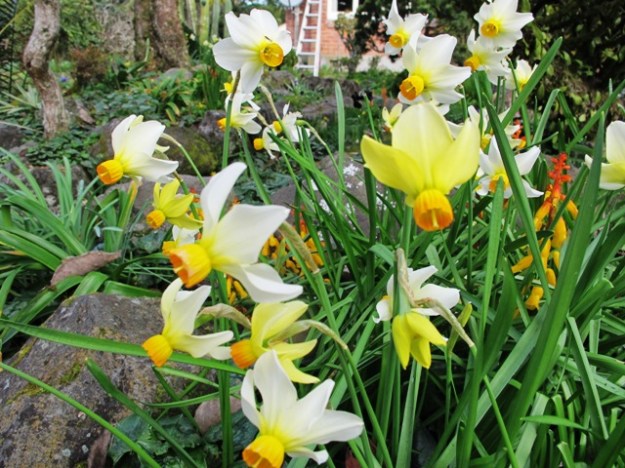
Narcissus ‘Beryl’ has yet to open her flowers this season but is another reliable performer amongst the dwarf narcissi.

Narcissus ‘Beryl’ has yet to open her flowers this season but is another reliable performer amongst the dwarf narcissi.

Where bulbs have stopped flowering, there are several possible causes. The most likely is the dreaded bulb fly which I have written about before. The grubs eat the bulbs from the inside out. Don’t ever let your clumps get so crowded that they push each other out of the pot or ground. There is no point in making it even easier for the offending narcissi fly. Shallow pots are not best suited to narcissi. Laying mulch on top of the bulbs as you wait for the foliage to die down can also help. Other reasons for poor flowering may be too much shade, cutting off the foliage too early the previous season (leave it for at least 6 weeks after flowering), wet ground, too much nitrogen fertiliser or congested, overcrowded clumps that need to be lifted and divided. Some varieties are much better than others at naturalising and being left to their own devices in paddocks or long grass situations but sooner or later, most will respond well to some attention.

If you like the novelty types with pink or apricot colours, split coronas (that is the trumpet bit), full frilled flowers and the like, then you need to look to the modern hybrids. We were given a whole collection of these a few years ago. We weren’t sure what to do with them so we planted them in the veg garden where they flowered well. We looked at them for two seasons and then dug up the lot and gave them away. When it comes to bulbs, we prefer the simplicity of the smaller varieties closer to the originating species. Charm over showiness.
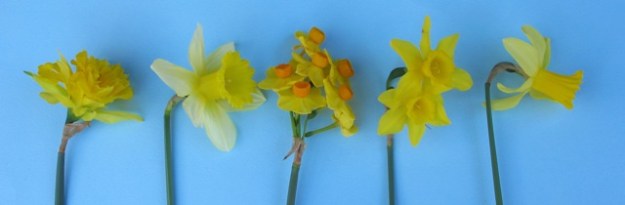
Left to right: An old, scented double variety often found in paddocks and around homesteads even today. The closest bloom I could find to a King Alfred type in our garden this week is this larger flowered cultivar with classic trumpet (corona) and skirt but in lemon. Third along is what is often called a jonquil with its delicious scent, but it is actually a N. tazetta hybrid which we think is ‘Soleil d’Or’. Next to it is one of my favourites, the fragrant N x ‘Odorus’ which is believed to be a natural jonquilla hybrid (crossed with psuedonarcissus). Finally on the right is ‘Peeping Tom’, rated a dwarf variety though somewhat larger in size than most dwarves. It is a remarkably reliable performer.

Left to right: An old, scented double variety often found in paddocks and around homesteads even today. The closest bloom I could find to a King Alfred type in our garden this week is this larger flowered cultivar with classic trumpet (corona) and skirt but in lemon. Third along is what is often called a jonquil with its delicious scent, but it is actually a N. tazetta hybrid which we think is ‘Soleil d’Or’. Next to it is one of my favourites, the fragrant N x ‘Odorus’ which is believed to be a natural jonquilla hybrid (crossed with psuedonarcissus). Finally on the right is ‘Peeping Tom’, rated a dwarf variety though somewhat larger in size than most dwarves. It is a remarkably reliable performer.

While we all know of Wordsworth’s host of golden daffodils, less well recorded is the fact that he was out walking with his sister, Dorothy when they came upon the sight. Her record of the event did not reach such legend status but has its own charm:

“When we were in the woods beyond Gowbarrow park we saw a few daffodils close to the water side, we fancied that the lake had floated the seed ashore & that the little colony had so sprung up – But as we went along there were more & yet more & at last under the boughs of the trees, we saw that there was a long belt of them along the shore, about the breadth of a country turnpike road. I never saw daffodils so beautiful they grew among the mossy stones about & about them, some rested their heads upon these stones as on a pillow for weariness & the rest tossed and reeled and danced & seemed as if they verily laughed with the wind that blew upon them over the Lake, they looked so gay ever dancing ever changing. This wind blew directly over the lake to them. There was here & there a little knot & a few stragglers a few yards higher up but they were so few as not to disturb the simplicity & unity & life of that one busy highway.”

Dorothy Wordsworth, The Grasmere Journal Thursday, 15 April 1802

First published in the Waikato Times and reprinted here with their permission.
Garden Lore

I wandered lonely as a cloud
That floats on high o’er vales and hills,
When all at once I saw a crowd,
A host, of golden daffodils;
Beside the lake, beneath the trees,
Fluttering and dancing in the breeze.

William Wordsworth, Poems in Two Volumes (1807)

Bug hotels or insect hotels

Insect Hotels

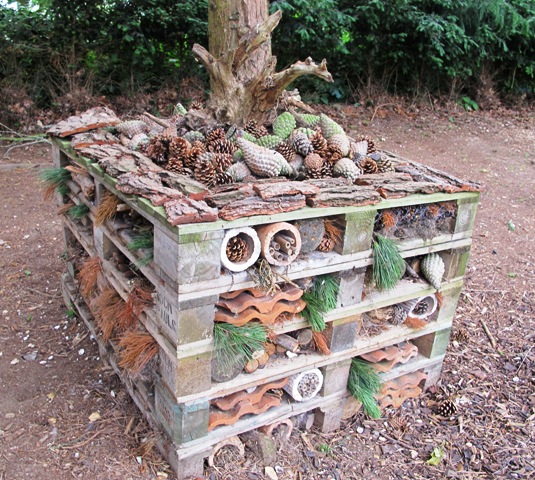
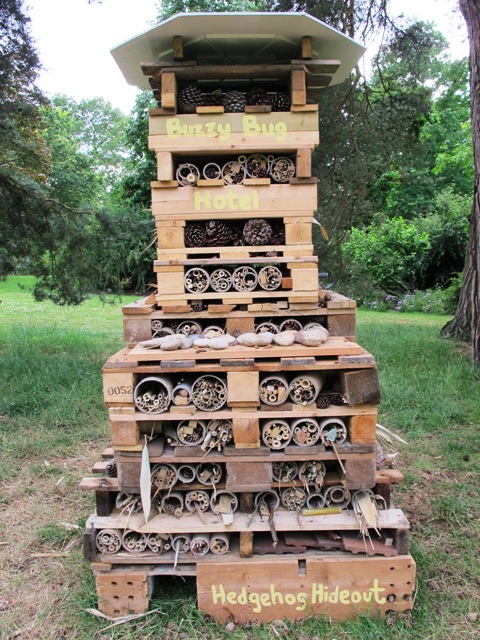
Bug hotels or insect hotels – are these the hot new accessory for gardens? This question comes from the house that inaccurately predicted the rise and rise of the garden obelisk a few years ago. These failed to make an appearance in every second garden in this country, as we expected. The insect hotel has a certain rustic and childlike charm and I am sure we will see at least some installations. The trick appears to be the use of a range of different materials to attract hibernating insects, giving them somewhere to over-winter. They need to be located in sheltered positions, out of the wind, rain and direct sunlight.

I liked the optimism in one publication which talked about appealing “to a wide variety of beneficial insects” (italics mine). Unless you are going to set up an audition for all incoming guests, there is no way that you can separate the beneficial ones from their less desirable colleagues. It is highly likely that queen wasps may find it a perfect location for over-wintering. It won’t be all charming ladybirds, damsel flies and dragon flies. There will be a fair number of slaters, earwigs, centipedes and spiders so if the children in your life are squeamish about creepy crawlies, you may want to think again before going too far down the track of this as a child-centred activity.

These constructions are favoured in Britain where there is much more conversation about ecosystems and sustainable gardening than we have here. There is also greater pressure on the environment because of population density. Unless your yard is spartan and manicured to within a centimetre of its life, odds on the bugs will find natural spots of their own as they always have – hedges, leaf litter, wood piles, beneath rocks, sheltered cracks in paving and underneath the house. The only reasons I can see to construct insect hotels are that they can look cute and are an educative tool.

insect hotels
First published in the Waikato Times and reprinted here with their permission.
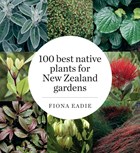
100 best native plants for New Zealand gardens by Fiona Eadie

9781775536512If this book looks a little familiar, it is because it is a new edition of one first published in 2001, updated in 2008 and again for 2014. It is a handy book, not comprehensive because it only covers 100, but many are varieties of native plants that you may want to know about. Credit to both author and book designer for having a flexible approach where the sections on each plant can vary in length rather than dumbing the content down to fit a formulaic lay-out of the style seen in recipe books.

The author is head gardener at Larnach Castle in Dunedin and a passionate advocate for using our native flora. Her information is useful. Plants are given their botanical name, Maori name (which is often the name we use most widely) and any common names. General information is given about each plant – identification, location in the wild, important botanical information such as whether both male and female are required, followed by handy info on using these plants including preferred garden situation, pests and problems, landscaping suggestions, a short list of some different cultivars available and related species. There is plenty of information, delivered in a user-friendly form. All plants are photographed, though the photography is a bit patchy in quality.

If you have earlier editions of this book, the 2008 version changed 17 plants from the 2001 edition and this one changed a further 16 plants so it is about one third of new content over the original. I notice the price has not changed in the six years since the mid edition. The only thing that really annoyed me is the sales hype on the back cover (for which the author has no responsibility). “An expert guide to the top 100 New Zealand native plants…” it trumpets. What a cheapening effect one word can have. Not “THE top”. It is “an expert guide to 100 top plants”. There is a difference.

100 best native plants for New Zealand gardens by Fiona Eadie. (Random House; ISBN:978 1 77 553 651 2).

First published in the Waikato Times and reprinted here with their permission.
Floral Skypaper – the garden in August

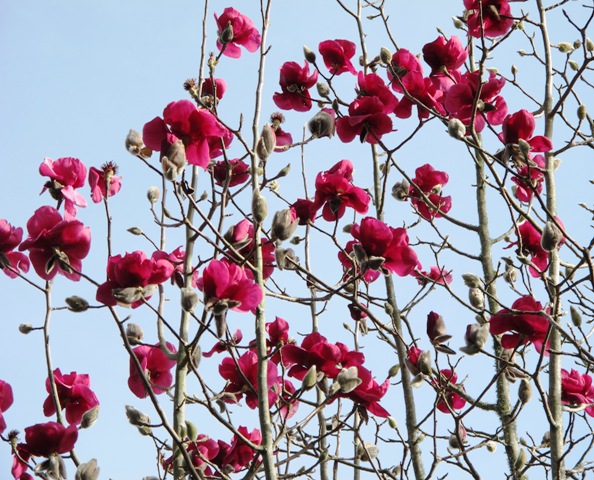
Magnolia Felix Jury

Magnolia Felix Jury

Not for us the refinement of declaring we garden for foliage and form. Give us floral extravaganza, we say, and August obliges. In the deciduous magnolias, it is the reds that dominate. By the end of the month and well into September, the softer pinks and whites come into their own but at the start, we have an unrivalled display of the stronger colours which just gets better every year as the trees get ever larger. Floral sky-paper, I call it when looking up from below. I say it is an unrivalled display because nowhere else in the world gets the same intensity of red in these magnolia, nor have they done the breeding on them that has been done in this country over the past 40 years. First Felix Jury, now Mark Jury and also Vance Hooper have pushed the boundaries with the reds. Mark was very pleased to find recently that Britain’s Royal Horticultural Society has given an Award of Garden Merit to the magnolia he bred and named for his father, ‘Felix Jury’. While we admit to being biased, it still takes our breath away each season.

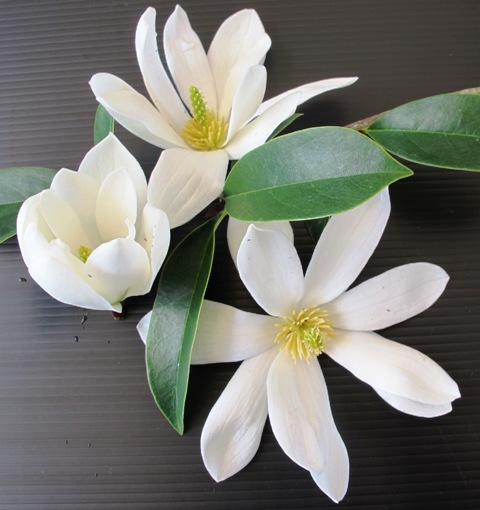
Mark's new 'Fairy Magnolia White'

Mark’s new ‘Fairy Magnolia White’

It is also michelia time – or as they have been reclassified botanically, magnolias. Do not confuse them with the evergreen grandiflora magnolias which are the summer flowering trees with big, glossy, leathery leaves. I admit we still call them michelias in conversation or we go with the “Fairy Magnolia” branding that has been placed on Mark’s new cultivars. Because michelias flower with their leaves, they are not as individually spectacular as the deciduous magnolias but they are a wonderful addition to the spring garden.

Mark has been breeding michelias for coming up to two decades now and we have many hundreds, maybe over 1000 of them, planted around our property. Out of all those, he has only named and released three so far. Fairy Magnolia White is the earliest of the season to open and has the loveliest star flower as well as being strongly fragrant. There is a purity in such white flowers, especially when contrasted with deep green foliage and wonderful velvet brown buds. One of the breeding advances has been to eliminate the tendency of some cultivars to drop their leaves and defoliate after flowering. Readers with Michelia doltsopa ‘Silver Clouds’ may recognise this trait.

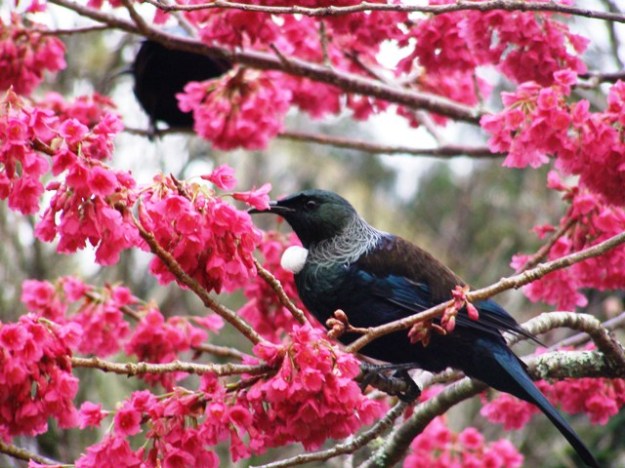
???????????????????????????????Nothing excites the tui more than the Prunus campanulata. These are somewhat controversial, especially in warm northern areas, because too many of them set seed freely, threatening to become noxious weeds. Both the tui and we would be grieved to see all campanulatas banned, though we are vigilant weeders on the germinating seed. We have a number of different trees that come into flower in sequence and we can have literally scores of fiercely territorial tui bickering and fighting in these trees as they try and claim their feeding space. There are times it can appear as if the trees are dancing with the tui.
Until a whole lot more work is done on selecting and marketing sterile forms of campanulatas (in other words, they don’t set viable seed so will never become weedy), if you live in Northland, Auckland, Waikato, Bay of Plenty, Marlborough or the West Coast, where regional councils are understandably touchy on this topic, look for Prunus Pink Clouds or Prunus Mimosa which are sterile options.
???????????????????????????????
From the big to the small – narcissi season is in full swing here. The little pictures they create give wonderful detail in a big garden. We have such a problem with narcissi fly that we struggle with the later flowering hybrids which comprise most of what is sold through garden centres (commonly called daffodils). The dwarf forms tend to flower earlier so they are over and going dormant when the narcissi fly are on the wing later in spring. The little cyclamineus ones, with their swept back skirts, seem to have a look of perpetual surprise. We are delighted with how well they are naturalising on our grassy banks where conditions are harder than in cultivated garden areas.
???????????????????????????????
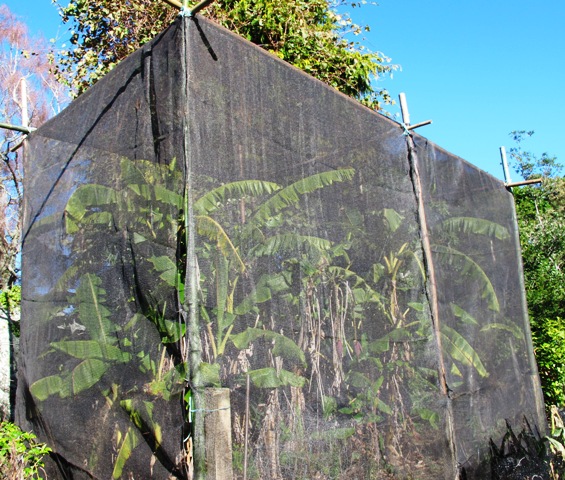
We looked enviously at Russell Fransham’s magnificent bananas in the June issue.
They are a pretty marginal crop this far south and as we live 5 km from the coast, we have to take extra care and cover them in winter. We do this with giant bamboo frames and old shade cloth. A bunch of 50 is a triumph for us so we were in awe of Russell’s 200. We won’t remove the covers from ours until later in spring, just to be on the safe side. I call these constructions here the Theatre of the Banana.

First published in the August issue of New Zealand Gardener and reprinted here with their permission.

The Meadow

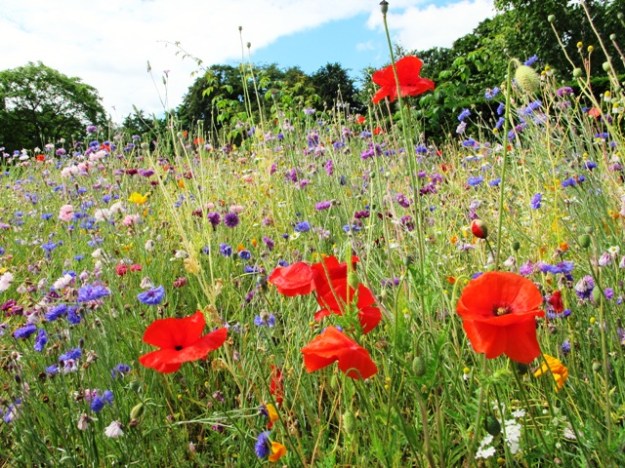
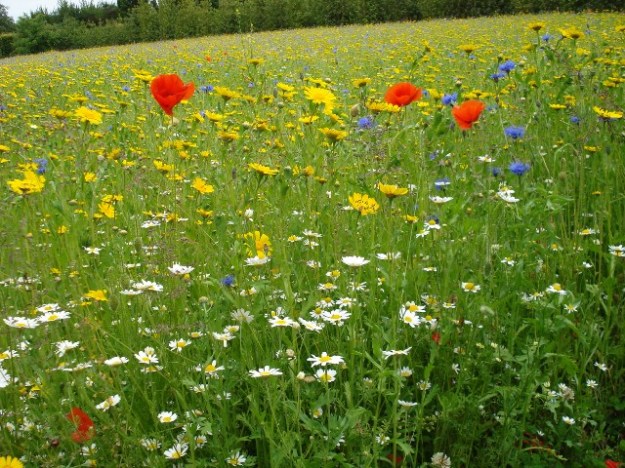
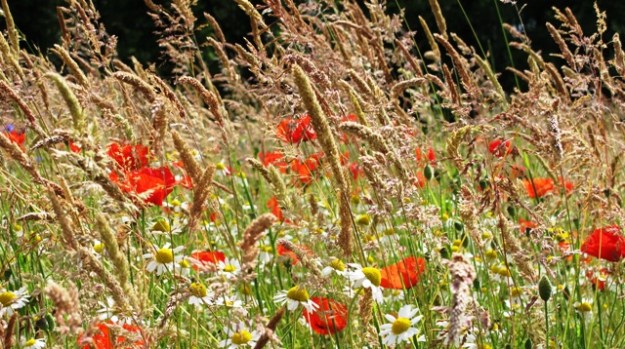
Still in its first season, this sown meadow features daisies, corn poppies and the naturally occurring Yorkshire fog

Still in its first season, this sown meadow features daisies, corn poppies and the naturally occurring Yorkshire fog

Meadow gardens sound so very romantic yet are not often seen in this country whereas they are de rigueur in Britain, to the extent that I make jokes that it is clearly the law to have one. But not all meadow gardens are the same by any manner of means.
???????????????????????????????wildflower-rain-affected
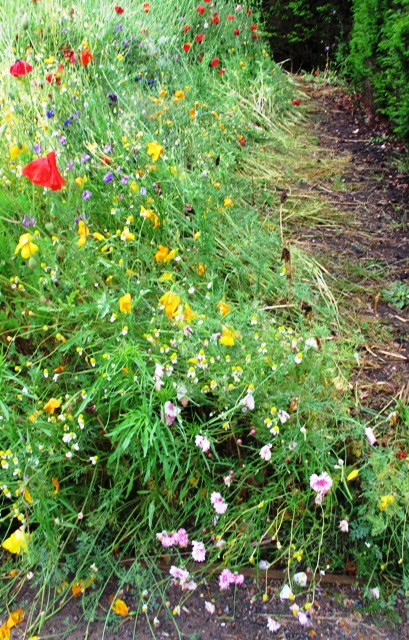
1) The field sown with wildflower mix is probably what is most commonly referred to as a meadow in this country. These of course are not our native wildflowers – far from it – but the reference is usually to the inclusion of varieties closest to the wild species and consequently smaller and simpler blooms than seen in garden hybrids. The problem in our climate is that favourable growing conditions can make for leggy plants that will be flattened by both heavy rain or wind. It was heavy rain that flattened this wildflower mix at Wisley.

Missouri Meadow June 2014

Missouri Meadow June 2014

As we saw it in June 2009

As we saw it in June 2009

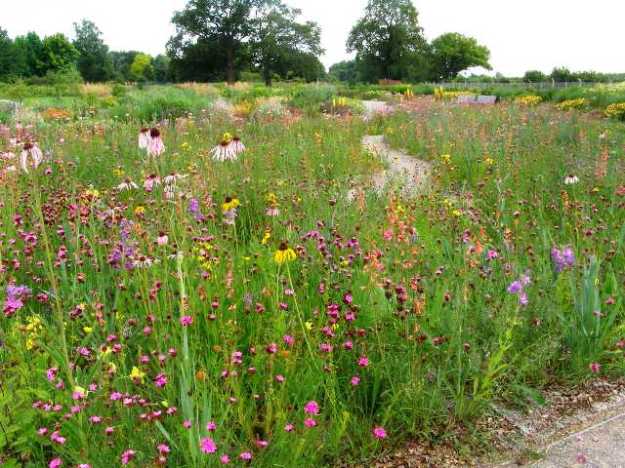
2) We were entranced in 2009 by the new Missouri meadow garden at Wisley, designed by Professor James Hitchmough from the University of Sheffield. This style is now often referred to as being of the Sheffield School of planting design with its focus on ecology and sustainability. Five years later, it has developed into a huge perennial bed and much of the original detail has gone. It is still most attractive and low maintenance but it has lost the meadow feel. I have not seen prairies but I doubt that it is a prairie reinterpretation either.

June 2014 at the Old Vicarage in Norfolk

June 2014 at the Old Vicarage in Norfolk

Same month, back in 2009

Same month, back in 2009

3) The wildflower meadow at the Old Vicarage Garden in Norfolk was delightful in its flowering simplicity in 2009. This is it at the same time of the year in 2014 although the flowering appeared to be delayed this year. The yellow corn marigold and grasses have swamped out most other plants. The owner told us he keeps trying to get the corn poppies re-established but without great success. Meadows evolve over time. To constantly spray off and resow in flowers, as sometimes recommended in New Zealand, does not give you a meadow. It gives you a garden of annuals.

Pensthorpe in the north of Norfolk

Pensthorpe in the north of Norfolk

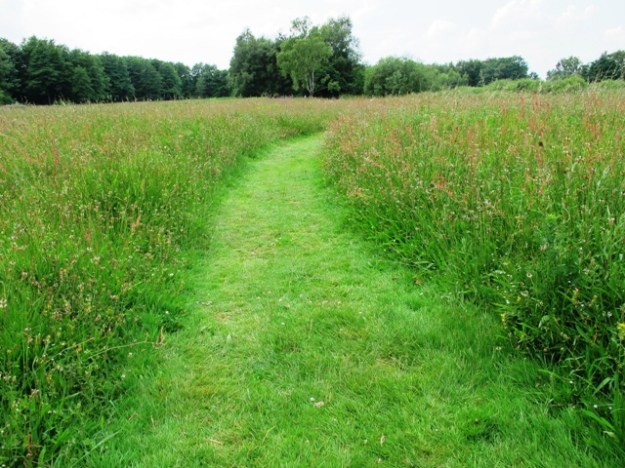
4) Maximum ecological brownie points are earned by those who have the patience to allow a natural meadow to develop with no over-sowing or management of plant content. What is present has arrived naturally and is allowed to stay. No sprays are used and no stock grazes the area. However, most meadows will be cut sometime in late August, left to lie for two weeks to allow seed to fall out and then the hay raked off, to prevent a build up of fertility.

Pettifers Garden near Stratford on Avon

Pettifers Garden near Stratford on Avon

5) Dry grass has charm. This is a bulb meadow being allowed to dry off naturally – quite possibly bluebells, daffodils and snowdrops in spring. Those are allium seed heads showing which are just passing over, heading into early summer. In our more fertile conditions with higher rainfall, we are more likely to get less attractive rank, wet, green growth heavily infested with what we call weeds. Maybe it is time to reconsider our classification and attitude to many such weeds.

yellow rattle (2)

6) Yellow rattle (Rhinanthus minor) is an integral part of English meadows. It is a parasitic plant that weakens grass growth and allows other plants to establish with reduced competition, increasing the diversity. Obviously we do not need this plant to escape into our farming pastures and I do not even know if it is in New Zealand. We have seen something similar growing wild on our road verge and will be having a closer look this summer. We think it may be a broomrape rather than a Rhinanthus.

First published in the Waikato Times and reprinted here with their permission.