Garden Lore

Sir Frank Crisp’s eccentricities were reflected in his garden. In 1905 Lady Ottoline Morrell visited Friar Park where she found Crisp, dressed in frock coat and top hat, proudly showing his visitors around the garden, which had ‘Sham Swiss mountains and passes decorated by china chamois’. Twenty-three thousand tons of rock were used in the construction of this garden which accommodated an extensive collection of alpine and other rock garden plants.

Alastair Forsyth Yesterday’s Gardens (1983)

graft incompatibility
Graft incompatibility

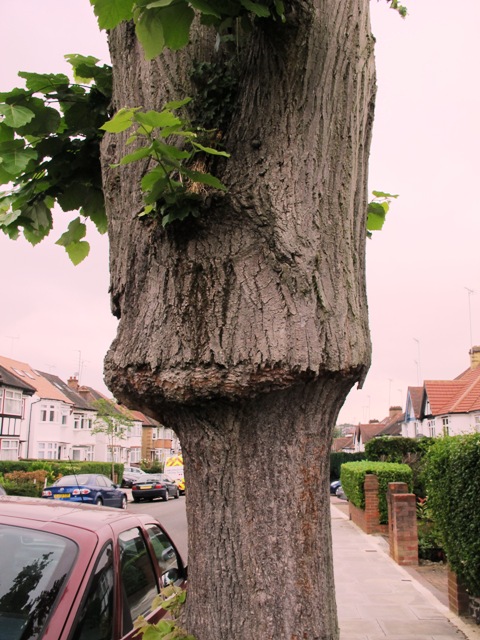
The odd growth on this tree is a fine example of what is called graft incompatibility. Many trees and some shrubs are grafted or budded – in other words the roots of a different cultivar are used to grow the desired top. There are many reasons to do this. Sometimes dwarfing stock is used to keep fruit trees – particularly apples and citrus – small enough for home gardens. Often a plant will have special characteristics – maybe variegated foliage, bigger flowers, weeping habit – but it cannot be raised true from seed and getting it to root from cuttings may be difficult, too slow or impossible. In that case, it is budded or grafted.

A closely related plant has to be used as root stock and as a customer you are reliant on the propagator or nursery knowing what root stocks to use. If they make a poor choice you can end up with this effect over time. It will be a weak point on the trunk. Where the top and bottom are fully compatible, it is hard to pick the join although it always pays to keep low growth removed in case it is the root stock coming away. It can out-compete the grafted top if left to its own devices.

This is a lime tree, or linden on a London street.

First published in the Waikato Times and reprinted here with their permission.

Plant Collector: Carpenteria californica

Carpenteria californica - but in Yorkshire, not Tikorangi

Carpenteria californica – but in Yorkshire, not Tikorangi

This is my photograph but not taken in our garden. We saw a number of carpenterias flowering in English summer gardens, none lovelier than this specimen in Yorkshire. We tried growing it here when Top Trees Nursery near Clive were selling plants in this country. Ours did not thrive and eventually gave up the ghost. It’s failure to thrive will in part have been that it hails from California and is better adapted to a Mediterranean climate – dry summers and cool, dry winters.

There is only one species of carpenteria, which is a large, evergreen shrub. However it is a relative to philadelphus which we do succeed in growing here. In the wild, it occurs in a very limited geographic area and is apparently endangered but it is so widely grown as a garden plant that its survival is guaranteed. Unlike philadelphus, there is no fragrance.

The common name is a tree anemone and those lovely big white blooms with golden stamens are indeed an anemone form.

First published in the Waikato Times and reprinted here with their permission.

All for show? Not necessarily

“Our Garden” by Andy Sturgeon – I wouldn’t mind this as my garden

“Our Garden” by Andy Sturgeon – I wouldn’t mind this as my garden

We have never been to the Chelsea Flower Show and have no particular desire to go. We went to the NZ equivalent, the Ellerslie Flower Show maybe three times, just to keep in touch. Maybe we are just too cynical about show gardens.

A six-way discussion on this topic recently illustrated the division. The four hands-on gardeners around the table felt there was little cross-over from show gardens whereas the two academics with a design focus (whom I do not think ever allowed dirt beneath their finger nails) argued that show gardens were trend setters. I guess the divide may be whether one thinks designers are more important than gardeners.

We were at the Royal Horticultural Society flagship garden, Wisley (near Guilford) for a couple of days and their installation of model gardens in the area they call “Witan Street” suddenly took on new meaning. These are show gardens, all measuring a uniform 9m x 6m, designed by members of the Society of Garden Designers and installed between 2004 and 2008. Where else are you going to see what show gardens look like up to ten years on, after being given only a moderate level of routine maintenance?

“I don’t think much of these,” sniffed a passing garden visitor, dismissing the whole lot in one sweep of the hand. On the contrary, we thought quite a lot about them. What these gardens showed is that good design lasts, fashion items don’t. A well designed show garden can mature gracefully and become a softer-edged back garden appropriate for a domestic setting.

Perspex panels, no thank you. Dated already, as fashion items do.

Perspex panels, no thank you. Dated already, as fashion items do.

Perspex panels were not a good long term option. The clear perspex example was a bit grungy and in need of a good clean. The coloured perspex panels no longer looked cutting-edge contemporary in style. They looked like outdated, tacky gimmickry.

The full length mirror also looked grubby and unappealing. We never liked this idea, even when it was promoted in this country. “Make your garden look larger and reflect light”, some suggested. Mirrors are best in bathrooms and bedrooms. They are a bit contrived in a garden setting, in my opinion. It appears they don’t age gracefully either. We felt further vindicated when an English gardener commented on how dangerous mirrors are for birds who can fly into them at speed. No garden mirrors here, thanks.
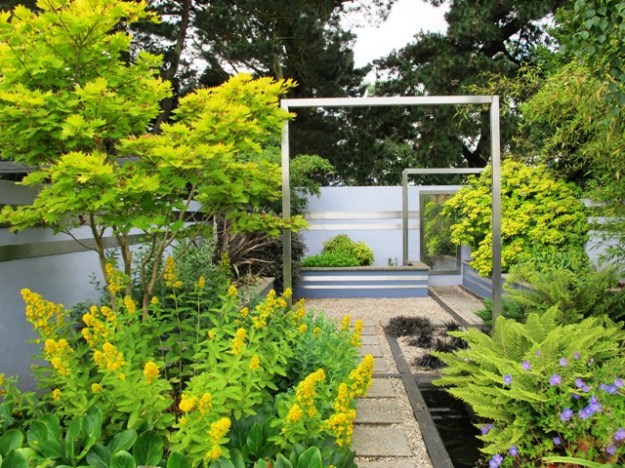
The blue and yellow colour scheme is very “of the day”. I am reserving judgement on the stainless steel

The blue and yellow colour scheme is very “of the day”. I am reserving judgement on the stainless steel

I am keeping an open mind on the use of stainless steel. It looked okay in Dizzy Shoemark’s “A Garden of Contrasts”. It did, but I would want to see it in another decade before deciding whether it is legitimate long term material or fashion item.

Flat planes of colour on boundary walls can date a garden quickly but are relatively easy to update – if you notice. The danger is that the aubergine, Mexican gold or solid blue that looks so sharp and edgy when first painted then stays on well past its use-by date, in danger of achieving floral carpet status over time. The owner can become so used to seeing it there, that he or she fails to register that it is now tired, faded and dated.
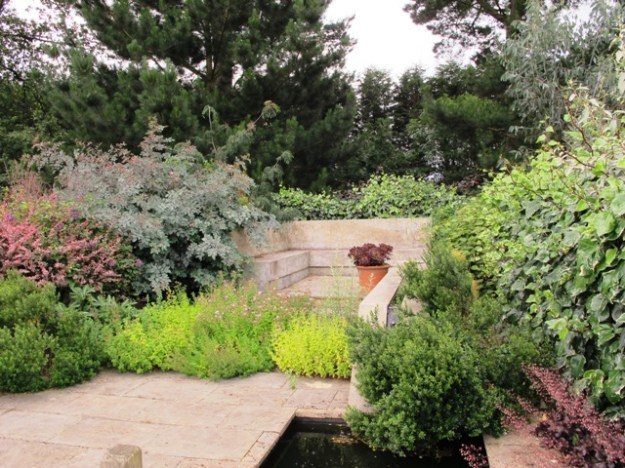
The Rill Garden. I am sure it would have had many scatter cushions in its original inception

The Rill Garden. I am sure it would have had many scatter cushions in its original inception

Each garden has an information board  in show garden style

Each garden has an information board in show garden style

I fear that the Rill Garden by Roger Webster showed too much bare concrete to achieve its aim of “a sensual and social space evocative of a warm climate”. But I would bet money that in its original concept, all that expanse of concrete benching was luxuriously encased in the many scatter cushions that featured in most show gardens of the day. Without said cushions, the seating looked cold, damp and very hard to the derriere.

Water is clearly problematic and much depends on design and installation. Some water features looked decidedly stagnant and unappealing whereas others were standing the test of time. Water is not low maintenance and you need to get it right – or live with the consequences of mosquitoes, in our climate at least.

I think the maturing block planting had achieved the status of being dull in ‘Intersection” where the designer states: “Blocks of yew and box reflect the geometric design of the garden and contrast with the more informal drifts and random planting that flows around the static elements.” I have seen it done better and the square blocks were not inviting as a back yard option.

But some of the gardens had mellowed out to charming effect. These gave lie to my dismissal of show gardens. Yes you can learn from them. They demonstrate trends and fashion and focus the mind on design. I just think they are a lot more interesting a few years later if given the chance to settle in, lose the hard-edged perfection and to actually grow.

First published in the Waikato Times and reprinted here with their permission.

Garden Lore

Don’t think I haven’t tried; I have fertilized my crops with a variety of stimulants. I have scattered Hitler’s speeches and most of DuPont’s most expensive chemicals over their stunted growths, but so far all I have to show for my trouble is a small bed of wild marijuana, a sprig of mint, and a dislocation of the trunk muscles that has an excellent change of developing into a full-blown rupture… I only hope that Uncle Sam isn’t relying too heavily on my Victory Crop to sustain the nation through the coming winter.

Groucho Marx, Groucho Marx and other Short Stories and Tall Tales (1993) edited by Robert S. Bader

green?
I have mentioned before the folly of thinking that painting something green will somehow make that object blend better into a predominantly green garden environment. I could not resist photographing this fine example of how wrong that green premise can be. It is at Wisley (the RHS garden) and there were many such ground items painted this garish aqua tone, presumably in an attempt to render them less visible. Charcoal, dear readers. I keep telling you to paint things charcoal if you want them to blend. Or leave them au naturel. Gently rusting metal would have looked less intrusive in this case. If you feel you must go green, at least pick a green from the yellow tones, not the blue toned column to avoid this look.

First published in the Waikato Times and reprinted here with their permission.
Pink & white parade

April is the cruellest month, wrote T.S. Eliot in his famous poem, The Waste Land. Not, I have to say, out of fear of late frosts in a northern hemisphere spring, as one gardening wit thought. Here, it is July that brings us the bleakest days of winter.

But as July progresses, it also heralds the start of a new gardening year. Magnolias and snowdrops mark the passing of winter into spring.

Magnolia campbellii

Magnolia campbellii

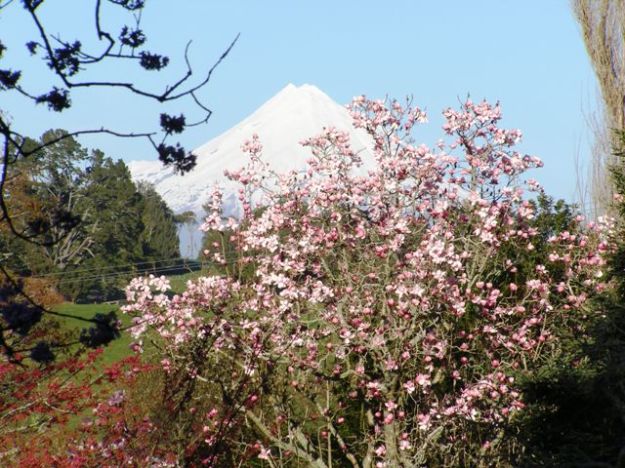
The first deciduous magnolia of the season to open is always M. campbellii. There is an attractive group of them in New Plymouth on Powderham Street and the first flowers on those appear in late June, sometimes before all the leaves have fallen. Asphalt and concrete in cities raise temperatures enough to trigger flowering earlier than in country areas. M. campbellii is not a great option in colder parts of the country because frosts can take the early blooms out but where space and climate allow, it is beautiful. Our tree was considerably larger until a falling Lombardy poplar took out half of it, but it is staging a comeback. There is a white form too, but the pink is generally regarded as superior.

Magnolia Vulcan

Magnolia Vulcan

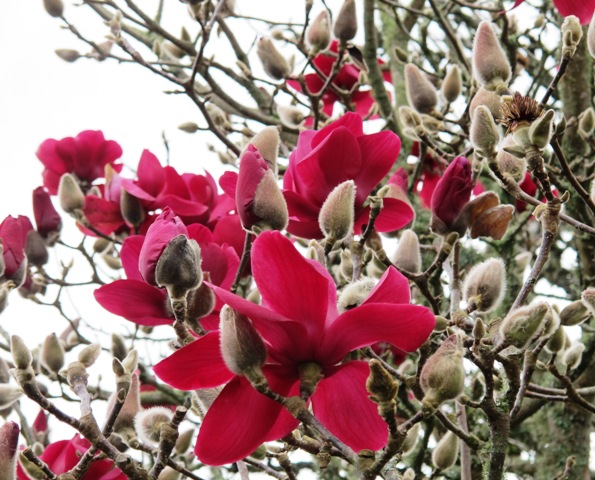
July also sees the first blooms opening on Magnolias ‘Lanarth’ and ‘Vulcan’. The latter was bred here by my late father in law, Felix Jury, and marked the first of the new generation red-toned magnolias. For several years after we first released it, we used to be able to track it flowering down the country by the phone enquiries. It opens in Northland much earlier than it shows colour in Otago and Southland.

Magnolia Lanarth

Magnolia Lanarth

Lanarth (technically M. campbellii var. mollicomata ‘Lanarth’) remains the best purple available, in our opinion, even though its flowering season is brief because it only sets flower buds on the tips and they all bloom at once, rather than in sequence down the stems. It is worth having in a large garden because it will take your breath away for two or three weeks in late July and early August but smaller gardens probably need trees with a longer season.

Galanthus  S. Arnott

Galanthus S. Arnott

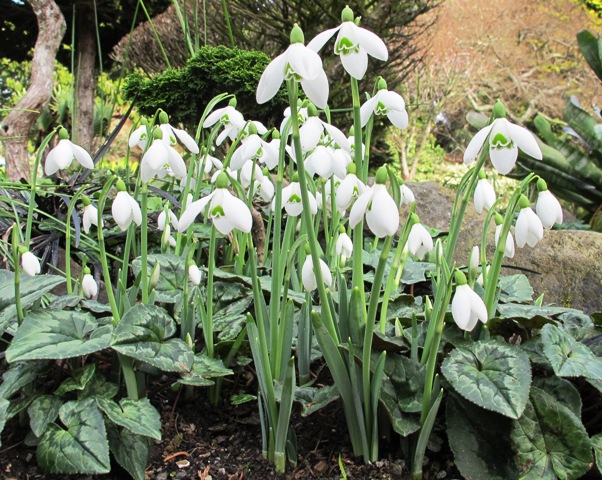
At the other end of the scale, we find snowdrops enchanting. We have tried growing a wide range of different species but in the end it is Galanthus nivalus ‘S. Arnott’ that is happiest here in the mid north, although we also get a good run from the larger leafed G. elwesii. Gardeners in cooler, southern areas will have a bigger selection to choose from but we have to go with what performs here.

Snowdrops are one of the few bulbs where the standard advice is to lift and divide in full growth – usually straight after flowering although there is no reason why you can’t do it when they are dormant. They multiply satisfyingly well and we are on a mission to spread these charmers in huge swathes throughout the garden.
???????????????????????????????
What northerners often call snowdrops are not. They are leucojums, commonly called snowflakes. Proper snowdrops are much smaller and prettier. They have a central cup surrounded by three longer petals that look like dainty wings. Leucojums, on the other hand, just have the cup as a bloom and are much stronger growing with plenty of foliage that looks like daffodil leaves. You often see them growing in paddocks around old farmhouses. Some of the bigger flowered selections make good garden plants (Leucojum vernum ‘Gravetye Giant’ is the one we use), because they have a much longer flowering season than galanthus. But they lack the dainty refinement of the proper snowdrop. There can be little doubt about that.

First publshed in the New Zealand Gardener July issue and reprinted here with their permission.