First published in the Royal Horticultural Society’s 2014 Journal of Rhododendrons, Camellias and Magnolias

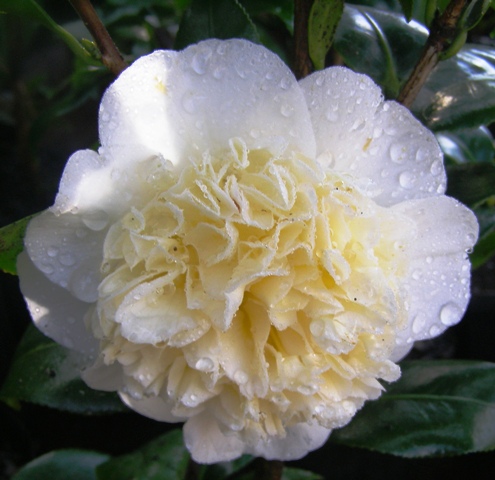
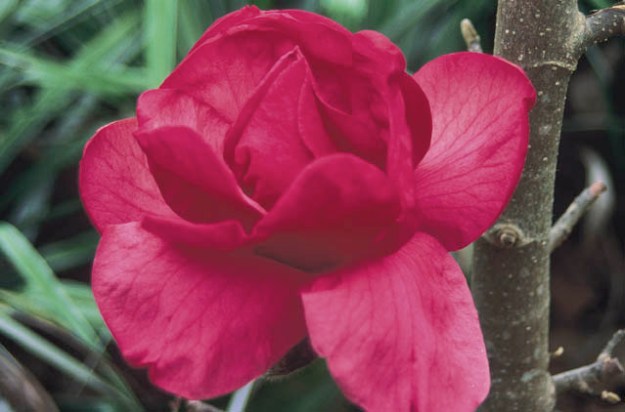
Camellia Water Lily (Felix Jury)
Long before the Jury name became associated with magnolias, there were the Jury camellias. There are rather a large number of these because there were actually two Jury brothers breeding them at the same time and a market which was very keen on new releases. These days we find that most of the Jury camellias are attributed to Felix when in fact the lion’s share was bred by his older brother, Les Jury. In his later years through to the 1980s, Les Jury had the greater reputation, partly because he entered an arrangement with the powerhouse nursery, Duncan and Davies, to distribute his material internationally. They took over the material from his breeding programme and continued to name and release cultivars well after his death.
By the time Mark Jury (Felix’s youngest son) showed an interest in 1980, Les Jury was elderly. He had little contact with Felix but was particularly encouraging to Mark, giving advice and making suggestions.
This made three Jurys on the quest for new camellias at the time of their heyday in New Zealand. In camellia terms, these were heady times. Only roses ranked higher in popularity, measured by sales volume. It was a rare garden in this country that lacked several camellia plants. This meant there was a substantial local market. In addition to that, there was considerable interest from overseas, particularly the USA, and both Les and Felix picked up awards. Camellia societies were very strong and both men were active at local and national level.
At the time when Les and Felix started breeding camellias, the range was dominated by large old varieties of Camellia japonica which grow so easily throughout New Zealand. Alas many of these don’t like the bright sun and the foliage can turn yellow. Worse is their failure to shed spent blooms so they are often covered in a mass of pink, red or white flowers interspersed with sludgy brown. Examples of these early japonicas can still be found, particularly on abandoned rural house sites where nothing survives but the house chimney and huge old specimen camellias.
Camellia Jury’s Yellow (Les Jury)
Nowadays, we wouldn’t even consider naming a camellia unless it was self grooming (the term used to describe dropping spent blooms) but it was a breakthrough fifty years ago. It was the extensive use of C. saluenensis that brought this characteristic to the fore. In addition to that, Les Jury liked large, showy flowers in abundance and was keen to extend the colour range. With the passage of time, he is probably best known for ‘Jury’s Yellow’. It isn’t a true yellow camellia but it came before the yellow species were even known to the west. Mark remembers him talking about his theory that he could get the stamens to bleed colour into surrounding petaloids and that is what he achieved in ‘Jury’s Yellow’ – a white camellia with pale yellow petaloids in the centre. Had Camellia ‘Sir Victor Davies’ been a better growing shrub (and given a more appealing name but it was labelled thus by Duncan and Davies management after Les’s death), he might have been similarly remembered for one of the early purple breakthroughs. I am particularly fond of his ‘Antique Charm’ which moves pink along the colour spectrum towards apricot. I should comment that Les gave this cultivar to Mark under the name of ‘Antique Rose’ but the Camellia Nomenclature only records ‘Antique Charm’. Alas there is nobody left to clarify whether they are one and the same.

Camellia Dream Boat (Felix Jury)
Felix Jury also looked for self grooming characteristics and large flowers and he had a love affair with the formal shape. His most enduring cultivars fall into that category – ‘Water Lily’ was an early selection and is still around but it was ‘Dream Boat’ that seemed to capture the imagination of the gardening public. The incurved petals of the latter give it a distinctive appearance. We rate his ‘Mimosa Jury’ as probably the most beautiful flower he named. It is a very pretty shell pink and shows good weather hardiness in our conditions. Added to that, it has a particularly long flowering season. Felix clearly liked it because it is named for his wife (although equally, it may have been she who laid claim to naming rights).
‘Rose Bouquet’ is another that has stood the test of time. It has an abundance of large blooms which are rose form and rose coloured. It has been described as the closest thing in appearance to an herbaceous peony that can be grown in our climate.
Camellia Itty Bit (Felix Jury)
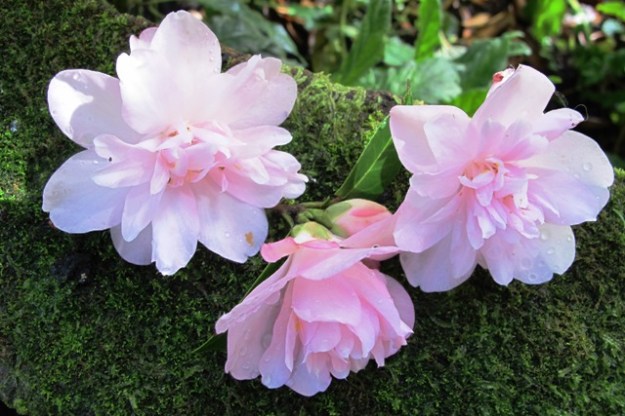
Arguably, ‘Itty Bit’ was the most significant breakthrough from Felix Jury. Most of the japonicas and the hybrids that Les and Felix named grew to be substantial plants. After a few decades, some of the original plants are sitting around the four, five or even six metre mark in our conditions. As town gardens shrank in size, the demand grew for smaller growing plants. ‘Itty Bit’ was a breakthrough – miniature flowered and miniature growing. It has never reached more than a metre to a metre and a half, though there are sister seedlings here that are substantially taller. This is less desirable in colder climates because this type of plant is just too slow to grow, but in this country, camellias that flowered profusely but stayed small and developed a natural bonsai form opened up new possibilities for use as garden plants.
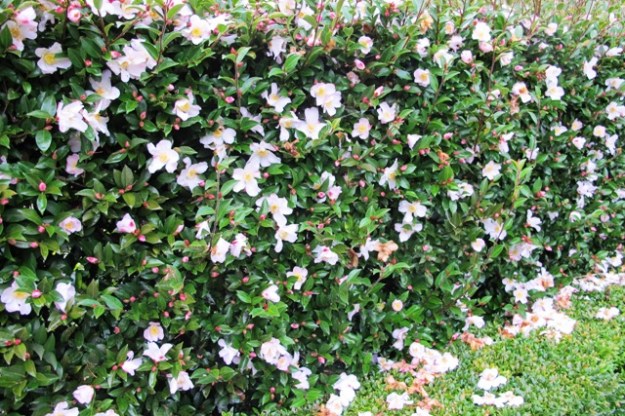
The plant world is as driven by fashion as any other sector. By the time Mark started breeding camellias, he was reading the signs that the market wanted an abundance of small flowers on smaller growing plants. The love affair with the japonica was waning and New Zealand gardeners were working out that many of miniature flowered varieties then available grew into huge plants. The first project Mark undertook was saturation coverage of an established C. pitardii in a nearby garden but he was also after scent. He was reasonably dismissive of his first selection – Camellia ‘Fairy Blush’. While he rated it as a pretty little flower with good scent, it was open pollinated, not a controlled cross. The seed came from C. lutchuensis and appears to be a cross with C. pitardii.
Camellia Fairy Blush (Mark Jury)
Even today, twenty years after we released it, we still regard ‘Fairy Blush’ as the one that got away from us. If we knew then what we know now, we would have applied for plant breeder’s rights. It is particularly galling when Australian nurserymen tell us how well they do out if it. The realisation that it shows no ill effects from petal blight is an added virtue. Being small leafed with red new growth, satisfyingly fragrant, and with an extraordinarily long flowering season of several months, ‘Fairy Blush’ has many positive attributes. We find it makes a particularly good hedge, clipped to about 120cm.
Camellia Volunteer (Mark Jury)
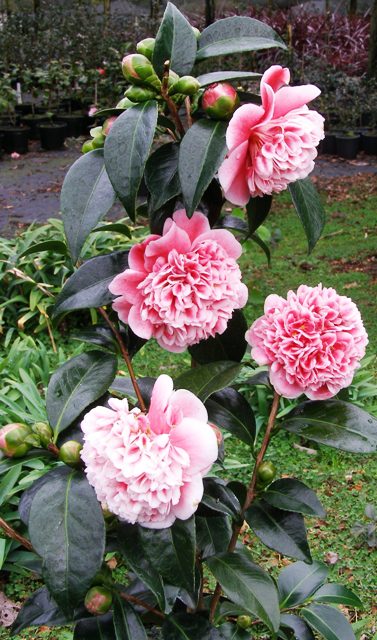
Ironically, the second most successful selection of Mark’s was another chance seedling. ‘Volunteer’, as he is wont to say, volunteered itself. It was amongst the root stock to be grafted when it first bloomed and it was clear that it was something different. The solid flower is a pretty white and pink bicolour at the start of the season, deepening to a white and red combination as the season progresses with late flowers having the same anemone form but in red with no white. It is clearly a japonica and was named for the United Nations International Year of Volunteering in 2001.
Of his controlled crosses, ‘Jury’s Pearl’ is probably the one that has pleased Mark the most. The cream to palest pink flower has an opalescent glow which lights up dark areas of the garden and the peony form means it is a pleasingly full flower.
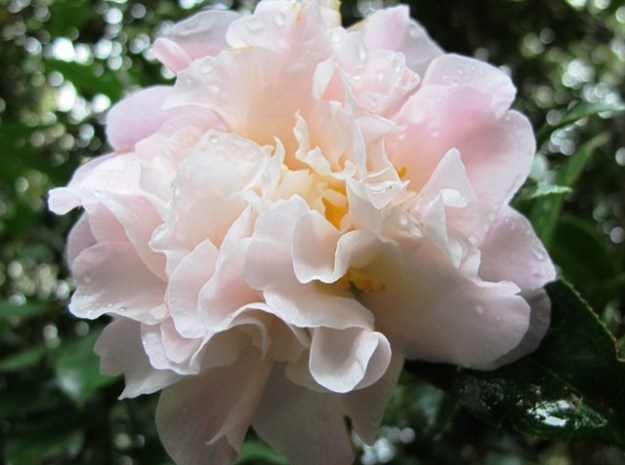
Camellia Jury’s Pearl (Mark Jury)
Mark was in full flight hybridising camellias and had named and released eight different cultivars (now ten with two recent additions) when the news came that petal blight had reached New Zealand. We both remember the day, about twenty years ago, when senior members of the local branch of the Camellia Society arrived unannounced to break the news. Mark understood instantly what it meant. He stopped working with camellias and turned his attention to michelias (now magnolias) instead.
It took a year or two for Ciborinia camelliae to arrive here at Tikorangi. We collectively held our breaths and hoped that it would only affect late season blooms but it has settled in to making its appearance at the end of May or the very beginning of June which is the start of the season for all but the sasanquas. The effect has been devastating and cut the floral display substantially. Controls are not practical. Petal blight is a fungal spore which appears to travel unimpeded at least 5km in the air. The camellia is such a ubiquitous plant in this country that even if we could clear our own property, we would get reinfected from the neighbours. It was apparent we had to learn to live with it. Alas the worst affected types are the large flowered, show blooms so valued by both Les and Felix Jury. To keep a good display on these types of camellias, we have to groom the plants. The sought after characteristic of self grooming doesn’t apply with petal blight. The flowers stay solid, turn mushy brown and hang on unless removed by hand. This type of grooming is not a problem if you only have one or two plants but we have hundreds. Camellias here are used as utility hedging plants (both clipped and casual), wind breaks, small trees, back of the border fillers, topiary, clipped feature plants both large and small – they are wonderfully versatile in our conditions and we have too many to groom.
Only now, after two decades of petal blight, is Mark turning his attention back to camellias. We have not found any evidence of camellia petal blight on any of our sasanquas. Red blooms carry the disfigurement better. But above all else, the stars are the miniature flowered types which set a mass of flower buds over a very long period but where each bloom is short lived. It is not that they are immune, though some show a level of resistance. It is just that the individual blooms fall before they are taken out by the blight so the floral display remain clean.
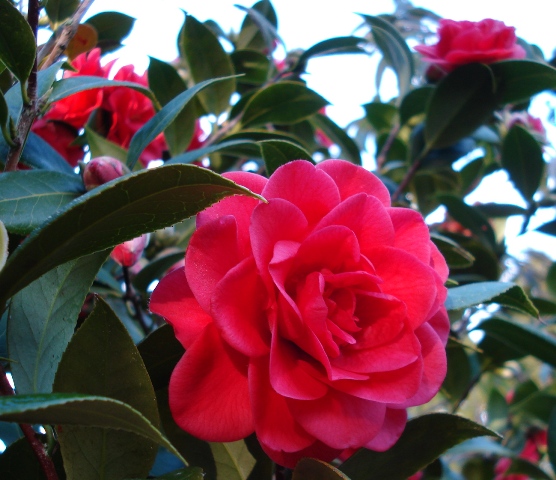
Camellia Roma Red (Mark Jury)
In fact ‘Fairy Blush’ probably remains the very best camellia performer we have in the garden. It may forever be the one that got away from us but it is also the marker by which we will measure the next generation of camellia hybrids bred for the post Ciborinia camelliae era. I recall the customer who asked: “You know how Fairy Blush flowers from April to September? Do you have one that flowers from October to March?”. “What? A camellia?” I replied. “Yes,” she said. Such a question ranks alongside those customers who, looking at a plant in flower, ask: “Does it come in any other colours?”
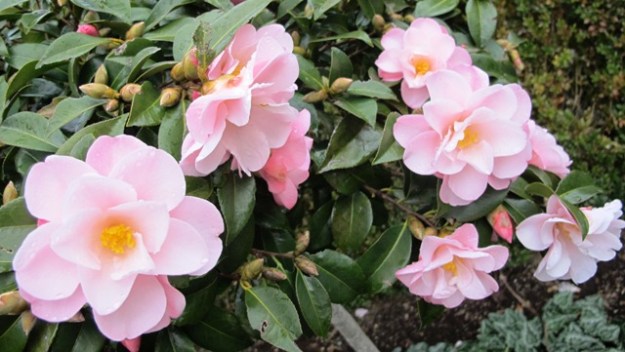
Camellia Pearly Cascade (Mark Jury)
Les Jury cultivars
As there are at least 71 registered cultivars attributed to Les (not including variegated sports), it seems excessive to list them all. Not all are significant and even fewer are still commercially available. Full details are available in the Camellia Nomenclature. A short list of his more popular cultivars would include ‘Anticipation’, ‘Avalanche’, ‘Ballet Queen’, ‘Debbie’, ‘Elegant Beauty’, ‘Jubilation’, ‘Jury’s Yellow’ and ‘Les Jury’.
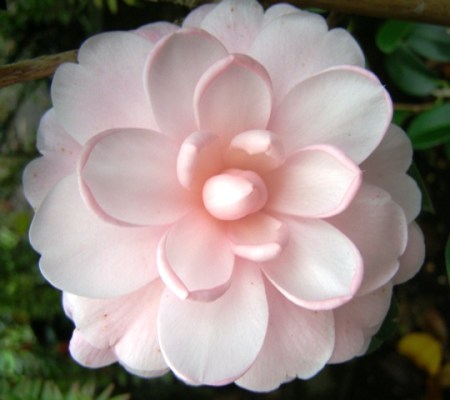
Camellia Mimosa Jury (Felix Jury)

Camellia Rose Bouquet (Felix Jury)
Felix Jury cultivars
Debbie’s Carnation (saluenensis x japonica ‘Debutante’)
Dream Boat (saluenensis x japonica ‘K.Sawada’)
Dresden China (saluenensis x japonica ‘Joshua E. Youtz’)
Itty Bit (saluenensis x Tiny Princess)
Julie Felix (saluenensis x japonica ‘Joshua E Youtz’)
Mimosa Jury (saluenensis x japonica ‘K Sawada’)
Pearly Shells (saluenensis x japonica ‘K Sawada’)
Red China (reticulata ‘Trewithen Pink” x reticulata ‘Cornelian’)
Rose Bouquet (saluenensis x japonica ‘Tiffany’)
Softly (saluenensis x japonica ‘Joshua E Youtz’)
South Seas (saluenensis x japonica ‘C M Wilson’
(Spencer’s Delight an early saluenensis x japonica hybrid never put into commerce, as far as we know)
(Tiny Bit An ‘Itty Bit’ sister seedling never put into commerce although the original remains a fine specimen by our back door)
Waterlily (saluenensis x japonica ‘K Sawada’)
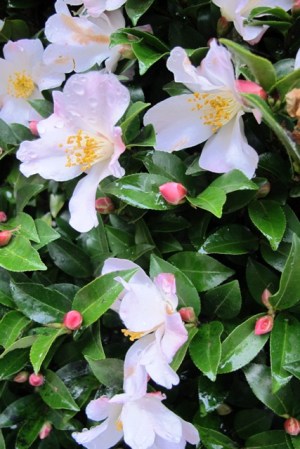
Camellia Fairy Blush (Mark Jury)
Mark Jury cultivars
Apple Blossom Sun (pitardii var pitardii open pollinated)
Cream Puff (pitardii x ‘Tiny Princess’)
Fairy Blush (lutchuensis open pollinated)
Gay Buttons (tinsie x ‘Snowdrop’)
Jury’s Pearl (pitardii x ‘Tomorrow’)
Moon Moth (C.pitardii var.pitardii x C.japonica ‘K. Sawada’)
Pearly Cascade (C. pitardii hybrid)
Purple Pompom (‘Fuyajo’ x ‘Zambo’)
Roma Red (tinsie x ‘Dream Boat’)
Topiary Pink (pitardii seedling)
Volunteer (japonica seedling)
-39.042098
174.300314


 Tikorangi The Jury Garden