

Even Magnolia Little Gem drops leaves
I like walking in city suburbia. This is not only because I live in the country so it has a certain novelty value. In our younger days, I dragged Mark southwards to live in Dunedin for three years and we would often walk for many kilometres through our surrounding suburbs. They are rich sources of ideas for both what to do and what not to do. With the right walking companion, they can also be a source of amusement and astonishment and occasional interesting encounters.
Mind you, nothing is likely to eclipse the time an elderly woman asked our help to get her equally elderly and very drunk husband up the path and into their bright strawberry pink house. As we obliged, she said, “I can’t help. I have no hands,” and held out both her arms. Indeed there were no hands at the end of the arms. On a grey Dunedin evening, it was like a scene from a Gothic horror. But I digress.
Being in the gardening and nursery scene, we are used to being asked for landscape advice. We very rarely give any, being aware of our own limitations. We are neither landscapers nor designers. For people with a small budget and no ideas who live in town, our advice has long been to take up walking. It is a case of getting your eye in and starting to analyse what is to your personal taste, style and circumstances. With just a little more experience, you will start to recognise the plants that are doing well and that you like the look of. Walking around your own suburb and then expanding outwards, you will see more useful ideas and good and bad examples than you will ever see in books, on line or even a garden festival.
Where the budget is tight – or non-existent – there is no substitute for upskilling yourself. If you have more money, you can pay someone to do it for you. Free advice is fraught. Retailers will give free advice that ranges from excellent to appalling but is usually predicated on selling you product. If you have a particularly good plant retailer whose advice you trust, then that is great. Odds on, however, if you have built up a good personal relationship with your plant retailer, it is because you have some experience and are not an absolute beginner. Going in cold to just any garden centre and expecting to get good landscape advice is a tad optimistic.
Mind you, as my perambulations around Mount Eden at the weekend showed, having a bigger budget does not guarantee success. I saw one of the worst examples of planting around an expensive new townhouse. I should have photographed it but I felt it was an imposition, given that it is somebody’s private home so you will just have to imagine it. Clearly the owners like greenery and I would guess had trotted down to a garden centre. Given the price on the labels left on the plants and the nature of what they bought, I could probably even name the retailer with a high degree of accuracy.
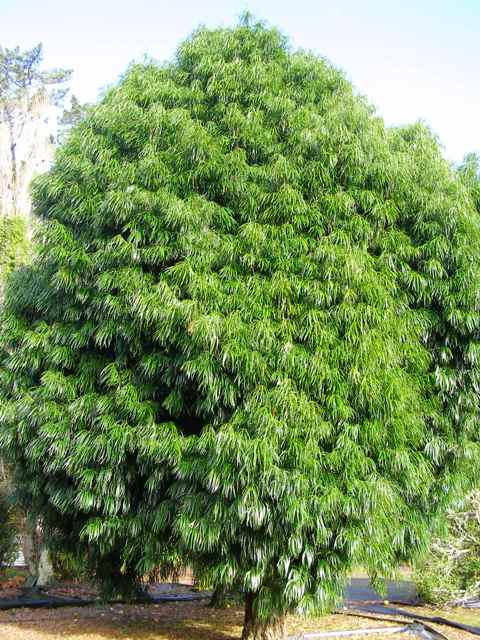
Alas, the Podocarpus henkelii I saw have no chance of ever reaching this stature
Picture a compound of expensive Auckland townhouses, each with a private courtyard not much larger in area than two average sized internal rooms – maybe 10 metres by 4 metres in total. The perimeter was planted with Podocarpus henkelii at 30cm spacings. I am very fond of P. henkelii which is a handsome, African podocarpus (totara). True, it is very slow growing and well suited to the climate in Auckland. But its beauty lies in its lovely shape and habit of growth. Our handsome specimen here measures at least 7 metres across and 8 metres high. I almost wept for those plants at 30cm spacings which are destined either for removal long before they reach anything near maturity or forever to be hacked into submission at 2 metres high by 50cm wide.
The owner of the neighbouring townhouse was most inclined to chat and proudly told my walking companion and me that he had paid $1.8 million for it. He was keen to plant his area and declared that he liked the existing specimen of Magnolia Little Gem in the corner of his courtyard but it was very messy because it dropped leaves. I did not point out that all plants drop leaves and that his tree was going to grow quite a lot larger than he anticipated. But as soon as he ascertained that I knew something about plants and gardening, he wanted to whip me in to his locked compound and pick my brains. I politely declined. You can afford to pay $1.8mill for your house, I thought, but you want free advice from a passing stranger? Pay a professional!
First published in the Waikato Times and reprinted here with their permission.
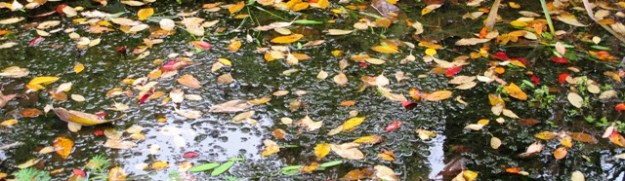 Autumn colour occurs when deciduous trees shut down the chlorophyll which is what makes most leaves green. It is chlorophyll which enables the plant to combine sunshine, water and carbon dioxide, making the simple sugars that sustain the plant (a process called photosynthesis). Once the green colouring disappears from the leaves, the other colours already in the leaf become obvious.
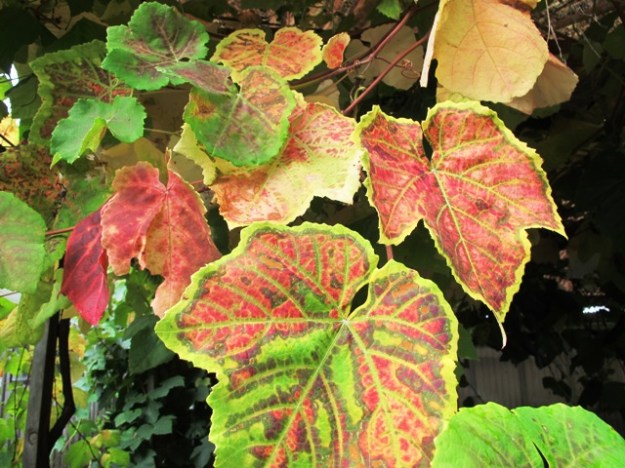 You can see in this grape leaf that the chlorophyll is still alive in parts, particularly the veins but other colours dominate in the body of the leaf. Not all grapes colour the same way. Our Albany Surprise grape becomes brilliant yellow, making it appear as if the sun is shining, even on a grey day.
 Some of our flowering cherries (prunus) turn yellow but this one is notable for its red colouring, caused apparently by anthocyanins which are what give the red and purple tones. Bright light in autumn helps the anthocyanins and bright sunlight is one thing we do well in most of this country.
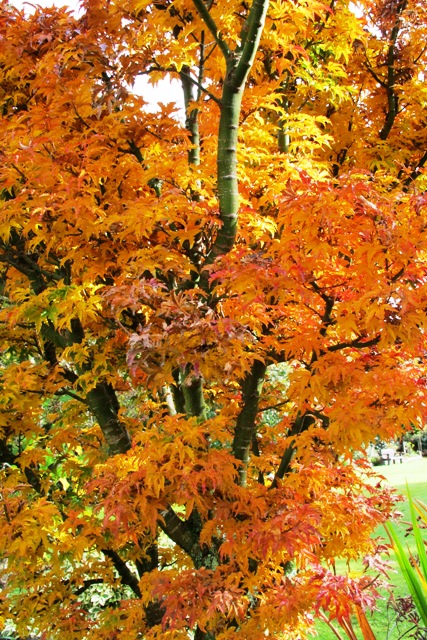 Maples, particularly the Japanese varieties, are one of the most reliable plants for autumn colour and the brilliant hues occur even in milder areas where some other plants will just skip the colouring step and turn brown. What is more, there are many petite maples (often sold as patio varieties) which will fit in even the smallest garden.
 We find the deciduous conifers colour well for us. This is a taxodium but the metasequoia and glyptostrobus are also good. However these are large trees, unsuitable for small urban sections. There are many smaller growing options like the koelreuteria or parrotia.
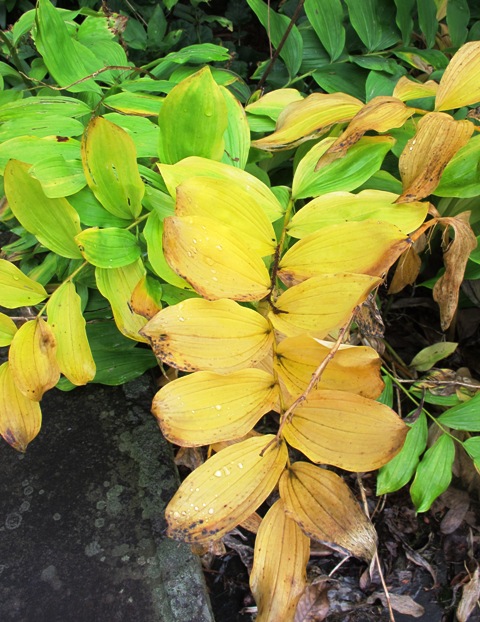 Just to prove it is not only the woody trees and shrubs that can flaunt their autumn raiment, Soloman Seal (Polygonatum multiflorum) grows from rhizomes below ground. A common enough plant which fills a role in semi shade conditions, it can startle with its golden foliage as it prepares to hibernate for winter.
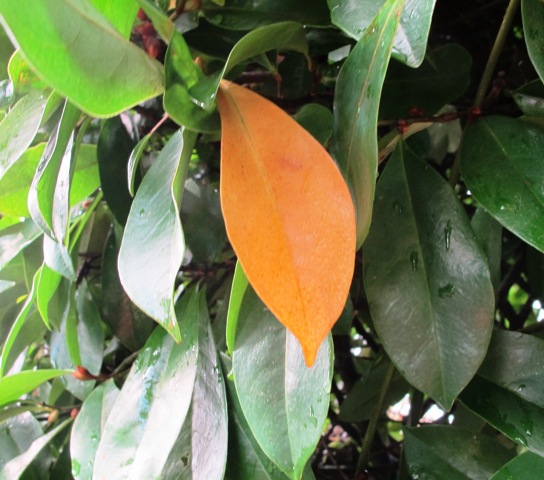 Many folk never consider that evergreen plants also drop leaves (do they think that foliage is permanently attached for the life of the plant?). All evergreens drop a full set of foliage every year. It is just that they don’t drop them all at once. However some plants, like this Fairy Magnolia Blush, have a tendency for some leaves to colour and then drop in autumn. It is not a bad sign, it is just part of the plant’s cycle.


 Tikorangi The Jury Garden