Oh my, but our petrochemical sites are getting very close together now. Some residents may be able to see two sites from their homes. One lucky family has sites close in on both their boundaries now.
 This is Kowhai C site as seen from Mangahewa E site. These sites belong to two different companies drilling right on their boundary which happens to cut through Tikorangi.
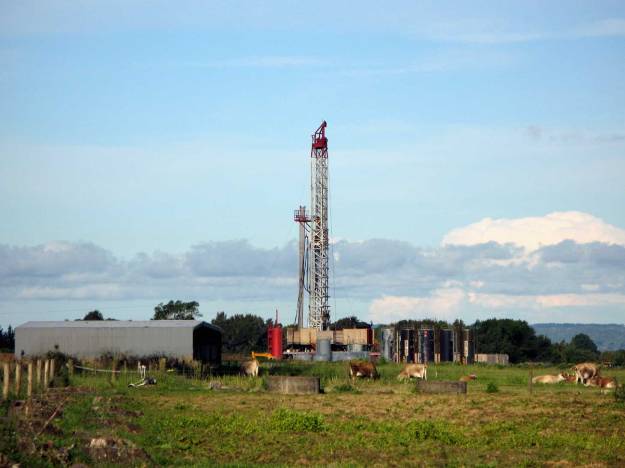 Here we have Kowhai C site – the one this community said it didn’t want but got anyway. This photo was taken 150 metres to the side of Kowhai B site in order to get a clear view. Both sites belong to the same company – Greymouth Petroleum. Kowhai B is consented for 8 wells. Only one has been drilled so far. Close by, so very close that one wonders why the company needed a second site, Kowhai C is consented for 4 wells.
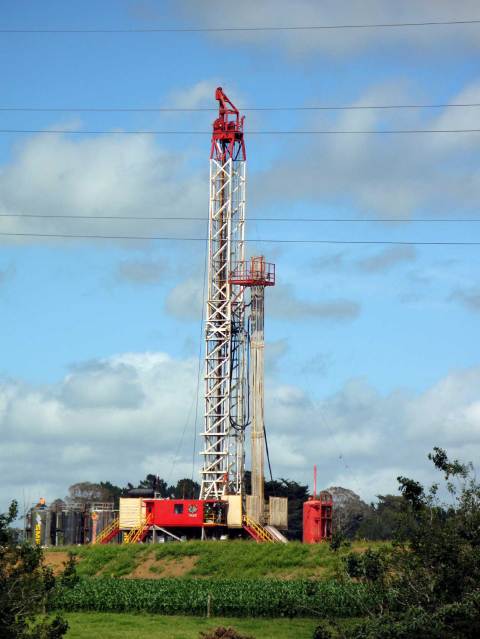 Kowhai C again, this time from Otaraoa Road. It is one of about 10 well sites Greymouth Petroleum has in Tikorangi. I know of 9 that have been consented – I am not sure of the current status of Urenui A (which is not in Urenui but is in Tikorangi).
 This photo taken about August last year – the rig has now gone but it was on Mangahewa C, as photographed from Kowhai C. It is like a quadrilateral of sites, already. These two belong to separate companies again.
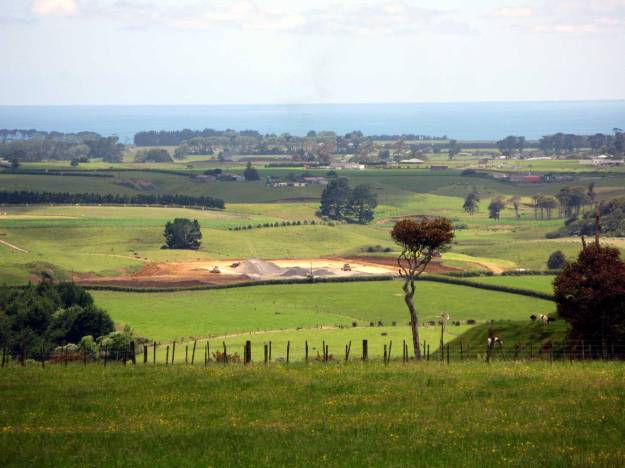 Mangahewa E site from Stockman Road (near Mangahewa C site). These two Mangahewa sites are Todd Energy’s but, to be fair, it should be pointed out that Mangahewa C site has 8 wells drilled on it so is at capacity on its current consent.
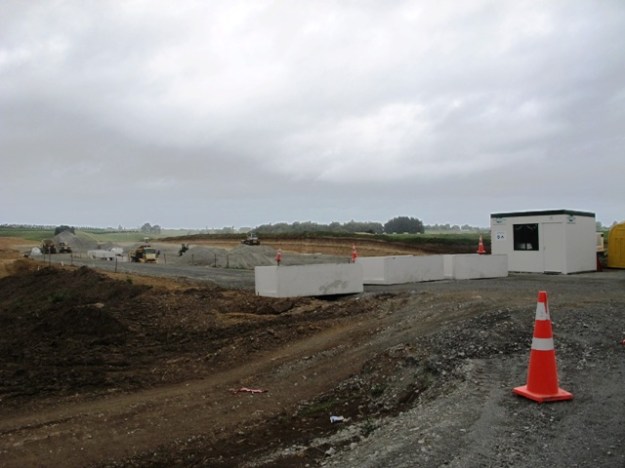 Work progresses on the new Mangahewa E site.
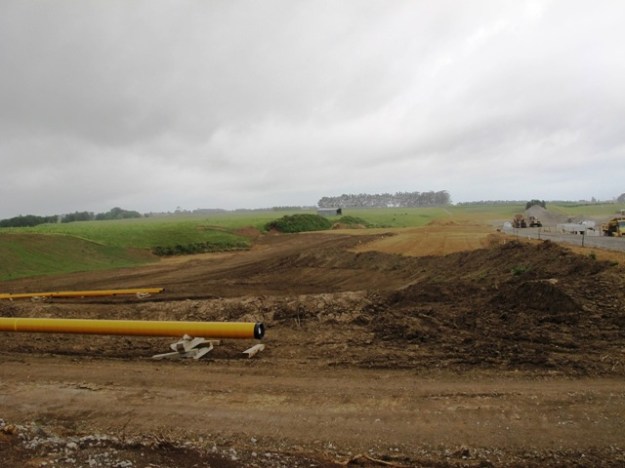 Mangahewa E site again. It is often stated that this petrochemical development (still called “exploration” but they are long past exploration in Tikorangi where it is decades since a dry well was drilled) is “temporary”. Does this look temporary? How can these developments be temporary when the majority of consents are open ended with no expiry date? Only the most recent three sites have a time limit on the consents – 15, 20 and 30 years. In whose books is this “temporary”?
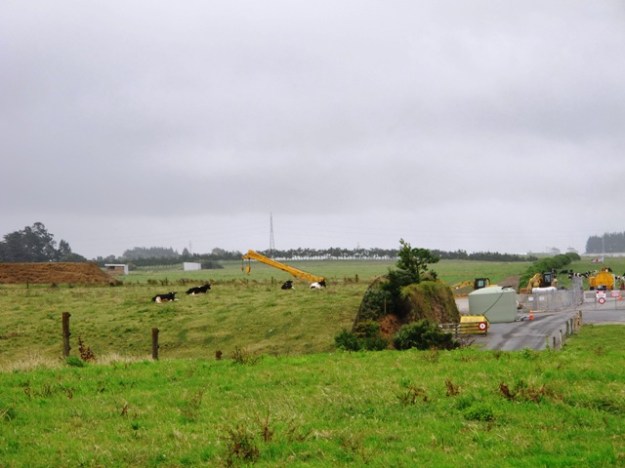 And work progresses on extensions at Turangi A site. These are the other company’s sites (Greymouth Petroleum).
 But wait, there are more. Turangi C site is, according to the company (Greymouth Petroleum) “about” 850 metres from Turangi A site. It can’t be any more than that from Turangi B site, in that case, because it is pretty much set back between the two. Neither Turangi A nor Turangi B have been drilled to capacity. So why does the company need a third site and could they not have deviation drilled from one of the other two sites? Who knows? Only the company and neither New Plymouth District Council nor Taranaki Regional Council seem inclined to ask them why. It looks mighty like speculative consenting to some of us – described by the company rep to me as “future proofing”. Right-o then. That is future proofing the company, not Tikorangi.
Turangi C site broke new territory, even for Tikorangi. The farmer who owns the land from where the photograph was taken was not even told of the site. His farm manager discovered it when site works started. It is consented to go right on the boundary – the bunding will presumably come up to the fence. This is a whole new precedent – getting a heavy industrial site on the boundary and nobody even bothering to tell you. Apparently the company didn’t think it was necessary, neither did the two councils, not even the land owners who let the company in told their neighbour. Only in Taranaki, surely, could this happen.
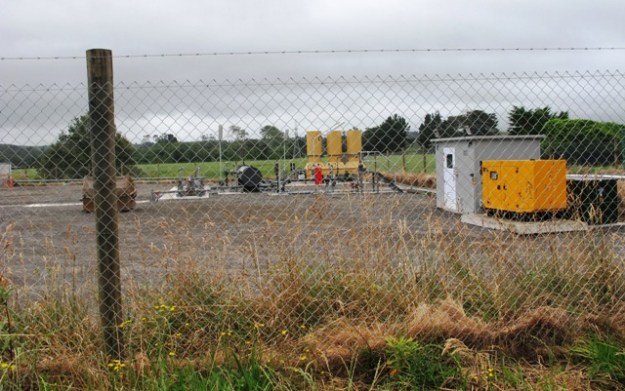 And Kowhai B site with one hole drilled, as viewed from the neighbour’s property. It doesn’t look “temporary” and it was anything but silent on the day I took this photo. It has a significant impact on the neighbour’s adjoining paddock and could well affect his future property options but he was never deemed an “affected party”. I think, to the right of centre at the front of the photo, that is an example of the screen planting done by the company. It’ll be quite a few years before anything is screened by that sort of planting.
Still New Plymouth District Council faffs around with no evidence of any sense of urgency. Despite being responsible for the conditions in the District Plan that have allowed this situation in Tikorangi, they fiddly faddle around the edges, failing to get to grips with planning and management of petrochemical development
Columnist, Dion Tuuta, wrote in our local paper this morning:
“By ignoring the wishes of the iwi, hapu and wider community involved, the company is indicating that it values profit above all else – including its long-term relationship with members of the tribal group in whose area they are likely to be spending a significant amount of time and resources.”
He was referring to Tag Oil’s determination to drill on a sensitive site a mere 220 metres from the Egmont National Park on the flanks of our maunga, Mount Taranaki. His comments are just as applicable to Greymouth Petroleum in Tikorangi. With bells on. In determinedly pursuing the Kowhai C site, against the wishes of the vast majority of the local community, they deliberately ignored all local opinion, just as they wilfully ignored Otaraua Hapu who claim that area as part of their territory. Profit is to come above all else for some of these companies. It is a bitter legacy they are creating. Both those companies might do better to look to the strategies adopted by Todd Energy which places a very high priority on building community relationships and working with the local residents.
-39.042098
174.300314


 Tikorangi The Jury Garden