Garden Lore Friday Jan 31 ,2013

“By the time you have grown two thousand species you could believe that you had exhausted Nature’s imaginative variability; by the time you have grown five thousand you realise you never will.”
Geoffrey Charlesworth, The Opinionated Gardener (1988)
OLYMPUS DIGITAL CAMERA
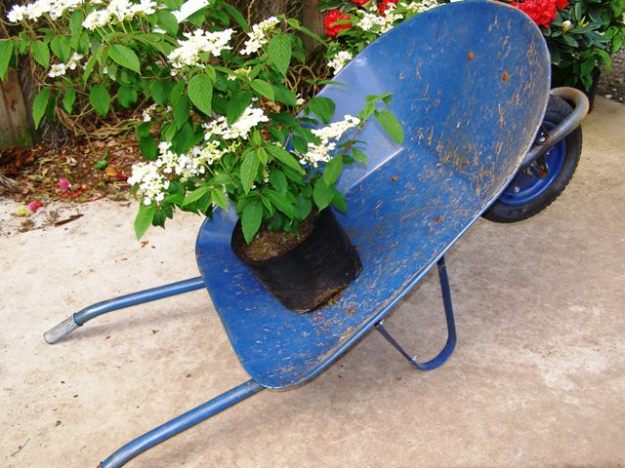
Garden Lore: wheelbarrows
Quite possibly, you may not have pondered the origins of the wheelbarrow but when you think about it, it is a design of some genius – a single wheeled cart with great manoeuvrability which enables the pusher to move pretty heavy loads and to tip them out easily. Its origins go back in the mists of time. Chinese history often attributes its invention to Chuko Liang around AD 200, when records show it being used to transport military equipment and supplies. There is some evidence that it dates back even earlier and there is a school of thought that it may even go back as far as Ancient Greece around BC 400. It did not come into wide use in Europe until the Middle Ages but when it did, it must have made life a lot easier.

The position of the wheel varied from the middle to the front throughout history but has now settled on the latter. The whole principle of the single wheeled barrow is the even distribution of weight. After 2000 years, you would think we could get this right every time but that is far from true. There are too many barrows – particularly at the cheaper end of the market – which will tip over easily unless you load them perfectly, starting from their centre point of balance. If you are buying a new barrow, try placing something a little weighty right at the back and then at the side. A well designed barrow won’t tip.

First published in the Waikato Times and reprinted here with their permission.

January bulbs for mid summer

Regular readers will know that we are very keen on bulbs here. As I surveyed the January ones, I figured that most bulbs are stars on their day. I guess because they are both seasonal and transient, they have to wow in their short time in the spotlight. A bulb in bloom can make you look in admiration, despite even the most unattractive location. We would not be without them.

The prized worsleya

The prized worsleya

Indubitably, the star this week is the unusual Empress of Brazil (Worsleya procera syn. rayneri) which does indeed hail from Brazil. It is an exotic showstopper. But the reason it is hardly ever seen is because it is rare in cultivation and requires a patient gardener. This particular specimen took 13 years from planting to bloom. There aren’t many gardeners willing to wait over a decade for a flower.

Scadoxus multiflorus ssp katherinae

Scadoxus multiflorus ssp katherinae

The Scadoxus multiflorus ssp katherinae are also big and showy but much easier to source, being very popular with Auckland landscapers. We have reached the point where they seed down and are naturalising themselves beneath trees where they have become a real feature in the summer shade garden. Some of those blooms are getting close to the size of human heads. We have South Africa and Zimbabwe to thank for these beauties.

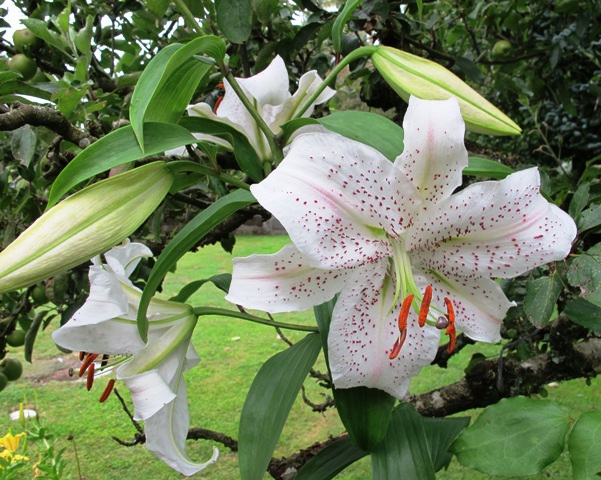
Auratum lilies

Auratum lilies

In sunnier spots and on the margins, it is the lilies that astound. I wrote about the aurelians two weeks ago but it is now the time for the auratums (sometimes known as the golden-rayed lily of Japan). These can be sourced from garden centres in winter. Just make sure you never let the bulbs dry out, even when they appear dormant. If you give them lots of TLC for the first few years, you can increase numbers from the small offshoots as well as raising seed.

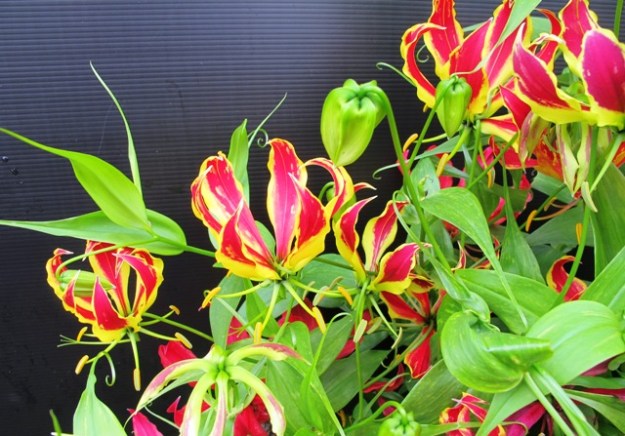
Gloriosa superba

Gloriosa superba

Gloriosa superba are often called climbing lilies, though they are only distant relatives at best. These are great plants for hot, dry conditions – the sort of spot many of us have under house eaves facing north. They flower for a long time in high summer and require absolutely no care at all beyond giving them something to cling to so they can climb rather than tumble.

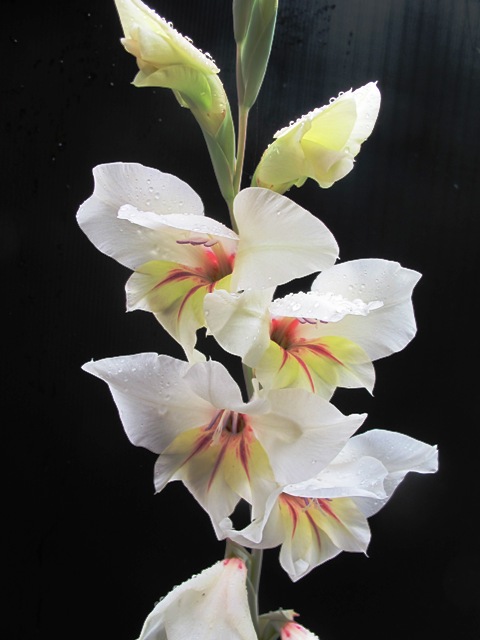
Gladiolus

Gladiolus

Gladioli! Dahlias! We often take both families for granted but summer gardens would be poorer for their absence. We don’t have many of the Dame Edna hybrid gladdies. While there is a certain charm in their exuberant vulgarity, we are less enamoured of the rust that afflicts the foliage, making them unattractive plants. This white gladiolus is not a species, as far as we know, but it is somewhat further back up the breeding chain from the modern hybrids. Dahlias I tend to lump in with perennials though technically they are tubers, so within the bulb group.

Crinum moorei

Crinum moorei

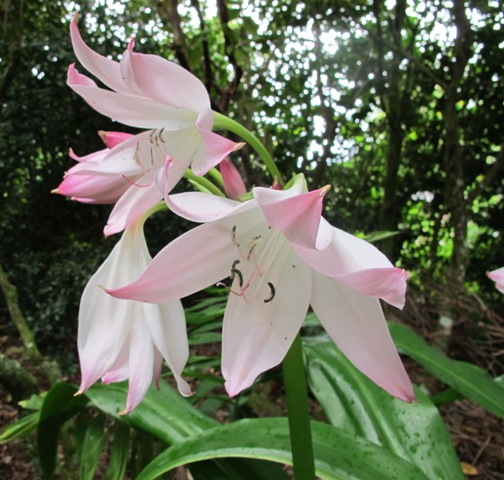
The crinums are coming into flower and C. moorei is another shade garden option though it needs to be in a position where its rather large foliage can be ignored during the times when it is scruffy. These plants stand chest height, the fragrant flowers close to nose level so there is nothing small and dainty about them.

Add in the crocosmia featured last week, the tigridias in Plant Collector today, summer flowering ornithogalum, the yellow zephyranthes (‘rain lilies’), even the early Cyclamen hederafolium coming into flower. While January is not in any way peak bulb season, those in bloom add a great deal to the summer garden.

First published in the Waikato Times and reprinted here with their permission.

Plant Collector: Tigridia pavonia

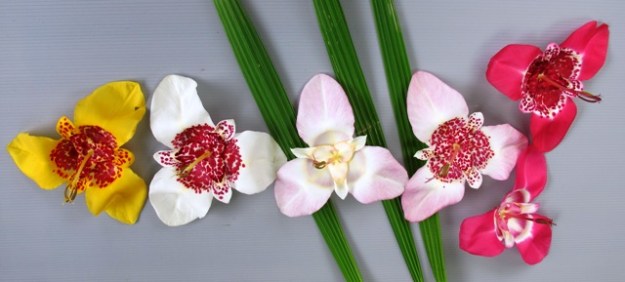
Tigridia pavonia - missing the scarlet red one we have which had no flowers open on the day

Tigridia pavonia – missing the scarlet red one we have which had no flowers open on the day

There is nothing rare, choice or difficult about these bulbs which can border on garden weeds, they are so easy. But in the right situation, they are a delight in the summer melee. Tigridias are from southern Mexico but probably on the road to naturalising anywhere hospitable. They set prodigious amounts of seed and can reach flowering size from seed in two years. Their common name is jockey caps and they belong to Iridaceae (iris) family. The flowers are relatively large – up to 15cm across – with 3 large outer petals and 3 inner small ones, but short-lived. Each bloom only lasts one day, opening in the morning and wilting away to oblivion by evening. However, each stem produces multiple blooms in succession. The pleated leaves are attractive in themselves and both flower and foliage sit around 60cm high. In case you are worried about weed potential, be reassured that they are easy to pull out if they pop up in the wrong place and you can control them by removing seed pods.

Tigridias want full sun and good drainage but also some summer rain when in growth. We find they combine well with larger growing summer plants like dahlias and lychnis in less formal areas of the garden.

Mark’s very late Uncle Les (he who bred such camellia classics as Jury’s Yellow, Anticipation and Debbie) spent some time trying to breed the freckles out of tigridias which always seemed a rather odd track to take, though the freckle-less blooms perhaps have a finer charm of some sort.

First published in the Waikato Times and reprinted here with their permission.

Garden Lore

“It is a greater act of faith to plant a bulb than to plant a tree.”

Clare Leighton, Four Hedges (1935)

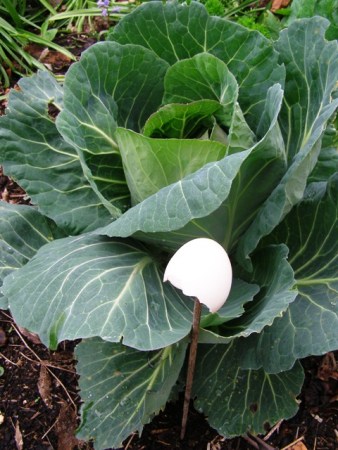
Do we really believe that cabbage whites have large enough brains to be duped?

Do we really believe that cabbage whites have large enough brains to be duped?

Garden Lore: Cabbage whites and brassicas
Brassicas are like ambrosia to the cabbage white butterfly. Or maybe heroin. For this reason, we prefer not to grow brassicas during the summer months when the cabbage whites are at their most active. I am a reluctant consumer of cabbage, broccoli and cauliflower at the best of times. The latter two are passable in a winter soup flavoured with cheese (blue cheese is the classic, but any cheese helps). However, many of the increasingly popular Chinese greens also belong to the brassica family, and these are acceptable to me at any time of the year.

You can net the vegetables, but the netting needs to be raised clear so that the winged parent cannot land and lay eggs through the netting. If you want to spray, talk to your local garden centre about BT (which is a bacterial based treatment) or pyrethrum-based options. Pyrethrum is the active ingredient in flyspray and was originally extracted from a daisy. These days it is more likely to be synthetic but it remains a pretty safe control. Vigilant digital control (squashing with the fingers on a daily basis) can work in the early stages. We think it is a myth that egg shells on sticks will confuse the butterfly and they will fly away. White butterflies show no territorial instincts at all, that we have ever seen.

If you don’t like added protein to your cooked vegetables (while Mark does not mind the odd cooked caterpillar, most people find them very offputting), you can sprinkle lots of salt over the florets or leaves as you prepare them, then cover them with cold water for a few minutes while the caterpillars die. Rinse them thoroughly, inspect closely and cook with no added salt.

First published in the Waikato Times and reprinted here with their permission.

Climbing and clambering clematis

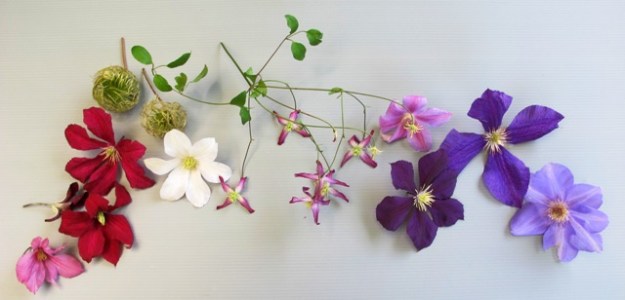
A selection of clematis which are still flowering in the garden, including two of the decorative seed heads

A selection of clematis which are still flowering in the garden, including two of the decorative seed heads

Clematis. I have not written about clematis before. This is in part that there is clematis specialist living around the corner from us and my technical knowledge on the genus is so sparse that I am worried about betraying my ignorance. I am terrified he will come and set me right. But they are such a lovely addition to the summer garden.

When I looked up clematis, I didn’t feel quite so bad about my botanical ignorance. It is a huge family with hundreds of different species (somewhere between two and three hundred or even more). Add to that the thousands of different hybrids that have been named. While ignorance may not be bliss, it is at least understandable in the face of such complexity. At least I found out that they are buttercup relatives – members of the Ranunculaceae family.

There are clematis and there are clematis. Some are altogether too vigorous. Who can forget “old man’s beard must go” on the telly? Clematis vitalba is such a strong grower that it threatens our native forest and can kill established trees. It is one garden escape that cost this country dearly. C. vitalba is not alone in its strangling and invasive personal habits but one hopes that somebody will have made those decisions long before you look at a pretty plant in the garden centre.

Clematis are equally notorious for karking it when planted out. That magnificent specimen in a pot with a frame covered in flowers can disappear before your very eyes when transferred to the garden. The problem is usually “clematis wilt”, reportedly a fungal affliction. If you spot it, cut back to healthy leaves, or even to the base of the plant if the whole thing is affected. Remove the diseased sections, cross your fingers and wait. Often, the plant will shoot again but it can take a while and the clematis roots can survive a year or longer without shoots above ground.

These are the only plants I know where the advice is to plant deeper in the ground than in the pot – around 8cm deeper is good. This is largely protection against the dreaded wilt, as far as I can see, so follow the advice. Like most climbers, they prefer their roots in cool, humus rich soil with adequate moisture levels but their heads in the sun. This is not always that easy to find, especially as you have to combine it with something for them to climb up. Once away, they can get purchase and twine onto surfaces that are not smooth – their instinct is to reach for the sun so most will climb if possible.
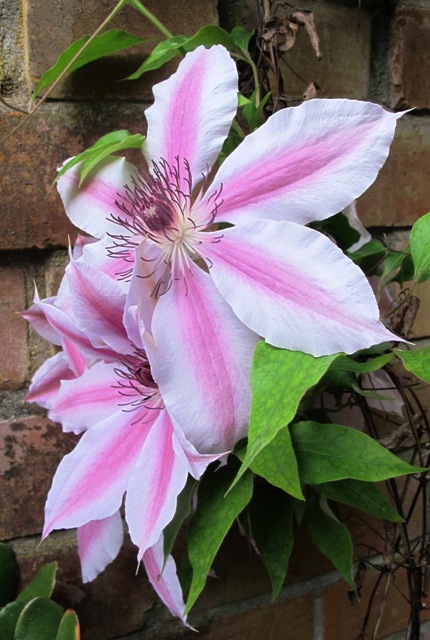
What we have as the tried and true "Nellie Moser" although it may be a seedling rather than the real thing

What we have as the tried and true “Nellie Moser” although it may be a seedling rather than the real thing

As garden plants, I favour the hybrids and the viticella types. We have a fair number twining their way through shrubs in mixed borders and they never fail to delight when they flower. You need to make sure that you don’t have overly rampant varieties when they are expected to co-exist with other plants. I took out what I think were texensis types – given to me as ground cover but distinctly shy on flowering, bell-shaped which I was not so keen on, and given to choking habits. I did not think they justified their position but there may be better texensis varieties available.

We have several growing under cover. Everybody admires “Niobe” in bloom. She has large flowers in deep burgundy but she proved damn difficult in the garden and it has taken several attempts over a fair number of years before we had a plant performing well, scrambling through evergreen azaleas. Planted in the ground but under cover with just some rain run-off to keep the roots moist, she has been much more reliable.

At the opposite end of the scale, the lovely, late-flowering yellow C. tangutica threatened a takeover bid in the garden but when relocated to a trellis under cover, behaved perfectly in comparative isolation.
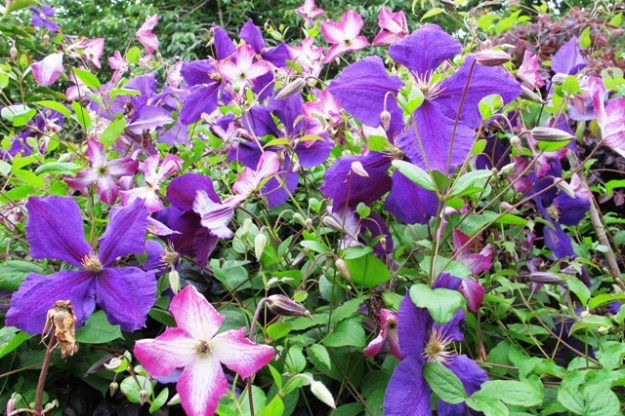
Two named varieties. I just don't have the names any more.

Two named varieties. I just don’t have the names any more.

Often they can be combined with other climbers to extend flowering interest. We have clematis planted successfully with wisteria, Trachelospermum jasminoides and schizophragma. The latter two plants, for those who struggle with plant names, are a garden-friendly jasmine-type plant and a variation on the climbing hydrangea.

If you cut back most of the hybrids to just above ground level after flowering, feed and water them, you can encourage a second coming about six weeks later. Now is the right time to try this if you have some that have, as we say, ‘passed over’. However, it won’t work with the early spring flowering Clematis montanas. We don’t have C. montana any longer (it is a bit rampant for the garden, being better at covering old water tanks or sheds. It is once flowering only and needs different pruning treatment, if any. Most of the others I cut back to maybe 30cm above ground in winter and they are fine. Once established, they are easy and reliable and bring delight in spring and summer.

We have some lovely native clematis in this country but they are a story in their own right for another time.
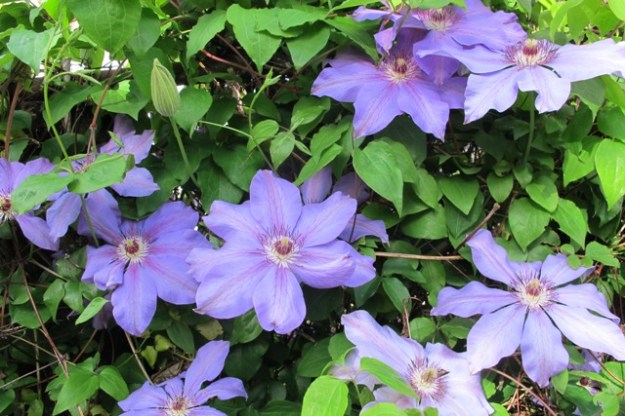
An unnamed blue seedling that has settled down happily in a mixed border

An unnamed blue seedling that has settled down happily in a mixed border

If you want to know more about different types of clematis or maybe even buy mail order, my neighbour is http://www.mrclematis.co.nz/ (email: yaku@xtra.co.nz). He produces a phenomenal range and has a passion and knowledge for the genus way beyond mine.

First published in the Waikato Times and reprinted here with their permission.