Plant Collector: Rosa Mme Plantier

Scented, healthy and lovely in every way, but only once flowering - Mme Plantier

Scented, healthy and lovely in every way, but only once flowering – Mme Plantier

It has taken years, nay decades, to get a name on this pretty old rose but finally a visiting rosarian sorted it out for us. Mme Plantier is in the oldie but goodie class. It is currently smothered in fragrant white flowers, like soft pompoms measuring about 7cm across. The buds (and there are many more to open) are soft pink but that colour disappears entirely as the flower matures. Add in two more highly desirable characteristics. Basically it is thorn and prickle-free and it is so healthy that it keeps good foliage right through to autumn without ever having seen even the faintest hint of spray.

What is not to like? It is only once flowering and these days the majority of the buying public demand that roses repeat flower. We accept that a rhododendron may only flower for 3 weeks but woe betide any rose that fails to throw up blooms for 6 months. We must get close to 6 weeks from Mme Plantier and her all round performance is so good that we are happy to live with that.

The doyen of English roses, David Austin, has Mme Plantier on his recommended list and notes that it is a cross between an Alba and a Noisette. This may mean more to readers who are better versed in rose species and classifications than I am. All I can say is that it is a top garden variety in our experience.

First published in the Waikato Times and reprinted here with their permission.

Bulb meadows

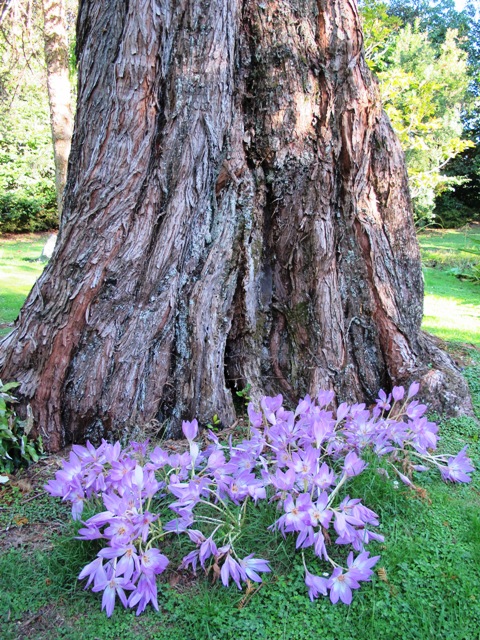
Colchicums in the park

Colchicums in the park

The demise of two of our grand old pine trees a few weeks ago has necessitated a fairly large clean up. They were about 140 years old and had been on a major lean for much of that time. Clearly they passed the point of balance. But, as happens in gardens, their collapse also opened up an opportunity. Suddenly there was a nice little area which had been dense shade and more or less left to its own devices but was now light, open and clearly of potential.

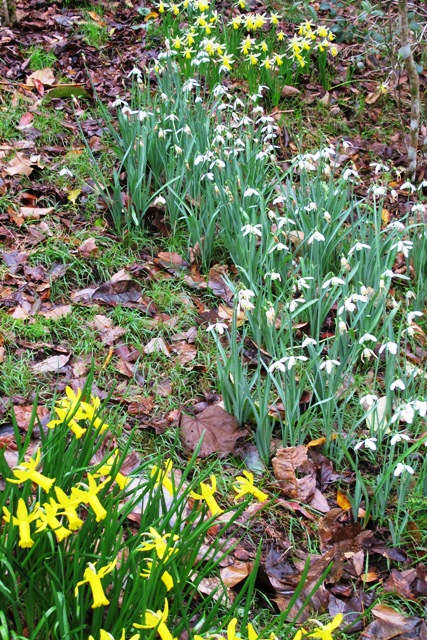
“Bulbs,” I thought, “I shall plant it in a succession of bulbs to take it through the seasons.” I started with what was already there – a congested but large clump of snowdrops, a few cyclamen and some valiant pleione orchids which were battling on despite choking ground cover plants. Then I raided the nursery where we still had quite a few pots and trays of suitable bulbs, particularly dwarf narcissi of various types. By this point, I was already committed to using minis and dwarf growers which would co-exist and not choke out their growing companions.

So how many bulbs are needed to fill an area?

So how many bulbs are needed to fill an area?

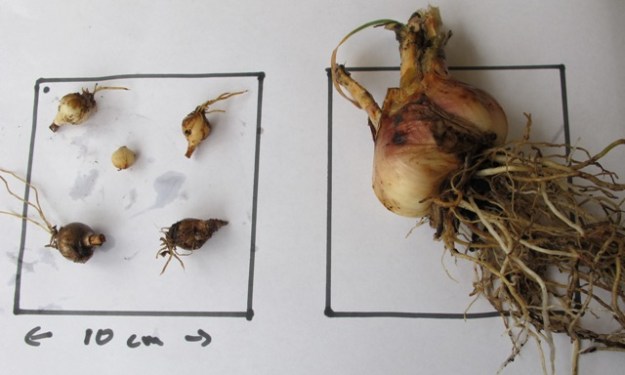
    As I continue to raid suitable bulbs from wherever I could find them, I started to do the maths. We are not talking a large area here. It is maybe 10 square metres (5x 2) at the most. Do you have any idea of how many dwarf and mini bulbs are needed to fill that space? Allowing maybe 5 bulbs per 10cm square, that adds up to a massive …. 5000! Okay, so the cyclamen are not planted at that density, but many of the others are.

Had I chosen to start with larger bulbs of stronger growing varieties – full sized daffodils, bluebells, tulips, colchicums and the like – I could have planted them at maybe 10 cm spacings so would have only needed about 1000 bulbs. It is still a lot.

The lesson is that if you are besotted by bulbs, as we are, it helps to learn how to look after them so that you can increase the supply for other plantings. Having depleted the nursery of spare bulbs that are suitable for this situation, I am now taking apart beds in the rockery to thin the bulbs there and get the surplus for my new area. So far, as well as the types already mentioned, I have added rhodohypoxis, blue brodiaeas, various different lachenalias and crocus. I am aiming for mix and match in the hope that there will be something seasonal and dainty flowering in that particular section at all times of the year. It will take some tweaking over time to get it right.

Belladonnas beneath the gum tree at our entrance

Belladonnas beneath the gum tree at our entrance

    I have a mix and match of large and some invasive bulbs beneath a huge old gum tree at our entrance. Invasive bulbs are easily contained there and there is room for sometimes scruffy performers like the belladonnas to put on a good show.
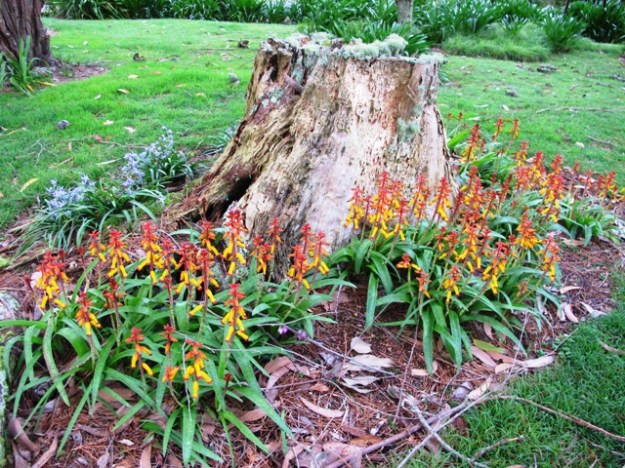
Bluebells to the left and common old Lachenalia aloides in front

Bluebells to the left and common old Lachenalia aloides in front

    Elsewhere, we have tended to keep our bulb plantings separated by variety. This may be our nursery background – keeping the option open to start selling bulbs again if need be. But a big show of a single variety can be striking. We sometimes use the root zone at the base of large, specimen trees, usually on the sunny side because most bulbs enjoy light but are adapted to surviving quite harsh conditions. This gets them out of the way of the lawnmower.
Drifts of bulbs are harder to manage here

Drifts of bulbs are harder to manage here

    But really what we covet most are drifts of bulbs – informal, randomly organised rivers of seasonal colour flowing through. In harsher climates where the grass stops growing in winter (too cold) and summer (too dry), it is possible to do it in grass. But not here. Without significant management, the strong growing grasses overwhelm the bulbs and need mowing before the foliage has had a chance to carry out its function of replenishing the bulb.

It is easier to work with bulbs which shed their foliage quickly. There are big differences in how long different types keep their leaves – anything from 4 to 6 weeks up to 11 months. Fortunately the pretty snowdrops (galanthus) are light on foliage, because what we really want over the next decade is to develop proper drifts of snowdrops. Not a few hundred. Thousands. They will be a fleeting wonder lasting a mere week or two each year. But it is the sheer frivolity of self indulgence that will spur on the snowdrop dream. At least we know which ones perform well in our climate – without snow or much winter chill – and we will just gently work on it by continually dividing and spreading the existing clumps. I am guessing the one clump of Galanthus viridapicis in my new little bulb garden yielded upwards of 300 bulbs. That is a good return.

First published in the Waikato Times and reprinted here with their permission.

Garden Lore

“I wish the sky would rain down roses, as they rain down from the shaken bush. They would fall don light as feathers, smelling sweet, and it would be like sleeping and yet waking, all at once.”

George Eliot (1819 – 1880).

???????????????????????????????Staking trees
Staking trees and shrubs is often done so badly that it does more damage than good. If you have to stake a plant to keep it upright, don’t force the stake in as close to the trunk as you can get it. This sheers off all the roots in the wedge radiating out from that point. Even moving the stake out a few centimetres can make a big difference to the damage caused.
Keeping trees staked can do more harm than good. A bit of wind rock actually helps the plant to stabilise itself and to develop a tapered trunk as a result. Where you need to stake because it will fall over, keep the stakes low. They should not be more than a third of the existing height of the plant. If you still have a problem with stability, reduce the canopy bulk (called the “sail” area because this is what catches the wind). It is likely that you have a plant with too much top and not enough of a root system to sustain it.

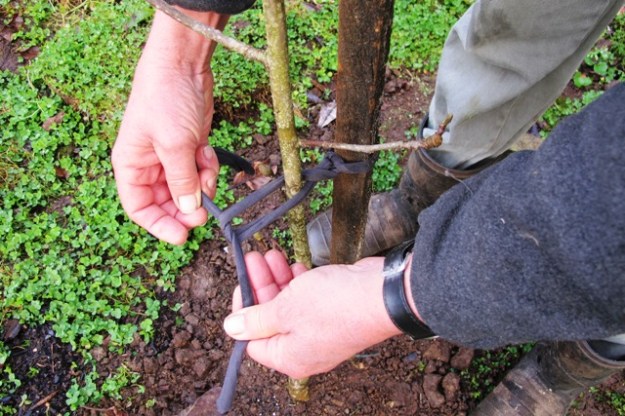
Always use flexible ties of stockinette, old panty hose, strips of rubber from an old inner tube or similar. String and wire will cut into the trunk causing damage and potentially ringbarking it.

The bottom line remains: only stake if you really need to, not as a matter of course. It is actually better for the plant in the long term not to be staked.

First published in the Waikato Times and reprinted here with their permission.

Plant Collector: Rhododendron sino nuttallii

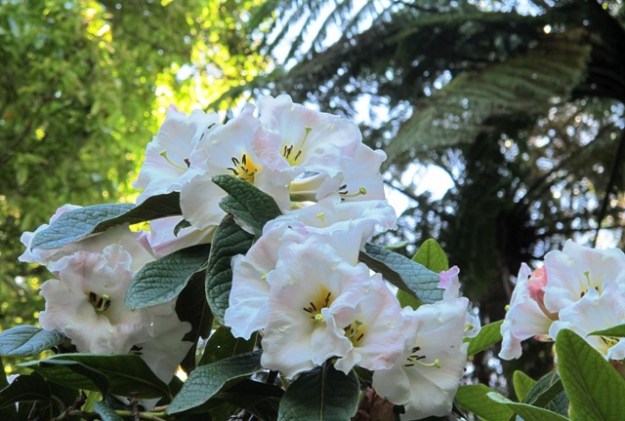
Just beautiful - R. sino nuttallii

Just beautiful – R. sino nuttallii

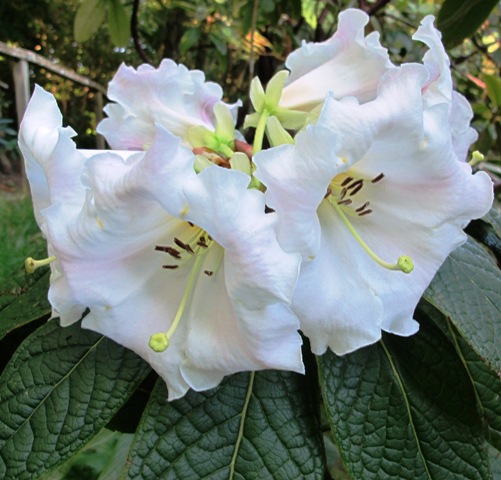
Oh my, but we are besotted with the nuttallii rhododendrons which flower on even as November draws into December. We would rate these in the elite class as far as rhododendrons go. Not only are the heavy, waxy trumpets large and showy, they are also very fragrant. This one is planted on a bank which was a good decision because we can look down on it and the scent wafts up. Some of the others here are several metres above nose and eye level so the scent is a bit academic because they are best viewed from afar.

The foliage is large and heavily textured (bullate for the botanical or like heavy seersucker for those of a sewing disposition) and over time the main stems develop beautiful shiny, peeling bark in a cinnamon colour. These are large and open growing shrubs so do not fit the tight and tidy mould preferred by some.

‘Sino’ just means it is the Chinese form of the species, as opposed to R. nuttallii which is found in Tibet, North Burma and northern India. The Chinese form is bigger and showier and more sensitive to cold temperatures. These plants are rarely offered for sale though you can sometimes find some of the hybrids that have been bred from them.

Rhododendron sino nuttallii

Rhododendron sino nuttallii

First published in the Waikato Times and reprinted here with their permission.

Maples in the garden

???????????????????????????????Maples. They are acers, botanically speaking and there are plenty of them. They are often seen in gardens too, though the majority are probably what is commonly referred to as the Japanese maple – A. palmatum usually dissectum. There are multitudes of selected forms of this around, many of them carrying Japanese names. One of the reasons I have not written much about Japanese maples is because we don’t have names on many of the ones in our garden here and I have not gone to the trouble of working out which varieties they are. This failure is irrelevant when it comes to their role in the garden but it matters rather more when I write about them.
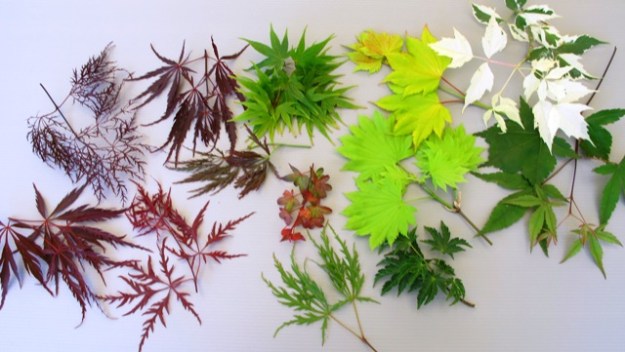
A random collection of maple leaves from around the garden

A random collection of maple leaves from around the garden

The world of maples goes well beyond those feathery Japanese ones. Maple syrup, dear readers does indeed come from maple trees, unless it is a synthetic version. Acer saccharum – the sugar maple – and that is the inspiration for the Canadian maple leaf emblem. It is also a major contributor to the autumn colours we associate with North America, along with Acer negundo. These are large landscape trees, not dainty little garden specimens though Acer negundo ‘Flamingo’, a pretty variegated form, is widely sold here and stays small enough to be a good option.
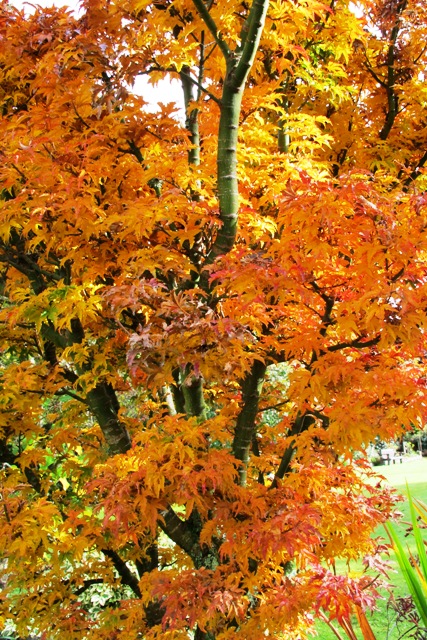
Autumn colour supreme

Autumn colour supreme

Maples are classified botanically and share certain characteristics including curious winged seeds which are designed to be dispersed by wind. In a gardening or landscape context, they have some common ground too. The foliage is soft so almost all of them are unsuitable for windy locations. They need adequate moisture levels in summer so are never going to like baking in hot, dry conditions. Many of them are happy in semi shade though some will lose their colour and become dull green in low light levels. Many colour up beautifully in autumn, even in milder climates.

Beyond that, rather than looking at pictures and deciding that you want a particular variety, this is one plant family where I suggest you go to your garden centre and read the plant labels. If you are really lucky, you may even strike someone there who knows about maples. You need to make decisions about whether you want a tree (and if so, what sized tree) or a little dwarf – often called patio maples. Also whether you want weeping or arching growth, or a more upright habit. Then there is the colour and whether you want one that keeps the same colour through spring and summer because some of them change colour as the leaves age.

I would counsel caution against buying too many red or burgundy foliaged maples. These are very dominant colours in the garden landscape and best used sparingly as feature plants. And if you feel compelled to plant a collection of maples, bear in mind that there may not be a huge difference in style between the dreaded conifer garden of the 1970s and the maple garden of more modern times. Enough said on that issue.
???????????????????????????????Besides feature trees which add to the skyline, we find the smaller growing maples combine well in a variety of situations. I really like the little weeping one we have planted with roses growing through it. It is a very pretty combination, especially with perennials also in flower. Pretty too are the ones in a semi- shaded bed with clematis scrambling around them and seasonal bulbs at their base. We have more upright forms in the rockery where we can keep their bases clear and they give good year-round form.
???????????????????????????????But one of the unsung delights of the smaller growing maples is that as they grow older, they can be gently encouraged into natural bonsai forms which give shape and interest in winter when they are fully naked. We do a bit of thinning and shaping but not much is required to make a feature of a maple with a good skeleton.

Plants which delight with distinctive, fresh spring foliage, last all summer, colour up in autumn and then have a really interesting shape in winter justify their garden position all year round. Add in their adaptability to a range of situations and their happy characteristic of combining with all sorts of other plants. It all comes down to making the right decisions on the variety and the garden position from the start. These are good staple plants to incorporate into any sheltered garden.

First published in the Waikato Times and reprinted here with their permission.