Know thine species

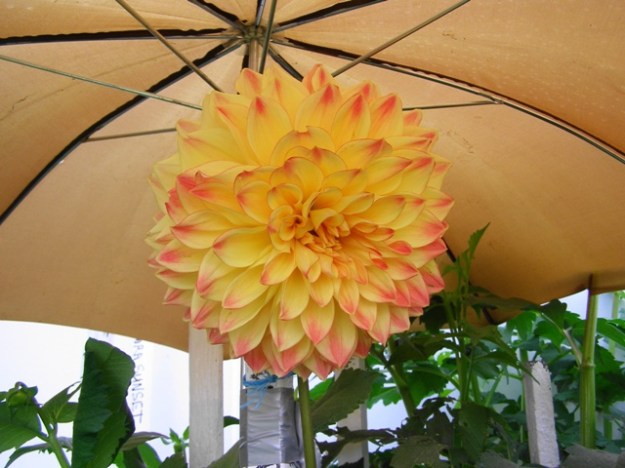
The show dahlia

The show dahlia

You can quite easily live out your gardening days without ever worrying about species and hybrids. Indeed you can, but as with most activities, many people will find that the more they know, the more they enjoy what they are doing.

At its simplest level, species are the natural form of a plant in the wild. And all plants originated somewhere in the wild.

Hybrids are mix of two different species in the first instance and after that they can quickly become a mix of many different species and resulting hybrids getting ever more complex genetic makeup. There is no value judgement in the rights and wrongs of that. Sometimes these hybrids occur in the wild without any human intervention (usually referred to as “natural hybrids”). Often it is done deliberately to try and improve plants.

A variation on controlled hybridising is line breeding – raising many seed from a plant and selecting only the very best with which to continue. Then seed from those best plants is raised time after time until it shows stability. Seed can be extremely variable and this form of line breeding is trying to edit out the less desirable aspects over several generations.

It happens all the time with edible crops. Think how much sweet corn and kiwifruit have changed over the years. The original, wild collected species of edible crops are often poor shadows of what we have now in terms of yield, reliable production, ease of handling and palatability.

It is not always true, of course. Sometimes commercial imperatives have seen us saddled with inferior tasting product – tomatoes are a prime example. And there are concerns about the loss of the wild species which are important to maintain the gene pool for food crops.

As far as ornamental plants are concerned, most of us will have gardens which are a mix of species and hybrids. There are no hard and fast rules although I have met a fair number of gardeners in my time who parade a collection of species only as a badge of status.

Species Camellia gauchowensis

Species Camellia gauchowensis

Some species have a simple charm which is lost in their showier hybrids. Others are nondescript in the extreme. Some highly desirable species are simply damn difficult to grow whereas the hybrids bring new vigour which makes them much more rewarding garden plants. Sometimes there are species which make splendid garden plants but they can be overlooked because their names are not appealing. Camellia gauchowensis has been the standout star of that family here recently and why anybody would grow the likes of Mine No Yuki instead of C. gauchowensis, I don’t know.

We have been revisiting the camellia species as we pick over the best options in the face of the devastating camellia petal blight which has so affected many of the hybrids we grow. It is not that the species don’t get it. It is just that some of them have less susceptibility and have other good characteristics which are worth looking at. More on this in the future.

Show blooms, no matter which plant family, often tend to be over-bred hybrids which are but distantly related to original species. Dahlias which are too heavy to hold their heads up without staking, bizarre daffodil forms, overblown cyclamen or chrysanthemums, enormous begonia flowers – anything that is bigger, allegedly better or a novelty genetic freak.
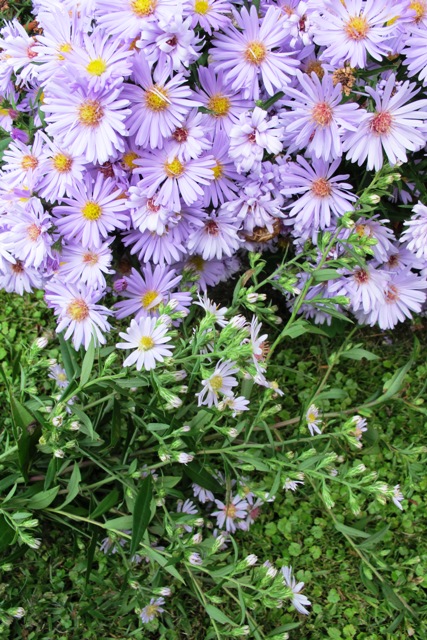
Named hybrid aster at top, self sown seedling at bottom

Named hybrid aster at top, self sown seedling at bottom

But controlled hybridising can also give us garden plants which are hugely better performers. You can see in the photograph of asters that the abundance of blooms at the top are from a named hybrid whereas the few poor specimens at the bottom are from a self sown seedling which has probably reverted closer to how the original species looks.
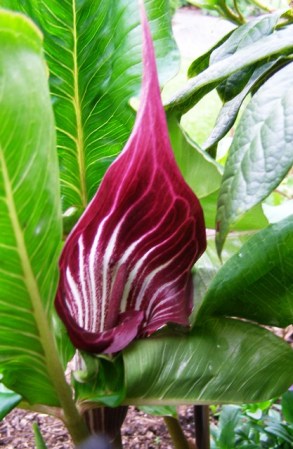
Hybrid arisaemas for our own garden

Hybrid arisaemas for our own garden

I am of course married to a plant breeder who is driven by the desire to create better performing garden plants. Sometimes it is just to get plants which will grow better in our garden here. His work with arisaemas is of this ilk. Many of the desirable arisaemas are a battle to grow in our conditions with insufficient chill and they simply don’t come back a second year. By hybridising two different species, he can get hybrid vigour which means they are much more reliable and stronger growing.

Other plants may be hybridised to look for new or improved characteristics – extending the colour range, reducing the impact of disease, getting more compact growth, better floral display, a longer season, sterility (to avoid unwanted seeding) or bringing the best features of different hybrids together in one plant. There are many reasons to hybridise and one of the final tests before selecting a new cultivar for release is to measure it against both the originating species and the actual parent plants. If it is not a significant improvement, then it won’t get released on the market.

Hybrids have their place in the ornamental garden and in the edible garden. But in a world which is squeezing the natural environment in every way possible, we need to retain the original species for reasons of ecology and bio-diversity. The more people who understand the difference the better – even more so if they can move away from the modern “green” cliché that says the original species are, by definition, better. They are not, but they are important.

First published in the Waikato Times and reprinted here with their permission.

Garden lore

“Now that all the other many-hued flowers have scattered without a trace, the dead white heads of the miscanthus remains alone in the fields until the end of winter. As it stands there so gracefully, not realising that it has entered its dotage, and bending its head as if in memory of past glories, it looks exactly like a very old person, and one cannot help feeling sorry for it.”

Sei Shonagon , The Pillow Book of Sei Shonagon (tenth century),
translated by Ivan Morris (1967)

???????????????????????????????
Pruning wisterias
Winter is the pruning time for many plants, but none more so than wisteria. The most common reason for their failure to flower in spring is savage pruning. Don’t cut them off at ground level because they flower from last year’s growth so you will be cutting off all the potential flower buds which form on the spurs. Think of them like an apple tree. Find the main stems which give the framework or shape to the plant. Shorten all the other whippy growths to between 3 or 4 leaf buds from the main stems. Thin out the ones at the base by cutting them back flush to the trunk. You don’t want the growths which sneak along at ground level because they will put down roots and your one plant can become many.

At the same time, deal to borer where you spot it. You will find the borer holes in the older wood. I tend to reach for the CRC or cooking oil to spray down the holes. It smothers them. Or you can use fly spray. None of these seem to harm the plant whereas the borer can ruin entire sections over time. It pays to keep replacement leaders coming through in case your main stems get too badly damaged.

Wisteria whips are very flexible when first cut and can be used for weaving in a similar way to basket willow.

Step by step instructions for pruning (with photos) here.

First published in the Waikato Times and reprinted here with their permission.

Plant Collector: zygocactus or Schlumbergera (probably truncata hybrid)

Winter woodland charmer - we refer to it as zygocactus

Winter woodland charmer – we refer to it as zygocactus

We have always referred to this plant as a zygocactus. Others sometimes call it a chain cactus (although that is confusing because there are other cacti referred to by that term also). In the northern hemisphere, it is widely called the Christmas cactus because that is the time it flowers, or sometimes the descriptive term of Crab’s claw cactus. In fact it is a schlumbergera, often referred to as a S. truncata hybrid although it is likely to have S. bridgesii in its parentage too. Not having any expertise in cacti whatsoever, I will wait for somebody more knowledgeable to tell me the dominant species in its makeup.

It is a cactus, but not a desert one and it is not prickly, hailing instead from the rainforests of Brazil, where it is epiphytic – using other plants as its host. It is widely grown throughout the world as a house plant and much favoured in hanging baskets because of its pendulous, arching growth, tolerance of semi shade and prolific flowering in the depths of winter.

If you are frost free, you can grow it outdoors and this is what we do. We have it perching and festooning throughout our woodland area where it is particularly joyous in the depths of winter. We only have the somewhat garish, cerise form which is the most common one around. Hybridists have extended the colour range considerably, even to oranges and yellows, but the different colours have not been as vigorous for us.

Being cacti, these are easy to propagate from the flat, jointed leaves. Just leave them to dry for a few days or longer before putting them into a fine, sandy mix.

First published in the Waikato Times and reprinted here with their permission.
A flurry of feathers*

* That is a flurry of feathers as opposed to a tranquil haven filled with bird song.

Some dreary weather and the need to find the best photos we have of our garden had me trawling through and sorting all the many photos on my computer. I was quite pleased with the bird file and in an act of displacement behaviour (because the more urgent task was far more difficult) sorted some out for here.
???????????????????????????????
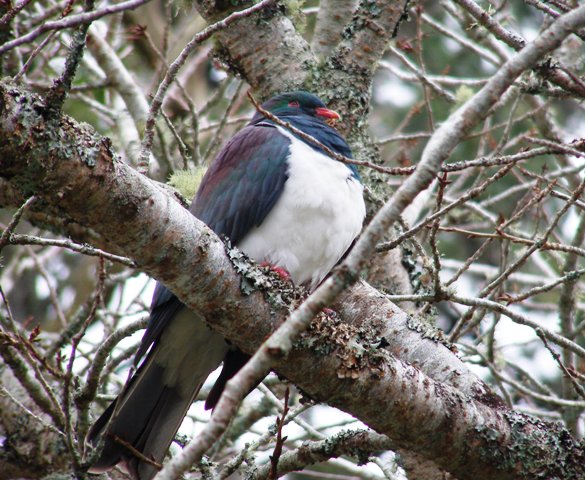
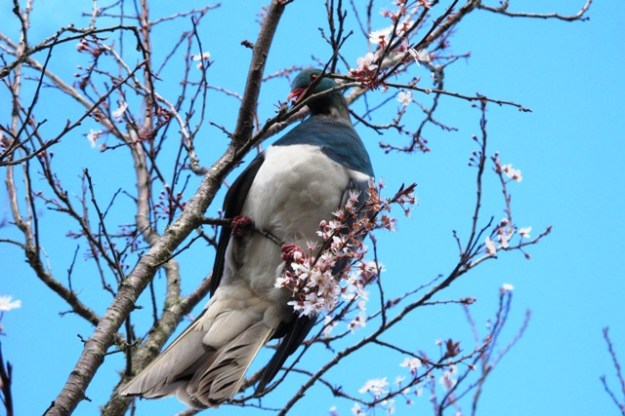
Photographing our native kereru (New Zealand’s wood pigeon) can be a challenge because they are inclined to take fright and crash away. This large bird is protected these days and is slow to procreate.
???????????????????????????????
Mark has been known to erect hammocks beneath a precarious kereru nest to protect the growing baby (kereru usually raise only one young at a time), and to build a large ground enclosure to save one which was learning to fly from ground predators.
???????????????????????????????
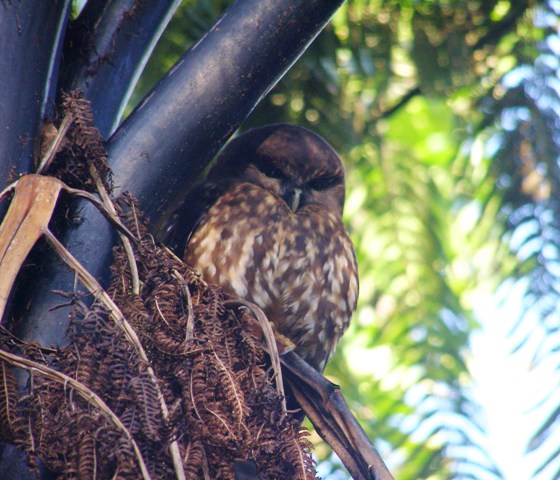
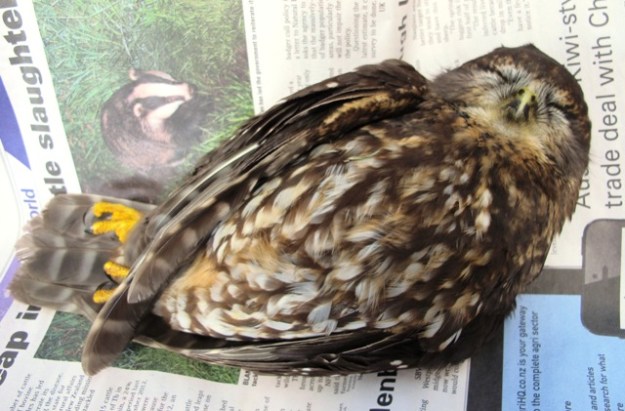
The morepork or ruru is our native owl and is rarely seen by day. This was almost certainly a young one. A morepork calling is one of the loveliest night time sounds. One of the most delightful sights we have seen was a family of five roosting in a tree here during the day. Mama and Papa Ruru were trying to sleep and three babies with big owl eyes were all bright and alert.
??????????????????????????????? Sadly this one was lying dead beside our letter box last week – almost certainly coming off second best from an encounter with a vehicle at night.
???????????????????????????????
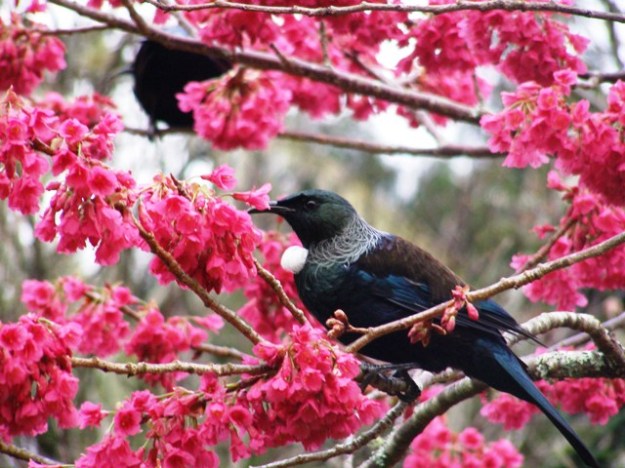
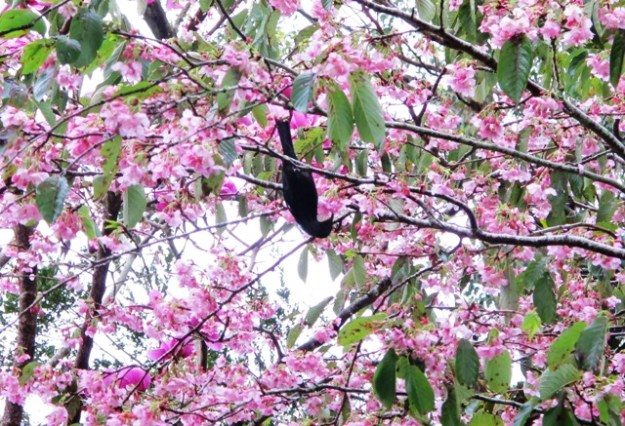
I have spent a great deal of time photographing the tui. There is no shortage of candidates – we can have trees heaving with scores of bickering tui – they are strongly territorial.
???????????????????????????????
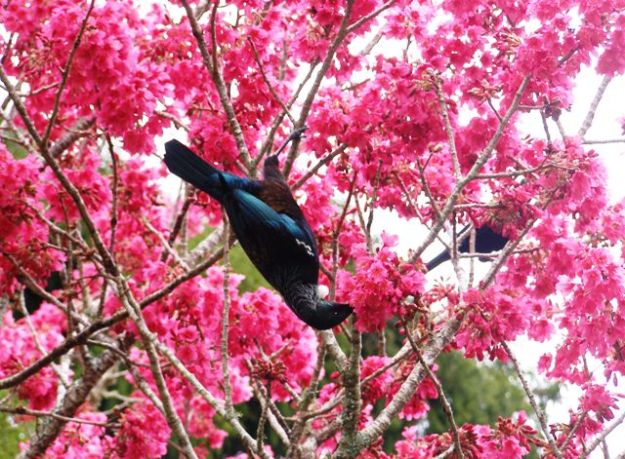
And acrobat tui number two. Feeding upside down is no problem to these nectar feeding birds.
???????????????????????????????
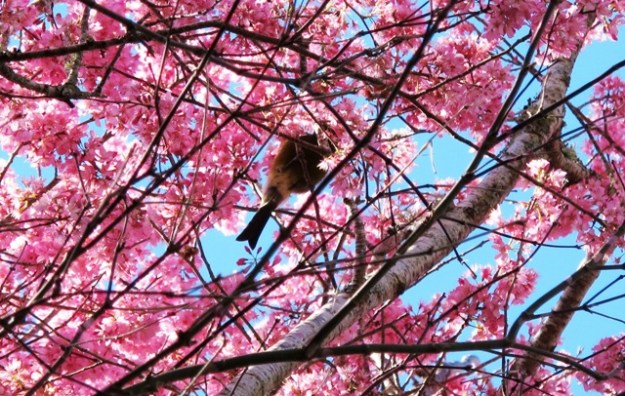
King tui, we call this one. He looks as if he is the dominant bird in this campanulata cherry. I posted two short clips of feeding tui last spring here and here.
038 - Copy
Bellbirds, often known by their Maori names of korimako or makomako, tend to be heard more often than seen. They are a modest bird to look at and very shy in their behaviour, but with beautiful song.
???????????????????????????????
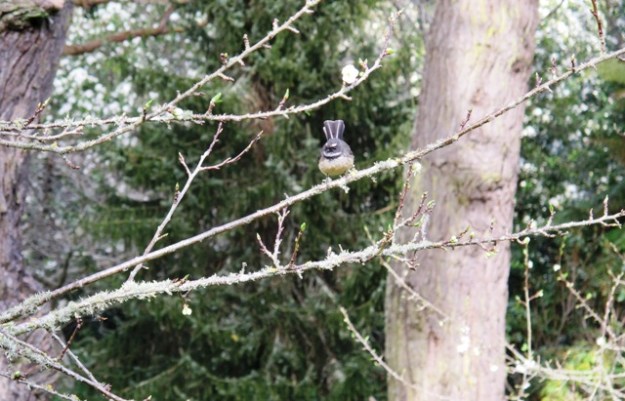
One of our most ubiquitous birds is the little fantail or pīwakawaka. The tail spreads out in a full fan and these little birds do not show a great deal of fear around humans. However they also move extremely quickly and this is the best photo I have managed so far.
???????????????????????????????
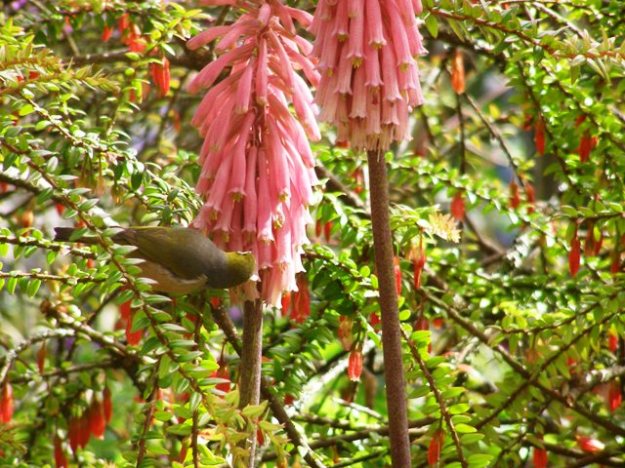
The little waxeyes are here in large numbers – almost our equivalent of humming birds, which we don’t have in this country. Because it is self-introduced to this country, it is regarded as a native. Wikipedia says: “ Its Māori name, Tauhou, means “stranger” or more literally, “new arrival”.”
???????????????????????????????
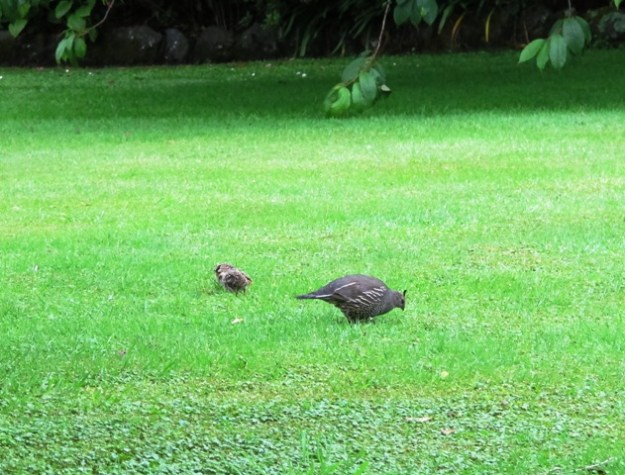
The Californian quail are a more recent arrival to our garden but are a quietly delightful addition. Each spring we watch nervously as Mama Quail heads off with a gaggle of little babies in tow – each of them a tiny bundle of feathers. Up above we can see Papa Quail and hear him calling. We like to think he is cooing out directions: “Turn left.” “Veer right.” “Danger ahead.” Sadly, we then watch an ever-diminishing number of fluffy babes as each day passes. But this winter we have seven mature quail quietly foraging around so maybe they are going to be a permanent feature.
???????????????????????????????
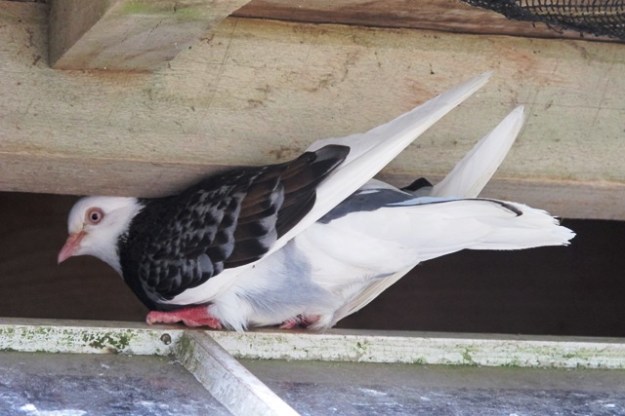
And Mark’s pidgies – tumbler pigeons these days. He likes the coloured ones rather than the white ones more commonly favoured. There are times when he feels he is raising fodder for the rare, endangered native falcon or Kārearea which makes frequent feeding forays through this area. The surviving pigeons are the wise ones.
???????????????????????????????
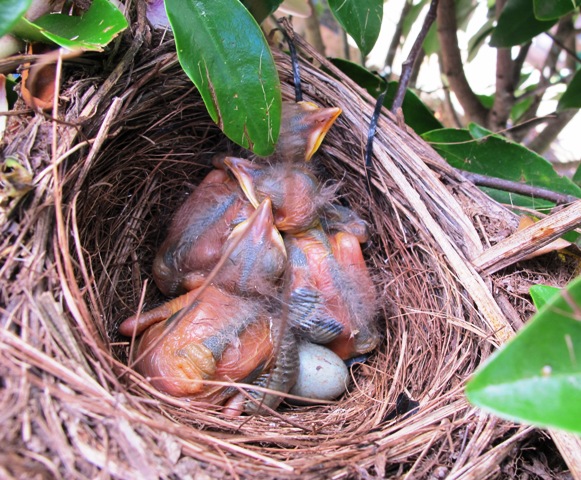
Just common old blackbirds in a nest last season – a nest in a particularly public position – but the sight of babies brings out the protective instinct all the same. They all matured and flew away – probably to thieve our strawberries.
???????????????????????????????
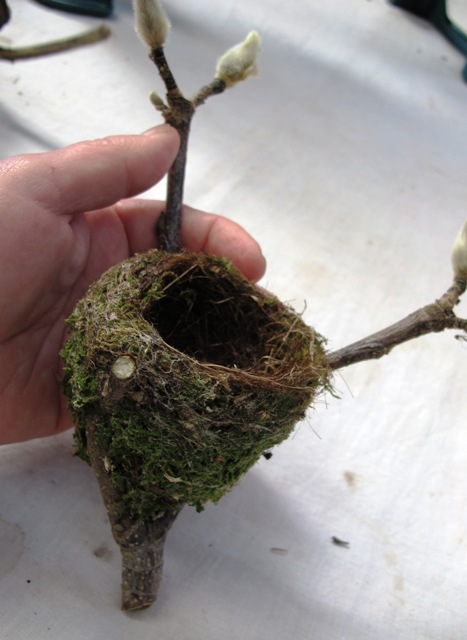
Then there are the nests. This one is an exquisite little fantail nest built in a fork of a magnolia tree.
???????????????????????????????
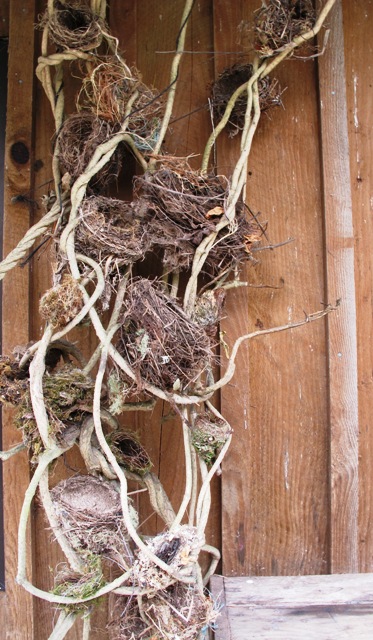
Each year we gather the abandoned nests which are in good condition and bring them under cover – our nest installation. Each spring the birds fly in gradually demolish them in their search for nesting materials – recycling in action.
???????????????????????????????
And my most favourite tui photo of all. Sitting in a mandarin tree out from our back door. It was gorging itself on the fruit. We no longer have a cat and none of our immediate neighbours have cats. We would rather have the birds.

Managing garden maintenance

Close in by the house is under constant maintenance

Close in by the house is under constant maintenance

Garden maintenance. Oh yes, it is often like housework outdoors. No matter how much you do, it always needs to be done again. Vaccuming, tidying, dusting, spring cleaning – there are garden equivalents for the lot.

I admit I am not the world’s most dedicated housekeeper. I do it because I have to. If I found a gem of a reliable cleaner, I would find the money to pay this person to do it for me. But the times of my life when I have paid regular cleaners have also been somewhat irritating because they do not do it to my standards. Gems are hard to find.

Good garden help is equally difficult to find, I believe. Fortunately, because I don’t mind the garden maintenance side, I don’t feel the need to pay someone to do it for me. I have a wonderful book from 1984, vintage Alan Titchmarsh who is now a doyen of English garden television but who was a lesser known, bright young wit 30 years ago. It is called “Avant-Gardening, A Guide to One-Upmanship in the Garden.” In it he has a chapter entitled: “Having a Man In” and his opening line is: “Or a woman; but most likely a man.” He divides gardening help into Treasures and Tolerables. The Treasures, he declares, are rarer than blue roses.

I would love to quote the lot about The Tolerables, but it is too long. Edited highlights include: “They resent change. Their favourite flowers are …scarlet salvias, orange French marigolds, standard fuchsias and lobelia and alyssum. They love ‘dot’ plants. They have difficulty in recognising your treasures and pull them up as weeds…. The vegetables they grow will be their favourites, not yours. ….They dig beds where you don’t want them and act on ‘initiative’ without asking if you actually wanted the orchard felling…. They don’t let you know when they are not coming in (it pays to keep you guessing).” There is more in that vein.

Judging by the number of enquiries I have had over the years, good garden help is just as scarce nowadays as it has ever been. But, as with anything else, if you are only willing to pay the equivalent of minimum wages, you are unlikely to find a Treasure who knows what he or she is doing in your garden. A Treasure whom you can trust is even rarer and will need to be cherished.

The bottom line is that most of us end up doing it ourselves and gardening as a DIY ethos is deeply ingrained in this country to the point that it is often worn as a badge of pride.

The outer areas are on a once a year maintenance cycle

The outer areas are on a once a year maintenance cycle

I credit the potted wisdom on garden maintenance I received years ago to senior NZ gardener, Gordon Collier. Think of the garden as radiating circles, he told me. The circle closest in to the house is where you carry out the most garden maintenance to keep it well presented. Essentially, you stay on top of it by keeping at it all the time. The next circle out should be on a seasonal cycle so you get around it four times a year. Then there is the outer circle which you do once a year.

This of course is big garden advice. A smaller urban garden probably does not take you beyond the second circle. I have always remembered his words because it gave a sensible and manageable framework for a large garden, and we are large gardeners here. It is worth thinking about if you are extending your garden. The further out you go, the less you will do in terms of regular maintenance. Plan from the start to keep it on an infrequent cycle and you won’t be making a yet bigger rod for your own back.

He Who Does the Majority of the Weed Control here (aka my Mark) would like it pointed out that this does not apply to weeding. Depending on the time of the year, he will start a weeding circuit as often as every three weeks. If you leave the weeding circuit to three monthly, or annually, you will never keep invasive weeds under control. The convolvulus will have smothered its host, the seedling cherries grown too large to hand pull and there will be a permanent carpet of bitter cress. Most weeds will have viable seed on them by six weeks – hence the three weekly cycle to catch the weeds missed on the last round.

That outer round of maintenance is the pruning, cutting out dead wood from shrubs, the removal of large debris, seasonal dead heading where necessary, cutting bank rank grass and a general tidy up. It is what I am doing right now.

The middle circle is hedge trimming, digging and dividing perennials, cutting back, staking, pruning, shaping, clipping and mulching.

The close in circle is… well… like vaccuming the living areas and washing the kitchen floor really. Frequent and ongoing. I just prefer to work outdoors and, in my case, without power tools.

First published in the Waikato Times and reprinted here with their permission.