The outdoor dining and entertaining conundrum

A well designed outdoor dining area at Foreman's garden in Lepperton - and well under 20 paces from the kitchen

A well designed outdoor dining area at Foreman’s garden in Lepperton – and well under 20 paces from the kitchen

We live in a house which was built in 1950, long before “indoor outdoor flow” was ever conceived of and there is no doubt that we lack it. At one time, I had ideas to rectify this and went as far as getting concept plans drawn by an architect. The estimate of $100 000 for the work was a bit of a disincentive so we did not proceed, for which I am now relieved.

The latest House and Garden magazine has an article on the renovation of a Wellington property where the owner is quoted as saying: “We didn’t want to open the front of the house to the weather because, if we did, we’d all get blown away. We designed our house as an interior home, not an exterior one. Wellington is not a sit-outside sort of environment.” Actually, much of this country is not best suited to outside entertaining, at least when it comes to evening dining. Witness the plethora of fire pits, gas heaters and outdoor fireplaces. But you would not think that to look at modern design in houses and gardens.

One of the properties featured in the new book “Contemporary Gardens of New Zealand”, shows an outdoor dining area on an exposed platform with no shelter or shade and down a flight of 37 steps. Or it may be 39. I bet they never use it. Who wants to dash up so many steps to get the dipping sauce you forgot, or the serving spoon? Make that glass of wine last because the first to finish gets to climb the steps to the house to get another bottle or two. If the owners leave the dirty dishes on the table until the next morning, the neighbours will be able to see and judge. That particular property has a second outdoor eating area immediately by the house so you can be pretty sure that is the one they use.

Oft times, home owners place seating and entertaining areas too far from the service areas. I paced it out and think that few people would want their outdoor eating area more than 20 paces from the kitchen. It becomes inconvenient and if it is inconvenient, you won’t use it much. I’ve seen too many summer houses placed where they will create a focal point in the garden but they are just in the wrong place for use. Unless you have servants at your beck and call (and children are an unreliable substitute), save your money and make a focal point in some other way.

Most of us will wander a little further with just a cup of coffee in hand, but again if your seating areas are beyond about 30 paces from the electric jug or fridge, you are not likely to use them for morning teas or evening drinks. Even more than gazebos, garden seats are often stationed as focal points rather than for use. Never is this more obvious than when it is but one gaily painted chair. I think that seats need to be placed where you will use them, not used as de facto garden ornaments.

Just our glorified porch but an indication to me of how well used a garden room could be

Just our glorified porch but an indication to me of how well used a garden room could be

Garden rooms are my preferred solution after noticing these in a number of English gardens. These differ from gazebos and summer houses in that they have the capacity for more protective walls. There are times when just a roof is not enough to keep the situation pleasant enough to linger longer. Most of us find eating outdoors very pleasant in the right conditions and it can also make for more relaxed entertaining. After all, gardens are best enjoyed when you are out amongst them, not viewed from house windows so a charming and versatile garden room situated not more than 20 paces from my kitchen would be lovely addition. With some forethought and investigation, it could be so much more than just a free standing conservatory or a trellised gazebo. In the meantime, we make do with a comfortable outdoor dining suite beneath a large sun umbrella which is good for daytime use when there are more than just the two of us, but not so good for long evenings, even in summer. The closest we get to a garden room and the reason I know one would be well used, is our favoured sitting spot which we use all year round and at all times of the day. It is enclosed on three sides but completely open to the garden. It is just a glorified front porch and it only fits two comfortably but I think it is a pointer in the right direction for my choice of a garden entertaining area.

My all time favourite garden room from the Alhambra in Granada but it may look a tad pretentious here

My all time favourite garden room from the Alhambra in Granada but it may look a tad pretentious here

I leave you with the very best example of a garden room or gallery that I have seen. It might look just a little pretentious in my garden, it being of Moorish origin dating back to the tenth century and located in a palace at the Alhambra and Generalife in Granada, Spain. But can you imagine entertaining in that space and glorying in your garden surrounds?

First published in the Waikato Times and reprinted here with their permission.
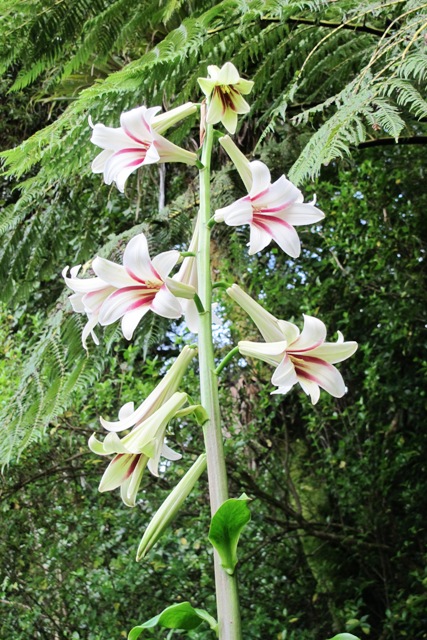
Plant Collector: Cardiocrinum giganteum

The three metre flower spike of Cardiocrinum giganteum - worth the wait of up to 7 years to bloom

The three metre flower spike of Cardiocrinum giganteum – worth the wait of up to 7 years to bloom

If any bulb were to be the king or queen of wow, it is this giant Himalayan lily in full bloom. That is because these flowers are on a hefty stem that is around three metres high. Add to that the fact that it takes somewhere around seven years to flower and each bulb only flowers once. It then sets large amounts of seed and forms offsets around the base of the original bulb, each of which will take another five to seven years to flower. That life cycle must offer a metaphor for something. In the interim years, it just forms a seasonal clump of large, luscious, heart-shaped leaves reminiscent of an arum lily. This is a plant for cool, open, woodland conditions with soils which never dry out and are rich in humus. It does not perform in warm regions and won’t take much wind because of that great height in flower. We grow the plants in a cold, south facing border.

Cardiocrinums are very fragrant but the flowers are a fair way up in the air so to get the full impact of the scent, one possibly needs a veritable grove of them to walk through. The scent is stronger in the evening.

First published in the Waikato Times and reprinted here with their permission.
Garden lore

The more one gardens, the more one learns; and the more one learns, the more one realises how little one knows. I suppose the whole of life is like that

by Vita Sackville-West.
(1892-1962)

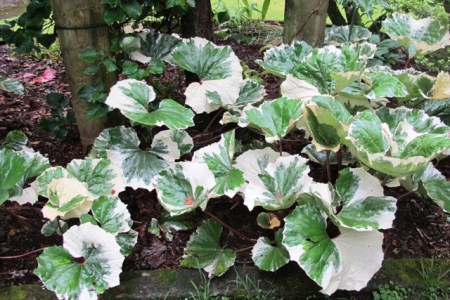
Farfugium tussilagineum argenteum - standing up well after being dug and divided last autumn

Farfugium tussilagineum argenteum – standing up well after being dug and divided last autumn

Digging and dividing

While the advice is freely given to dig and divide perennials, it is often the garden task that slips so far down that it falls off the to-do list because it is rarely urgent. If you have clumping, leafy plants which are either dying back in the centre or flopping all over the ground, that is a sign that they will benefit from being lifted, divided into smaller pieces which are then cleaned up and replanted into well dug and composted soil. This patch of Farfugium tussilagineum argenteum (some of you will know it as a ligularia) received this care and attention last autumn and now it is sitting up looking much more attractive, rather than falling apart with leaves lying on the ground.

In our comparatively mild climate, we can do this pretty much any time of the year though hot, dry summer is best avoided unless you water twice a day. In cold climates, plants can rot out if dug and divided when dormant, so times of growth in spring and summer are usually recommended.

First published in the Waikato Times and reprinted here with their permission.

The vexing issue of underplanting

A row of alternating annuals makes a statement, though it may not be the statement the gardener is aiming for

I had a day out and about looking at gardens recently and I was struck by the nature of under planting, though this preoccupation may have had more to do with my thoughts at the time. What I noticed about the under planting was how badly it was done in a couple of gardens. Bear with me, dear readers. You are going to have to imagine it because I know the garden owners so I was not going to whip out m’camera and take photos of the worst examples to embarrass them in the newspaper and on line.

Words like mishmash and hodgepodge came to mind as I looked at the bottom layer of plants in otherwise perfectly competent gardens. In other words, they had good upper layers of larger plants but when it came to the bottom layer of ground covers and under plantings, the selection criterion seemed solely that the plant should not reach more than 30cm in height. And there was one of this, one of that and one of the other, bunged in higgledy piggledy in most spaces.

Even worse, and I had to visit my local garden centre to set up a photo to demonstrate, is the horror of alternating annuals in a row along the edge. These certainly make a statement in the garden, though it may not be the statement that the gardener thinks when he or she plants them. I saw something similar (maybe with pansies and alyssum?) looking incongruous in a garden with otherwise high quality woody trees and shrubs and there were not any resident children to justify such a lapse in taste.

Nor am I a fan of edging plants, or indeed anything planted in rows other than proper hedges or vegetables, but that is a matter of style and personal taste. Fringes of mondo grass, liriope or anything else leave me cold but edging rows of matched annuals make me raise my eyebrows. Not even moderately tasteful white petunias cut the mustard when planted as an edging.

The contemporary look is to plant in blocks. The landscaper look is to plant in sharply defined geometric blocks each comprised of only one evergreen plant. Clivias are good, renga renga lilies are a bit untidy. Hellebores are probably acceptable, as is liriope or trachelospermum. Natives like prostrate muehlenbeckia are better.

Bergenia ciliata and Siberian irises – this gardener’s version of block planting

The middle ground is to gently block-plant but in more interesting combinations and in less rigidly defined grids. I am far more comfortable with that approach and it makes gardening interesting to play with different combinations. It also has advantages in making maintenance easier to group plants which require more frequent care – such as dead heading, staking, dividing, or grooming. Rectifying mistakes or bad decisions including eliminating invasive thugs is more localised if you are planting in blocks. I tend to blur the edges of my block plantings so that the overall look is softer and less delineated because that suits our style of gardening better. There is no doubt that if the upper layers of the garden are varied and mixed, some sort of unity in the bottom layer creates a more harmonious picture. I would argue that the flip side of the coin is also true: if your upper layers are rigidly conformist and consist of restrained plantings of only one or two different plants, ringing the changes with more complex and varied under plantings will make it a great deal more interesting.

Acceptable clivias

If you don’t want to go the block planting route, the old fashioned cottage garden genre may be an alternative. Essentially this is a jostle of perennials, annuals and bulbs in combination with small shrubs, often roses, where self seeding is encouraged. If you want a more modern look, you colour tone it rather than the traditional riot of random colour that nature achieves. If you like a tidy garden which is weed free, it is not an easy style to manage well. More often it is best viewed in passing, rather than looking at the detail.

Then, of course, you could ask yourself whether under planting is even necessary in some areas. The requirement that all garden beds and borders be layered with nary a glimpse of garden soil is relatively recent. In times past, it was fine to plant shrubs and trees without any bottom layer at all. It was called a shrubbery. Just don’t plant the shrubs too close together or you end up with a hedge. Each shrub needs to stand in its own space. As nature abhors a vacuum, mulch all the bare earth with something anonymous or you will grow a carpet of weeds. It is certainly easier to maintain than more complex plantings. It will probably look more attractive than the hodge podge assemblage of random plants I saw. It should look classier than the row of alternating annuals. Maybe it is time to start a movement called The Shrubbery Revival. Neo-shrubberies, maybe?

First published in the Waikato Times and reprinted here with their permission.

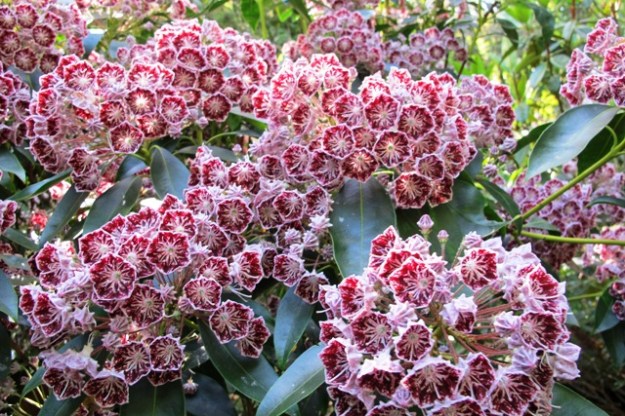
Plant Collector: Kalmia latifolia “Nipmuck”

Kalmia latifolia “Nipmuck”

Just when all the spring flowering trees and shrubs have passed over and we move into early summer, the kalmias open. They look as if they belong in the spring group and they like to grow in similar conditions to rhododendrons and camellias but their blooms take us into December. This one has the rather odd name of “Nipmuck” and is the darkest variety we grow. I failed to find out how it came by its name but would guess it may derive from the indigenous people of America.

In leaf, these slow growing, evergreen shrubs are pretty anonymous. But when the buds appear, they look like piped icing such as often adorns wedding cakes, opening to little cups, chalices maybe. The backs of the petals are white with just the red shading through from the inside.

Kalmias are native to North America, though only to the east coast where they stretch from Canada to as far south as Mexico. Locals call them the Calico Plant or Mountain Laurel. Most of the prized garden selections are forms of latifolia which is hardy. In other words it won’t be harmed by cold winters of the type we get in New Zealand, even inland, southern areas. They belong to the ericaceae family.

There is nothing rare about kalmias but they are very difficult to propagate from cutting so you may find them hard to source. When you do find them for sale, be prepared to pay a decent price for one. Cheap plants are cheap to produce so difficult ones should command a higher value.

From 2009, Kalmia Ostbo Red.

First published in the Waikato Times and reprinted here with their permission.