In the garden this fortnight: Thursday 23 February, 2012

The natural look can take a surprising amount of effort and intervention

The natural look can take a surprising amount of effort and intervention

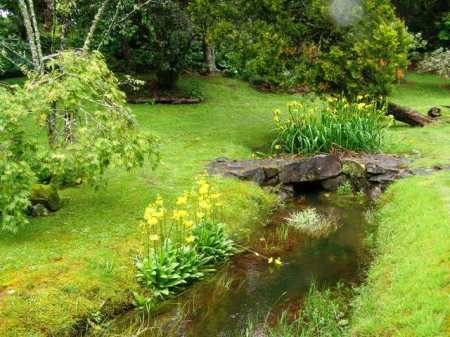
We have been making a major, combined effort to return our natural stream closer to something resembling pristine condition. I say natural stream because it is entirely natural where it enters and leaves our property but in between we manipulate it quite a bit. We have ponds, we play with the levels to create little rapids so we have the sound of water running and we have total control over what happens with flood water when we get torrential rain – achieved by a simple weir, flood channel and stopbanks. What we don’t have control of is the build up of silt and invasive water weeds.

What started as a pleasant summer activity reducing the water weeds (Cape Pondweed, oxygen weed and blanket weed are the worst), has grown to be something more major. We have hand pulled and raked most of the weed out. The clumps of streamside planting (mostly irises but also bog primulas, pontederia and a few others) are all in the process of being dramatically reduced in size. We hadn’t noticed quite how large they had grown in the years since they were first planted. The build up of silt in the water channel – up to my knees in places – is being stirred up and then flushed through to settle in the ponds. To flush it through requires holding the water back and then releasing it in one swoosh. To do it properly requires the building of a second, simple weir. Once all the silt is in the ponds, we will hire a sludge pump to clear it. Trying to stay on top of water weeds (none of which we introduced ourselves) is an ongoing task. We are thinking a bit more regular maintenance may keep the silt under control. Our access makes getting a digger in very difficult and the mess afterwards is such that we prefer to do things by hand.

The end result is that we will have a natural looking stream again. Sometimes it takes a lot of work to achieve and maintain a natural look in a garden.
Top tasks:

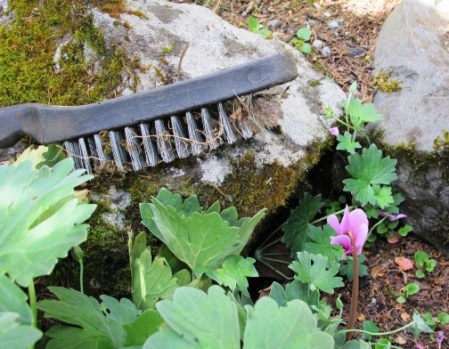
1) Continue reducing mossy cover and lichen on rocks and paths in the rockery. In our humid climate, we have continual moss growth and while some of it softens hard lines and adds a certain look, too much of it obliterates lines altogether and makes the place look unloved. I use a wire brush and I know I will probably have to continue doing it for the rest of my gardening life here.

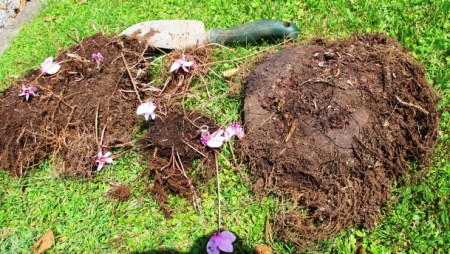
2) And on the theme of having too much of something, no matter how good, I need to finish my radical thinning of the black mondo grass (ophiopogon) and the cyclamen hederafolium which seem determined to try to choke each other out. The mondo grass goes on the compost heap. The large cyclamen corms I am laying as ground cover in an area where I have given up on both Rubus pentalobus (orangeberry) and violets which both proved to be too strong growing.

A fortnightly series first written for the Weekend Gardener and reproduced here with their permission.

Tikorangi Notes: Friday 17 February, 2011

Latest Posts:

It rained heavily earlier in the week - very heavily

It rained heavily earlier in the week - very heavily

1) Lunacy or of horticultural merit? Planting by the moon – Abbie’s column. I expect some fallout from this one. Back in the days when I used to write for the local paper, we received many more phone calls from locals. One gentleman rang, urging me to write a piece on planting by the moon. He sponsored an African child and he was very confident that if he could just get the entire African village planting by the moon, it would solve all the problems of famine once and for all. When I demurred and suggested I wanted to see some independent, scientific proof, he felt sorry for me, that I was so duped by science. I quickly hung up on the nutter.

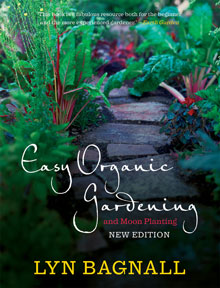
2) In for a penny, in for a pound: a review of “Easy Organic Gardening and Moon Planting” by Lyn Bagnall. A little too much smoke and mirrors for my taste.

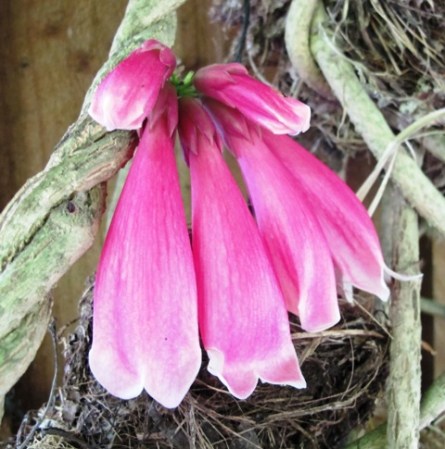
3) The lovely tropical Tecomanthe venusta is featured in Plant Collector and is flowering here, even though we are far from tropical.

4) Growing oregano and marjoram, what the difference is and the most likely way of intensifying the flavour in GIY.

Bet mine are larger than yours - Cyclamen hederafolium tubers

Bet mine are larger than yours - Cyclamen hederafolium tubers


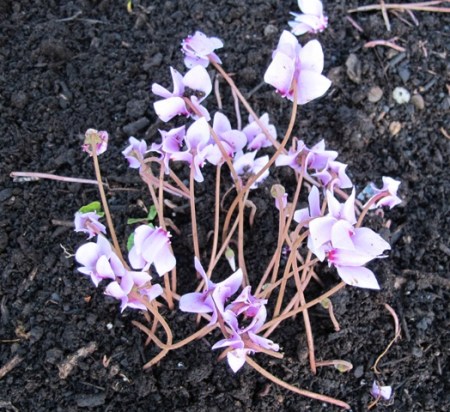
A mere taste of what is to come

A mere taste of what is to come

Tikorangi Notes: Friday 17 February, 2011

The cyclamen photo is because I finally finished rustling up the surplus Cyclamen hederafolium to carpet an area as ground cover. I needed quite a few to cover about 14 square metres but it helps when you find enormous tubers which measure over 20cm across. It takes many years for them to reach that size. They should be looking very pretty in a few weeks time with the first flowers showing already. This is my third attempt to find the perfect groundcover for that particular bed.

It was sad this week to hear that the Weekend Gardener magazine is now in the hands of liquidators – and I don’t say that just because I had a fortnightly writing contract. The gardening media market will be the poorer without it. Fundamentally, I think Weekend Gardener suffered from a split personality. While some aspects remained about as downmarket as they could be (particularly the DIY project using Resene products each fortnight where you too could replicate something astonishingly ghastly), there were an increasing number of interesting stories and features. The just retired editor, Susie Longdell, did much to lift the horticultural status of the magazine and steered clear of the cult of the personality. But in the end, it appears it was not enough to win sufficient subscribers to keep it viable. A pity.

The second most read article on my website is the piece I wrote about plagiarism – The Tui NZ Fruit Garden – dear oh dear. It still gets hits every single day, despite Penguin’s apparent attempt to pretend it never happened. Thanks to a reader, I am now hot on the case of another plagiarised book which may prove to be just as bad. Watch this space.

Lunar planting – your very own personal organiser

Mark has had A Revelation. If he turns around three times in an anticlockwise direction in front a pot of fresh sown seed, the seed germinates and grows more rapidly. He is fairly sure this has something to do with channelling cosmic energy and just to prove it, he is going to sow two pots at the same time but hide one around the corner so it can’t see his actions. He is confident that the seed that has received the special attention will grow better and this experiment will give conclusive scientific proof.

Silly? Of course.

We have been looking at planting by the moon, in an attempt to see if there is any independent evidence to back up the claims. We are seeing lunar gardening being featured ever more widely in this country, almost to the point of becoming mainstream. Is there any scientific foundation to it? Not that we could find. Well, there is the work by Nicholas Kollerstrom but there is a bit of a credibility gap with him – he being best known as a leading Holocaust denier. Beyond that, it is all affirmation, testimonial and anecdote.

We could comprehend the theory that the times when the moon’s gravitational pull is at its strongest are the best times for plant growth. I don’t say we believed, but we could understand it. What we failed entirely to get a grip on was why this meant you could ONLY plant at this time for best results. Some seeds can take a long time to germinate. If you planted them two weeks early (when the gravitational pull is weaker), what is to stop them just sitting there waiting until the time is right? Why are they allegedly so disadvantaged when compared to seed planted 14 days later at the right phase of the moon? Logically, should not the gravitational pull be a deadline, not a tight time frame? We also failed to get to grips with the differentiation between the positive forces of a waxing moon and the negative forces of a waning moon when the gravitational pull is roughly equal at various stages.

There is a fair amount of wiggle room. There does not seem a definitive source of guidance so beyond the principles of gravitational pull and the lunar influence on tides, most other interpretations appear to be flexible. Some claim that you should only water on a waxing moon, others that if you mow your lawns or clip your hedges in the last quarter, you will slow regrowth. This might be termed residual effect? It appears that timing is everything and we can indelibly affect the long term behaviour and subsequent performance of plants based simply on the exact timing of planting, pruning and other gardening activities.

It didn’t get any better when we delved further. Fertile and barren days are apparently linked to the zodiacal belt. You know, the signs of the zodiac. That is astrology and you have to be of a certain ilk to take astrology seriously in your daily life.

We came to the conclusion you have to be a believer. Planting by the moon in modern times has more to do with pagan moon worship than scientific fact. And it arouses great passion and devotion amongst followers, a sense of belonging and a belief that all will go well – as long as you follow the rules.

Ancient practice alone is not validation. We are so selective in our use of history. Fortunately we no longer think that sacrificing the odd virgin or two will bring better harvests. In the days before calendars and clocks, it is likely that the ancients did indeed use the moon’s phases to determine planting times, along with other factors like day length, temperature change and seasonal rainfall. Productivity and harvests have long been wrapped up with religion and both the moon and the sun were objects of veneration. How curious that moon worship has persisted in this form and remains a major source of spiritual inspiration.

And yet, just as the outcome of biodynamic practices can be sound organic land management no matter how flaky some of the underpinning rules appear to be, so too can planting by the moon have beneficial outcomes. As far as we can see, it is the perfect tool for people who need deadlines to get themselves organised and motivated. “You must plant this carrot seed within the next three days or you will have to wait another month by which time it will be too late.” You obediently follow instructions. Whereas the non believer procrastinates and delays, thinking there is still plenty of time, so often doesn’t get around to planting the seed at all. Lunar planting is your own personal organiser but, as far as we can see, it does not actually have anything to do with the moon’s gravitational pull.

Organics, biodynamics, permaculture, planting by the moon – these are all ways of encouraging sound gardening practices which enhance the environment rather than harming it. I just wish some of the proponents and their devoted followers didn’t feel the need to use pseudo science to try and justify what are sometimes faith-based gardening systems.

First published in the Waikato Times and reprinted here with their permission.

Photos for this article here have been sourced from Wiki Commons. Photo credit for lunar eclipse time lapse: A. Skorochod.

"Easy Organic Gardening and Moon Planting" by Lyn Bagnall

Easy Organic Garden

Easy Organic Garden

This is organic gardening as carried out by a dedicated moon planter but easy it is not. The author subscribes to the why-use-one-sentence-when-you-can-use-ten school of writing. It is very long and wordy, filled with so much detail that even the experienced and knowledgeable gardener can end up seriously baffled. You need to be a believer to want this book. As it is in its second edition, there are either a fair number of believers out there or there is a thirst for knowledge on the topic of organic gardening. I suspect the latter but I am not convinced this book will give the answers.

I am very keen to see books which will separate the organic gardening concepts from faith and mystique. Psuedo science does not do it. Nor do sweeping statements. When I read statements like: “I must confess to not fully understanding the science behind this particular portion of moon-planting principles, but I do know it works in practice,” I start to worry. The author is referring to the changed polarities of yin and yang in Virgo and Libra. I get irritated by the careless use of the word chemical as a synonym for all that is bad and destructive in gardening. A chemical is simply a substance or a compound. In itself it is neither good nor bad. I raised my eyebrows at the claim that synthetic fertilisers lock up essential nutrients in New Zealand soils. Really?

I am all for sustainable gardening practice and I think it is all to the good that we are questioning some pretty dodgy habits. If you are willing to drill down into this book, it promotes good environmental practice, aimed at the author’s homeland of Australia. It covers both ornamental and productive gardening and even has a helpful section on bushfire season. There is just an awful lot of smoke and mirrors to get through first and the husband still doubts that it is possible to get a tomato crop through in our climate without a little non-organic intervention.

(Scribe; ISBN: 9781921372605)

First published in the Waikato Times and reprinted here with their permission.

Plant Collector: Tecomanthe venusta

The pink bells of Tecomanthe venusta

The pink bells of Tecomanthe venusta

We are so excited by our Tecomanthe venusta in bloom. That is because it is tropical but we are not so it doesn’t often flower for us. And I have to admit that there are only a few clusters of these pink flowers in evidence. A garden visitor once told us there was a specimen at the entry to Whangarei Gardens’ glasshouse which flowers magnificently. We have not seen it but it would figure that it is happier further north because it originates in New Guinea and is the most cold-sensitive member of the tecomanthe family, all evergreen climbers in the bignoniaceae group.

The tecomanthe family is not large and some readers will know our own T. speciosa – a tender but rampant climber which was found in the wild as a single, surviving specimen on Three Kings Islands. It needs a frost free position which rules it out for most inland locations and it needs a bit of training and management if you want to see the lovely creamy trumpet flowers. It will shoot up the highest tree available and flower only at the very top if left to its own devices, but if you train it along a horizontal support, it can be encouraged to flower along its length.

Back to T.venusta. We grow it under the cover of a deep verandah with opaque roofing. When it does decide to flower, it puts out clusters from its bare vines, which is very obliging because they are so obvious. Most plants set flowers on either new growth or last season’s growth but venusta appears to be quite happy to do it on gnarly old growth. We get a far more spectacular display in spring from the species we have as T. montana, also from New Guinea, which is grown in the same conditions but there is a delicious unpredictability to venusta.

First published in the Waikato Times and reprinted here with their permission.