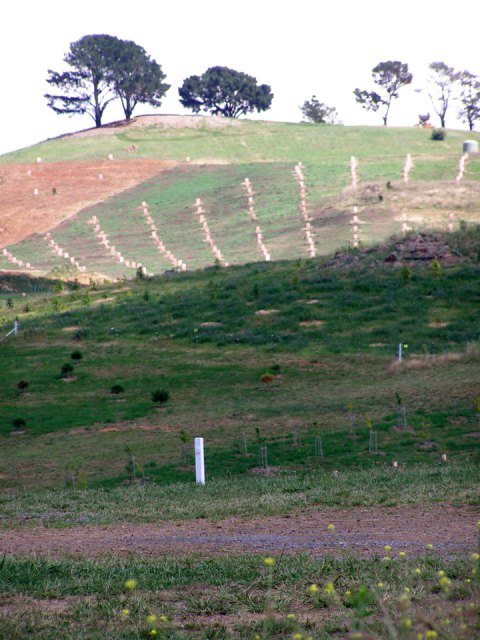
Not a lot to see yet - the national arboretum
Sometimes we parents just have to accept that we have lost our children to the western continent. With two daughters now across the Tasman, we are philosophical that at least they have not chosen to live in Perth (long haul flight) or further afield in the northern hemisphere. New South Wales and ACT are as easy to get to, and often cheaper, than the bottom of the South Island. We headed over for some family bonding last week. This was our first visit to Canberra in warmer months. Mark had been underwhelmed by his previous visit in winter (it is cold, very cold) but it was a great deal more charming at the end of an unusually wet summer.
Canberra is a city of wide boulevards and many trees. How we wish that New Zealanders would be so tolerant of trees. But Canberra is a designed city and the butt of many jokes in Australia, seen as dull and lacking in soul. Its designer was in fact an American, Walter Burley Griffin. While his Canberra creation may be scorned by non residents, his other talents apparently included introducing the world to the ubiquitous carport and the L-shaped floor plan for housing so he certainly left a legacy. His city plans for Australia’s capital included an arboretum and it is only now, seventy years after his death, that his vision is being realised with the implementation of a plan for 100 forests and 100 gardens. I am a bit suspicious of the future of 100 gardens which will require considerably more maintenance than the 100 forests. Pragmatism and economic issues may determine the future of that aspect of the plan but they are well on track with the forests.
An arboretum is a collection of woody plants, predominantly trees. It usually has a strong conservation and educative function and encompasses a wide array of different tree species with particular emphasis on those that are rare and endangered. Our best known arboretum in New Zealand is Eastwoodhill, just inland from Gisborne. The national arboretum in Canberra is a somewhat different vision, although they certainly acknowledge the guiding rules of arboreta. There were three principles governing tree selection. Varieties either had to be rare or endangered (such as Australia’s own iconic Wollemi pine), of ethno-botanical significance (not sure what that means), or symbolic in their countries of origin. That last criterion seems to have governed a fair number of selections, partly because overseas embassies have been encouraged to become involved. This would explain the plantings of varieties such as Ginkgo biloba, Parrotia persica, Cedrus libani (the cedar of Lebanon) and Acer saccharum (the sugar maple). In addition to the selection criteria, varieties had to be capable of surviving Canberra’s climate which can get up to 40 degrees in summer and drop to minus 10 in winter, along with being dry, very dry.
The impetus for the arboretum is worth noting, as this country struggles with the aftermath of the Christchurch earthquake. It was the devastating impact of the 2003 bushfires around Canberra. I remember them well because our daughter headed back after Christmas just as those fires were starting – a source of some angst to her parents back home as the reports of the fires licking at the outer suburbs and destroying the surrounded countryside featured on our news. I saw the aftermath some months later on a visit. Amongst other destruction, the fires took out the pine plantations which had been planted on the land originally earmarked by Walter Burley Griffin for the arboretum. The space was cleared and the need for a symbol of recovery from disaster led to the arboretum plans being put back on the table. This being Canberra and the seat of government, it was not to be a state arboretum. No, like most other Canberra institutions, it was designated a national arboretum from the start. The area is 250 hectares on the outskirts of the city. The first 65 forests have seen 30 000 trees planted.
It is easy to be cynical. Much of it is mass planting of single species in rows – described to me as a rather industrial approach. The cherry tree selected in conjunction with the Japanese ambassador is Prunus x yedoensis – 320 of them in fact, planted en masse. Some might think that a whole range of different flowering cherries might have been more interesting but it is, apparently, to be 100 forests of 100 different tree varieties (one type per forest). Who are we to argue? This is a grand vision and over time, as the trees gain in stature, it will be an impressive sight indeed.
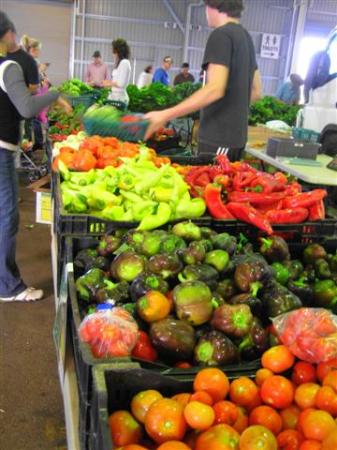
Simply the best farmers' market I have seen
Our forbears in this country had the vision to plan public areas and plantings. That is what gave us our beloved Pukekura Park today. But we are not continuing with new plantings and new areas on any large scale. In this country, arboreta are commonly the work of dedicated private individuals. We appear to lack the will to continue to do public plantings of significant trees in any number for future generations.
While in Canberra, Daughter took me to the best ever farmers’ market I have seen. Huge, apparently quite loosely organised, enormously popular and fascinating. Daughter loves it for the unsurpassed, genuine chai latte sold at one stall and because, if she gets there early enough, there are usually backyard vendors with seasonal curiosities like fresh mulberries, loquats, her much-missed feijoas, and, on the Sunday we went, different varieties of fresh figs. I would shop there if I lived in Canberra.
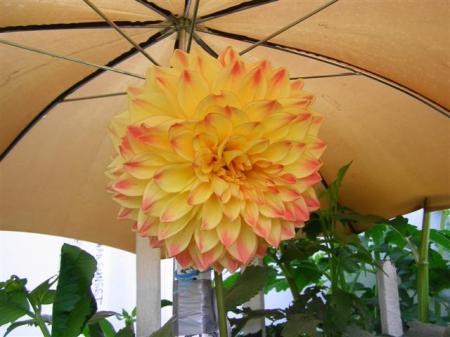
Protecting the dahlia blooms
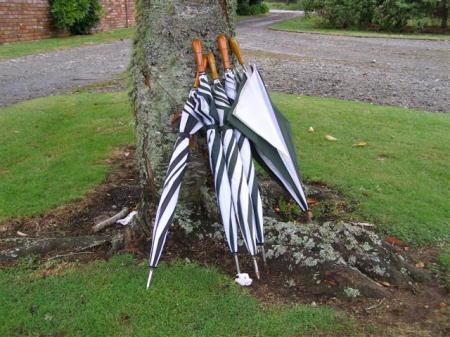
Whenever we are travelling, we also try and check out local open gardens, partly to establish international benchmarks of quality for comparison to our local festival gardens. Australia has adopted an open garden structure closely modelled on the Yellow Book scheme in the UK where selected gardens will open for charity one or two days of the year. We drove out to the ‘burbs to see one such garden and handed over our $A6 each. In the back garden there were only show dahlias – large quantities of beautifully tended dahlias, all in pots. I was particularly taken with the umbrellas erected over selected plants to protect their show quality blooms. Dahlias may be staging a bit of a comeback in the fashion stakes but we can’t get too excited over them so we were relieved to find more traditional mixed plantings at the front of the section. It was a nicely presented garden, not exciting, but served as a useful reminder how pleasant it is to be able to chat to the garden opener. In this case, he was both knowledgeable and genial.
Garden visiting in New South Wales will have to wait for a future column.
-39.042098
174.300314