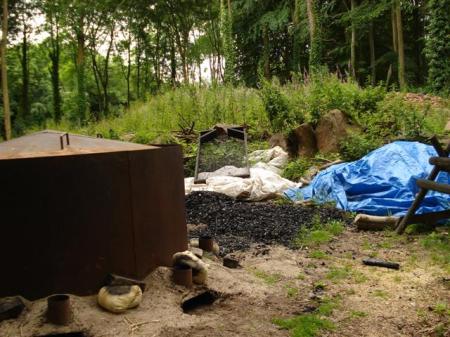
Reality didn't quite match the romantic mental image - charcoal making at Hestercomb
Prime Television appears more willing to deliver gardening programmes to us than TV1. Clearly the head of programming on the state owned channels is no gardener – maybe we just don’t fit the target demographic? It seems a long time since we have had any garden programme, good or otherwise, on state-owned television but Prime are currently running a doco series on the famed Sissinghurst Garden on Friday evenings.
For those of you not in the know, Sissinghurst Castle Garden in Kent is one of England’s most famed. Created in the first half of the twentieth century by a flamboyant and eccentric couple, Harold Nicholson and Vita Sackville-West, it was cutting edge in that very pretty, flowery style the English do so well, confined within tight, formal design. It certainly helps to have huge walls and castle remnants including a splendid tower. Alas it fell prey to England’s savage inheritance taxes so the Nicholson and Sackville-West progeny could not afford to keep it in private ownership in the 1960s and it was given to the National Trust with the proviso that the family be allowed to occupy the house for up to three generations. The current occupant is the grandson, Adam Nicholson and his wife Sarah. It does appear that Adam sees himself as the guardian of their dream though it is the National Trust which provides the money and the labour force to maintain the dream. The rather drawn-out series is worth dipping in to even if you don’t find it sufficiently compelling to last the full hour each week.
You need Sky and the Living Channel to tap into some of the other back to nature lifestyle programmes coming out of Britain these days. I think it was a Grand Designs episode (also screened on TV3) that finally spurred Mark in to some serious attempts to get to grips with sustainable woodlots. We watched one man hand building his house primarily from green chestnut, harvested from his sustainably managed woodland. In New Zealand we are so used to the notion of kiln drying or air drying timber to season it, that there is little knowledge about which timbers can be used freshly cut and still wet. That is what the term green oak and green chestnut refer to, though to use fresh-cut timbers you must also understand the way each different wood will react as it dries out. We are not talking pinus radiata here.
I don’t think Mark is intending to go into building, but he is certainly interested in sustainable woodlots at a lifestyle block level. We get through a lot of wood here (most of it burned for heating) and while we are currently self sufficient in firewood, we can take that principle further.
Then there is the series on Saturday evenings on the Living Channel where selected candidates learn traditional English crafts. It is hosted by Britain’s very own Expert on Many Things, Monty Don. The first programme was fine – it had the participants learning traditional methods of making furniture using green woods (naturally from a sustainably managed woodlot). The chairs they made were delightful and I would be more than happy for Mark to get back into working with wood. He used to do a lot of it in the days before we had expensive children to maintain and he had more leisure. In fact he became an accomplished wood turner and we still have his lathe in the back shed though it has lathered there in pieces for thirty years under the delusion that he will get back to it. He bought it when we lived in Dunedin and it was entirely rebuilt for him at no cost other than a couple of turned lamp stands by someone who knew someone who worked in the Hillside Railway Workshops. Back then they called such freebie jobs “foreigners”. We still recall those railway workshops most kindly though Richard Prebble’s analysis of how New Zealand Railways operated was probably closer to the mark than many people knew.
The third programme in the series was safe enough – blacksmithery or forging. Mark watched with deep fascination and commented that they made it look really straightforward but I don’t think he is going to get diverted into ironwork. Nor to weaving or leadlighting which have also been explored.
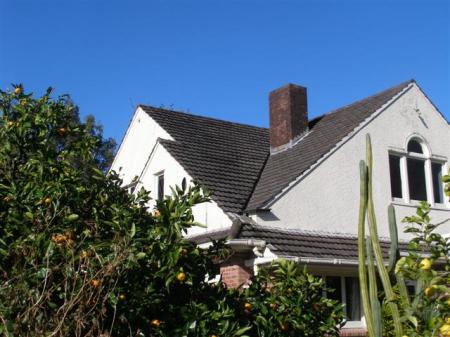
From this (1950's concrete roof tiles)....
No, it was the second programme that is causing me some angst – thatching for beginners. Everybody knows that traditional English thatched cottages are unbelievably cute, genuine chocolate box cute. It is just so much more aesthetically pleasing and indeed environmentally sustainable than our long-run roofing iron. And the life expectancy of each layer of thatch is about the same as roofing iron – forty years or so – though finding a skilled thatching team to repair your roof is harder than finding a team of modern roofers. It should be said that apparently you don’t replace your thatch, generally you just add another layer to waterproof the roof. The principle is that the thatch is packed so tightly that it directs the water downwards and sheds it quickly.

... to this, maybe (thatched cottages at Hidcote)
You don’t want a house fire. I have seen a burned out shell. Once the thatched roof catches, it is impossible to quench. Beneath the more recent layers, there may be dried straw or reeds which are 500 years old. Personally I am a bit worried about spiders and mice too. And maybe other livestock. I feel that the dry and warm under-layers of thatch may be altogether too appealing for them and they might set up home en masse.
So I began to get a little worried by the level of interest Mark shows in thatching, more than a little worried when he commented that he felt our house would look a great deal more appealing with a thatched roof. He has even tried making one of the packed bundles which are the foundation of thatching. With a gleam in his eye, he announced that he could now see a use for his buckwheat straw. It was with some relief that I saw the straw recycled as mulch for the strawberries and he observed that maybe he would be better to start with a smaller project than the house, perhaps a thatched dovecote.
We have yet to get an episode on making charcoal but I am sure it will come. The British are big on charcoal and, in the near absence of the gas-fired barbecue, charcoal is still popular (though these days it is more likely to be cheap charcoal imported from defoliating third world countries). We realised that charcoal-making is undergoing a renaissance when we visited Hestercomb near Taunton last year. The garden map showed a site for the making of charcoal. We were inspired. We even bought a book on the topic – this could be the novel activity to attract additional visitors to the garden. Or so we thought, until we came to Hestercomb’s charcoal campsite. The only aesthetically acceptable aspect was the repro charcoal maker’s hut which may have been cold and drafty and minus a resident charcoal maker but it was at least quaint. No, we figured we would leave the making of charcoal to the Taranaki Regional Council. It seems a suitable activity for the folksy rebranding of their garden at Kaponga. I wonder if I should offer to loan them our book on the topic?
-39.042098
174.300314

 1) This tree aloe (Aloe thraskii) is in the wrong place and has been for at least fifteen years. Large plants can be moved, but this involves taking a large enough root ball to support the top. It is best carried out between late autumn and early spring so that the plant has a chance to settle in and put out new roots before summer.
 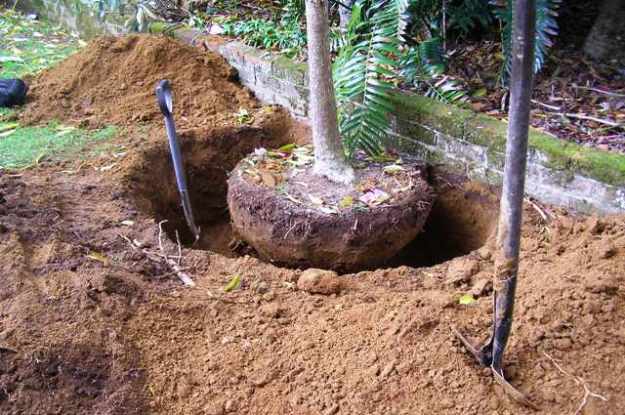 2) A large trench needs to be dug out, wide enough for you to stand in. This trench is around 60cm deep. Dig it with straight sides to start with. It allows you to look at the plant’s roots and to get access right underneath the plant. Keep it well out from the plant because you can make the root ball smaller but you can’t make it larger again.
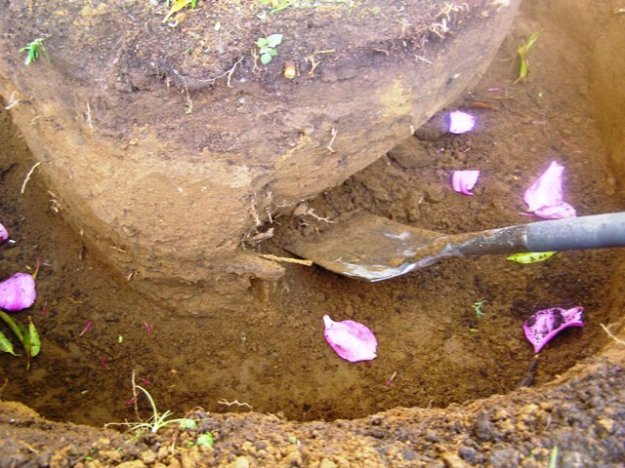 3) Standing inside the trench, start digging to excavate right underneath the plant. We wanted to keep the root ball relatively whole to act as an anchor because this plant is very top heavy. Gradually reduce the size of the clump, removing excess dirt, keeping a close eye on the root system. If it has a huge root system, you don’t want to be cutting into it too much. If it has a smaller root system, you can reduce it to a size that is more easily managed. We were surprised at how small the root system was on this plant and they were mainly on the surface.
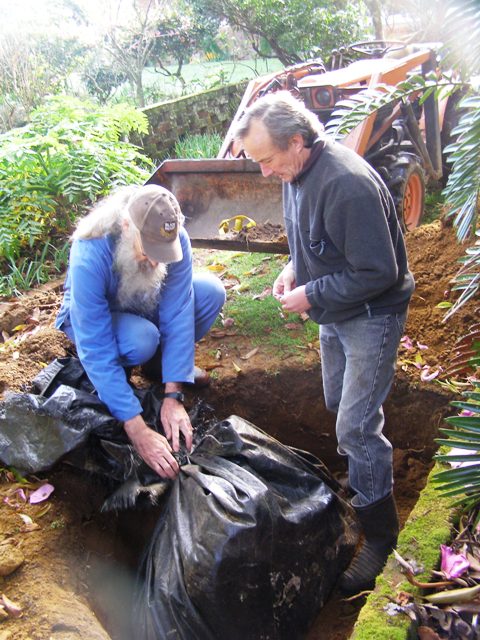 4) Get some heavy plastic, sacking or old weedmat underneath the plant. Do this by rocking the plant to one side and getting the wrapping right underneath it. This usually requires more than one person. Do not let the roots dry out at any stage. With very big plants, the plant can be raised out of the hole by tilting it to one side and backfilling that side. Then rock the plant back and put dirt in on the other side. Repeat the process until you have raised the plant to the level where you can lever it out of the hole more easily. We moved this plant on the front bucket of our baby tractor. You may need to do it by trailer.
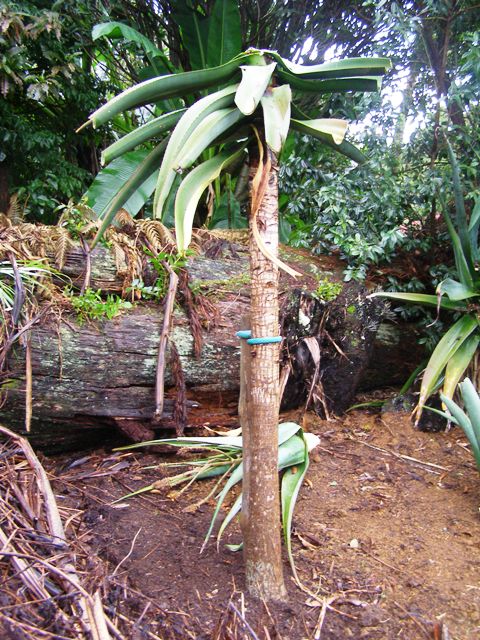 5) In this process, we had an accident and the heavy top was knocked out so we were forced to cut the the poor aloe back but there is no reason why it should not recover. Get the planting level as close as possible to where was. Measure the depth of the root ball and the depth of the hole before planting by placing a board across the hole and measuring from that. Put the stake or stakes in before the plant so that you do not cause more damage to the roots by driving the stakes through them later. We have gone for one very strong stake and a flexible tie.
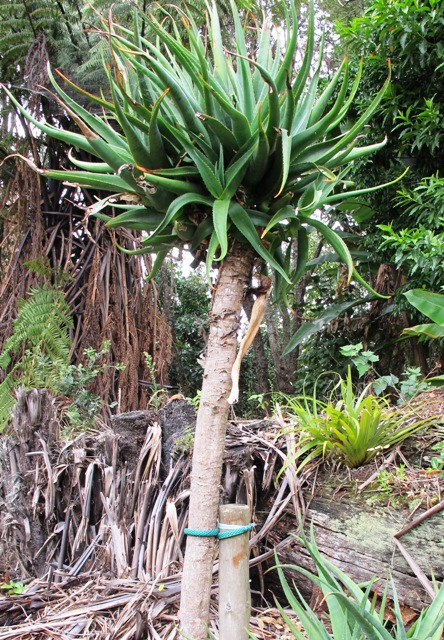 6) Two years later and the plant is recovering well although the foliage has yet to reach its former spread. It should now be safe to remove the stake.




 Tikorangi The Jury Garden