The delight is in the detail

We like a detailed garden, we do. It is not just the big views that catch our eye. Often it is the little delights – tiny, even – that focus our eyes on the close-up. It is possible to have a highly detailed garden without it descending into fussy clutter.

Here we are in midwinter and the small bulbs are bursting into flower. No, this is not early; nor is it a sign of climate change. It is on cue for an area where our winters tend to be mild and lacking in extremes. Goodness knows, we complain as much as anybody about cold weather, dreary days, rain and wind but the plants tell us that it is not as bad as we think.

In the days when I used to write for the Waikato Times, we had a sheltie dog who quietly photo-bombed many a picture. Now we have Ralph channelling the spirit of the late Zephyr, except he is a boisterous photo bomber.

The swathes of snowdrops and dwarf narcissi that we have in areas of the park are only just showing first colour because it is colder on the south facing slopes but there are plenty out in the cultivated areas of garden that are noticeably warmer.

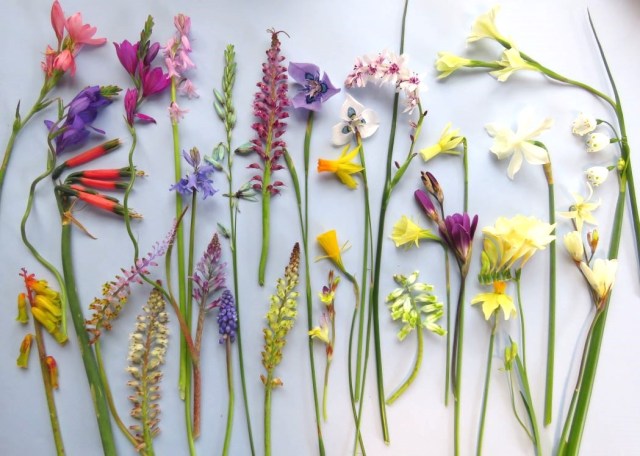
I started with the snowflakes and an obscure scilla that flowers earlier than the more common bluebells. The snowflakes – leucojums – are often taken for granted as robust survivors that are inferior to the more desirable snowdrops (galanthus). This is unfair to them because they are very different as a garden plant and under-rated, especially when we consider their extended flowering season.

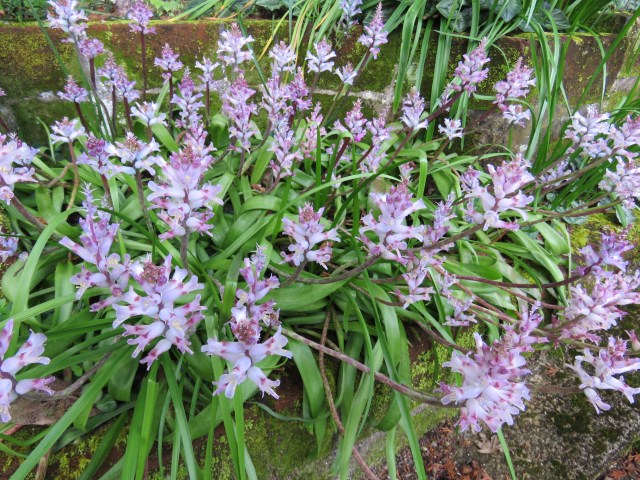
I am fine with under-rating this particular scilla. Its only redeeming graces are that it is pretty to pick and it is the very first to flower. It isn’t worth garden space – far too much foliage for the number of flowers – so it has been banished to the wilder margins. We used to have a collection of species scillas – there are a lot of different species – with names like greilhuberi, hohenackeri and litardierei but I think they came to us under incorrect names even before we lost the names. I have no idea which one this is.

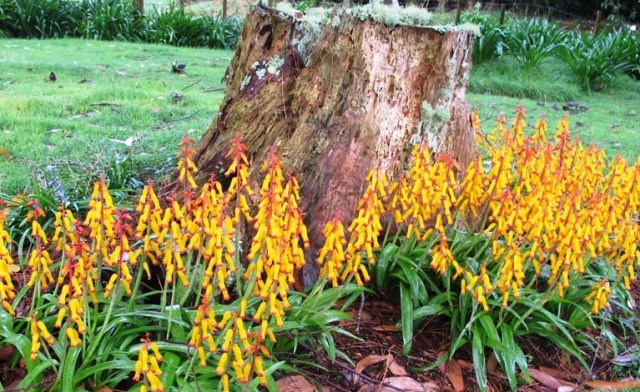
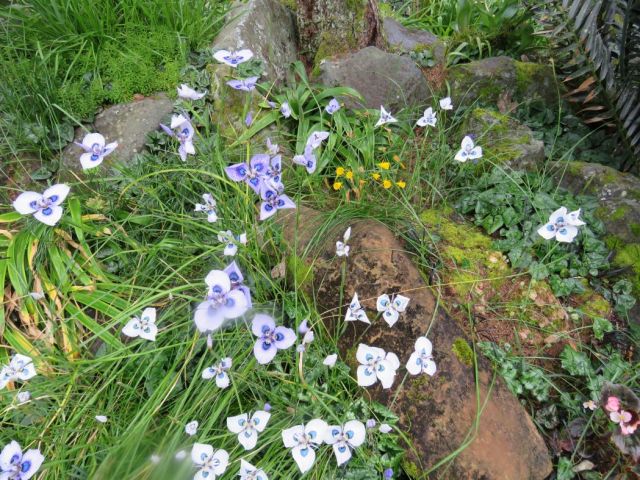
I added in the early flowering lachenalias to the flower lay. We still have an extensive lachenalia collection which flowers for us from now through to early November. Some are much easier to keep going in the garden than others but these early ones are toughies which will withstand competition and meadow conditions. The more collectable blue and lilac forms flower later. From left to right we have the most common, robust, cheerful but vulgar Lachenalia aloides (still sometimes to be found mislabelled as Lachenalia pearsonii),  the somewhat more refined Lachenalia aloides quadricolour (quad = four colours, in this case orange, yellow, green and burgundy), the red Lachenalia bulbifera and finally the yellow of Mark’s L.reflexa hybrid.

Sometimes I think I would have enjoyed being an illustrator or a graphic designer specialising in pretty florals but nothing can compare with the ephemeral charm of living flowers.

In a world where the news just seems to get more complicated and worse by the day, where things feel as though are spinning out of control, I find dainty flowers can be a welcome diversion. They don’t come any prettier than snowdrops, cyclamen and little narcissi. The snowdrops are a mix of Galanthus ‘S Arnott’ and G. nivalus which are our two mainstay varieties that perform in our area where we don’t get much winter chill, let alone snow. The cyclamen is C. coum which, according to Wikipedia, has the common name of ‘eastern sowbread’. I am not even going to ask who calls it that and why. While they might have wild sows in its native habitat around the Black Sea, the corms are so small and its rate of increase slow so it is unlikely that would ever make much of a food staple for browsing animals.

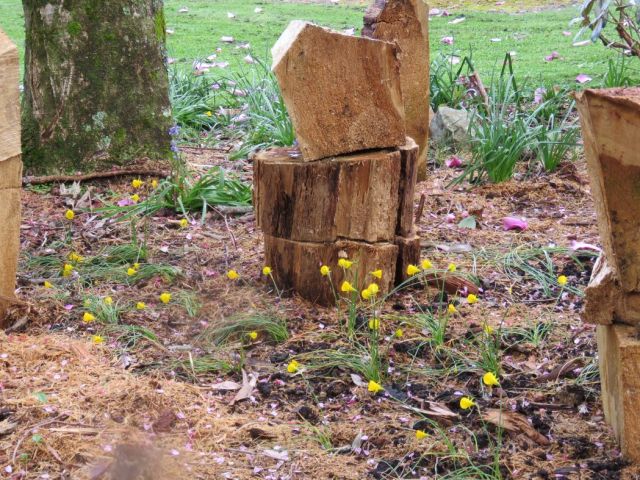
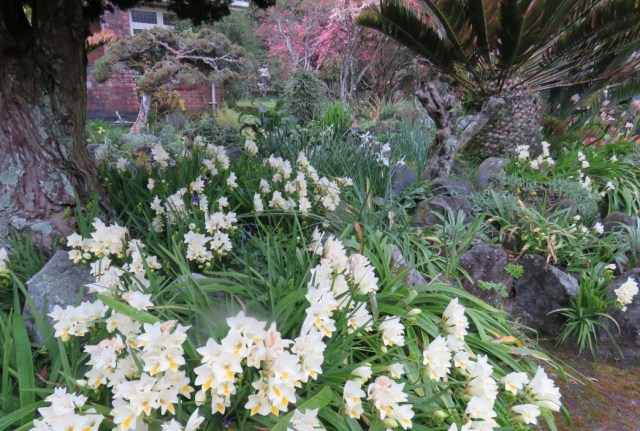
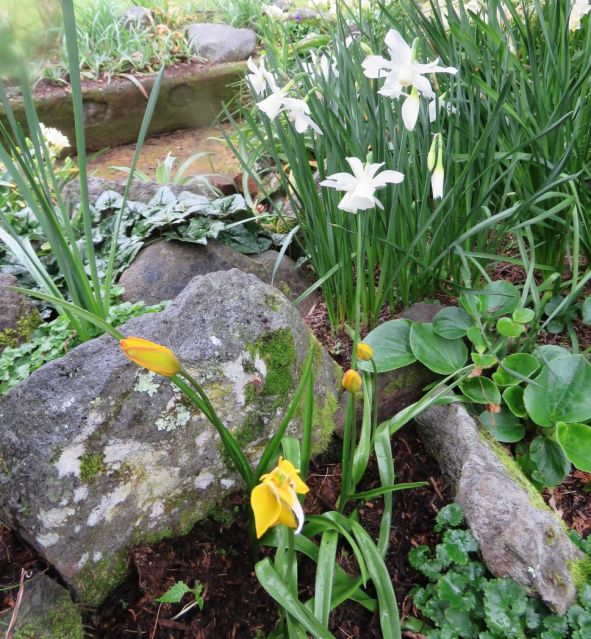
The narcissi are a mix of species and hybrids. My preference is for the cyclamineus types with their swept-back, reflex petals but the earliest jonquils in both yellow and white are deliciously fragrant and the bulbocodiums or hooped petticoats are also very charming.

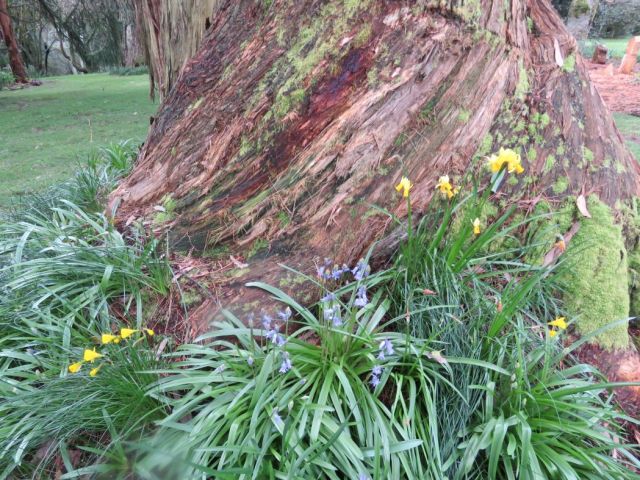
Zach has been lifting surplus bluebells to make way for more desirable snowdrops and baby daffs in the area we refer to as the hellebore border. I suggested he could rehome some of the bluebells – thugs that they are – into the area by our gate where the giant eucalypt came down in February’s Cyclone Dovi. Over the years, I had planted a fair swag of surplus bulbs around the base of the old gum.

When he had finished, I couldn’t work out what the white patch was until I got up close. Buried bluebells, obviously from an earlier planting. Deep beneath the soil that had become displaced by the falling tree, some had leaves 30cm long and still not breaking the ground into the light.  I knew they were tough but that shows a high level of survival skills.

I have spent some time in the past working out the differences between the highly desirable, scented English bluebell and the dominant Spanish species and came to the conclusion that what we have are predominantly Spanish (Hyacinthoides hispanica), maybe with some Spanglish hybrids. They will not flower until mid spring.

We still have the worst of winter to get through but the earliest spring bulbs are a daily reminder that we are on the right side of the solstice already.

Finally, welcome to new subscribers who came this week after reading this recommendation from Julia Atkinson-Dunne. May you enjoy what you read and see.

A little bit of Tikorangi on Corrie

Sometimes life can throw up little surprises. I saw a clip from Coronation Street come down my social media, a tribute to the victims of the 2017 bombing at the Ariana Grande concert in Manchester. Gail Platt and Eileen Grimshaw were laying flowers at a bench commemorating Martyn and other victims. Martyn Hett, a real life victim of the bombing and a great Corrie fan reportedly had a tattoo of Deidre Barlow.  It is a poignant moment on that long running television soap opera.

Yellow Wave! In poll position centre foreground

What caught my attention was the plant of Phormium ‘Yellow Wave’ in prime position in the scene. Ha! A little bit of Tikorangi on Corrie! ‘Yellow Wave’ is one of the earliest of Felix Jury’s plant breeding efforts and arguably the most widely grown internationally, although not so often attributed to the breeder. All one minute 21 seconds of the clip can be found on Facebook here and on YouTube here.

In Aotearoa New Zealand, we know the phormiums as flax in English or harakeke in Maori. They grow widely throughout the country but ‘Yellow Wave’ was one of the very first compact. variegated cultivars to be released on the market. It wasn’t released by Felix. He was never a nurseryman and he never received a single cent for the plant. This was back in the late 1960s or early 1970s before there was any provision to claim plant variety rights or a plant patent over a new cultivar. We have always quipped that such is its international popularity, had he received just one cent per plant sold, he would have been a rich man. It received an Award of Garden Merit from the UK Royal Horticultural Society.

I made Mark pose beside Phormuium Yellow Wave at RHS Rosemoor in the UK in 2017

In this country, the flaxes tend to get a spotting on the foliage that rather detracts from their looks but they keep very clean foliage in other climates. Maybe this is why we prefer the newer dark burgundy and black phormium cultivars as garden plants? Also, we do not have a love affair with variegated plants.

I have used some of the newer burgundy to black phormiums in the new Court Garden

Felix went on to breed with astelias and cordylines in preference to the phormiums and Cordyline ‘Red Fountain’ continues to be very successful internationally. It is likely that in total numbers produced, sold and grown, ‘Yellow Wave’ eclipses that and we have often seen it growing overseas. I just did not expect to see it on Coronation Street.

Nga Puawai o Matariki or The Flowers of Matariki

Hippeastrum aulicum

After I posted last week’s piece about Matariki – the Maori new year, the winter solstice and Magnolia campbellii, a loyal reader commented that no magnolias are opening where he lives so he went looking to see what could be his Matariki flower. He settled on Mark’s Camellia ‘Fairy Blush’ which felt like an honour to us.

I like the idea of people determining their Matariki flower. We had our first ever public holiday to mark Matariki last Friday and for many of us, it was special. Not only does it mark a point in time that is significant both spiritually and scientifically to the first people of the land here, it is the only public holiday that has a nation gazing at the stars and taking an interest in astronomy.

Friends invited us to lunch to celebrate the occasion. Home entertaining is back in these Covid times, at least for our demographic. I took a bunch of Hippeastrum aulicum and our hostess commented that she had no flowers in her garden. This wasn’t quite true. She had Alstromeria  ‘Indian Summer’ still blooming but nothing else I could see. It inspired me to come home and walk around the garden with my camera to capture some of the flowers we have in the depths of mid-winter.

A vireya rhododendron seedling

The subtropical rhododendrons are blithely unaware of the seasons, except for frost which makes them turn up their toes, and we have them in flower all year round. We have a mix of species, named hybrids and unnamed seedlings from crosses Mark has made. This is an R. hellwiggi seedling which means it is also sweetly scented.

Constant companion, new dog Ralph

Everywhere I go in the garden, Ralph is at my side. He does not, alas, show any respect for the garden at all and this morning knocked off the first open flower on a dainty dwarf narcissus. We have some work to do teaching him to respect garden boundaries.

Luculia ‘Fragrant Cloud’

It is luculia season and my favourite of these is the almond pink, scented blooms of ‘Fragrant Cloud’ which has a very long flowering season but generally flops if I cut them to bring indoors. I could do without the yellow totara to the left of the scene but the red form of our native cordyline works well. This luculia is rangy, brittle and lacks any merit in its form as a shrub but all is forgiven when it flowers.

Schlumbergera or chain cactus

Right at home under the rimu trees is the schlumbergera, commonly called chain cactus. We have a few different colours but this cerise form is easily the most obliging and showiest of them. These are plants that thrive in dry shade and, despite the cactus reference, have no prickles and spines. They are also dead easy to increase by just snipping off a length and tucking into a crevice with a bit of leaf litter to root into.

Camellia ‘Mine No Yuki’ with hanging tillandsia

It is of course camellia season and this is why I don’t love Camellia sasanqua ‘Mine No Yuki’ at this time of year. It doesn’t shed its spent flowers because the foliage is so dense and they sit around looking brown and sludgy. We only keep the plant because for the rest of the year we clip it tightly into stacked clouds and it justifies its existence for the form of the plant and healthy foliage. The flowers are a disadvantage, not a bonus as far as I am concerned.

That is a fine form of Spanish moss or tillandsia threaded on inverted, old, wire hanging baskets – a trick I learned from an Auckland gardener several years ago. His were more loved than mine but they add a detail suspended from the camellia branches.

Camellia yuhsienensis

We love Camellia yuhsienensis far more, enough to grow a fair number of them as specimen plants, particularly for winter interest in the Summer Gardens. It is meant to be strongly scented but it needs a warm day and a nose stuck right in the flowers to get much of a whiff so that is a bit hyperbolic. However, the bees love it and anything that feeds the bees in midwinter is a good thing.

Dudley and Ralph

I reached the the Summer Gardens and Dudley had risen from his retirement bed to join Ralph and me. Duds is a quiet, old dog and the arrival of Ralph has come as a bit of a shock to him but they co-exist harmoniously. Dudley has made it clear that ALL dog beds are his while Ralph has laid claim to all the dog toys and already destroyed some that had survived years of Dudley’s more gentle play.

The Court Gardens in midwinter

I was focusing on flowers that are coming out or at their peak in midwinter rather than the carryovers from autumn but I made an exception for the yellow Salvia madrensis which makes a great autumn/winter plant for frost-free areas with plenty of space and nothing delicate nearby for it to smother. It is showy but large and rangy.

Daphne Perfume Princess

I have to acknowledge Mark’s Daphne ‘Perfume Princess’. Sure, it is just a daphne but what a daphne. Vigorous, reliable, exceptionally large flowers and an exceptionally long flowering season. Very scented, of course, as daphnes should be. We had stock plants left in the nursery that I threaded through the house gardens so it is quite a dominant plant here for us at this time.

Lobelia physaloides
Look at those big, blue-purple berries on the Lobelia physaloides

Look at this lesser known NZ native – Lobelia physaloides! It is sometimes referred to as the NZ hydrangea, presumably because its lush foliage loosely resembles some of that plant family. To my shame, I missed the flowering on it but the photos on line do not show any resemblance to hydrangeas. It is the berries that are the most extraordinary feature, in both size and colour. It is another rare, endangered plant on our threatened list, mostly from loss of habitat. In the wild it is limited to our offshore, subtropical islands (Three Kings and a few others) and a few mainland spots in the far north. For the botanically inclined, there is a whole lot more information here about this interesting plant. We are very pleased to have three plants of it in the garden.

The early jonquils are promising spring

I didn’t focus on the bulbs this time. We are on the cusp of peak bulb season – the early snowdrops are opening, the first of the narcissi, lachenalias in red, yellow and orange, Cyclamen coum is at its peak. It may be midwinter but we are blessed with conditions that allow plant growth and flowering all year round.

Happy Matariki from Aotearoa.

New Year New Zealand style – Matariki

Opening right on cue with Matariki and the winter solstice, Magnolia campbellii var campbellii, albeit against a leaden, wintry sky

The winter solstice this year is this coming Tuesday, 21 June. On Wednesday, we can wake in the knowledge that we are past the shortest day of the year. The days will grow longer again, imperceptibly at first but the cumulative effect means we will start to notice soon enough.

Next Friday, on June 24 we celebrate Matariki with a public holiday for the first time. Matariki marks the rising of the Pleiades star formation and the new moon which means that traditionally it covers a longer period but it has been narrowed to the one special day on the calendar of public holidays. It is the Maori new year and it is a source of awe to me that in pre-European settlement days, Maori determined the commencement of a new year which closely corresponds with the seasonality of the European new year with its arbitrary date of January 1.

For me, Matariki is synonymous with the flowering of the campbelliis and the start of a new year of gardening

I regard Matariki as a marker in time which is relevant to our country in a way that the northern new year and Queen’s Birthday are not. Because I am not a fan of winter, the declaration of hope that the year is changing and spring is just around the corner lifts my spirits. And my spirits certainly need lifting in the current run of unrelenting leaden skies punctuated by rain.

The Powderham Street campbelliis have a lovely location beside the Huatoki Stream and can be viewed from the road above so the dominant view is looking down or at least across at eye level

On the first cold day of winter here this week – the first day that has seen me needing to wear a coat – I went to town. And yes, right on cue, the campbellii magnolias are indeed in bloom. These are the pink Quaker Mason form of M. campbellii var campbellii which is the most widely grown selection around here. I photograph and write about them every year and I am not at all sure that I have anything new add but the emotional response I have to seeing these magnificent trees coming into bloom on or near the darkest day of the year never dims.

As usual, the three trees on Powderham Street in New Plymouth by the Huatoki Stream have a fair number of blooms already open although they won’t be at their peak until mid July.

The last gasp of autumn – the golden Ginkgo biloba to the left of the church…
and the promise of spring with Magnolia campbellii to the right.

I think the tree in the grounds of St John the Baptist Church is Waitara is matching it for open blooms. All these trees are in sheltered positions, very close to the coast and, being urban, surrounded by large amounts of concrete and tarseal which warm the areas they are planted. I like the juxtaposition of the gingko to the left of the church in its golden raiment and the magnolia to the right opening to its pink glory. Autumn meets spring in the churchyard of Waitara.

The promise of much to come on our tree of M. campbellii

Our tree in the park is always later. We are about 5km inland and our tree is in a colder position and that can make a difference of ten days or more to the blooming. But we have the first few blooms showing colour although not yet fully open, with the promise of many more to come.

I managed to line up one of the first blooms just opening on our tree with a rare patch of blue this week

Spring is just around the corner.

The flower to the left is an immature Stenocarpus bloom. When fully open, it has long clusters of red stamens as seen just above

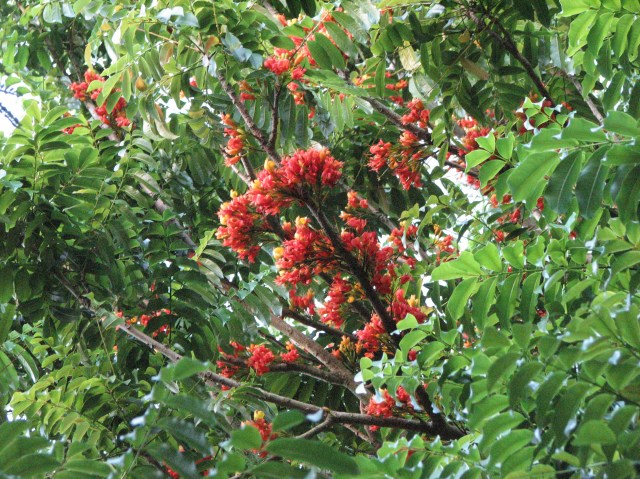
Unrelated, but picked up in our park, I like decayed leaf skeletons. In this case I think it is a leaf from Magnolia insignis, formerly Manglietia insignis. The curious pin-wheel item beside it is an immature flower from the Stenocarpus, probably sinuatus, or Queensland Firewheel Tree.  To be honest, our specimen of this tree is so tall and the flowers are so high up that we largely notice them only as the fallen red stamens on the leaf litter below. They are sometimes used as street trees in warmer areas both in their homeland of Australia and California and, when pruned and shaped and in a warmer climate, the flowering appears to be showier than here. I assume this flower head was blown off the tree before it could open fully. How amazing is that structure of the flower cluster?

Groomin’ grasses

The Court Garden in winter

I do not subscribe to the notion of no maintenance gardening. There is low maintenance gardening, lower, lowish, high and very high maintenance gardening. The grasses are generally on the lower side of the spectrum.  

Before on the Stipa gigantea

I certainly don’t groom ornamental grasses in wilder, more naturalistic settings but the Court Garden requires some quite precise maintenance to keep its looks, although it is not usually onerous. This train of thought came about because I have been grooming the Stipa gigantea and that has been more major than I anticipated. At least I have worked out that every established clump is putting up maybe 40 flower spikes which is a lot, really. But there are 24 large plants of it in that garden (yes, I counted!) and every one takes up to an hour for a thorough dead heading and grooming out the dead leaves with a few also needing to be reduced in size. It is not such low maintenance and it is entirely optional but the plants do look tidier for it.

and after on the Stipa gigantea. There is at least half a barrow load per plant removed.

The lowest maintenance option are the deciduous grasses that just get cut down to the ground. That is Miscanthus sinensis ‘Morning Light’. We also cut down Calamagrostis ‘Karl Foerster’ and ‘Overdam’ which are not deciduous but look pretty scruffy and of no merit by late autumn. We have plenty of other evergreen plant material in that garden that gives winter interest and, when cut down, the calamagrostis return with pristine fresh foliage in spring.

Cut to the ground. Maybe don’t try this with clumps that have yet to establish well because you may run the risk of them rotting out over winter but ours are now solid plants.

If you have a very sharp spade and sufficient strength, it is possible to reduce the size of the clumps when they are cut down without having to lift the plants and disturb the roots. I have our Zach with a sharp spade to do this very job, as he has done on the calamagrostis last week and will do on and miscanthus that are looking too large when we cut those down soon.

A simple tool, cheap enough and sometimes sold here as a flax cutter. Along with my homemade arm protectors and garden gloves.

For cutting down grasses or perennials, buy yourself one of these very handy little tools with serrated teeth and a curved blade. I think I bought my latest one described as a ‘flax cutter’.

Chionochloa flavicans at the front with an unnamed red phormium or flax and the rather large Austroderia fulvida or proper toetoe behind.

Our native Chionochloa flavicans (dwarf toe toe) has a reputation for ‘whiffing off’, as Mark is wont to say. In other words, it grows beautifully for a few years and then starts dying out. I feel that the proper toetoe we grow – Austroderia fulvida – is showing signs of the same trait and I put it down to a build-up of detritus and dead foliage in the middle of the plants. In the wild, it will be part of the natural cycle; in the garden, we don’t want to cope with half dead plants needing replacement. My theory is that if I keep the plants cleaned out, they won’t suffer that fate. Ask me in five years’ time if I am right on that. I cleaned the plants up in summer, after flowering. The chionochloa were fine to do and did look better for it. The mature toetoe were not much fun to groom because, like a number of our native grasses, they are a form of cutty grass and cut they do. I always wear gloves and I also covered my arms but my ears, my ears! Those very long leaves can cut ears readily. At least it is only a once-a-year job.

The adjustable metal leaf rake, long handled hand rake and flax cutter

The Stipa gigantea does not cut flesh and is probably fine to be left without intensive grooming. I have never done it this thoroughly before so maybe it is overkill or maybe just something to do every few years. You can take the Monty Don of BBC ‘Gardener’s World’ approach and just use your hands as a comb to pull out the dead leaves. He doesn’t even wear gloves that I have seen so I guess they don’t have cutty grasses. I have used the metal leaf rake before and that does a pretty good job when you have room to move around the plants. This time I got in for a thorough clean using our useful little hand rake that you won’t be able to buy at the garden centre. Mark tells me it once  belonged to his father but that he replaced the broken handle with a beautifully whittled, sanded and oiled handle that is longer than the original. Not only is this a useful implement for getting in to plants, it is also very nice to handle.

Chionochloa rubra
Anemanthele lessoniana

A few of the grasses don’t need much attention at all – notably our native Chionochloa rubra (red tussock) and Anemanthele lessoniana (gossamer grass). They may need digging and dividing every few years to reduce their size in a garden situation, but they don’t need routine maintenance, bar weeding out the many self-sown seedlings of anemanthele. It is the only prolific seeder we are using in the Court Garden. The miscanthus throws a few seedlings; the stipa is sterile; the others I have yet to find seedlings of (a thick mulch discourages seed germination) but the anemanthele… It is just as well it is both native and has merit because it certainly seeds down.

Ralph

Finally, may I introduce Ralph? Ralph came to us from the city pound. He is a little larger than our usual grade of dog but he has settled in here instantly with no doubt that this is his home. Life is terribly exciting for Ralph with so many interesting smells. He is constantly on the move outside and most of my photos end up being a passing blur. But he makes us laugh and it seems that everybody loves a scruffy dog. Come the evening, tired Ralph decides he is now a lap dog and that can be a bit challenging with one his size.  Engaging but challenging.

Ralph, briefly sitting down to order, in the Wild North Garden – or dog heaven as he prefers to call it