
This is a longer piece than I usually post on this site but it was written for and first published by the Royal Horticultural Society (UK) annual journal of the Rhododendron, Camellia and Magnolia Group, 2022.
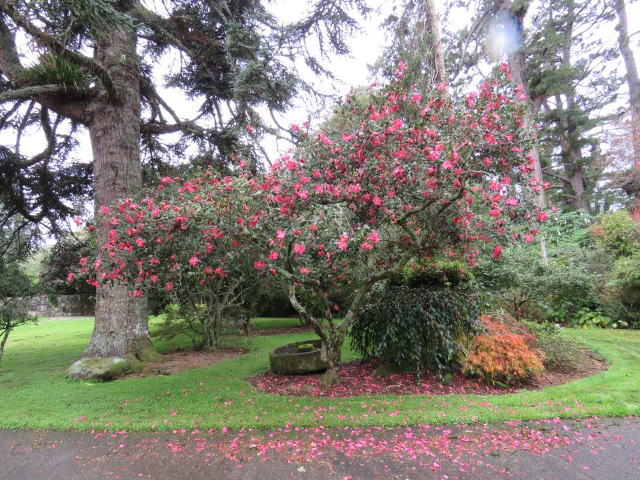
I married into a camellia family. Both Les Jury and Felix Jury were recognised in their day as making significant contributions to the camellia world with their new cultivars. Both worked with Camellia japonica and hybrids to create plants that were self-grooming (dropping spent flowers rather than having them hang onto the bush) and breeding out the tendency for stamens to turn black as blooms aged. Hugely popular in New Zealand, camellias ranked second only to roses in sales figures.
My own mother was not as keen. True, she described a young plant of Felix’s C. x williamsii ‘Rose Bouquet’ as being like growing an herbaceous paeony in a climate which did not favour the growing of any paeonies at all, but it was clear she saw it as second best. Memorably, she once declared that the trouble with camellias was that they were all red, white or pink blobs with shiny green foliage. With more experience, I now realise she was only thinking of C. japonica and hybrid camellias. I do not think she ever met the species or had anything to do with C. sasanqua.
We have a large garden with many camellias used in a variety of situations. I have never counted them but it will be in the hundreds, not the tens. When Mark started plant breeding, he followed in the footsteps of his father and his uncle and chose camellias first. They are right at home in our climate so we have camellias as feature plants, background plants, hedges both informal and clipped, windbreaks and as a backbone plant repeated throughout the garden.

The arrival of camellia petal blight – Ciborinia camelliae – was nothing short of devastating. Our massed displays of C. reticulata, C. japonica and hybrids blooming in winter and spring disappeared as petal blight took hold and now they are just a memory. Petal blight is common throughout the world. Is it only Australia that remains free from it now? It took a trip to the International Camellia Convention in southern China in 2016 for us to realise that our particular climatic conditions mean that the impact of blight here is arguably at the very worst end of the scale. We are humid and mild with regular rainfall and plenty of wind to spread the spores far and wide – ideal conditions for any fungal ailment. In the drier conditions of China, it was nowhere near as big a problem as here and talking to growers from around the world, they don’t suffer the same level of impact as we do.
In our particular location, it is bad enough for me to say that we haven’t and wouldn’t plant a C. japonica, a large flowered hybrid or a C. reticulata now. There is no point. Flowering has become sparse and all that early breeding for plants which are self-grooming does not work for these vulnerable camellias so the display is now pale brown blighted blooms or blooms in the process of being blighted with just a few lovely flowers to remind us of times past.
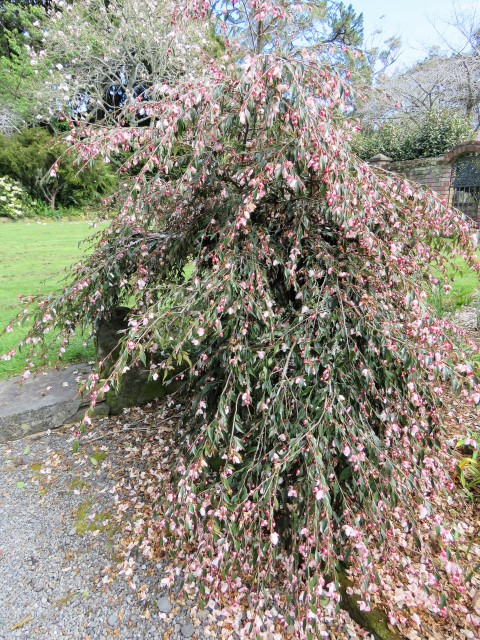
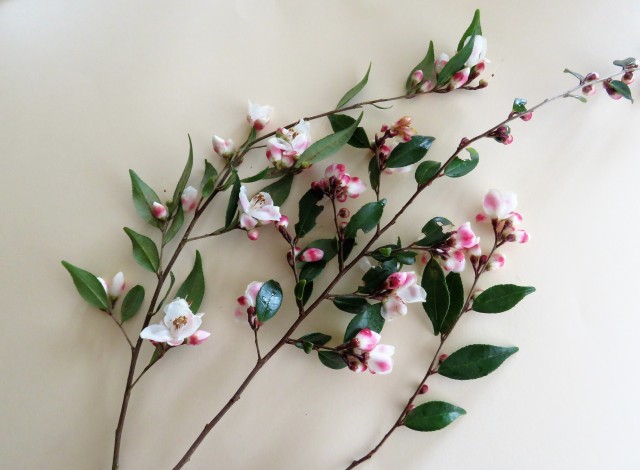
All is not lost, but we have done a serious re-think. Fortunately, Mark had always been interested in miniature flowered camellias with a strong personal preference for the simplicity of singles and semi doubles. They mass flower and each bloom only lasts a couple of days so they fall before blight takes hold. We also like the species and had already set out to build a collection of most that are available in this country. Some of the species bring in a wider range of growth habits and foliage than are seen in commercial camellias. In fact, some don’t even look like camellias as most people know them. We are so besotted with little C. minutiflora that we have several in the garden; what came to us as C. puniceiflora doesn’t look like a camellia at all and only aficionados would identify the pink flowered form of C. sinensis and the assorted yellow species we have as camellias.
We also have a good representation of autumn flowering varieties from the C. sasanqua group, which are not affected by the blight. In the days when the large flowered C. japonica were favoured, with a particular preference for the perfection of formal doubles like ‘Dreamboat’ and scores of others, the attitude to C. sasanqua was bit dismissive. They lack the solid petal texture and defined form in their blooms and are slower to establish, as nursery plants at least. In New Zealand, they were largely seen as utility hedging, best in white and even better if C. sasanqua ‘Setsugekka’. The white ‘Setsugekka’ hedge became a cliché.
Tastes can change. Now we appreciate the C. sasanqua cultivars for their mass display in autumn through to early winter, preferring that looser flower structure and simplicity. Added to that, as mature plants, most have a naturally graceful form that is easy to tidy up and enhance to create a feature plant even when not in bloom. Shapes are important all year round and shapes with good, healthy foliage that are also hardy, reliable and low maintenance are not to be disdained.
We give a lot more thought to our camellia plants these days. Many are invaluable for shelter and wind breaks. Flowers are a bonus. But not every camellia plant is valuable. If they are not flowering at all well, are not pleasing to the eye as a shrub and are not filling a useful purpose, we have no qualms about removing them. These plants used to at least fulfil one of those functions – that of mass flowering.
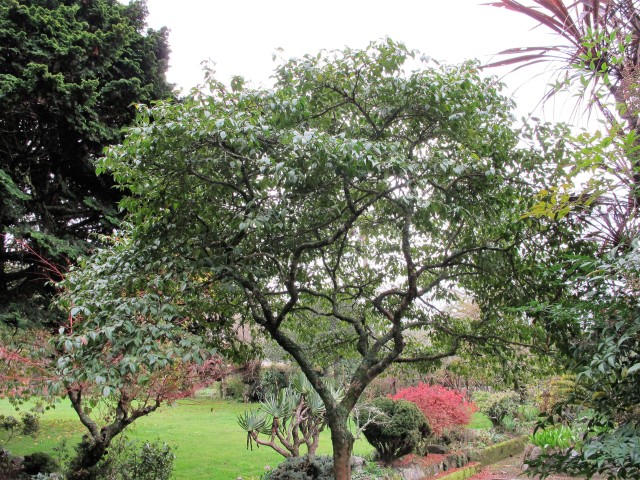
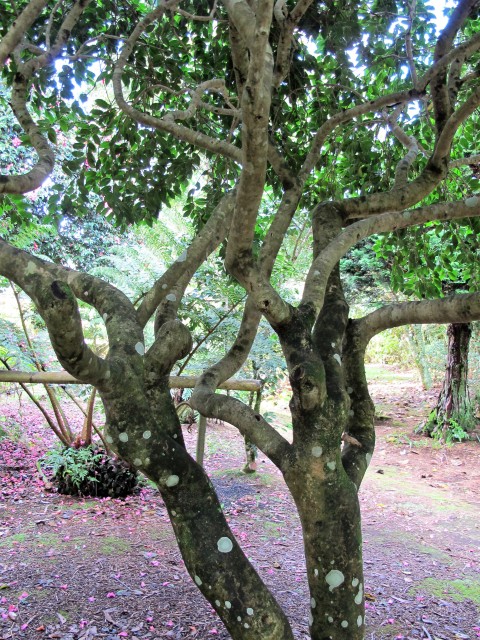
We do a lot of what we call lifting and limbing here. In a mature garden, raising the canopy and letting light in is ongoing. What sets lifting and limbing apart from simple pruning is that it is more focused on making the most of the natural shape of the mature plant. Mark is the master of this but my skills are improving. More time is spent standing and looking, then tracing where branches go than actually cutting and there is much going up and down the ladder. It is very satisfying to find the most pleasing forms within a plant and to highlight the shape by removing extraneous growth. Added to that, it is a one-off activity that just needs a bit of occasional maintenance in future years. It is possible to remove a lot without a plant looking massacred, as long as clean cuts close to the trunk or branch are made.
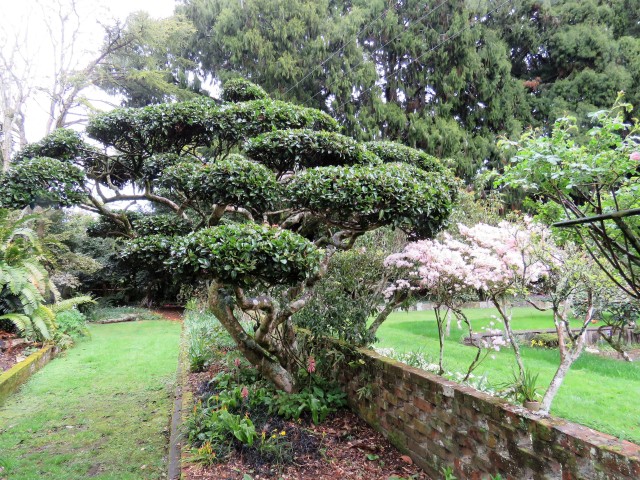
Our garden is very light on ornamentation. We don’t go in for sculptures, statuary, pots or a plethora of trellises and archways, preferring to use key plants as focal points, along with natural vistas. Mark’s cloud-pruned camellias are particularly fetching. He started on Camellia sasanqua ‘Mine-no-Yuki’ which was so huge that its weeping growth was blocking a pathway. The initial shaping took him several days up and down the ladder which was hard on his knees. He must have removed well over half the jumbled plant but found the most pleasing shape beneath. We keep it clipped to flat- topped cloud shapes. It only needs trimming once a year to maintain that form and that is a simple job that takes a couple of hours with hedge clippers. ‘Mine-no-Yuki’ is not good in bloom here. We get a few days of pristine white blooms before they get weather damaged; from then on we get a display of brown and white flowers. As a clipped, evergreen shrub it makes a splendid feature all year round.
I differentiate between clipping and pruning. Pruning is done with a pruning saw and secateurs; clipping is carried out with trimmers, be they hand-held hedge clippers or motorised trimming blades. Good pruning is a higher grade skill because the aim is to get into the plant and shape it without the work being visible – ‘blind pruning’, an older colleague used to call it. Hacking is bad pruning.

We don’t clip many plants – ours is not a garden modelled on the clipped and corseted Italian genre – but we have a few that we like to use as punctuation points in the garden. Inside our entrance, we have a small grouping of camellias that we clip tightly once a year. The shape of each has been entirely determined by following their natural growth habit and exaggerating that. So C. gauchowensis is a plump, rounded pillar, C. puniceiflora a three tier cake stand and the somewhat insignificant C. trichoclada is a flat plinth. They are backed by the cloud pruned C. x hiemalis ‘Elfin Rose’.
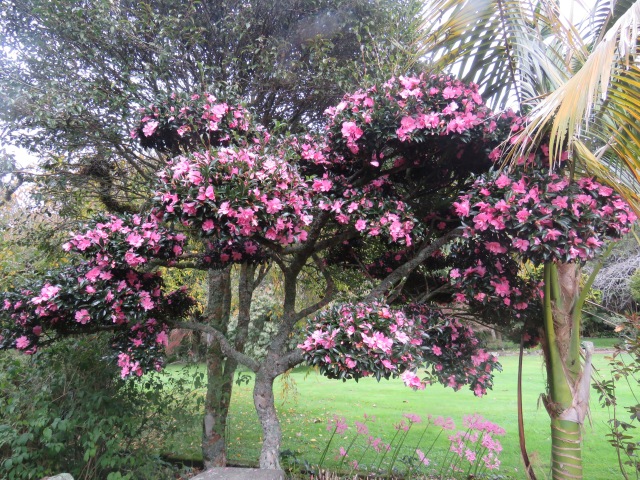
The problem with clipping is that it cuts every single outside leaf that then turns brown on the cut edge. This does not matter when the clipping is being done on plants with very small leaves and it is not generally a problem on the C. sasanqua cultivars which have a somewhat softer leaf. It matters a great deal if the clipping candidate has the tough, shiny, leathery leaves common to the C. japonica types. I drive past a clipped white C. japonica hedge from time to time and it simply looks awful when it has been freshly cut. I wonder if the owners went to buy the aforementioned ‘Setsugekka’ (which would have been much more successful) but the garden centre had sold out so they talked them into a white japonica instead? It was not a good choice. Keep your clippers away from C. japonica varieties is my advice; reach for secateurs instead and forget any ideas of tight-clipped shapes.
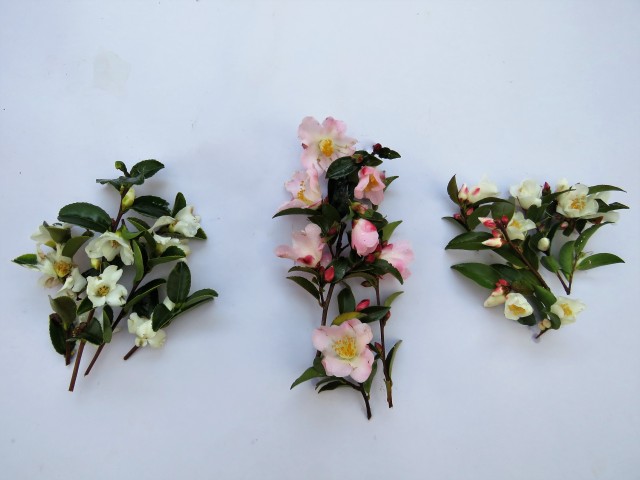
We have camellia hedges ourselves but all are small leafed varieties that clip tightly to make a dense barrier over time, looking sharp-edged and smart. We also select for small single flowers that drop cleanly and break down quickly, thereby avoiding the brown sludge that large, heavy textured flowers can create when they fall. The three camellias we have used for hedging are ‘Fairy Blush’, C. transnokoenis and C. microphylla. ‘Fairy Blush’ is our first choice where we want dense hedges to around 1.5 or 1.8 metres high. It is a C. lutchuensis hybrid, the first camellia Mark ever named and the one that remains our all-time favourite with its exceptionally long flowering season. Unlike its scented parent, it is fully tolerant of sun and open conditions (C. lutchuensis is inclined to yellow in the foliage in full sun), very free flowering and, en masse, it exudes a delightful scent on warmer, sunny days.
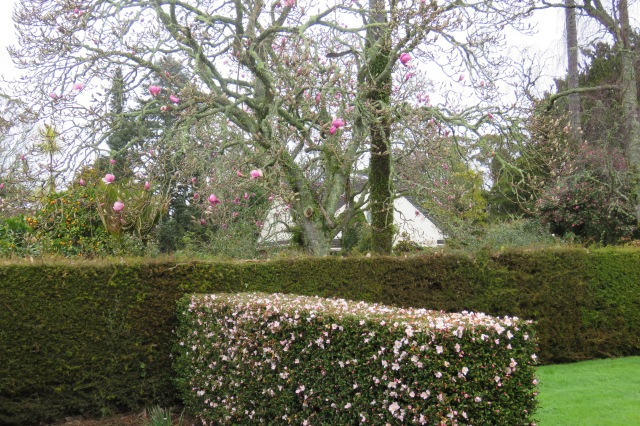
We have never grown much buxus hedging here but when the threat of box blight loomed (mercifully, it has still not reached us and we don’t have the buxus caterpillar in New Zealand), Mark took the opportunity to rip out a couple of box hedges and replace them with C. transnokoensis. I think the blight might just have been an excuse really, because the main reason was that he thinks hedges should be more than just green walls; they should also contribute to the eco-system and plants that flower and attract bees and butterflies do more than just act as a visual divider. C. transnokoensis has excellent small foliage and tiny white blooms but its flowering season is much shorter than ‘Fairy Blush’ and it is taking longer to become dense in its growth.
When it comes to tight clipping, timing is important. We tend to clip hard in early to mid-spring, just as the new growth is being made. If it gets left later, the next season’s flower buds will have set and clipping will be at the expense of next season’s flowering. Sometimes we get to the C. sasanqua plants earlier; in our relatively mild climate, we have more latitude and can garden through winter without risk. We only clip once but we are fine with the softer, woolly look that develops as the seasons progress. If you want a sharper look, do the hard spring clip and then follow up in summer, but just with a light prune to tidy up the wayward fresh growths.
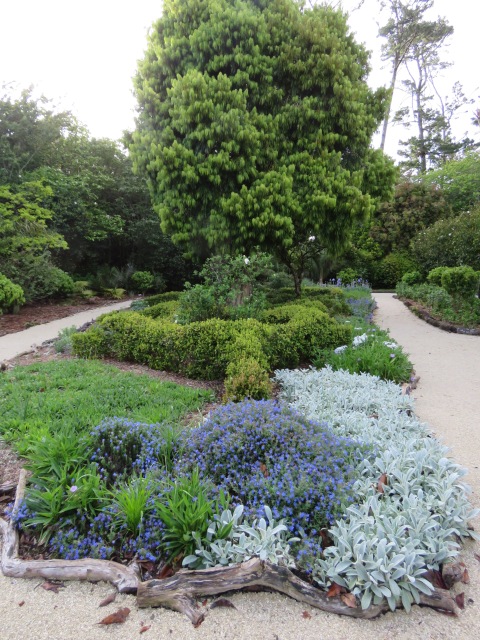
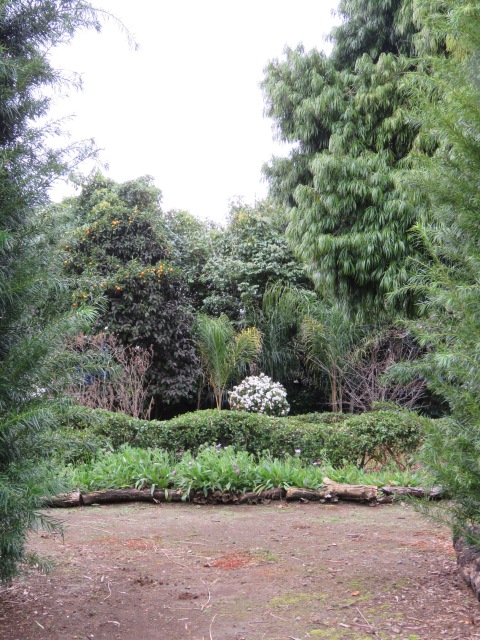
C. microphylla has an even shorter season in bloom and flowers in late autumn for us but we selected it less for its white, starry blooms and more for its very compact habit and small leaves which lends it to tighter clipping where we want low, undulating hedges in the area we call the Wave Garden. It is taking some time to grow and clip into the tight growth we want, particularly because the plants Mark had raised from both cuttings and seed languished, unloved, in pots in the nursery for longer than they should have. It took us a while to plan and then plant the garden they were destined to grace. Healthier plants would have taken off faster but we can see it will work exactly as planned.
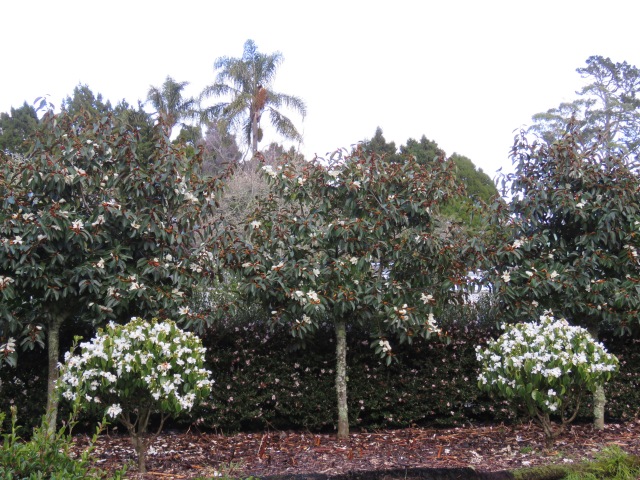

Overall, we do more pruning than clipping and that is aimed at keeping some key plants from growing to their full potential. Essentially, we are trying to contain them to a certain size. We have used the lesser-known species, C yuhsienensis, as punctuation points with winter interest along the summer gardens. We love its open, starry blooms which are lightly scented and reminiscent of a michelia as well as the heavy-textured foliage which many people fail to identify as a camellia. It is not self-grooming and it is one of the few camellias I am willing to go through and brush off spent blooms which is a sign of how much it pleases me. Left to its own devices, it will reach 2.5 to 3 metres high by 2 metres wide in our conditions, getting somewhat more open as it grows. I am keeping these to around 1.6 metres high and a metre wide and that is done on a single, perfectly straightforward annual prune with secateurs and sometimes a handsaw. Each plant is reviewed individually as I work out which branches I want to take out entirely and which ones I just want to shorten. It sounds more onerous than it is in practice but my aim is always that the pruning not be visible to other people’s eyes.
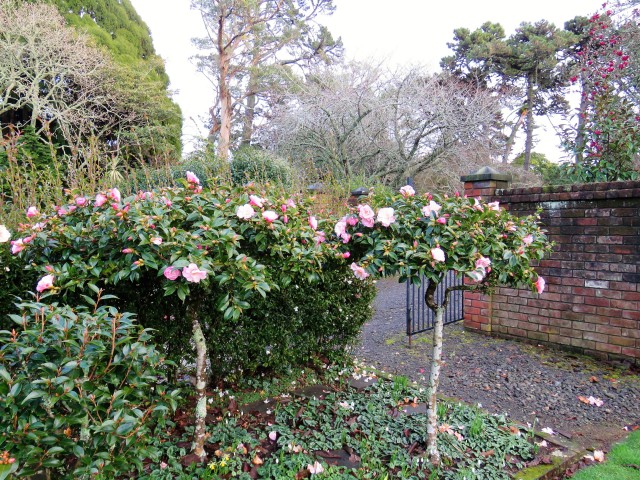
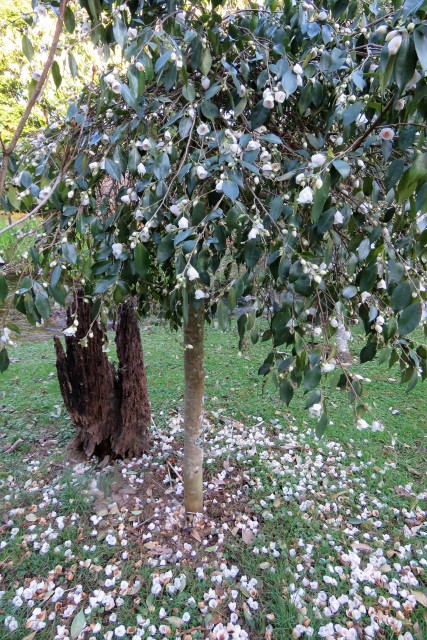
We have a few high-worked standard camellias, grafted a metre or so up a single, strong trunk. These are not easy to do so certainly not widely available commercially here, if at all these days. Our plants date back to when we still had a plant nursery and specialised in unusual options. The weepers are just left to weep. These are ‘Quintessence’ and one that came to us ‘Nuccio’s Pink Cascade’ but I am now doubting that name because I can’t find it on line. I scrapped all the weeping ‘Sweet Emily Kate’ specimens because the exceptionally pretty flower did not atone for the dreadful yellowed foliage.
Our other standards are slow growing hybrids from Mark’s breeding programme that are not commercially available. The natural characteristics of being both slow and dense in growth is what makes them easy to maintain. Trying it with stronger growing varieties would mean a whole lot more work fighting nature to keep the desired shape.

Mark is not a lollipop or pompom man. He likes these camellias clipped to low, flattened domes – mushroom shapes he calls them, or maybe umbrellas. Again, we clip or prune just once a year and that is sufficient to keep these as statement plants.

I have never gone in for espalier. I am not so keen on that level of extended fiddle-faddling, myself. But I stopped to photograph a very well-established espalier done with C. x hiemalis ‘Elfin Rose’ in a garden down the road. Unfortunately, the flowering was finished for the season so you will just have to imagine how pretty it looks with the bright pink blooms and deep forest-green foliage. It has been trained on a readymade trellis fan and is kept clipped to make a dense screen which is only about 30cm deep.
In days gone by, I used to keep a small collection of trained and clipped camellias in large containers to move around to particular locations. Each one was treated differently to emphasise individual characteristics. The reason I planted them all out or gave them away was simply because I decided that, in a garden as large as ours, having large plants in pots that need regular watering, feeding, repotting and root pruning was too much work. I prefer to work on plants already growing in the ground but the container approach may work for other situations.

We used to view camellias as a low maintenance, undemanding but top performing utility plant in our garden. That changed with petal blight. Now their roles have changed. We treat each plant individually and give them a lot more attention but that is what makes gardening interesting for us. We wouldn’t be without them. It may be putting a brave face on it, but I am not sure I miss those days when they were largely big blobs of white, pink or red on shiny green foliage. Times change and we just change our gardening ways to meet the new situation.






 Tikorangi The Jury Garden