It seems to be common practice internationally to name severe storms. I am old enough to remember when they were always female names. I don’t know who confers the names these days but they are now gender neutral or gender alternating. In this country, I think it is largely restricted to cyclones that come down to us from the Pacific and stall over this country.
Mark still remembers Cyclone Bola back in 1988 as does every other local resident of a certain age (I was in the maternity hospital at the time). We took a direct hit from Cyclone Dovi in 2022 but that was eclipsed by the magnitude of damage in other parts of the country by Cyclone Gabrielle the following year.
We were a bit sorry to lose the Calodendrum capense but at least we have another one
Happier days for the calodendrum
Friday’s storm was not, I think, a cyclone or even a cyclone remnant (for context, hurricanes and typhoons are what these cyclones are called in other geographic areas). I think it was just predicted to be a severe winter storm with strong winds, possible heavy rainfall and snow to low levels in the mountains. Nothing out of the ordinary, nothing that warranted an identifying name.
It turned out to be a bit more than that. As reports came in during the morning of road closures and warnings were issued against non-essential travel, we started to realise that it was not just a stormy day. When our power went out, I checked on line and saw that power was out for very large parts of the entire district which is a swathe of land stretching about 150km.
Our electric car is one that has the capacity to act as a battery power source but it can only be connected to a multi board to power plug-in appliances. I felt smug as I had bought the special reverse charging cord that is designed for this very situation so we could boil the electric jug for afternoon tea. We were just completing preparations for a night with neither electricity nor water when the power came back on as darkness fell. We were one of the lucky ones. The scale of restoring power to thousands of homes means it is the luck of the draw as to who has to wait.
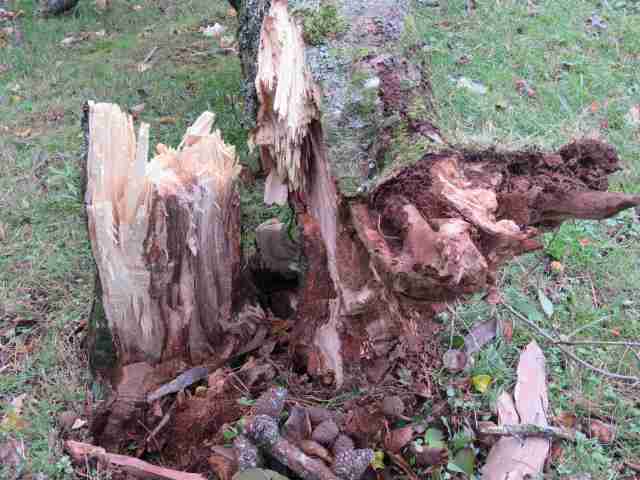
The Picea omorika stood maybe 10 metres tall but one side had rotted at the base
Compared to Dovi, this storm is on a much wider scale but for us personally, the damage is considerably less. We only have three trees down, one of which was dead anyway, and none of them are major. There are many smaller branches down and debris everywhere but nothing major, by our standards. Spare a thought for those hit considerably harder.
This is climate change in action, folks, and your personal opinion of whether climate change is a hoax/conspiracy/over-hyped/not manmade or exaggerated is utterly irrelevant now. The climate don’t care what your personal opinion or political affiliation is. It is just going to keep climating and weathering along on its new trajectory at this stage.
As an aside, spare a thought for weather forecasters and the Meteorological Service who get lambasted every time they over-predict or under-predict a weather forecast. As I understand it, weather is a great deal more predictable when there are large land masses like continents. We are a collection of islands that spans about 1600km in length with an average width of 150km, set in the middle of vast ocean expanses. The weather forecasters do their best but it is not an exact science in our situation. Being just one or two degrees out in calculation of weather trajectories can make a big difference by the time it reaches our shores.
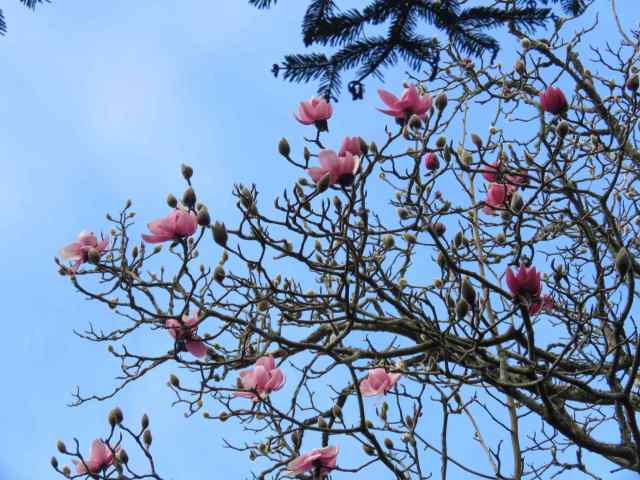
Even after a major storm, Magnolia campbellii looked like this the next morning when there was a brief spell of blue sky and a bone-chilling wind.
Stay safe. I expect the maunga – our mountain – will be covered in fresh snow when the cloud clears and we can see it again.
This spray of orchids was a casualty of the storm – broken off and lying on the ground. It is in the laundry because we heat the house to such a level that cut flowers wilt and die very rapidly in the main rooms we frequent.
First published in the May issue of Woman magazine. This is what one might call a retrospective view of the impact of Cyclone Dovi back in February and what it might indicate for the future with climate change.
“Imagine if trees gave off wifi signals, we would be planting so many trees, we would probably save the planet, too. Too bad they only produce the oxygen we breathe.”
social media meme
I did not have ‘hit by cyclone’ on my personal bingo card of climate change risk. Rising sea levels, flooding, mini tornado (we get a few of those in our area), slips, droughts – I had mentally considered all those scenarios.
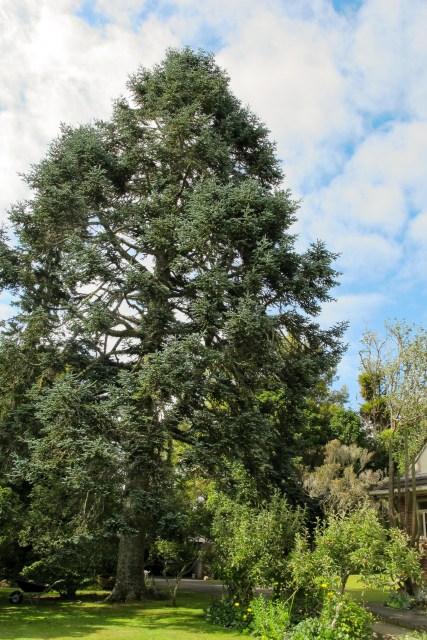
We dropped the large abies two years ago as a precautionary move lest it fall on the house and when Dovi hit, we were very glad of that.
Indeed, we made the decision two years ago to drop the one big tree that could fall on our house and pretty much demolish it. It was a handsome Abies procera glauca, also known as the blue Noble Fir, planted by my late father-in-law about 70 years ago. We were sad to see it go but it seemed a wise precaution at the time.
It seemed an even wiser decision when we took a direct hit from Cyclone Dovi in mid February. As massive trees crashed down around us, we could at least take comfort from the thought the abies was not going to fall on us as we sheltered indoors.
When Cyclone Bola hit parts of Taranaki and then the East Coast in 1988, it largely bypassed our little corner of the countryside. The winds were strong but nothing too far out of the ordinary. New Zealand is a windy country and we are used to that, but there hadn’t been any cyclones in our area in the intervening 34 years which is why I hadn’t put it on my mental bingo card.
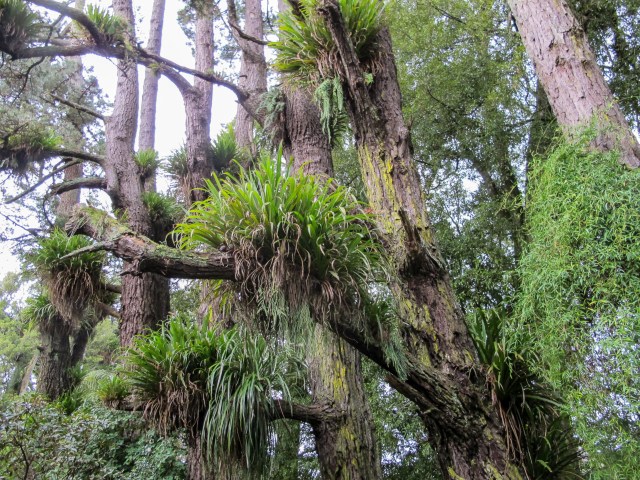
At 150 years old, our massive old Pinus radiata trees are weighed down with epiphytes and nearing the end of their life.
I garden on a fairly expansive scale, with my husband, Mark. It is a property that has been handed down the generations of his family since 1870 and we know who planted which trees and when. Some of the trees are now 150 years old, planted by Thomas Jury, and we know the old pine trees are pretty much at the end of their life. They are not helped by the fact Thomas’s son, Bertrum Jury, topped them at about 10 metres high in the early years of last century. It didn’t stop the pines from growing and the biggest are now up to 45 metres but with a weak point where Bertrum cut them. We have had some snap off at that point and others that uproot entirely and fall.
Why, you may wonder, do we not bite the bullet and get all the pines felled? It is just too big a job. We can’t get heavy machinery into that part of the property and it would probably have to be done by a massive logging helicopter. We are not in that financial league and, where those trees are, when they fall, it is only our property that gets damaged so they are not a risk to others.
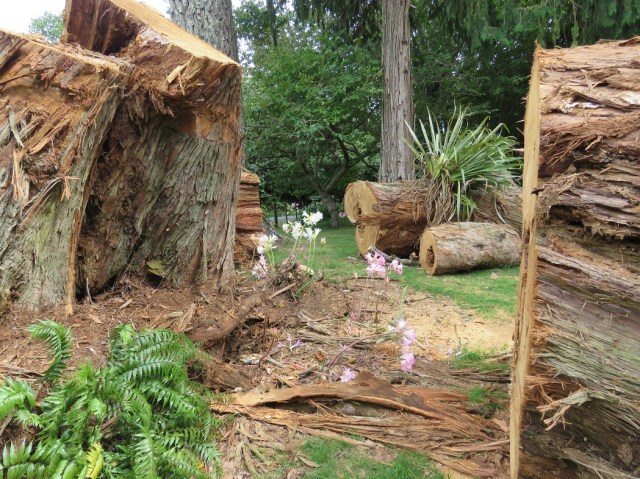
The belladonna lilies flowered on, unperturbed by the fallen gum tree. I measured the diameter of the tree and the main section was two metres across. We cut the root ball and base free from the trunk and used heavy machinery to push the base back upright to create a more attractive gardening environment.
Besides, we can cope when big trees fall one at a time. We are used to that and can go in and do an efficient and speedy clean-up. Losing several at once, as we did with Cyclone Dovi, was rather different. It wasn’t just the damage from falling pine trees; we also lost a giant gum (eucalyptus) at our road entrance that was also 150 years old and Mark literally had tears in his eyes when he found another abies – a baby at just 70 years but one of our most handsome trees – uprooted in the park and lying over our high bridge. Those were just the largest trees. There were smaller trees and branches down everywhere.
The sheer scale of damage from fallen trees after Cyclone Dovi left us paralysed by shock for two days.
Mark and I went into shock for the first two days, paralysed by the scale of the clean-up task that lay ahead. Fortunately, most of it was garden damage, not structural damage, and we have good people around us. It did not look so overwhelming when we eventually got power and running water restored and the most urgent areas were being cleared. A fair number of homes in our local town of Waitara will be heated by firewood and pine cones after I offered both free, on a local Facebook page.
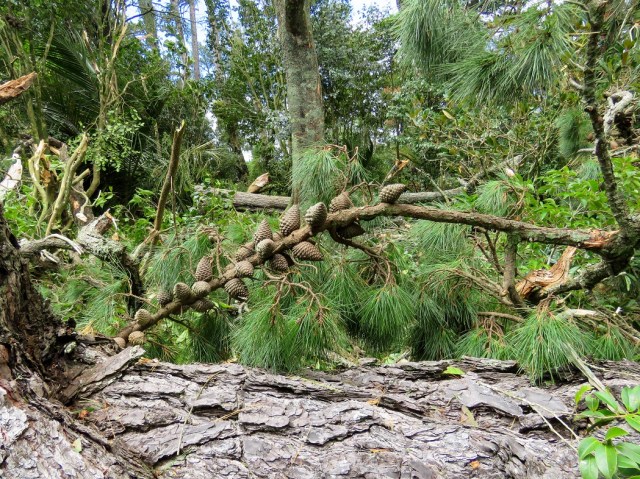
We cut back the fallen pine on the left to clear the path and it will eventually collapse to the ground but it perches somewhat like a giant lizard in the midst of woodland garden.
When big trees fall, our approach is now tried and true. Attempting to remove the fallen tree in its entirety would cause huge amounts of additional damage to the area and add considerable expense. We go in and remove all the debris, the foliage and side branches on the tree. We will cut through the trunk where it is blocking paths or access but we leave the main length lying where it fell.
I use ‘we’ in the royal sense. I do not chainsaw and I would not like to mislead with a mental image of me in work boots and ear muffs wielding a noisy chainsaw. My strengths lie more in the lighter aspects of cleaning up and reinstating gardens around the remaining trunks.
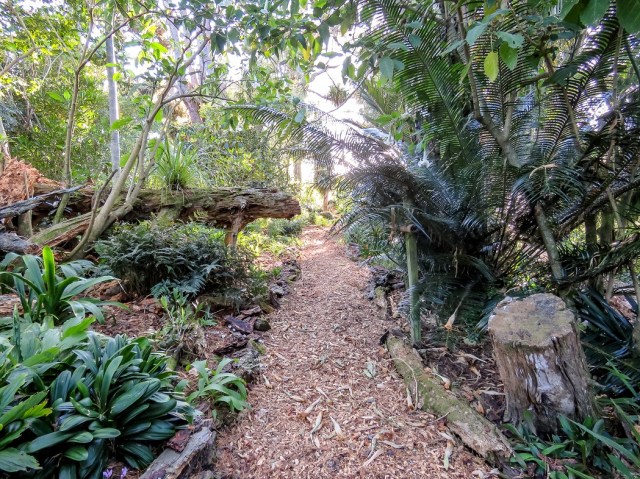
These two pine trees fell eight or nine years ago and we left the main lengths where they lay, gardening around them and allowing epiphytes to establish as they gently decay.
Within a year, we can have those fallen trunks nestled into the garden with plants thriving on and around them and they can gently decay over the years. Instant, unplanned stumperies, one could say, or a pragmatic gardening solution.
The conundrum is that we know one of the ways to mitigate climate change is to plant many trees. Big trees. Long-lived trees. A dwarf apple or maple is not going to contribute to saving the world. But with climate change, we know also that we will get more extreme weather events and that can bring those big trees down.
Power companies and linesmen are not tree-lovers. I can understand why when I saw trees on three roads around us bring down lines in the cyclone. I was relieved that none of them were our trees. It is a fine line to tread. We monitor our trees that could endanger power lines or buildings and have already dropped some that we deemed too risky.
The answers seem to be: plant trees, lots of trees if you have space, not just for future generations and to help the planet but also for the pleasure of watching them grow. But choose the spots carefully so that they have a chance of reaching maturity without threatening power lines or buildings and without casting unwanted shade on either your own house or the neighbours.
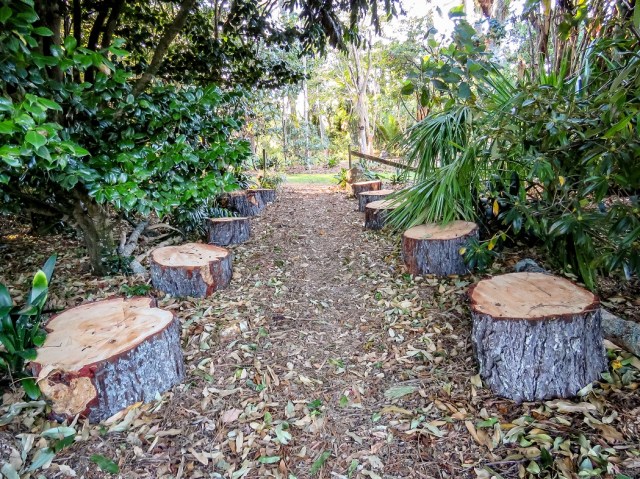
Circles of pine trunk now define the edges of a pathway
Don’t believe the heights given on commercial plant labels – these are often conjured out of thin air to make the tree seem less threatening to the customer or, at best, are what might be expected in the short to mid-term. If space is limited, consider narrow, columnar trees that give height and grace without spreading or casting much shade. Trees which stay lower often spread widely instead, taking up much more space without giving stature in a garden.
Think long term. Some trees can live hundreds of years. While a tree can achieve some size in 20 years, they are not mature – not by a long shot. From about 40 years on, you can start to claim you have mature trees. Trees are generally low maintenance, but that does not mean no maintenance.
We will be keeping a closer eye on our higher risk trees after Cyclone Dovi.
I am not usually one for sharing social media memes but today, I make an exception. They say far more succinctly than I can what needs to be said about climate change.
Thank you Joel Pett. Mark is of the view that it matters not one whit whether people believe in climate change or not because only an idiot could think that we can continue trashing the planet as we are and not suffer catastrophic consequences. We MUST change our ways. Urgently.
And for those of you who find it all too much, thank you Olga Evans.
We have made major changes in our own lives here, to reduce our carbon footprint and consumption. The issue that worries me at a personal level is air travel, exacerbated by being a New Zealander. For us it is four hours and two flights to get over to our children in Australia (all our three children live in different east coast Australian cities), about twenty five hours in the air to get to the UK or Europe (and another twenty five hours to get home again). That is one where I am pinning my hopes on new technologies to reduce the impact of flying.
In the meantime, I am listening to the young people who are mobilising on this matter. I would much rather listen to them than to older folks (mostly, but not all, old men) who last studied science back in their high school years fifty or sixty years ago but who have found some dodgy website that backs up their complacent world view, no matter what the majority of the world’s scientists are saying.
Change is coming. Massive change. The planet does not care whether you or I believe in climate change. The longer we insist on continuing the status quo, the more shocking that change will be.