
• We are dry. If you dig down a little, you will probably find that even if you have watered, the soil is very dry. Rain will come, we know that. But in the meantime if you have been busy planting, you will need to water until we get some consistent rain. Keep an eye on container plants too. They can get stressed by drought even at this time of the year. If you have laid new lawn or oversown bare patches, it will probably need regular watering.
• It is time to cut back the old Helleborus orientalis foliage and any seed heads that you have left on them. This is optional as an activity but does greatly improve the visibility of the winter flower display. It may also reduce the infestations of aphids in your garden. I have found some heavily infested plants. While you are about it, pull out germinating seedlings to avoid overcrowding. Hellebores are one plant which is less than grateful to be lifted and divided. Raise fresh plants from seed, rather than splitting up established clumps. They can last for years in quite heavily compacted soil. We like to lay a blanket of compost after cutting off the old foliage.
• For cheap winter colour, pansies, primulas and polyanthus can be very cheering. Existing polyanthus plants need dividing often and can be done right now. Proper English primroses are delightful but prefer a cool climate – here we tend to get mostly foliage and little flower. Sadly the auricula branch of the primula family also likes it much colder. Inland gardeners may manage them but in coastal areas, they are more likely to be a waste of effort.
• If you haven’t trimmed your formal hedges, don’t delay.
• If you like silver beet, it is one of the most reliable stand-by plants for the home gardener because you can just keep harvesting off the same plant all season and it will keep growing. Spinach, on the other hand, which some of us much prefer, is picked once and that is generally it. Both can be still be planted.
• Planting in the veg garden continues to be focussed on brassicas but not Brussels (it is a bit late for those now unless you have large plants ready to go in), broad beans, peas and leafy greens. You may enjoy trying some of the quick maturing Asian and oriental greens of the pak choy and mizuna types. Kings Seeds have a superb range of these less common crops available by mailorder but we have also noticed local garden centres extending the range they stock. There are a host of alternatives to silver beet, spinach and Buttercrunch or Iceberg lettuce.
Countdown to Festival, April 2010
The Taranaki Rhododendron and Garden Festival is in its 23rd year now and will run from October 29 to November 7 this year.

The late Buffa, on guard here at Tikorangi last year
While it is still six months out from the Rhododendron and Garden Festival, dedicated gardeners around the province are hard at work already. The days when a quick spruce-up a week out from the event could suffice are long gone. The open gardens these days maintain much higher standards which in part explains the longevity of the festival and the high visitor satisfaction rankings.
• At La Rosaleda in New Plymouth, Coleen Peri is one of the younger garden openers (possibly the youngest) and is highly motivated by her large visitor numbers in her first year of opening in 2009. She has been much preoccupied by irises of late, having bought a large range from a mailorder bearded iris business that was closing down. These are all planted out and growing away well at a different location to her garden and she is hoping to have some available for sale during Festival. At home, she is impatiently awaiting the arrival of this year’s rose order in late May or early June so she can start planting out her newest area. While she has other plants awaiting in pots, she likes to place her roses first and build out from there. An avid follower of mailorder catalogues, she is pleased to have sourced at least four different varieties of large headed alliums – yes alliums are the onion family but there are some spectacular ornamental varieties with big, round flower heads usually in purple. We saw these used extensively in English gardens and covet them ourselves.
• At Te Popo, near Stratford, Bruce and Lorri Ellis were delighted to find themselves featured in a six page spread in the January edition of a French magazine, My Garden My House (or, more correctly, Mon Jardin Ma Maison). The cover even included an inset photo of Lorri. There was a slight problem in the Ellis household in that neither of them have any French so what was actually written was a frustrating mystery as they tracked down a translator but it all looked good. Whether this leads to a massive increase in French visitors remains to be seen, but it is certainly good promotion for our festival and gratifying for Bruce and Lorri.
• Festival stalwarts, John Sole and Tony Barnes at Ngamamaku in Oakura are taking a year off. Tony says they weren’t foundation openers but he thinks they have opened without fail for around 19 years. In a garden where they have used box hedging extensively to define areas, they have been hit hard by buxus blight. Indeed, they have already incinerated extensive metreage of affected hedging. It has forced them to review the structure of their garden and it seemed a good time to take a year off while they redevelop.
• In Kakaramea, Jacq Dwyer has been thinking ahead and striking cuttings of her robust lavender. She has a bed of lavender planted under the verandah where it thrives a little too much – the plants are getting trunks which are too large for the situation but she doesn’t want to do anything drastic until she has good sized plants ready as replacements. Jacq also comments that her Boston ivy is the most amazing red now that autumn has come. This is a deciduous ivy and somewhat easier to control than many others but it is the astounding red autumn colour which is its main feature.
• In town, Mary Vinnicomb has been dealing with losses in her small but perfectly formed city garden. Her pachystegia folded its leaves and died, a termination that Mary attributes to the very wet period we had in late November and December. The pachystegia is also referred to as the Marlborough rock daisy where it clings to crevices on coastal cliffs. Its big grey leaves are almost like cardboard with white velvet below and it has white daisies in summer, making it highly prized as a garden plant though not the easiest candidate to keep alive and well. The loss also of a key plant in Clematis montana Freida was overshadowed by the death of the Vinnicomb’s much loved little black 17 year old cat, Misty. Mary comments that many visitors have been enchanted over the years to be greeted at the entry archway to their garden by Misty. Her long life belied an inauspicious arrival as a tiny scrap to be delivered by caesarian and not expected to survive. She defied the odds after being hand reared and is now permanently in the garden, marked by a Chamaecyparis obtusa Lenny’s Star.
• Here at Tikorangi, we too are mourning the loss of characterful cat who has been a part of our daily lives for over a decade. However, we could not pretend that our Buffa waited to delight garden visitors. With her, it was more a case of us having to issue a health and safety warning lest visitors be misled by Buffa’s benign appearance and lulled into thinking she was a nice cat who would welcome their attention.
Tikorangi notes: April 16, 2010
Latest posts:
1) April 16, 2010 There are times we have regretted letting our purple bougainvillea reach its natural massive proportions but it is a splendid sight in flower.
2) April 16, 2010 There are no like for like replacements for the ever handy (if a little dull and clichéd) buxus hedge.3) April 16, 2010 Making the most of mild autumn conditions in the garden – what to do in the Taranaki garden this week.
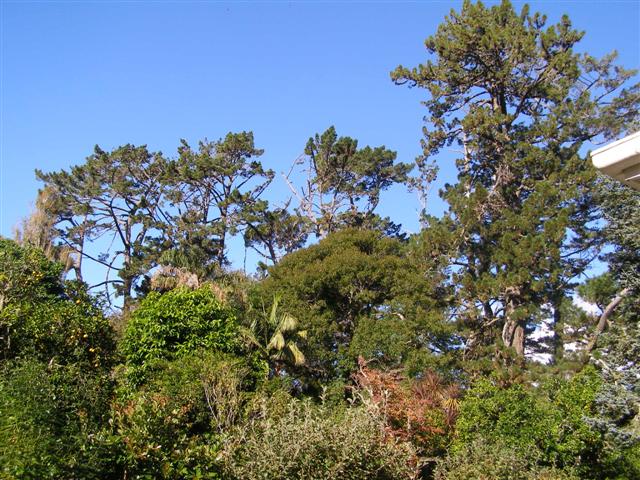
Our venerable old man pines against the blue sky of autumn
The common reaction from New Zealanders to our massive, but elderly pine trees is that we should be taking them out immediately because they are dangerous but we are fond of their scruffy majesty on our south eastern skyline. Planted in a double row around 1880 by Mark’s great grandfather, they were originally a shelter belt and will rank amongst the oldest specimens in the country. Californians are often impressed because these Monterey pines tower around 50 metres or over 150 feet high which we are told is unusual for their homeland on the Monterey Peninsula.
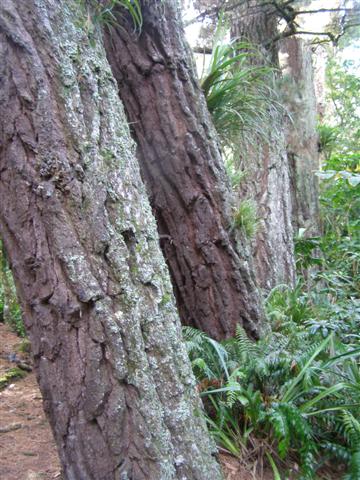
Our Monterey pines - not all are exactly at right angles to the ground
But to New Zealanders, they are just crusty old Pinus radiata, a cultivar the timber industry has made our own as a very quick turn around, low grade timber crop covering vast acreages.
Occasionally we lose a pine tree – running about once every fifteen years at the moment – and the last one dropped itself in the one clear space that we would have chosen had we deliberately felled it, doing minimal damage as it crashed down but gouging out a 30cm deep indentation on the ground. Because they started life as a shelter belt and are planted in more or less straight rows, they now give us a woodland avenue below to grow frost tender material such as vireya rhododendrons, cymbidium orchids, monstera delicosa and a range of woodland bulbs. Such is their location, they would have to removed by logging helicopter but we are happy to live with them as a characterful backdrop.
Flowering this week – our rather rampant bougainvillea
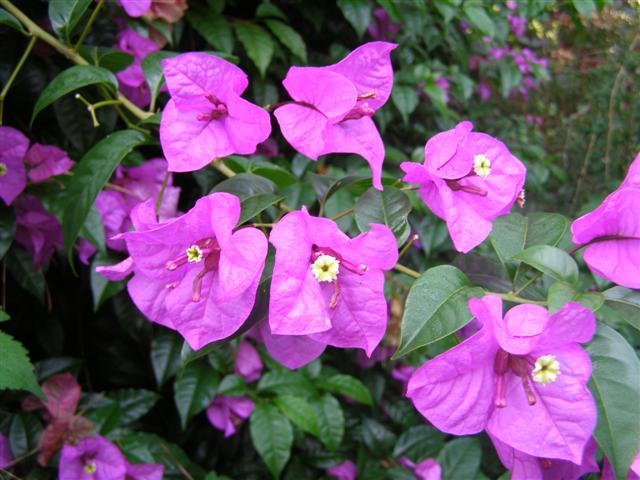
Decidedly rampant, extremely spiny but quite spectacular - the bougainvillea
Not, as we assumed, originating in the Bougainville Islands, but named for the French explorer, Louis Antoine de Bougainville and hailing from South America. We think this form is glabra, from Brazil. There is nothing rare about these scrambling climbers and they are appreciated throughout the temperate and tropical world for their display which can be all year round in latitudes close to the Equator. Here they peak in summer to autumn. It is not the insignificant flowers that make the show but the coloured bracts which surround the flowers and hang on for a long time. The colours range from the royal purple of this variety through cerise, red, pink, lilac, orange, gold and white. Left to their own devices , these can be formidable plants. Ours smothered a dead tree to around ten or fifteen metres high, and a little shy of that figure in both width and depth until the host tree rotted and fell over bringing down most of the bougainvillea with it. It then became a major mission because one of the other characteristics of this genus is its many sharp thorns.
Most of what are sold now are hybrids and they are not left to their own wayward habits as we have done. They are easy enough to trim and shape when small, sometimes trained as standards. We saw some really interested topiary specimens in Bali where three different colours had been grafted onto one stem and then trained to shape as a curious container plant. They are also recommended for hedging and with their thorny ways, they may be just the ticket to deter burglars in crime-prone areas with a mild climate.
In the Garden – April 16, 2010
- Forward planning is needed if you want to move larger trees and shrubs in winter. This involves wrenching the plant, which is simply cutting the roots in a staggered sequence well in advance of the moving process. This will shock the plant but also encourage it to form fresh young roots. Move as large a root ball as you can physically manage. Make the first cuts now with a sharp spade around two sides of the plant. You will follow up with the next cut in two weeks or so.
- Continue planting out in the ornamental garden and the orchard. Pretty well anything and everything can be planted successfully now though you may need to protect tender material for the first winter as it acclimatises to your conditions. Tender plants are those which do not like cold, wet or frosty conditions.
- The autumn rains trigger a new round of weeds so try and stay on top of these to save work later on. Slugs and snails also become more active with wetter, still mild conditions. If you reduce numbers now, you may reduce the spring population explosion.
- Autumn leaf fall is starting. Raking these into mounds or heaps and keeping them moist will accelerate their breakdown. You can then rake them back thinly over the area later in the season to nourish the soils with leaf litter. There is no excuse for burning leaves.
- If you are harvesting pumpkins, they are best dried out before storage and eat the most blemished specimens first. The softer green skinned buttercup types don’t store anywhere near as long as the armour plated grey skinned ones.
- By now you should have your winter vegetables in the ground. We are not far off planting for spring. You can get in broad beans, spring onions, winter spinach, peas and even leek plants (though they will only make small specimens now) and the ever faithful brassica family. You can start preparing the beds for garlic which can be planted from next month. Dig the area over incorporating compost and animal manures and then leave it to settle down until planting time.
- Get any bare areas which are not going to be planted until spring sown down in green crops as soon as possible. We can not over-emphasise the value of green crops in terms of good, sustainable gardening practice. Vegetable gardening involves constant cropping, stripping goodness from the soil. You need to keep replenishing it and it is so much better to do it by compost, manure and green crops than synthetic fertilisers (which do nothing for the soil structure and the worms).
- Shame on Te Radar. Delightful he may be, but we saw him on Sunday TV filling his new raised vegetable bed with plastic sacks of commercial mix. There is nothing sustainable about that practice.
 Tikorangi The Jury Garden