A step by step guide by Abbie and Mark Jury first published in the Taranaki Daily News and reproduced here with permission as a PDF.
New Outdoor Classrooms are uploaded fortnightly.

A step by step guide by Abbie and Mark Jury first published in the Taranaki Daily News and reproduced here with permission as a PDF.
New Outdoor Classrooms are uploaded fortnightly.
February 26, 2010 Monarch caterpillars and butterflies – a safer mid-life obsession than buying a Harley-Davidson.
February 26, 2010 Flowering this week: Justicia carnea (the candlewick bedspread of the plant world).
February 26, 2010 In the Taranaki garden – garden tasks and hints for the coming week.

There are good reasons why we are always green in Taranaki. In this case it was summer rain yesterday morning – around 10cm in a very short space of time. The water disappears nearly as quickly as it arrives and within ninety minutes of taking this photo, the sun was shining again and the flood waters had receded entirely.

The green swan seed pods and the fat monarch caterpillar in high summer
Mark has always loved butterflies. Alas it was his misfortune to be born in a country with remarkably few butterflies so he has had to focus all his efforts on the only obliging candidate, the monarch. When we travel overseas, he likes to be armed with guides to both local birds and butterflies but at home the yellow admiral and the coppers are largely unknown in our area and the cabbage white does not qualify. The red admiral, which is here, is not as much fun because its main host is stinging nettle. New Zealand has an abundance of different moths, many of which are extremely beautifully marked, but you have to be of a nocturnal disposition for these. This brings us back to the monarch which is large, spectacular and can claim indigenous status because it was self introduced (like the wax-eye), arriving here under its own steam, apparently around 1840.
I admit that I fear his dedication to supporting an exponential increase in numbers of monarch butterflies wintering over may be nearing obsessive levels. Even I was a little surprised at the extent of his swan plant plantations. As magnolia crops have been harvested from our open ground area, he has gone in to the cultivated ground with his little seed sower and trundled up and down the rows dispensing swan plant seed. Strung end to end, we are talking several kilometres of swan plants – probably closer to five kilometres than two. What is more, he is successional sowing in the same way he does with the sweet corn and beans. All this is aimed at ensuring that we have plenty of food to take the monarch caterpillars through to late autumn. That way, they are far more likely to winter over here and there are few close up sights of natural beauty as magical as looking up into a tree on a fine winter’s morning and seeing the monarchs waking and stretching in the sunshine.
The drive to have successional crops may strike a chord with many readers who will be struggling now with a surfeit of caterpillars and a dearth of food. There is something both brave and poignant about watching an exodus of monarch caterpillars heading down from a completely stripped swan plant and wriggling off into the wide unknown in search of another. I suspect Mark suffered some emotional traumas in years past, coping with food shortages. One autumn he raised many caterpillars on slices of pumpkin and he finds it hard to cull babies to preserve dwindling food supplies for the more advanced specimens who are likely to reach maturity and chrysalis in time to metamorphose.
Merely sowing swan plant seed is not enough, however. Definitely not. Crops require management. For starters, you want to try and get at least one plant through to its second season so you can gather your own seed. It germinates readily if sown fresh. We have always known the swan plant as an asclepias, Asclepias fruticosa in fact but it has apparently been renamed Gomphocarpus fruticosus which is altogether too difficult for us to remember even with our experience in horticulture. Sometimes it is referred to as milkweed (it exudes a milky sap) but the term swan plant is commonly understood. The seed pod is like a green bubble swan and when it bursts, the fine seeds come out attached to silky white filaments – maybe they resemble white swan feathers? The filaments help the seed to be dispersed by the wind.
The problem with juvenile swan plants is that the monarchs don’t understand about food conservation so you have to protect your swan plants or they will be stripped long before they become established. If you only have a few plants, you can cover them and restrict access to the egg laying butterflies. These days we have so many plants that the supply finally outstripped demand but in the awkward mid stages, Mark did have to resort to a little infanticide to protect the plants for autumn. And we have to be honest and say that our swan plants are not organic. Without intervention in the form of insecticide, the yellow aphids would have destroyed the entire crop before the monarchs even got going. When he first decided that spraying was necessary a couple of years ago, he went through and carefully picked off all the larger grade caterpillars and relocated them to a clean area. These days we just have too many plants so he tries to get his timing right because insecticide is indiscriminate and will kill eggs and caterpillars as well as the nasty aphids. He tries to do it as early in the season as he can before the explosion of monarch caterpillars.
If you only have a few plants or a single plant under siege from caterpillars, it helps to put in a twiggy branch alongside. Too often the caterpillars will chrysalis on the swan plant where they can be very vulnerable to subsequent generations eating off the stem to which they are attached, so it is better that they be encouraged to neutral territory. Our observations are that cocoons must hang in order to allow the butterfly to emerge undamaged. If you have a stray cocoon, you can try tying a piece of fine cotton to its top so you can suspend it. We have resorted to a bit of sticky tape just across the stem at the top of the cocoon which seems to hold them long enough as long as it doesn’t get too wet.
The final piece of the jigsaw for us is having enough food throughout the year to sustain the butterflies. So it is swan plants as host for the eggs and caterpillars and nectar rich flowers for the butterflies. They will just fly away if you live in a green desert with no food for them. I have written before about butterflies feeding in winter on our Prunus Awanui and Edgeworthia papyrifera. There are many flowers with good nectar but I am slightly amused to see zinnias and marigolds making a reappearance here. We haven’t grown these since back in the competitive school garden days of our children but I notice Mark will row them out in the vegetable garden for the prime purpose of feeding the butterflies. In fact the monarchs have caused him to revisit his approach to the vegetable and kitchen gardens and to give space to many flowering plants in order to feed his butterflies. There is nothing as twee as a potager. We are talking more meadow garden style but it is very pretty. The monarchs are a good argument in support of a gardening style which favours flowers twelve months of the year.
Mark is by no means alone in his monarch butterfly fetish. There is a strong organisation in New Zealand to foster the monarch and readers who wish to know more can visit their website on www.monarch.org.nz . This site will also give further suggestions for nectar rich flowers. One of our friendly neighbours has derived much delight from our monarch butterflies visiting his garden in winter, despite Mark threatening to bar code them and charge accordingly. Send our butterflies home, I heard him say. As far is Mark is concerned, his monarch butterflies give him a great deal more pleasure than a mid-life Harley Davidson and are a lot safer and cheaper.
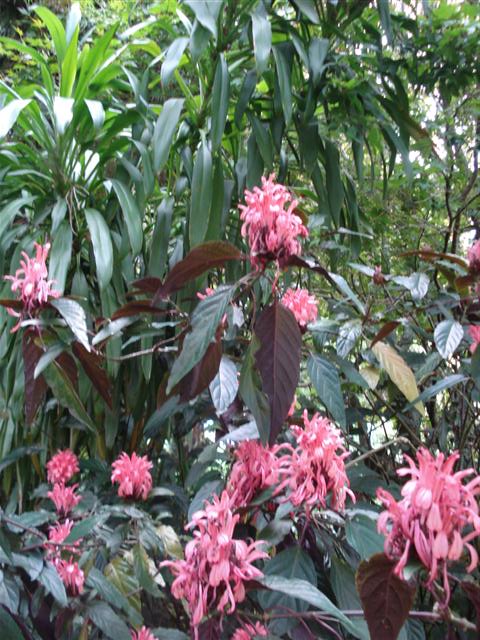
Summer flowering Justicia carnea in our woodland
Plants which thrive and flower prolifically in reasonably dense shade are rare indeed but Justicia carnea is a stand out this week with a particularly lovely combination of foliage and flower colour visible from quite some distance. The tufted flowers of justicias always remind me of the old candlewick bedspreads despised by my mother but now having a second coming as a collectable on Trade Me (our NZ equivalent of Ebay). This form of carnea has a salmon pink flower complimented by very dark green leaves which are velvety maroon on the back but it does come in other colours, including a pure white form. And the yellow candlewick form which we used to know as Jacobinia chrysostephana is also referred to as Justicia aurea (which means yellow).
These central American shrubs are members of the acanthus family. It had never occurred to us that they are frost tender but in large parts of the world they are regarded as glasshouse plants or they are lifted each winter so they must be more tender than we thought. We have never seen them suffer from frost or cold in our garden but we do tend to favour them as a woodland plant. We just ignore them most of the time. When they start to get a bit rangy and leggy after several years, I cut the tallest stems back to the base of the plant. The old wood is surprisingly hard which is why I use loppers in preference to secateurs. It takes many years for them to get to the size of this one and you could keep them more compact by pruning and pinching out from the start but we don’t mind the tufted pink flowers and slender growth occupying an area about 2.5m x 2.5m. It combines well here with a tropical cordyline behind and ferns, Solomon Seal and mid green hosta at its feet.
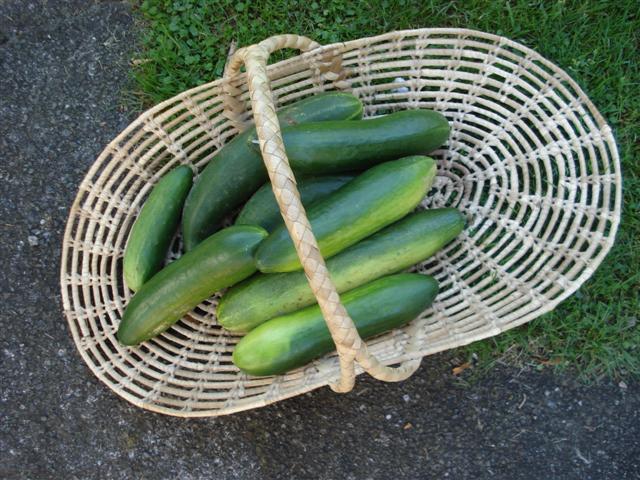
The challenge of the ongoing cucumber harvest
 Tikorangi The Jury Garden